Collette’s Lost Pet by I. Arsenault
DOI:
https://doi.org/10.20361/dr29333Abstract
Arsenault, Isabelle. Collette’s Lost Pet. Tundra Books, 2017.
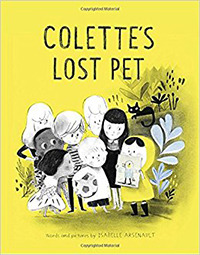
In this attractive, graphic novel-style picture book, Canadian author and illustrator Isabelle Arsenault tells the story of Collette—the new girl at Mile End. Unsure of how to meet other children in her new neighbourhood, Collette invents a story about a lost bird. As more children are recruited to help search for Collette’s lost bird, the fib grows, too.
Although children and adults of all ages will enjoy this book’s delightful illustrations, the text is best suited to more mature readers within and above the publisher-recommended age range of 4 to 8 years. Since many younger children are taught to always speak truthfully, this book is more suitable for older readers who can reflect critically on a white lie that is not punished, but instead elicits empathy and kindness. Additionally, much of the story is told through Arsenault’s illustrations, which invite readers to find meaning beyond the words on the page. However, this nuanced relationship between text and illustrations is balanced by familiar picture book conventions, such as the repetition of phrases.
Collette’s Lost Pet explores the relatable themes of being new and trying to fit in, and the protagonist’s fanciful invention of an increasingly larger-than-life parakeet makes this book’s text as engaging as its illustrations. This story demonstrates the importance of welcoming newcomers and is sure to be an appreciated addition to school, public, and home library collections.
Highly Recommended: 4 out of 4 starsReviewer: Samantha Nugent
Sam works as a librarian at the Hinton Municipal Library.
Published
How to Cite
Issue
Section
License
Authors who publish with this journal agree to the following terms:
- Authors retain copyright and grant the journal right of first publication with the work simultaneously licensed under a Creative Commons Attribution License that allows others to share the work with an acknowledgement of the work's authorship and initial publication in this journal.
- Authors are able to enter into separate, additional contractual arrangements for the non-exclusive distribution of the journal's published version of the work (e.g., post it to an institutional repository or publish it in a book), with an acknowledgement of its initial publication in this journal.
- Authors are permitted and encouraged to post their work online (e.g., in institutional repositories or on their website) prior to and during the submission process, as it can lead to productive exchanges, as well as earlier and greater citation of published work (See The Effect of Open Access).