The Pond by N. Davies
DOI:
https://doi.org/10.20361/dr29387Abstract
Davies, Nicola. The Pond. Illustrated by Cathy Fisher. Graffeg, 2017.
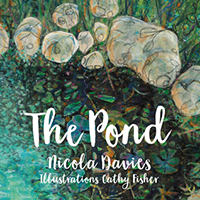
In this picture book, a half-finished garden pond, “a muddy, messy hole that filled our garden,” becomes a metaphor for a family’s grief at the death of a father, “a muddy, messy hole that filled our hearts.” The story highlights the fact that when someone dies, the family loses not only the person, but also the activities that the family did with that person. Eventually, the mother in this story gets the pond lined and it starts to come to life with tadpoles, dragonflies and a water lily, mirroring the family’s progression through their grief.
The artwork really carries the story forward, and accompanied by the simple text Nicola Davies depicts aquatic environments in a variety of ways. Her work is cinematic, capturing the movement and messiness of pond life. She uses dark colours, splatters, scribbles and fractures in lines to depict the family’s grief. Some of the images are beautiful. Her water lilies on solid black backgrounds are exceptional. The images in this book will engage all ages.
This book would be good for children coping with loss or those preparing to cope with loss and should be a part of public and school library collections.
Recommendation: 4 stars out of 4
Reviewer: Sean Borle
Sean Borle is a University of Alberta undergraduate student who is an advocate for child health and safety.
Published
How to Cite
Issue
Section
License
Authors who publish with this journal agree to the following terms:
- Authors retain copyright and grant the journal right of first publication with the work simultaneously licensed under a Creative Commons Attribution License that allows others to share the work with an acknowledgement of the work's authorship and initial publication in this journal.
- Authors are able to enter into separate, additional contractual arrangements for the non-exclusive distribution of the journal's published version of the work (e.g., post it to an institutional repository or publish it in a book), with an acknowledgement of its initial publication in this journal.
- Authors are permitted and encouraged to post their work online (e.g., in institutional repositories or on their website) prior to and during the submission process, as it can lead to productive exchanges, as well as earlier and greater citation of published work (See The Effect of Open Access).