Introduction
Several
librarians and researchers have written about scholarly communications and the
current state of flux as digital technology proliferates (Battin,
1980; Byrd, 1990; Odlyzko, 1997; Shaughnessy, 1989; Tenopir & King, 1997, 2000). In response to these
changes, many libraries have implemented scholarly communications programs to
raise awareness, provide services, and advocate for changes in costs of and
access to scientific, technical, and medical (STM) journals (Bergman, 2006; Malenfant, 2010).
The
term “scholarly communications” encompasses the myriad ways in which scholars
communicate their research findings and original creations to their peers and
others. A library scholarly communications program must respond to a range of
disciplines and their communication media and formats: journal articles, books,
paintings, music, etc. Knowing what programming, services, content, and
collections a library needs to provide requires a deep understanding of unique,
discipline-specific scholarly communication and publishing patterns.
Publishing
choices can indicate potential journal value. As Schauder
(1994) has said, “to be a scientist or scholar it is necessary to write and to
publish: it is not as essential to command a wide readership, or a contemporary
readership” (p. 82). Such publishing choices can also demonstrate attitudes
towards non-traditional approaches to journal article dissemination such as
self-archiving and open access publishing. Attitudes regarding these venues
play a primary role in the development of a scholarly communications program.
If scholars, as one study has found, do not see or remain unaware of pricing or
access problems in the journal publishing system, library programs and services
need to respond accordingly to those realities (Rowlands,
Nicholas, & Huntington, 2004).
This
paper reports on initial research regarding one mode of scholarly communication
– the journal article – and explores journal publishing patterns, rates of
access, and costs at a research-intensive university for the purposes of
informing a scholarly communications program. This type of research can also
inform collection development decisions. As library journal budgets continue to
constrict, collection development practices may require rethinking, especially
regarding evidence based decision-making. Collection development, “the process
of planning and building a useful and balanced collection of library materials”
(Reitz, 2004-2012), is a core function of librarians in many professional
settings. A number of factors may contribute to the decision to select or
deselect a particular journal (Dhawan, Phull, & Jain, 1980) and a variety of sources are
potentially useful for guiding this type of activity, including knowledge of
the journal publishing practices of faculty and research staff at the
institution, journal download statistics, and interlibrary loan (ILL) requests.
This paper demonstrates the potential value of these approaches and provides
usage and cost analyses for the University of Utah (UU).
Literature
Review
A
limited number of studies have looked at publishing patterns as important data
for evaluating library collections, but no literature was located that reflects
the use of publishing pattern data to develop scholarly communications
programs. Some authors have demonstrated the use of citation analysis to
evaluate how libraries meet the information needs of a local campus. For
example, Dykeman (1994) determined citation studies
to be “one indicator of a collection’s strength or weakness” after looking at
the publishing output of science and engineering faculty at a technical
institute (p. 145). LaBonte (2005) analyzed
publishing patterns as well as citations to determine the library’s journal
collection in response to a newly created research institute, starting with
faculty publication decisions, but focusing mostly on journals cited in these
publications. Lascar and Mendelsohn (2001) identified 12 key researchers,
searched Web of Science to determine where they published, and then reviewed
the references cited in these publications. The authors discovered only a few
newer journals cited by researchers that the library did not hold and used
these data to justify adding them to the collection, arguing that “collections
must be focused on the needs of the researchers as indicated by their citation
and publication patterns” (p. 432).
Other
authors have suggested that while citation analysis provides important
information for collection decisions, publication patterns should be given
greater weight. For example, Salisbury and Smith (2010) concluded that usage
statistics alone do not always reflect the true use and impact of a journal and
that different types of data greatly improve the ability to assess a library’s
collection, suggesting that libraries “at a minimum … provide access to the
periodicals in which … researchers published more than five times” in addition
to considering the number of citations (p. 76). Hughes (1995) obtained
bibliographies from an academic department, developed a list of journals, and searched
citations by faculty in SciSearch and journal impact
factor ranking in Journal Citation Reports (JCR). Hughes gave faculty publication patterns the greatest
weight in journal subscription decisions, arguing that publication patterns
indicated the journal’s importance to faculty for both quality and readership.
Wilson and Tenopir (2008) suggested that libraries
should consider using a combination of publishing patterns and local citation
analysis, as well as survey data on reading and writing productivity, in order
to analyze the quality of a journal.
These
studies indicate a range of decision criteria used by libraries to inform
journal collection development decisions. While many libraries rely primarily
on citation analysis for decisions, some libraries utilize usage and ILL
statistics, and a few incorporate publishing patterns into decision-making.
Emerging social tools such as altmetrics – metrics
for measuring the impact of scholarship based on the social web (Priem, Taraborelli, Groth, & Neylon, 2010) –
could provide another source of information beyond citation analysis. None of
the articles located focused on evaluating costs in relation to the usage of
the journals or on potential ways such metrics can influence a scholarly
communications program. The present study aims to contribute to this gap in
knowledge related to libraries’ potential use of faculty publishing patterns
and data about the costs associated with accessing journals in which faculty
publish, in order to inform collection development decisions and scholarly
communications efforts.
Aims
This
research builds on that of previous authors by considering a university’s
scholarly communications program and library journal subscriptions from the
perspective of the publication patterns of university faculty and staff. The
study explores the availability of journal articles published by prolific
authors at the UU, as well as the associated usage and costs of access.
Specifically, the research addresses the following seven questions with respect
to the journals in which prolific authors publish:
1. What proportion of subscription
journals is accessible to researchers at the UU through institutional holdings?
2. How often are these journals used at
the UU?
3. What are the costs to the UU of providing
access to these journals?
4. How do the costs of these journals
relate to their usage at the UU?
5. Do the journals in which authors
publish most frequently have the highest usage?
6. Do the journals in which authors
publish most frequently provide the best value for the money spent?
7. What proportion of these journals is
published under an open access model?
Methods
This
study was based on a list of journals in which prolific UU authors published in
2009. To identify journals in which UU authors published, the Scopus database
was used. Scopus was selected for its size and coverage of multiple
disciplines; the other widely used, multidisciplinary citation database, Web of
Science, was not available at the UU at the time this research began. Using the
affiliation search function, a search was conducted for “University of Utah”
and the results were manually reviewed to identify entities affiliated with the
UU. The database was searched for all articles published by authors listing one
of these entities in their affiliation (for the full search string, see
Appendix A). Search results were limited to items published in 2009, as this
was the most current year for which access and cost data were available.
Prolific authors were defined as those publishing 10 or more articles in a
given year, in this case 2009. The threshold of 10 or more articles helped
create a manageable sample size for an initial exploration. Scopus allows
search results to be filtered based on a variety of factors, including author,
and displays the number of items that will be retrieved if a filter is applied.
Search results were filtered to identify UU-affiliated authors who had
published 10 or more articles in 2009. The list of publications for each of
these authors was exported, and the journals in which the publications appeared
were identified. All Scopus searches were conducted in February 2010.
Access
Access
to journals was assessed based on holdings listed in the UU Libraries’ online
catalogue. A catalogue search was conducted in early 2010 for each journal to
determine whether the UU held an active subscription to the title during the
2009 calendar year. Journals publishing under an open access model were
identified from entries in the UU Libraries’ SFX link resolver.
Usage
To
determine usage of the journals to which the UU Libraries subscribed, journal
download statistics for 2009 were collected, either directly from publishers or
from aggregators. Usage for the UU is determined by Internet Protocol (IP)
address ranges and includes on-campus access as well as remote access by
authenticated
users. Both PDF and HTML downloads were counted in the usage statistics.
For
journals to which the UU Libraries did not subscribe, usage was estimated based
on ILL requests. The number of ILL requests processed for university-affiliated
faculty, staff, or students in 2009 for each journal was obtained from statistics
maintained by the ILL Departments of the UU Libraries.
Costs
For
each journal, the annual subscription cost for 2009 was determined. Several
sources for establishing costs were available, and the source used depended on
whether the UU Libraries subscribed to a journal. For journals to which the UU
Libraries subscribed, invoices were reviewed to identify the cost paid.
Approximately 70% of the journals in this sample were obtained through journal
packages or consortium-based purchases, and individual prices could not be
identified by means of invoices. Invoices for packages often do not itemize
costs by journal title, and title prices within a package can vary
significantly, limiting the utility of dividing the total package cost by the
total number of journals. If it was not possible to identify the cost of a
journal through invoices, the data were collected using, in order of
preference, Ulrich’s Periodicals Directory, journal publishers’
websites, or personal communications with publishers or vendors. Ulrich’s served
as a single source and efficient means of checking prices for several journal
titles. When Ulrich’s did not list a journal or its price, the
publisher’s website was consulted. If pricing information was not included on
the publisher’s site, an email was sent to a publisher representative or vendor
requesting the information. Estimations of annual subscription costs for
journals to which the UU Libraries did not subscribe were based on the same
sources, consulted in the same order, with the exception of UU Libraries’
invoices.
The
costs of providing journal access through ILL were estimated using a standard
cost of $30 per ILL request (Jackson, 2003). For each journal, the number
of ILLs processed for university-affiliated faculty, staff, or students in 2009
was multiplied by this standard cost estimate to provide an approximate ILL
cost.
Value
After
estimating journal costs and usage, these two factors were compared. A
cost-per-use value was approximated by dividing the estimated subscription cost
by the number of downloads for each journal to which the UU Libraries
subscribed. For journals to which the UU Libraries did not subscribe, the
estimated ILL cost was compared to the subscription price of the journal to
identify journals for which purchasing a subscription might be more
cost-effective than providing access through ILL. In addition, choice of
publishing venue was compared to journal usage and to the estimated
cost-per-use values.
Results
This
exploratory study focused on the most prolific UU authors in 2009, as defined
by number of published articles. The “University of Utah” affiliation search in
Scopus returned 59,807 publications, 3,275 of which were published in 2009.
There were 22 university-affiliated authors who met the criterion for
inclusion, which was defined as publication of 10 or more articles in 2009.
Collectively, these authors published 275 articles in 162 journals. A complete
list of journals, along with the number of articles published by prolific UU
authors in each journal, appears in Appendix B. Access, usage, and costs of
these journals were investigated. Complete data on these three factors were
available for 150 of the journals, containing 254 of the articles identified.
The following analysis is based on those 150 journals.
Access
Of
the 150 journals studied, 125 (83%) were accessible to
university-affiliated researchers through library subscriptions (Figure 1).
The
125 journals that were accessible to university-affiliated researchers through
subscription contained 217 (85%) of the 254 articles published by the
university’s most prolific authors in 2009 (Figure 2). The remaining 37 (15%)
of these articles appeared in journals that were not accessible through the UU
Libraries.
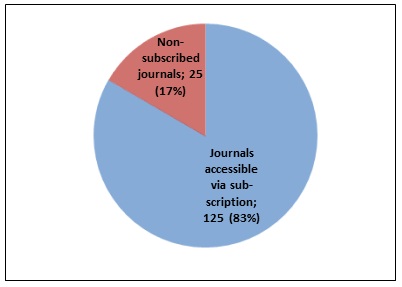
Figure
1
Access
to journals in which prolific University of Utah authors published in 2009; n =
150
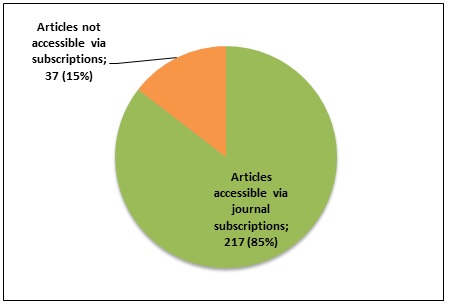
Figure
2
Access
to articles published by prolific University of Utah authors in 2009; n = 254
Usage
Usage
of the 125 journals to which the UU Libraries subscribed varied widely, from a
high of 42,208 article downloads to a low of zero downloads during 2009 (Table
1). Mean usage was 2,157 downloads per journal, while median usage was 365
downloads per journal. The most frequently used journal in this sample was Nature,
followed by the Journal of the American Chemical Society with 32,792
downloads, Science with 29,943 downloads, and Proceedings of the
National Academy of Sciences of the United States of America (PNAS)
with 28,061 downloads. Articles from two journals were not downloaded at all
during 2009, and four additional journals were each downloaded only once. The
majority (89) of the journals in this sample were downloaded less than 1,000
times each, while only six journals had more than 10,000 downloads.
Table
1
|
Number
of Article Downloads for Subscribed Journals;
n
= 125
|
|
|
Number of Article Downloads
|
|
Maximum
|
42,208
|
|
Mean
|
2,157
|
|
Median
|
365
|
|
Minimum
|
0
|
ILL
statistics were collected for the 25 journals to which the UU Libraries did not
subscribe (Table 2). Of these, 19 (76%) were requested at least once during
2009, while the remaining 6 (24%) were not requested. There were 184 ILL
requests processed for the 25 journals, for an average of 7 requests per
journal (Mdn = 5 requests per journal). There
were 10 or more requests each for 7 (28%) of these journals. Of the journals
that were requested, the number of requests per journal ranged from a high of 44
requests for Toxicon to a low of 2 requests
each for the American Journal of Therapeutics, Computing and
Visualization in Science, and Congenital Heart Disease.
Table
2
|
Number
of ILL Requests for Non-Subscribed Journals;
n
= 125
|
|
|
Number of Requests
|
|
Maximum
|
44
|
|
Mean
|
7
|
|
Median
|
5
|
|
Minimum
|
0
|
Costs
Subscription
costs were estimated for the 125 journals to which the UU Libraries subscribed.
Cost estimates varied significantly from a high of $12,370 to a low of $107
(Table 3). The cost of 1 (1%) of the journals was more than $10,000, while 66
(53%) journals cost more than $1,000 each. In total, the cost paid to access
these journals was valued at approximately $270,250, an average of $2,162 per
journal (Mdn = $1,160 per journal).
For
the 25 subscription journals not purchased by the UU Libraries, the
subscription cost was estimated to total approximately $31,300, an average of
$1,252 per journal (Mdn = $653 per journal).
Costs again varied, from $62 to $5,039 (Table 4). The subscription costs of 9
(36%) of the journals were estimated at more than $1,000 each.
For the subscription journals to which
the UU Libraries did not subscribe, ILL costs were also estimated (Table 4). The cost of
ILL in 2009 for these 25 journals amounted to approximately $5,520, with
individual journal costs ranging from $0 to $1,320 depending on the number of
requests processed. The average ILL cost per journal was estimated at
approximately $221 (Mdn = $150).
Table
3
|
Estimated
Costs for Subscribed Journals;
n
= 125
|
|
|
Estimated Subscription Costs
|
|
Maximum
|
$12,370
|
|
Mean
|
$2,162
|
|
Median
|
$1,160
|
|
Minimum
|
$107
|
|
Total
|
$270,250
|
Table
4
|
Comparison
of Estimated Subscription and ILL Costs for Non-Subscribed Journals;
n
= 25
|
|
|
Estimated Subscription Costs
|
Estimated ILL Costs
|
|
Maximum
|
$5,039
|
$1,320
|
|
Mean
|
$1,252
|
$221
|
|
Median
|
$653
|
$150
|
|
Minimum
|
$62
|
$0
|
|
Total
|
$31,300
|
$5,520
|
Value
Cost
and Usage
A
comparison of cost to usage was used to assess value for the journals made
accessible to the UU research community through library subscriptions. As was
the case with cost and downloads, the calculated cost-per-use values varied
widely for 123 of the 125 subscribed journals that were used, from a high of
$6,713 to a low of $0.01 (M = $1.00) (Table 5). The costs-per-use of 3
of the journals were greater than $1,000 each, while the majority of journals
(85) had costs-per-use of less than $10 each. The cost-per-use of 31 (25%) of
the journals was estimated at $1 or less. Cost-per-use was not calculated for
the two journals that were not downloaded at all during 2009.
A
comparison of ILL costs, which reflect usage, to subscription costs was used to
assess value for journals to which the UU Libraries did not subscribe. It was
estimated that the ILL costs paid by the UU Libraries in 2009 were higher than
the costs of the corresponding journal subscriptions for two (8%) journals. For
an additional three (12%) journals, the equivalent of more than half of the
subscription costs was spent in providing ILL. The ILL costs of 18 (72%) of the
journals were equal to less than 25% of the costs for those journals, had they
instead been purchased by subscription. For the journal requested most
frequently, Toxicon, the ILL cost was
estimated to be $1,320, approximately 42% of the estimated subscription cost.
Table
5
|
Estimated
Cost-Per-Use for Subscribed Journals;
n
= 123
|
|
|
Cost-Per-Use
|
|
Maximum
|
$6,713
|
|
Mean
|
$1
|
|
Minimum
|
$0.01
|
Publishing
Venue and Usage
Of
the journals to which the UU Libraries subscribed, the largest number of
articles was published in Astrophysical Journal, followed by AIP
Conference Proceedings, and the Journal of Physical Chemistry B. Astrophysical
Journal ranked 51st out of 125 journals in usage by UU faculty, staff, and
students, with 738 downloads in 2009, while AIP Conference Proceedings
ranked 86th with 140 downloads (Table 6). Three journals were highly ranked in
both number of UU articles published and number of downloads: the Journal of
the American Chemical Society (ranked 2nd in downloads), the Journal
of Physical Chemistry B (ranked 9th), and Biochemistry (ranked
10th). The most frequently used journal, Nature, contained two articles
written by prolific UU authors.
Table
6
|
Top
10 Subscribed Journals Ranked by Number of Articles by Prolific UU Authors
and Rank by Usage in 2009;
n = 125
|
|
Title
|
Number
of Articles
|
Rank
by Usage
(High
to Low)
|
|
Astrophysical Journal
|
13
|
51st
|
|
AIP Conference Proceedings
|
7
|
86th
|
|
Journal of Physical Chemistry B
|
7
|
9th
|
|
American Journal of Obstetrics and
Gynecology
|
6
|
19th
|
|
Journal of the American Chemical Society
|
6
|
2nd
|
|
Biochemistry
|
5
|
10th
|
|
Inorganic Chemistry
|
5
|
20th
|
|
Pediatric Critical Care Medicine
|
4
|
75th
|
|
Physical Review B - Condensed Matter
and Materials Physics
|
4
|
16th
|
|
Physical Review D - Particles, Fields,
Gravitation and
Cosmology
|
4
|
85th
|
Publishing
Venue and Cost-per-Use
With
respect to cost-per-use, Astrophysical Journal ranked 68th out of 123
journals, with an estimated cost of $3.75 per download in 2009. AIP Conference Proceedings ranked 103rd at $38.57 per
download, and Journal of Physical Chemistry B ranked 33rd, with a
cost-per-use of $1.15. The Journal of the American Chemical Society
was the only journal ranked highly in both number of UU articles and
cost-per-use, at $0.13 per download, the fifth-lowest cost overall (Table 7). The
Lancet, the journal with the lowest cost-per-use, published one article by
a prolific UU author.
|
Table
7
Top
10 Subscribed Journals Ranked by Number of Articles by Prolific UU Authors
and Rank by Cost-Per-Use in 2009;
n
= 123
|
|
Title
|
Number
of Articles
|
Rank
by Cost-Per-Use (Low to High)
|
|
Astrophysical Journal
|
13
|
68th
|
|
AIP Conference Proceedings
|
7
|
103rd
|
|
Journal of Physical Chemistry B
|
7
|
33rd
|
|
American Journal of Obstetrics and
Gynecology
|
6
|
11th
|
|
Journal of the American Chemical Society
|
6
|
5th
|
|
Biochemistry
|
5
|
25th
|
|
Inorganic Chemistry
|
5
|
38th
|
|
Pediatric Critical Care Medicine
|
4
|
48th
|
|
Physical Review B - Condensed Matter and
Materials Physics
|
4
|
47th
|
|
Physical Review D - Particles, Fields, Gravitation
and Cosmology
|
4
|
100th
|
Open
Access
Two
(1%) of the journals in the full sample of 162 journals were open access. These
journals contained 3 (1%) of the 275 articles by prolific UU authors published
in the sample journals. For these journals, access was available to all
university-affiliated researchers at no subscription cost to the UU Libraries.
Download statistics of open access journals for UU affiliates were not
available, so the value of these journals was not calculated.
Discussion
A
review of the literature identified a potential gap in knowledge regarding
libraries’ use of data about institutionally affiliated authors’ choices of
publishing venues to inform scholarly communications and collection development
programs. This case study illustrates how knowledge of such publishing
decisions and various associated factors can inform decision-making at a large
research institution. Factors considered included the accessibility, usage,
costs, and value of the journals in which the most prolific university authors
in 2009 published.
Access
to the journals in which these authors published in 2009 was high, with more
than 80% of the published articles available through UU Libraries
subscriptions. Percentages of access to the journals in which
university-affiliated authors published and to the individual articles
published were similar – 83% and 85%, respectively. This alignment between
publication patterns and subscription status reflects positively on the success
of the collection development program in selecting resources relevant to the
fields in which university research is occurring and providing the results of
that research to users. That much of the university’s research is available
through library subscriptions could have implications for the perceived value
of an institutional repository (IR), in that researchers may not feel as
strongly about the necessity of an IR if most university research is already
easily accessible. IR advocates may find more success focusing their efforts
initially on the articles to which the libraries are unable to provide access
through subscriptions.
Usage
of the journals studied revealed a small number of very highly used journals,
with most journals used only occasionally. Four high-profile journals – Nature,
the Journal of the American Chemical Society, Science, and PNAS – were used more
than 25,000 times each in 2009, more than double the number of downloads for
the fifth-ranked journal. With median usage at 365 downloads per journal, half
of the journals studied were used an average of once per day or less. Most
journals to which the UU Libraries did not subscribe were accessed through ILL.
Demand exists for these journals, but is not extreme; only slightly more than
one quarter of journals were requested 10 or more
times. As might be expected, a large difference in usage was shown between
journals to which university researchers had direct access and those to which
they did not. The average usage of journals to which the UU Libraries
subscribed was more than 300 times higher than for those available through ILL.
In
general, providing access to university research through journal subscriptions
is expensive. No journal to which the UU Libraries subscribed could be
purchased for less than $100, more than half cost more than $1,000, and one
journal subscription cost more than $10,000. The cost of journals to which the
UU Libraries did not subscribe was generally less than those to which
subscriptions were purchased. However, the cost of providing ILL access to
those journals was also generally less than that of purchasing subscription
access. Because of this, ILL was an economical way to provide access to rarely
used journals.
Several
indicators of value were considered in this study: the relationships between
cost and usage of journals, between publishing venue and usage, and between
publishing venue and cost-per-use. A comparison of cost to usage demonstrated
the need to consider this value independently for each journal studied. A
simple average calculated by dividing the total cost of the journals analyzed
by the total number of downloads would produce a cost-per-use of $1; however,
only 25% of the journals had individual costs-per-use of $1 or less. The
costs-per-use calculated for the majority of journals were less than the
typical costs of providing access to an article through ILL or pay-per-view
methods, a desirable measure for collection development. ILL was shown to be an
effective practice for the UU Libraries, with the costs of ILL rarely exceeding
the costs of subscriptions to the journals requested. Even for the journal
requested most frequently, the ILL cost was estimated at only 42% of the
subscription cost. Journals with high costs-per-use and ILL costs approaching
subscription costs should receive special attention in collection development
decisions, as they present opportunities in which changes in purchasing
practice have the potential to significantly, and positively, impact the
journal budget.
Results
from this study have shown that the journals in which prolific UU authors
publish are not necessarily those that UU faculty, staff, and students use frequently, nor those that might be considered
the best value based on cost-per-use calculations. This finding is worthy of
further study and merely scratches the surface of the complex topic of the
reading habits of those active in the research enterprise. Some of the journals
in which prolific UU authors published are used, while others are not, even
though research in that area occurs on campus. While Nature had the
highest number of downloads and The Lancet had the best cost-per-use,
neither accounted for more than 1% of the papers published by the authors
studied. Conversely, Astrophysical Journal contained the largest number
of UU-authored articles, yet had less than 1,000 downloads and a cost-per-use
in approximately the middle of the rankings. That rankings
of journals by these three factors – number of university-affiliated
publications, usage, and cost-per-use – differ highlights the complexity
involved in selecting journals for purchase and illustrates the value added by
considering multiple factors when making collection development decisions. In
isolation, each factor could offer a very different perspective on value to the
university. The Journal of the American Chemical Society represents the
rare journal that performs well on all three factors, making it an ideal
subscription candidate.
Finally,
the study results indicated that very few prolific authors published in open
access journals, perhaps showing that campus support of this model as an access
mechanism to research is low. Open access journals offer benefits for readers
in terms of access and cost, but their usage is more difficult to evaluate. Low
levels of open access publishing among prolific UU authors have implications
for a scholarly communications program, particularly in relation to increasing
awareness of open access as a viable publishing option and considering the
value for university funding of open access.
Limitations
This
research offers a case study example of the journal publishing patterns at a
large, research-intensive post-secondary institution in the US; results are
reflective only of the institution and time period studied and may not be
generalizable to other institutions or across time. As a pilot exploration,
this research considered only journal articles by those authors who published
10 or more articles in 2009 and identified authors using only a single database,
Scopus. Works by authors publishing in non-journal venues were not included in
this analysis, and the choice of Scopus for identifying authors may have
privileged those publishing in STM journals over the social sciences and
humanities due to its disciplinary coverage. The publication patterns of less
prolific authors may differ, and different authors may be identified as
prolific using other definitions, data sources, or years of analysis. Analysis
was limited by the inability to obtain complete pricing and usage data for all
journals in the sample and by the need to use a variety of sources to gather
this information. Furthermore, costs for journals purchased as part of packages
represented estimates rather than actual prices paid, as these costs were
derived from sources other than UU Libraries’ invoices. Purchasing journals
through packages rather than stand-alone subscriptions tends to reduce the
subscription costs; therefore, determining individual journal costs from
sources other than library invoices may have over-estimated the true costs paid
to access the journals and inflated the calculated costs-per-use for journals
obtained through package-based subscriptions. The use of download statistics to
represent usage ignores use of other mechanisms for accessing literature and
cannot provide article-level data. Similarly, the use of ILL requests ignores
the use of journals accessed through pay-per-view or other means, and cost
estimates may not be directly comparable to estimates based on subscription
prices.
Conclusions
Decisions
regarding a university’s scholarly communications program or collection
development activities can be based on a variety of factors. As illustrated in
the literature, citation analysis is a popular strategy for gathering data;
this research reflects on the value of a different type of analysis –
publication analysis. An exploration of publishing patterns of
university-affiliated authors and related data has been shown to provide
additional information, which can help inform better decision-making.
In
the case of the UU, access was available through the UU Libraries to the
majority of journal articles published by the most prolific
university-affiliated authors in 2009. Cost and usage data allowed for a
consideration of the effectiveness of current journal selection decisions, and
a comparison of the “best” journals when ranked by number of university
publications, usage, and cost-per-use highlighted differences among analyses
based on different factors. Articles published in open access journals
accounted for only a very small portion of publishing in this study, suggesting
a continued need for additional investigation and education in this area.
The
results of this study have implications for both collection development and
scholarly communication programming. Collection development decisions are
routinely based on the usage of journals as measured by citations, download
statistics, or ILL requests. However, more comprehensive decisions may be
possible through the consideration of additional factors, including the
publishing patterns of university researchers. A list of journals that are
widely used is not necessarily identical to a list of journals in which
researchers publish, even when those researchers are among the most prolific
authors on campus. The consideration of usage or publishing patterns may paint
a different picture of the value of journal subscriptions, and multiple types
of data allow for improved decision-making when shaping the journal collection
of a research library. Data about such patterns can also provide needed input
when developing the activities, events, and educational offerings of a
scholarly communications program. In making scholarly communications and
collection development decisions, efforts should be made to consider data
related to as many potentially relevant factors as is practical given the
constraints of time and other resources.
Further
research is needed to explore the implications of these results on a broader
scale and determine whether they are generalizable beyond the population and
time studied. A more comprehensive illustration of university publishing could
be obtained with a larger and more inclusive sample, including all university
authors rather than limiting to the most prolific and using a more complete
list of university publications. To further inform scholarly communications,
additional study concerning the number of open access compared to subscription
journals published in the areas in which research occurs at the university,
reasons for choosing subscription rather than open access venues for
publication, and rates of archiving in the IR could shed additional light on
these findings. In addition, research to investigate the relationship between
the journals in which authors publish and the journals authors cite in their
work would provide further value for collection development decisions.
Acknowledgement
This
research was supported in part by an appointment to the NLM Associate
Fellowship Program sponsored by the National Library of Medicine and
administered by the Oak Ridge Institute for Science and Education.
References
Battin, P. (1980).
Research libraries in the network environment: The case for cooperation. Journal
of Academic Librarianship, 6(2), 68-73. Retrieved 17 Aug. 2012 from http://www.eric.ed.gov/ERICWebPortal/detail?accno=EJ225890
Bergman, S. S. (2006). The
scholarly communication movement: Highlights and recent developments. Collection
Building, 25(4),
108-128. doi:10.1108/01604950610705989
Borgman, C. L. (Ed.).
(1990). Scholarly communication and bibliometrics.
Newbury Park, CA: SAGE Publications.
Byrd, G. D. (1990). An economic
“commons” tragedy for research libraries: Scholarly journal publishing and
pricing trends. College & Research Libraries, 51(3), 184-195.
Retrieved 17 Aug. 2012 from http://www.eric.ed.gov/ERICWebPortal/detail?accno=EJ412093
Byrd, G. D. (1999). Medical
faculty use of the journal literature, publishing productivity and the size of
health sciences library journal collections. Bulletin of the Medical Library
Association, 87(3),
312–321. Retrieved 17 Aug. 2012 from http://www.ncbi.nlm.nih.gov/pmc/articles/PMC226591/
Dhawan, S. M., Phull, S.K., & Jain, P, (1980). Documentation notes:
Selection of scientific journals: A model. Journal of Documentation, 36(1), 24-32. doi:10.1108/eb026689
Dykeman, A. (1994).
Faculty citations: An approach to assessing the impact of diminishing resources
on scientific research. Library Acquisitions: Practice & Theory, 18(2), 137-146. doi:10.1016/0364-6408(94)90021-3
Hughes, J. (1995). Use of faculty publication lists and ISI citation data to identify
a core list of journals with local importance. Library Acquisitions:
Practice & Theory, 19(4),
403-413. doi:10.1016/0364-6408(95)00055-E
Jackson, M. E. (2003). Assessing ILL/DD services
study: Initial observations. ARL:
A bimonthly report, 230/231, 21-22. Retrieved 17 Aug. 2012 from http://www.arl.org/bm~doc/illdd.pdf
LaBonte, K. B.
(2005). Citation analysis: A method for collection development for a rapidly
developing field. Issues in Science and Technology Librarianship,
43. Retrieved 17 Aug.
2012 from http://www.istl.org/05-summer/refereed.html
Lascar, C.,
& Mendelsohn, L. D. (2001). An analysis of
journal use by structural biologists with applications for journal collection
development decisions. College & Research Libraries, 62(5), 422-433. Retrieved 20
Aug. 2012 from http://crl.acrl.org/content/62/5/422.short
Malenfant, K. J.
(2010). Leading change in the system of scholarly communication: A case study
of engaging liaison librarians for outreach to faculty. College &
Research Libraries, 71(1), 63-76. Retrieved 20 Aug. 2012 from http://crl.acrl.org/content/71/1/63.short
Odlyzko, A. (1997). The economics of electronic journals. First
Monday, 2(8). Retrieved 20 Aug. 2012 from http://firstmonday.org/article/view/542/463
Priem,
J., Taraborelli, D., Groth,
P., & Neylon, C. (2010). Altmetrics: A manifesto. Retrieved 20 Aug. 2012
from http://altmetrics.org
Reitz, J. M. (2004-2012). ODLIS:
Online dictionary for library and information science. Retrieved 20 Aug.
2012 from http://www.abc-clio.com/ODLIS/odlis_c.aspx
Rowlands,
I., Nicholas, D., & Huntington, P. (2004). Scholarly
communication in the digital environment: What do authors want? Learned Publishing, 17,
261-273. doi:
10.1087/0953151042321680
Salisbury, L.,
& Bajwa, V. (2004). Faculty
publications as a source of information for identifying and satisfying users’
needs: A case study at the University of Arkansas, Fayetteville. Journal of
Agricultural & Food Information, 5(3), 11-25. doi:10.1300/J108v05n03_04
Salisbury, L.,
& Smith, J. S. (2010). The use of Web of
Knowledge to study publishing and citation use for local researchers at the
campus level. Collection Management, 35(2), 69-82. doi:10.1080/01462671003597959
Satariano, W. A.
(1978). Journal use in sociology: Citation analysis versus readership patterns.
Library Quarterly, 48(3), 293-300. Retrieved 20 Aug. 2012 from
http://www.eric.ed.gov/ERICWebPortal/detail?accno=EJ194533
Schauder, D. (1994).
Electronic publishing of professional articles: Attitudes of academics and
implications for the scholarly communication industry. Journal of the
American Society for Information Science, 45(2), 73-100. doi:10.1002/(SICI)1097-4571(199403)45:2<73::AID-ASI2>3.0.CO;2-5
Shaughnessy, T. W. (1989).
Scholarly communication: The need for an agenda for action – a symposium. Journal
of Academic Librarianship, 15(2),
68-78. Retrieved 20 Aug. 2012 from http://www.eric.ed.gov/ERICWebPortal/detail?accno=EJ394039
Tenopir, C., &
King, D. W. (1997). Trends in scientific scholarly journal
publishing in the United States. Journal of Scholarly Publishing,
28(3), 135-170. doi:10.3138/JSP-028-03-135
Tenopir,
C., & King, D. (2000). Towards
electronic journals: Realities for scientists, librarians, and publishers.
Washington, D.C.: Special Libraries Association.
Vieira, D.,
& Faraino, R. (1997). Analyzing the research record of an institution’s list of faculty
publications. Bulletin of the Medical Library Association, 85(2), 154-157. Retrieved 20 Aug. 2012
from http://www.ncbi.nlm.nih.gov/pmc/articles/PMC226243/
Wilson, C. S.
& Tenopir, C. (2008). Local
citation analysis, publishing and reading patterns: Using multiple methods to
evaluate faculty use of an academic library’s research collection. Journal
of the American Society for Information Science and Technology, 59(9), 1393-1408. doi:10.1002/asi.20812
 2012 Amos, Mower, James, Weber, Yaffe,
and Youngkin. This is an
Open Access article distributed under the terms of the Creative Commons‐Attribution‐Noncommercial‐Share
Alike License 2.5 Canada (http://creativecommons.org/licenses/by-nc-sa/2.5/ca/), which
permits unrestricted use, distribution, and reproduction in any medium,
provided the original work is properly attributed, not used for commercial
purposes, and, if transformed, the resulting work is redistributed under the
same or similar license to this one.
2012 Amos, Mower, James, Weber, Yaffe,
and Youngkin. This is an
Open Access article distributed under the terms of the Creative Commons‐Attribution‐Noncommercial‐Share
Alike License 2.5 Canada (http://creativecommons.org/licenses/by-nc-sa/2.5/ca/), which
permits unrestricted use, distribution, and reproduction in any medium,
provided the original work is properly attributed, not used for commercial
purposes, and, if transformed, the resulting work is redistributed under the
same or similar license to this one.