Research Article
Empowering
Postdoctoral Scholars: Insights From Library Focus
Groups
Lena
Bohman
Assistant
Professor
Senior
Data Services and Research Impact Librarian
Zucker
School of Medicine at Hofstra/Northwell
Hempstead, New York, United States of America
Email:
Lena.G.Bohman@hofstra.edu
Marla
I Hertz
Associate
Professor
Research
Data Management Librarian
University
of Alabama at Birmingham Libraries
Birmingham,
Alabama, United States of America
Email:
mihertz@uab.edu
Regina
Vitiello
Librarian
Northwell
Manhasset,
New York, United States of America
Email:
rvitiello1@northwell.edu
Received: 9 Oct. 2024 Accepted: 1 Apr. 2025
 2025 Bohman, Hertz, and Vitiello. This is an Open
Access article distributed under the terms of the Creative Commons‐Attribution‐Noncommercial‐Share Alike License 4.0
International (http://creativecommons.org/licenses/by-nc-sa/4.0/),
which permits unrestricted use, distribution, and reproduction in any medium,
provided the original work is properly attributed, not used for commercial
purposes, and, if transformed, the resulting work is redistributed under the
same or similar license to this one.
2025 Bohman, Hertz, and Vitiello. This is an Open
Access article distributed under the terms of the Creative Commons‐Attribution‐Noncommercial‐Share Alike License 4.0
International (http://creativecommons.org/licenses/by-nc-sa/4.0/),
which permits unrestricted use, distribution, and reproduction in any medium,
provided the original work is properly attributed, not used for commercial
purposes, and, if transformed, the resulting work is redistributed under the
same or similar license to this one.
DOI: 10.18438/eblip30647
Abstract
Objective
– The goal of this study was to assess how
postdoctoral scholars (postdocs) engage with the campus library and identify
barriers to access. Postdocs occupy a unique position within the research
community, bridging the gap between graduate studies and permanent academic
positions. Despite their critical role, there has been little formal research
to examine how postdocs interact with library resources and services, likely
due in part to their relatively small numbers at academic and research
institutions.
Methods – Three focus
group interviews were conducted at two research intensive institutions in the
United States. The qualitative analysis employed an iterative coding process to
explore several themes: self-proclaimed needs to succeed during postdoctoral
training; perceptions of library offerings, including space, services, and
collections; and barriers to success.
Results
– The thematic analysis revealed that postdocs value
library resources and are seeking a range of services including financial
services, mentorship, and scholarly writing support. There were only minor
differences observed between the two institutions. The study identified lack of
communication and time as the main barriers postdocs
cited for not using the library. Based on participant feedback, we developed
recommendations to enhance the postdoctoral experience with library resources
and support their career development.
Conclusion – This study contributes valuable insights into optimizing library
services for postdocs and highlights opportunities for libraries to better
align their offerings with the unique needs and challenges faced by this sector
of the academic community. Our approach also serves as a model to assess and
improve library offerings to other small communities.
Introduction
After
a researcher earns a PhD, they may do a postdoctoral fellowship to gain
additional experience, refine their research skills, and build a publication
portfolio. The postdoctoral rank (postdoc) typically lasts three to five years
and serves as a bridge between doctoral studies and a fully independent
research career, whether in academia, industry, or government (McAlpine, 2018;
Woolston, 2018a). In fact, a survey of over 18,000 researchers revealed that
the quality of mentoring received during postdoctoral training had a bigger
impact on career success than mentoring received during graduate school (Liénard et al., 2018). Although technically classified as
trainees, postdocs commonly mentor students and begin to apply for their own
funding. Postdocs are central to the academic research pipeline given that the
mentorship that the postdoc both gives and receives is positively associated
with career trajectory of the mentee (Feldon et al.,
2019; Liénard et al., 2018). However, because they
are not students, faculty, or staff, postdocs exist in a somewhat liminal
status (Figure 1). While postdocs gain valuable experience and mentorship, they
must navigate a temporary position and balance the demands of research with the
uncertainty of their future career path.
Partly
due to their unique status, postdocs tend to fall through the cracks regarding
access to resources, services, and community during a critical time in their
careers (Nowell et al., 2018). In addition, postdocs are dependent on the
funding provided by their mentor or principal investigator (PI), leading to an
unbalanced power dynamic (Kahn & Ginther, 2017; Woolston, 2020). Both
postdocs and their host institutions must actively address the challenges of
the postdoctoral experience and develop effective support strategies.
Shortcomings of postdoctoral programs have been well documented (Advisory
Committee, 2023; Woolston, 2018b). Since the 1960s, researchers have published
about “invisible” postdocs (Cantwell & Lee, 2010; Curtis,1969; Gunapala, 2014; McAlpine, 2018; Travis, 1992). By
recognizing and addressing postdocs’ needs, institutions can foster a more
supportive and productive environment, ultimately enhancing the quality and
impact of their future research.
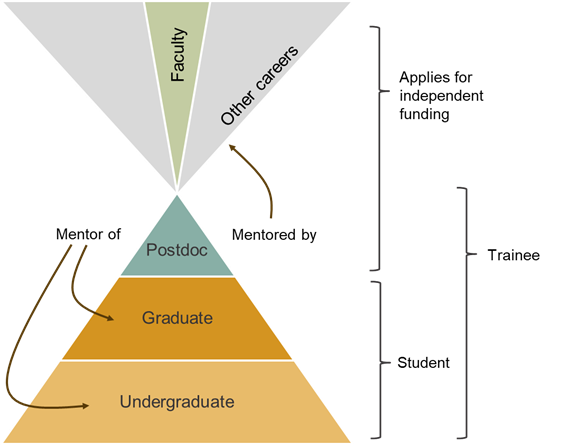
Figure
1
Postdocs
are a linchpin in the traditional academic career path.
Literature Review
Few
reviews have examined the library needs of postdoctoral scholars. A scoping
review protocol highlighted the need for a literature synthesis, however, at
this time no such synthesis exists (Nowell et al., 2018). Thus, our review of
the literature was expanded to gather information on how libraries have
investigated the needs of other early-career researchers such as graduate
students. Several researchers highlighted the unique information seeking habits
and needs of doctoral and postdoctoral trainees. A meta-review of doctoral
students showed they exhibit different information behaviour than other types
of graduate students (Catalano, 2013). Researchers (Ince et al., 2020) who
interviewed doctoral students and postdocs to gain insights into how they
conduct and disseminate research found that early career researcher workflows
were fragmented due to a lack of training and lack of specialized tools to
conduct these tasks.
Studies
have shown that graduate program curricula may have gaps in research training,
career development, and grantsmanship that could be filled by various campus
units (Fong et al., 2016). Several researchers have called for libraries to
address the unique needs of early career researchers. A survey of postdoctoral
positions within U.S. universities advocated for libraries to support these
researchers (O’Grady & Beam, 2011). Interviews of international postdocs at
one U.S. university identified gaps in library outreach and services. Gunapala (2014) called for librarians to partner with
university professional development programs to offer writing and communication
training for international postdocs. Scholarly communication support is also an
emergent need. One mixed-methods study documented the need for research and
scholarly communication skills guidance and training among doctoral students
and their supervisors (White & King, 2020). A focus group on graduate
students, but not postdocs, identified complex needs that require cross-campus
efforts to address such as better communication and orientation to services,
dedicated spaces to connect with peers, and opportunities to improve teaching
skills (Rempel et al., 2011).
Libraries
have examined different approaches for reaching the postdoc population. One
researcher found that postdocs would benefit from promotion of library
resources and services through both online and in-person orientations
(Tomaszewski, 2012), while others concluded that access to asynchronous
resources and virtual training was preferred (White & King, 2020). A
successful outreach program for postdocs was developed to include maintaining a
master list of current postdocs, providing library orientations, and meeting
with postdocs in their research spaces (Barr-Walker, 2013). Gau
et al. (2020) described a program created at the University of California, San
Francisco Library where postdocs give one-hour recorded talks and receive
guidance and feedback on their instruction by librarian mentors. This program
used a needs assessment survey and provided resource guides tailored to
postdocs. It also created a postdoc liaison librarian role to advocate for
postdocs within the library and the broader research community at the
university.
Objectives
Postdoctoral
scholars stand to benefit from library services that supplement and build on
the skills they developed during graduate school. Some studies assume that the
needs of graduate trainees will be mirrored by postdocs, an assumption which is
in part related to the challenge of defining and surveying the postdoc
population. However, postdocs represent a distinct population with complex
needs (Ott et al., 2021). The quality improvement project detailed in this
paper directly evaluates how postdoctoral scholars currently interact with the
library and their preferences for future access to library services. The study
is designed to uncover the barriers faced by postdoctoral researchers to access
library services with the goal of improving instruction and outreach to this
unique demographic. In this project, we aimed to investigate:
1.
What do postdocs need, and how can the
library support those needs?
2.
What is the postdocs’ current view and use
of library services?
3.
What are the main barriers to postdocs’
success and how can the library help ameliorate them?
Methods
This
study was submitted to the institutional review boards at Northwell Health and
the University of Alabama at Birmingham (UAB). Both review boards categorized
this study as not requiring IRB review. UAB is a public university with an
enrollment of 21,106 with an R1 Carnegie classification (University of Alabama
at Birmingham, 2023). The number of postdocs at UAB fluctuates between 200–300
with the majority concentrated in biomedical departments. Northwell is a large
hospital system with 85,000 employees distributed throughout the region. The
Institutes for Medical Research are Northwell’s medical research arm with
approximately 5,000 employees (Northwell Health, 2025). The vast majority of
postdocs in the Northwell system work in Institutes labs, and there are around
50 at any one time. Postdocs at both institutions are centered in health
sciences research.
The
target interview population was current postdoctoral researchers. Eligibility
criteria included age 19 or older and currently employed by UAB or Northwell
with a job title of “Postdoctoral Fellow” or “Postdoctoral Scholar.” Instead of
conducting a survey, which tends to yield low response rates, the focus group
methodology was chosen because the population of postdocs is relatively small
at both institutions (approximately 230 at UAB and 50 at Northwell) and focus
groups are better suited to capture the diversity of experience among small
populations (Morgan, 1997). Focus groups have a decades-long history of use in
the areas of program evaluation and library science. As part of our literature
review, we read a study by Rempel et al. (2011) that utilized focus groups to
review library services to graduate students at Oregon State University, but we
were unable to locate any that used focus groups to study the postdoc
population.
In
the two months prior to holding focus groups, we sent recruitment invitations
to relevant academic units, which at UAB included the postdoc office, and at
Northwell included the heads of research institute divisions and educational
programs. We also utilized access to our campus directories to identify people
with the job titles “Postdoctoral Researcher” or “Postdoctoral Scholar” and
email them directly. At UAB, we utilized digital library signage, and at
Northwell we hung physical flyers near postdoc workspaces. Participants
registered for the focus groups using the built in Teams or Zoom form feature.
We asked the following demographic and informational questions on sign up:
1.
Full name
2.
Email
3.
Department/Program
4.
How often do you use the [institution]
libraries? (Answers: Often, occasionally, never)
5.
Briefly, what is your area of study?
Three
semi-structured focus group sessions were run – two at UAB with five and six
participants each, and one at Northwell with eight participants. One researcher
was the moderator for the focus group, while the others observed and
contributed follow up questions. We prepared our questions using a backward
design, starting with our objectives as outlined above and then coming up with
questions that would allow us to find out that information. The number of
questions we could ask was restricted by the amount we could cover in a
one-hour focus group session. We did not pretest the questions given the
quality improvement nature of the project. The prepared questions are available
in Appendix A.
The
focus groups were conducted and recorded over Zoom or Teams, depending on which
platform was in common use at each institution. All participants gave written
informed consent when they signed up for the session and were read a consent
statement at the beginning of the focus group session. Participants had the
option to answer the questions aloud or through the chat, and the moderator
asked follow up questions as needed. Automatically
generated transcripts and chat logs were captured. The researchers prepared a
clean version of the transcript by comparing the automatically generated
transcript to the audio recording.
After
collecting the data, we used an iterative coding process (Katz-Buonincontro, 2022) and continued adding themes throughout
the coding stage as they became apparent through close reading of the
transcript. We created a codebook with definitions for each theme (Appendix B).
The clean transcripts and chat logs were coded independently by at least two
investigators using the open source Taguette software
(version1.4.1-50-geed050b). Differences in tagging were resolved by discussion
between the two coders with input from the third investigator as necessary.
This
was followed by a thematic analysis for common themes, divergences from themes,
and linkages between themes (Ritchie et al., 2013). Together, we analyzed the
codes to come up with conclusions and concrete recommendations. These
recommendations naturally fell into two categories: recommendations for the
library and librarians, and recommendations for the institution as a whole.
Results
The
focus groups garnered 26 registrations, with 19 actual attendees. Of the
participants, 11 were from UAB, and 8 were from Northwell. All attendees hailed
from STEM fields with 14 from medicine, 4 from engineering, and 1 from
dentistry. The attendee distribution reflected the dominant science focus in
the eligible pool of postdocs, and national norms (97% of all federally funded
postdocs are in science or engineering fields (National Science Foundation,
2021)). The focus group members reported different levels of library usage
based on their responses to the question, “How often do you use the library?”
which was asked during the focus group registration. The majority, 10,
responded that they occasionally use the library, 4 reported never using the
library, and 5 stated they use the library often.
Several
themes emerged from the analysis of the focus group responses. These themes
were organized into three major categories:
1.
Self-proclaimed needs to succeed in
their program.
2.
Perceptions of library offerings such as
spaces, services, and collections/resources.
3.
Self-identified barriers postdocs face.
Postdoc Self-Proclaimed Needs
Career Development Opportunities
Many
postdocs expressed a need for career development opportunities, with two
distinct areas of focus. First, postdocs wanted more instruction on navigating
the job market, writing job application materials, and networking with their
peers. As one postdoc described the problem: “It’s hard to get a clear picture
on what our next step is going to be.” Second, they wanted to learn skills that
they could add to their resumes to help them stand out in a crowded field. For
example, they wanted to learn about cutting edge software packages, responsible
use of AI, and lab management skills.
Funding
The
postdoc period is often when researchers transition from working on projects
funded by their mentor, toward writing to secure their own funding for research.
In addition to career development, postdocs also wanted training on how to find
funding opportunities and on grantsmanship to develop a competitive proposal.
Funding (or lack thereof) for specific research activities was also discussed
in relation to the publishing and software access themes below.
Publishing and Scholarly Writing Assistance
The
focus group participants expressed a desire for more support related to
improving scientific writing. They voiced a need for support when preparing a
manuscript, such as pre-submission peer review to strengthen the article’s
message, as well as language and style review. Some of the attendees who
self-identified as international trainees mentioned that this support was
especially critical for postdocs who are new to U.S. publishing norms and may
experience language barriers. As one international postdoc put it: “Especially
for international postdocs, grammar reviewers will be key before submission.”
Another international postdoc agreed about the necessity of using
pre-submission reviewers: “I had grammar mistakes and stuff like that that I
completely missed.” There were also expressions of concern for how to
responsibly adopt emerging technologies such as generative AI in scholarly
writing, and many postdocs hoped to learn more about this topic in the future.
The
Northwell library, in particular, advertises a service where librarians help
match manuscripts to possible journals. However, participants were split on the
usefulness of this service to the postdoc populations—many felt sufficiently
familiar with the journals in their field to decide where to apply themselves
or relied on their PI to suggest an appropriate publishing outlet.
Software Access
Researchers
require access to a number of software products such as reference managers,
data analysis tools, and electronic lab notebooks. At both UAB and Northwell,
some software packages, or training to use software packages, are provided by
the library. The postdocs said they rely on products that are provided by the
institution due to funding constraints and benefit from having access to
specialized software, such as GraphPad Prism (RRID:SCR_002798) for data
analysis and Biorender (RRID:SCR_018361) for
scientific illustration. As one postdoc said: “Software support is huge for our
lab. At the moment we are very dependent on GraphPad and Endnote from the
library.”
Mentorship
Postdocs
need both mentoring and opportunities to mentor others (See Figure 1). The
mentorship needs of each postdoc are unique, and ideally the relationship is
tailored to the postdoc’s career goals. The focus group members expressed
challenges finding informal mentoring relationships outside of their lab
groups. They also expressed an interest in learning how to become better mentors
themselves as part of their professional development. One postdoc typified this
experience succinctly: “I’m trying to gain experiences from different mentors.
However, I would like to get specific training on how to become a mentor.”
Postdoc Perceptions of Library Offerings
Libraries as Physical Spaces
A
majority of the postdocs we interviewed did not use the physical library space,
especially at Northwell, where the library has shifted to a majority-online
presence, especially post-COVID-19. However, there were several responses that
expressed a desire for an in-person library space, whether for quiet study,
events, or socializing with colleagues. One postdoc exemplified this longing:
“I really would [like] to be [at the library] and study and build social
connections with the other researchers.” Moreover, across both institutions postdocs expressed a strong preference for
in-person events as opposed to virtual.
Library Collections
There
was an uneven understanding about what library collections offer and mixed
awareness of what the library provided aside from books. For example, several
postdocs did not understand that the ability to access a paywalled article from
Google Scholar while on campus was due to library subscriptions and access
services facilitation. This lack of understanding can be interpreted positively
in that users are seamlessly accessing resources;
however, postdoc users do not attribute their ease of access to library effort.
There was more universal acknowledgement and appreciation for interlibrary loan
services. A postdoc expressed their appreciation for interlibrary loan this
way: “I often request old papers not available and get a scanned copy, which is
a great service.”
Library Services
We
asked the focus group attendees to rank three library services in order of
importance to them and explain their reasoning: (a) assistance with a
literature search, (b) help selecting a journal for a manuscript, or (c)
providing access and support for software. The most common reason given for not
using a particular library service was a lack of awareness that the service
existed or that it catered to postdocs. In a few cases, there was a sentiment
of not needing the service because they had the necessary expertise to perform
the activity without assistance. For example, the least popular option was
journal selection, as the interviewees felt most confident in this area
compared to the other two services. The two remaining options, literature
search assistance and software support, were equally popular. Those who ranked
literature search assistance highest cited the need for help procuring
resources and an appreciation for interlibrary loan. For example, a postdoc
stated: “Yes, we have recently reached out to [librarian] for help with a
literature search as we prepare to write a lit review.” Focus group
participants that ranked literature search highest tended to associate software
support with IT, not the library. Those who ranked software support highest did
so for financial reasons. Postdoc budgets are limited, and they were grateful
for the opportunity to access software they would not otherwise have been able
to purchase.
Library Visibility and Outreach
Postdoc
usage and perception of library services was heavily linked to the library’s
visibility and its outreach and communication efforts. A gap in marketing was
clearly evident. Even postdocs who knew and regularly used library resources
were unaware of the breadth of services available. In fact, when asked, “What
is the one thing you would change about the library?”, one postdoc summed it up
with: “I would say improve visibility so we can take advantage of your
services.” Another told us: “the most important thing to do is to improve
communication. Most postdocs don’t know that these services are available.”
Self-Identified Barriers for Postdocs Use of the Library
Communication
Postdocs
had inconsistent knowledge of what was offered by the library and were
frustrated by a lack of a centralized list of services relevant to them. As one
postdoc put it: “I'm very new to [the institution], joined about a month ago,
so I don't know where to find most resources.” This lack of knowledge was not
mended by time, as one attendee attested: “I have been here for the last four
years but even I don’t know many services that there are in the library.” When
asked about preferred methods of communication, the majority requested monthly
newsletters by email to update postdocs on events and services and indicated
that social media was not an effective communication method.
Lack of Time
Postdocs
expressed that time pressures were a major barrier. One interviewee summarized
the challenge:
I agree that time is a barrier,
especially if we want to publish a study in a higher impact journal; it can
easily take at least a year to gather the data and another half year/year for
the review process.
The
focus group members mentioned lack of time as one reason they don’t take
advantage of the optional services offered by the library.
Table
1
List
of Recommendations to Improve Service to Postdocs
|
Outside the library |
|||
|
Recommendation |
Challenge Addressed |
Recommendation |
Challenge Addressed |
|
Collect postdoc usage
statistics |
Visibility |
Collaborate with
research support offices |
Career development;
Lab management |
|
Adopt a direct communication approach |
Communication |
Maintain a central list of services for postdocs |
Communication; Software access |
|
Foster welcoming
spaces for postdocs |
Physical space;
Library collections |
Expand English
language support |
Writing/publishing |
|
Market library services at time saving |
Lack of time |
Increase funding for APC fees |
Funding |
|
Collaborate with
postdocs |
Career development |
|
|
Recommendations Within the Library
Collect Postdoc Usage Statistics
Our
first recommendation is to include postdocs as a category in collection forms.
Postdocs can wind up grouped with staff, employees, or graduate students, but
their needs are distinct. By collecting usage statistics, librarians will be
able to evaluate their library’s current effectiveness and measure the impact
from implementing these recommendations.
Adopt a Direct Communication Approach
Typically,
postdocs make up a small percentage of the institution, which means that
outreach and services can be more directed and do not have to be as scalable as
outreach to undergraduate or graduate students. Determine how many postdocs are
at your institution and explore the best ways to reach them. Options include
direct email to postdocs, contacting their primary mentors, and communicating
through a postdoc organization on campus. In our focus groups, all postdocs
expressed a preference for email as the primary mode of communication.
Foster Welcoming Physical Spaces
Postdocs
showed interest in using library spaces for quiet study or meetings, and as a
central social place to network and gather with peers. In our focus group,
members indicated a preference for in-person events. Depending on the
institution, the library may want to consider utilizing locations in proximity
to where the target postdoc population works for in-person events hosted by the
library. As many postdocs are under time constraints, it may be worthwhile to
consider drop-in or flexible programming.
Market Library Services as Time Saving
Most
postdocs are limited to five years, and as a result postdocs
feel immense pressure to progress rapidly. At the same time, postdocs do not
seem to take advantage of the full range of library services in part because
they have the expertise to do the work themselves. One solution is to market
services as time saving as opposed to librarian-specific expertise. For
example, working with a reference librarian to improve literature search
efficiencies or a scholarly communication librarian to identify publishing
options can save postdocs valuable time.
Build Mutually Beneficial Collaborations With Postdoctoral Scholars
Focus
group members showed an interest in learning both soft skills (such as teaching
and mentorship) and technical skills (such as AI, coding languages and
scientific visualization). To help postdocs gain these skills, consider
following the instruction model put forth by Gau et
al. (2020) to partner with postdocs to enrich library instruction. This model
is mutually beneficial. Having postdocs who are highly trained in their
specialty offer advanced workshops related to their field relieves librarians
from having to constantly upskill in the latest techniques. In turn, the
postdocs gain valuable teaching experience and pedagogical advice from a
seasoned librarian instructor.
Recommendations Outside of the Library
Collaborate With Research Support Offices Outside of the Library
The
focus group participants did not make clear distinctions between support that
came from the library versus other offices. For example, several of them asked
us for help generating grant templates (typically done by Grants Management) or
for software support (managed by IT support). Postdocs also wanted to be able
to view the full menu of research support services that the institution
provides. As one postdoc put it: “I would wanna see
more collaboration with other offices or departments to support postdocs,
especially as it relates to career development or as it relates to other issues
that postdocs encounter.” The postdocs expressed a need for more support from
senior members at the institution who understand their needs. As one postdoc
mentioned:
Starting there with someone who's
qualified and who knows the landscape of postdoctoral opportunities and career
paths, that would be important to help leverage [the postdoc’s] research
training as well as the things that they can bring forth and to their next
role.
For
these reasons, we recommend increasing joint programs and outreach with offices
like the Postdoctoral Society, the Graduate School, Institutional Review Board,
Grants Management, and Quality Improvement among others.
Create a Centralized List of Research Support Services
To
improve library visibility and communication, a centralized list of research
support resources and services applicable to postdocs should be developed and
maintained. This could be a worthy first action from a library collaboration
with other support units. Even if institutional units have generic lists of
services, that does not fix the problem needing to be familiar with all the
units and navigate their separate systems, nor does it eliminate the tedium of
having to sift through generic lists to find services applicable to their
career stage and unique needs. Postdocs thought that preparing tailored lists
of support to different user groups would be a friendly and effective outreach
strategy.
Increase English as a Second Language Support
In
2022, 56% of U.S. postdoctoral scholars were foreign born, many of whom do not
speak English as a first language (Smith et al., 2024). This was reflected in
the makeup of the focus groups as several participants recounted struggles with
English grammar and the U.S. scientific writing style. One solution could
include asking a university writing center to extend their services to
postdocs, who are sometimes no longer considered students and hence not served
by these offices. These types of accessibility improvements will likely benefit
all postdocs, as focus group participants regardless of their background
struggled with finding support during the writing phase.
Increase Support for Open Access Publishing
As
early career researchers, postdocs have less access to funds compared to those
further along in their careers. Many postdocs expressed frustration with paying
article processing charges (APC) to publish open access, and postdocs from both
institutions requested more support for paying APCs. As one postdoc told us:
“Recently one of my manuscripts got accepted for publication, but I had to pay
a publication fee of $725 out of pocket.” The issue will only become more
pronounced once the “Nelson Memo” becomes effective, requiring a zero-embargo
public access of research outputs from U.S. federally funded research (Nelson,
2022). Institutions have begun addressing this issue by brokering
transformative agreements or setting aside funds specifically to cover APCs for
early career researchers. We recommend ensuring that transformative agreement
language clearly includes postdocs as eligible recipients and promoting these
cost saving measures directly to postdocs.
Discussion
Our project
highlighted some common postdoc struggles to manage the different aspects of
their position including research, teaching, professional development, and
mentoring responsibilities. Our findings were consistent with prior studies on
both postdocs and other early-career researchers, such as a desire for
connection at in-person events and opportunities to develop new skills (Gau et al., 2020; Gunapala, 2014;
Rempel et al., 2011). The library can help by creating programming aimed at
postdocs and addressing their physical space needs. However, since postdocs
showed little awareness of the distinctions between different support offices,
some of their requests were outside of the sole purview of the library. In
these cases, we recommend that the library work with other units across campus
to facilitate positive change.
Our
results showed that the postdocs’ greatest barrier to library usage was a need
for more effective communication about relevant resources to take full
advantage of the available research support services. Poor outreach to the
postdoc community has been well documented, however there is no consensus on
how to effectively close the gap. In the focus groups, postdocs indicated a
desire for direct email communication and web resources. This outcome contrasts
with the conclusion reported at Georgia State University in 2012 to conduct
outreach through social media (Tomaszewski, 2012). This difference is not
surprising given the rapid changes in the social media landscape and
illustrates why libraries must frequently reassess which marketing platform to
use to stay relevant.
This
study’s applicability is limited by its sample size. While the focus group
research methodology is highly suitable for studying small groups in
institutions, we cannot say that our results reflect the experience of postdocs
across academic or health institutions in the United States. Rather, we hope
our work will inspire our colleagues to undertake similar quality improvement
projects at their own workplaces.
Indeed,
postdoc’s scholarly needs will continue to change as more postdocs come from
abroad and the open science movement gains momentum. However, our institutions
have not yet caught up. Postdocs expressed a need for more English writing and
APC support. Our results agreed with a global survey of the state of open
access conducted by Springer-Nature and Figshare
which indicated broad support for open access publishing among postdocs but
lack of awareness and monetary support for APCs (Hahnel
et al., 2023). This is a significant hardship that disproportionately affects
early career researchers. The library cannot provide these services alone, but
we can act as a partner and empower postdocs to self-advocate for greater
support in these areas.
Furthermore,
our study dovetails with a broader reckoning on the role and treatment of
postdocs in academia. In 2022, the National Institutes of Health (NIH ) in the United States assembled a Working Group on
Re-Envisioning NIH-Supported Postdoctoral Training, which released its report
in 2023 (Advisory Committee, 2023). In response to the report, the NIH
announced an 8% pay increase for postdocs, though it fell short of the amount
recommended by the Working Group (Heidt, 2024). Additionally, there has been
increasing recognition of the high burdens placed on postdocs compounded by a
lack of institutional support (Forrester, 2021). Postdocs are typically
dependent on the funding of their PI, placing them in a structurally vulnerable
and precarious position (“Is Science’s Dominant Funding Model Broken?,” 2024). While the role of the postdoc is debated on
a national stage, we can strive to do our part to improve their working lives
through implementing our recommendations for increased library support.
Conclusion
The
focus groups revealed that both institutions need to build better support
systems to improve the postdoctoral experience. Currently, a postdoc’s success
is strongly dependent upon their relationship with their primary mentor or PI.
To make the postdoc experience more welcoming and equitable, this dynamic needs
to be uncoupled by increasing and standardizing the institutional support for
this critical stage in trainee development. Postdoc associations or offices are
known to improve institutional support for postdocs (Bruckmann
& Sebestyén, 2017). We believe that as a central
unit the library can also be an instrumental driver for this change.
There
were some surprising incidental benefits from conducting this study. The act of
advertising the focus group itself not only made some postdocs more aware of
library services, but also portrayed the librarians as welcoming and invested
in their specific needs. For example, a postdoc commented: “[I’m] quite new
here, but also because [I’m] new, I wanted to join this meeting to gain more
information about library services.” The act of conducting the focus groups
served as outreach to postdocs, and we have seen an uptick in the number of
postdocs reaching out to librarians following the sessions.
We
are already implementing the recommendations from this study in our libraries.
At Northwell, we plan to launch a writing group for trainees. This writing
group will allow postdocs and other trainees to read drafts of each other’s
scholarly work and provide peer feedback in a semi-structured environment. We
hope this will help address the gap in scholarly writing support our focus
group participants identified and establish the library as a welcoming and
supportive space for new users. At UAB, we conducted a workshop on open access
publishing specifically for the postdoc population to demonstrate that the
library provides services specifically for their needs, while addressing the
gap in knowledge around open access identified in the focus groups.
This
study also exemplifies the power of the focus group
methodology for quality improvement and program assessment projects, especially
for isolated or smaller communities. Many of these populations are “hidden” or
“silent” in institutional data gathering because their numbers are small. Some
of these groups face additional societal discrimination. The phenomenon of
erasure of small groups from datasets has been well documented in
non-institutional cases, for example by the Urban Indian Health Institute
(2021) in regard to poor representation of Native Americans in COVID-19 public
health datasets. In our institutions, we can work to make sure that this type
of data collection omission does not happen by using methods beyond the survey
to gather patron feedback.
Author Contributions
Lena Bohman: Conceptualization,
Methodology (lead), Analysis (equal) Writing – original draft, Writing – review and editing (equal) Regina Vitiello: Methodology, Analysis (equal), Writing –
original draft, Writing – review and editing (equal) Marla Hertz: Conceptualization
(lead), Methodology, Analysis (equal), visualization, Writing – original draft
(lead), Writing – review and editing (equal)
Acknowledgements
The
authors would like to thank the postdoctoral researchers who took part in the
focus groups for their willingness to participate and their insights.
Additionally, the authors would like to thank Dr. Gretchen Arnold for her
invaluable advice on the research methodology of this project.
References
Advisory
Committee to the Director Working Group on Re-envisioning NIH-Supported
Postdoctoral Training. (2023, December 15). Report to the NIH Advisory
Committee to the director (ACD). National Institutes of Health. https://acd.od.nih.gov/documents/presentations/12152023_Postdoc_Working_Group_Report.pdf
Barr-Walker,
J. (2013). Creating an outreach program for postdoctoral scholars. Science
& Technology Libraries, 32(2), 137–144. https://doi.org/10.1080/0194262X.2013.789417
Bruckmann, C., & Sebestyén, E. (2017). Ten simple rules to initiate and run
a postdoctoral association. PLOS Computational Biology, 13(8),
e1005664. https://doi.org/10.1371/journal.pcbi.1005664
Cantwell,
B., & Lee, J. J. (2010). Unseen workers in the academic factory:
Perceptions of neoracism among international postdocs
in the United States and the United Kingdom. Harvard Educational Review,
80(4), 490–516. https://doi.org/10.17763/haer.80.4.w54750105q78p451
Catalano,
A. (2013). Patterns of graduate students’ information seeking behavior: A
meta‐synthesis of the literature. Journal of Documentation, 69(2),
243–274. https://doi.org/10.1108/00220411311300066
Curtis,
R. B. (1969). The invisible university: Postdoctoral education in the United
States: Report of a study conducted under the auspices of the National Research
Council. National Academy of Sciences.
Feldon, D. F., Litson, K., Jeong, S., Blaney, J.
M., Kang, J., Miller, C., Griffin, K., & Roksa,
J. (2019). Postdocs’ lab engagement predicts trajectories of PhD students’
skill development. Proceedings of the National Academy of Sciences, 116(42),
20910–20916. https://doi.org/10.1073/pnas.1912488116
Fong,
B. L., Wang, M., White, K., & Tipton, R. (2016). Assessing and serving the
workshop needs of graduate students. The Journal of Academic Librarianship,
42(5), 569–580. https://doi.org/10.1016/j.acalib.2016.06.003
Forrester,
N. (2021). Mental health of graduate students sorely overlooked. Nature,
595(7865), 135–137. https://doi.org/10.1038/d41586-021-01751-z
Gau, K. H., Dillon, P., Donaldson, T., Wahl, S. E., &
Iwema, C. L. (2020). Partnering with postdocs: A
library model for supporting postdoctoral researchers and educating the
academic research community. Journal of the Medical Library Association:
JMLA, 108(3), 480–486. https://doi.org/10.5195/jmla.2020.902
Gunapala, N. (2014).
Meeting the needs of the “invisible university:” Identifying information needs
of postdoctoral scholars in the sciences. Issues in Science and Technology
Librarianship, 77. https://doi.org/10.29173/istl1610
Hahnel, M., Smith, G.,
Schoenenberger, H., Scaplehorn,
N., & Day, L. (2023). The state of open data 2023 [Report]. Digital
Science. https://doi.org/10.6084/m9.figshare.24428194.v1
Heidt,
A. (2024). NIH pay rise for postdocs and PhD students could have US ripple
effect. Nature. https://doi.org/10.1038/d41586-024-01242-x
Ince,
S., Hoadley, C., & Kirschner, P. A. (2020). Research workflow skills for
education doctoral students and postdocs: A qualitative study. The Journal
of Academic Librarianship, 46(5), 102172. https://doi.org/10.1016/j.acalib.2020.102172
Is
science’s dominant funding model broken? (2024). Nature, 630(8018), 793–793. https://doi.org/10.1038/d41586-024-02080-7
Kahn,
S., & Ginther, D. K. (2017). The impact of postdoctoral training on early
careers in biomedicine. Nature Biotechnology, 35(1), 90–94. https://doi.org/10.1038/nbt.3766
Katz-Buonincontro,
J. (2022). How to interview and conduct focus groups. American
Psychological Association. http://www.jstor.org/stable/j.ctv2sjj0h6
Liénard, J. F., Achakulvisut, T., Acuna, D. E., & David, S. V. (2018).
Intellectual synthesis in mentorship determines success in academic careers. Nature
Communications, 9(1), 4840. https://doi.org/10.1038/s41467-018-07034-y
McAlpine,
L. (2018). Postdoc trajectories: Making visible the invisible. In A. Jaeger
& A. J. Dinin (Eds.), The postdoc landscape
(pp. 175–202). Academic Press. https://doi.org/10.1016/B978-0-12-813169-5.00008-2
Morgan, D. L. (1997). The
focus group guidebook (1st ed.). SAGE Publications, Incorporated.
National
Science Foundation. (2021). The shifting demographic composition of
postdoctoral researchers at federally funded research and development centers
in 2021. https://ncses.nsf.gov/pubs/nsf22345
Nelson,
A. (2022). Ensuring free, immediate, and equitable access to federally
funded research [Official Memorandum]. White House Office of Science and
Technology Policy. https://www.whitehouse.gov/wp-content/uploads/2022/08/08-2022-OSTP-Public-Access-Memo.pdf
Northwell
Health. (2025). We are Northwell. https://www.northwell.edu/sites/northwell.edu/files/2025-02/we-are-northwell-fact-sheet-updatefeb2025printer-spreadsv1.pdf
Nowell,
L., Alix Hayden, K., Berenson, C., Kenny, N., Chick, N., & Emery, C.
(2018). Professional learning and development of postdoctoral scholars: A
scoping review protocol. Systematic Reviews, 7(1), 224. https://doi.org/10.1186/s13643-018-0892-5
O’Grady,
T., & Beam, P. S. (2011). Postdoctoral scholars: A forgotten library
constituency? Science & Technology Libraries, 30(1), 76–79. https://doi.org/10.1080/0194262X.2011.545680
Ott,
N. R., Arbeit, C. A., & Falkenheim, J. (2021). Defining
postdocs in the survey of Graduate Students and Postdocs (GSS): Institution
responses to the postdoc definitional questions in the GSS 2010–16. https://ncses.nsf.gov/pubs/nsf21327
Rempel,
H. G., Hussong-Christian, U., & Mellinger, M.
(2011). Graduate student space and service needs: A recommendation for a
cross-campus solution. The Journal of Academic Librarianship, 37(6),
480–487. https://doi.org/10.1016/j.acalib.2011.07.004
Ritchie,
J., Lewis, J., Nicholls, C. M., & Ormston, R.
(2013). Qualitative research practice: A guide for social science students
and researchers (2nd ed.). SAGE Publications Ltd.
Smith,
B., Alldredge, Elham-Eid, Arbeit, Caren A., & Yamaner, Michael I. (2024). Graduate enrollment in
science, engineering, and health continues to increase among foreign nationals,
while postdoctoral appointment trends vary across fields (InfoBrief NSF 24-320; National Center for Science and
Engineering Statistics). National Science Foundation. https://ncses.nsf.gov/pubs/nsf24320
Tomaszewski,
R. (2012). Information needs and library services for doctoral students and
postdoctoral scholars at Georgia State University. Science & Technology
Libraries, 31(4), 442–462. https://doi.org/10.1080/0194262X.2012.730465
Travis,
J. (1992). Postdocs: Tales of woe from the “invisible university.” Science,
257(5077), 1738–1740. https://doi.org/10.1126/science.257.5077.1738
University
of Alabama at Birmingham. (2023). UAB total student demographics. https://www.uab.edu/institutionaleffectiveness/images/documents/student-demographics/Fall-2023-Total-Enrollment.pdf
Urban
Indian Health Institute. (2021). Data genocide of American Indians and
Alaska Natives in COVID-19 data. https://www.uihi.org/projects/data-genocide-of-american-indians-and-alaska-natives-in-covid-19-data/
White,
E., & King, L. (2020). Shaping scholarly communication guidance channels to
meet the research needs and skills of doctoral students at Kwame Nkrumah
University of Science and Technology. The Journal of Academic Librarianship,
46(1), 102081. https://doi.org/10.1016/j.acalib.2019.102081
Woolston,
C. (2018a). The quest for postdoctoral independence. Nature, 561(7724),
569–571. https://doi.org/10.1038/d41586-018-06794-3
Woolston,
C. (2018b). Why a postdoc might not advance your career. Nature, 565(7737),
125–126. https://doi.org/10.1038/d41586-018-07652-y
Woolston,
C. (2020). Postdoc survey reveals disenchantment with working life. Nature,
587(7834), 505–508. https://doi.org/10.1038/d41586-020-03191-7
Appendix A
Focus Group Questionnaire
1.
[Institution]
has a number of resources that can help you with your research. Which ones do
you use most often? How (or where) do you find out about them? For example:
biostatistics support, librarians, reading groups, events.
2.
What
do you think is the biggest barrier for postdocs in doing their research?
3.
Do
you currently use the library at [Institution]?
4.
The
library offers a variety of services. I’m going to list three of them and I
want to know which is the most important to you, and which is the least
important.
1.
4a.
Assistance with a literature search,
2.
4b.
Help selecting a journal for your manuscript
3.
4c.
Providing access to and support for software such as GraphPad, endnote, and biorender.
4.
Suppose
that you were in charge of the [Institution] library for a day and could make
one change. What would you do? (why did you choose
that?)
5.
What
skills do you want to learn during your postdoc training?
6.
What
do you think is the most important piece of feedback you have for our library
services?
7.
Is
there anything we should have asked you about but didn’t?
Appendix B
Codebook
|
Tag |
Description |
Number of highlights |
|
AI |
Relating to AI such as use of, tools for, ethics surrounding use |
12 |
|
CareerDevelopment |
Generally related to career development |
46 |
|
CareerDevelopment.Advancement |
A subset specific to preparing for and navigating the job market |
16 |
|
CareerDevelopment.Networking |
A subset specific to building professional contacts |
5 |
|
Communication |
How the library shares information about its services and
resources and how it hears from postdocs |
42 |
|
Funding |
Relating to funding, salary, cost of doing research, cost of
publishing etc |
25 |
|
Funding.Grants |
A subset specific to procuring grant funding |
25 |
|
LabManagement |
Relating to the management of laboratory spaces, research
programs, and research projects |
11 |
|
LackOfTime |
Relating to lack of time |
20 |
|
LibraryPhysicalSpace |
Relating to the physical spaces of the library |
17 |
|
LibraryCollections |
Relating to the use of library collections. Not software or
personnel support |
27 |
|
LibraryServices |
Pertaining to use of services provided by librarians, does not
include software or collections |
50 |
|
LibraryServices.EventDelivery |
Preferences for how Events are delivered to postdocs (ie, in person or virtual) |
7 |
|
Mentorship |
Relating to both the postdocs mentors and learning how to be
better mentors themselves |
22 |
|
Other |
Other |
10 |
|
PublishingWriting |
Support for publishing, writing, finding journals, etc |
36 |
|
PublishingWriting.JournalChoice |
Choosing a journal for a postdoc manuscript. |
15 |
|
PublishingWriting.LanguageNeeds |
Specific language needs writing, may pertain to ESL |
7 |
|
ScientificVisualization |
Relating to data visualization, scientific communication |
10 |
|
SoftwareAccess |
Pertaining to the use of software provided by library |
50 |
|
Visibility |
Visibility of library services or other support services |
19 |
|
Visibility.LibraryAwareness |
Lack of awareness of services used from the library |
33 |