Review Article
Scoping
Review of Transformative Agreement Research
Amy
Riegelman
Social Sciences & Evidence Synthesis Librarian
University
of Minnesota Libraries
Minneapolis,
Minnesota, United States of America
Email:
aspringe@umn.edu
Allison Langham-Putrow, PhD
Scholarly Communications Librarian
Walter Library
University of Minnesota
Minneapolis,
Minnesota, United States of America
Email:
lang0636@umn.edu
Received: 13 Feb. 2025 Accepted:
14 June 2025
 2025 Riegelman and Langham-Putrow. This is an Open
Access article distributed under the terms of the Creative Commons‐Attribution‐Noncommercial‐Share Alike License 4.0
International (http://creativecommons.org/licenses/by-nc-sa/4.0/),
which permits unrestricted use, distribution, and reproduction in any medium, provided
the original work is properly attributed, not used for commercial purposes,
and, if transformed, the resulting work is redistributed under the same or
similar license to this one.
2025 Riegelman and Langham-Putrow. This is an Open
Access article distributed under the terms of the Creative Commons‐Attribution‐Noncommercial‐Share Alike License 4.0
International (http://creativecommons.org/licenses/by-nc-sa/4.0/),
which permits unrestricted use, distribution, and reproduction in any medium, provided
the original work is properly attributed, not used for commercial purposes,
and, if transformed, the resulting work is redistributed under the same or
similar license to this one.
DOI: 10.18438/eblip30721
Abstract
Objective – Transformative agreements (TAs) are agreements between publishers and
institutions or consortia that combine reading access and open access (OA)
publishing. They can take many forms, and the first agreement is believed to
have started in 2014. This scoping review aims to identify and synthesize the
existing research on TAs.
Methods – Following
benchmarking and term harvesting, electronic searches were conducted in 48
databases and were complemented with handsearching and citation chaining which
resulted in 1843 unique results. Results were screened with pre-registered
inclusion and exclusion criteria which resulted in inclusion of 151 studies (80
case studies, 39 quantitative, 31 qualitative, and 1 theoretical).
Results – The
heterogeneity of methods and findings of research on TAs made synthesis
challenging. The synthesis was further complicated by the corpus including
studies examining different time periods, publishers, agreement types,
participating institutions, and more. Studies had varied intended audiences and
research dissemination routes further complicating discovery and synthesis.
Conclusions – Despite the heterogeneity, some themes emerged, including TAs increase
hybrid OA and that consortia can play an important role in negotiating and
managing TAs. Successful implementation relies on a
number of factors, including workflows for authors and those managing the
agreements. Studies found that TAs are not leading to a transformation of the
publishing system as a whole.
Introduction
Rationale
Transformative
agreement (TA) is a term used to describe agreements between publishers and
institutions or consortia that aim to transform some portion of the publisher’s
journals from closed or hybrid open access (OA) to fully OA. In 2012, the
“Finch Report” from the United Kingdom (UK) advocated for OA via article
processing charges (APCs; Finch, 2012). Around this time the concept of
“offsetting” was introduced, in which the publisher would return some amount of
money to the subscriber based on the amount of OA publishing in that
publisher’s journals. Many consider the 2014 agreement between IOP Publishing
and a group of Austrian institutions to be the first official offsetting
agreement, although the 2012 Royal Society of Chemistry’s “Gold for Gold” program
was an earlier experiment with the concept (IOP Publishing, 2014; Royal Society
of Chemistry, 2012). “Read and publish” (R&P) and “publish and read”
(P&R) agreements followed. Conceptually, these agreements consist of a
payment for reading access to subscription content and payment to publish the
institution’s works open. Publishing components range from discounted APCs to a
full waiver of the APC for all publications. The agreement between Wiley and
Projekt DEAL (a consortium of German institutions) announced in 2019 was the
largest agreement up to that point. There were some examples of publishers and
institutions experimenting with agreements that combined an OA component with
subscription or payment by an institution to a fully OA publisher to waive or
reduce APCs for authors, but these were not designed to be “transformative” or
have an offsetting component. Literature about the effects of TAs on all
aspects of scholarly communication is scattered and varied. This review will
identify and synthesize the literature on TAs. A
synthesis of the evidence could be used to inform policy and practice and
influence future research.
Definitions
The
Efficiency and Standards for Article Charges (ESAC) initiative defines TAs as,
“an umbrella term describing those agreements negotiated between institutions
(libraries, national and regional consortia) and publishers in which former
subscription expenditures are repurposed to support OA publishing of the
negotiating institutions’ authors” (ESAC Initiative, n.d.). ESAC also maintains
a registry of TAs, to which institutions provide transparent and somewhat
standardized data about these types of agreements. The aim is to “transform”
traditional—subscription-based—scholarly journal publishing model to one in
which publishers’ income is based on paying for publishing.
There
are a number of forms that TAs can take. Some of the most common varieties are
the following.
●
Offsetting agreements: The publisher
returns money to the institution to offset the amount of APCs paid. The first offsetting
agreement is often considered to be the aforementioned 2014 agreement between
IOP Publishing and a group of Austrian institutions (IOP Publishing, 2014). A
2017 blog post from the University of Cambridge Office of Scholarly
Communication provides five examples of offsetting agreements (Kingsley, 2017).
●
Read and Publish (R&P): The
institution pays two components to the publisher, one for reading access to
subscription materials and the other for publishing articles from the
institution’s authors OA. In some cases, there is a cap on the number of
articles that can be published at no cost to the author. We have included
agreements that provide a discount on the APC in this category. Some of the
first R&P agreements were made with Springer and called “Springer Compact”
agreements (, 2015).
●
Publish and Read (P&R): The
institution pays for publishing, and the fee includes reading access. An
example of this type of agreement is the 2019 Wiley-Projekt DEAL agreement,
which charged a €2750 fee per article published (Valente, 2021).
Literature Review
Offsetting
agreements were underway in 2014, but the idea of “transforming the system” of
scholarly publishing from paying to read to paying to publish gained momentum
starting in early 2015, when librarians from the Max Planck Digital Library
(MPDL) released a white paper proposing a systemwide transition of shifting
from paying for subscriptions to paying to publish (Schimmer et al., 2015). The
white paper argued that there is “enough money already circulating” in the
system for this to happen.
The
OA2020 initiative followed from the MPDL white paper and grew out of
discussions at the 12th Berlin Open Access Conference held in September 2015
and the resulting Expression of Interest in the Large-Scale Implementation
of Open Access to Scholarly Journals (OA2020, 2024). OA2020’s aim was to
form a community of institutions committed to transforming their subscription
budgets to pay for OA publishing by 2020. The goal of full OA by 2020 was
supported by the 2016 Netherlands’ European Union presidency through the Amsterdam
Call for Action on Open Science. This document was the outcome of a
conference on open science and set a goal for full OA for all scientific
publications by 2020 (Ministère de lʼEnseignement
Supérieur et de la Recherche, 2016).
cOALition S, a group of
research funding organizations, released Plan S in September 2018 and called
for all scientific publications resulting from research they fund to be
published OA, with a CC-BY license, as of 2020. The timeframe was extended and
went into effect in 2021. TAs, later “transformative arrangements” were one of the three routes authors could use to comply, if
the journal was covered by a TA that had a “clear and time-specified commitment
to a full Open Access transition” (Science Europe, 2018). The guidance stated
that cOAlition S funders would stop supporting TAs
before the end of 2024. The coalition confirmed this deadline in 2023 (European
Science Foundation, 2023). Alongside TAs, Plan S launched a “transformative
journals” (TJ) program, in which publishers would commit to transitioning the
journal to full OA within a specific timeline, based on meeting annual OA
growth rates. The program ended in 2024, with analysis of 2023 data showing
that although 40% of the roughly 1,000 journals in the program met or exceeded
their annual targets and 4% had flipped to fully OA, 56% did not meet their targets.
Their analysis concluded, “in aggregate the TJ data clearly shows that the
transition to full and immediate OA for many of the TJ publishers is still a
long way away” (Kiley, 2024).
Arguments
against TAs have been put forth. The Jussieu
Call for Open Science and Bibliodiversity was
released two years following the Amsterdam Call and called for OA models
beyond those that transform subscription payments to publication fees (Jussieu Call, 2017). The statement outlined how this approach is hindering innovation
and slowing, if not preventing, growth of bibliodiversity.
It pointed to a joint statement of UNESCO and the Confederation of Open Access
Repositories (COAR) on OA, which warned of the dangers of TAs and other
transformative models (COAR & UNESCO, 2016).
A
2021 piece in College & Research
Libraries News addressed negative aspects of TAs and similar themes are
evident in the Budapest Open Access Initiative (BOAI)’s 20th anniversary
recommendations (Farley et al., 2021). In contrast to the approaches of OA2020
and Plan S, the recommendations emphasize a move away from TAs, reminding the
OA community:
When we spend money to publish OA
research, we should remember the goals to which OA is the means. We should
favor publishing models which benefit all regions of the world, which are
controlled by academic-led and nonprofit organizations, which avoid
concentrating new OA literature in commercially dominant journals, and which
avoid entrenching models in conflict with these goals. (BOAI, 2022)
Despite
BOAI’s calls for an end to TAs and the end of cOAlition
S’s financial support for TAs in 2024, there were still 196 agreements starting
in 2024 added to ESAC Registry and 299 registered agreements that would end
2025 or later (ESAC Initiative, n.d.).[1] There were a total of 1123 agreements as of
December 5, 2024.
Objectives
This
review sought to retrieve and synthesize the diverse body of literature on TAs. This work included investigating: What research exists
on TAs? How is the effectiveness or ineffectiveness of TAs being measured?
Methods
Scoping Review
Scoping
review methods are used to systematically examine broad questions. Scoping
reviews can be used to “understand the extent of the knowledge in an emerging
field” and “examine how research is being conducted on a certain topic or
field” (Peters et al., 2020). The identification of relevant literature should
be comprehensive and transparently reported. There is established guidance on
how to conduct scoping reviews in each of the stages: identifying relevant
literature, evidence screening and selection, data extraction, analysis, and
presentation of results (Arksey & O’Malley, 2005; Peters et al, 2020). In
the present scoping review, we systematically identified and examined existing
research on TAs and presented our results in the narrative and in visual
presentations.
Protocol and Registration
The
protocol for the present study was registered at the Open Science Framework on
October 11, 2023, using the Generalized Systematic Review Form (Langham-Putrow & Riegelman, 2023; Van
Den Akker et al., 2023). We followed the methodological guidance outlined in
Arksey and O’Malley (2005) and incorporated recommendations from the JBI
Manual for Evidence Synthesis (Peters et al., 2020). We report our methods
and analysis according to the “PRISMA Extension for Scoping Reviews” (Tricco et al., 2018).
Eligibility Criteria
The
aforementioned preregistration outlines the inclusion and exclusion criteria.
Eligible studies could be any publication type, regardless of peer-review
status, which measured effects or uptake of TAs.
Eligible studies were published in 2012 or later. Ineligible studies included
opinion pieces, reviews of published research, commentary, press releases, and
any studies published prior to 2012. Our study focused on TAs as a subset of OA
agreements, which, as described in the Rationale, were introduced after the
release of the “Finch Report” (Finch,
2012).
Information Sources
We
cast a wide net to target all the relevant literature on TAs.
In exploring the known literature on this topic, we determined that relevant
studies were dispersed among many different subject and multidisciplinary
databases, leading us to search 48 databases to acquire relevant studies. See
the full database list in Appendix A. Grey literature was indexed in some of
the selected databases, and further, we specifically targeted grey literature
via the following venues: AgEcon Search, arXiv, OSF Preprints, Europe PMC, Web of Science Preprints
Citation Index, Zenodo, and Figshare.
Search
Two
librarians performed term harvesting and benchmarking to design a comprehensive
and reproducible electronic search strategy based on a set of relevant studies.
We identified terms used to denote TAs in the known literature and confirmed
that there were no relevant subject headings in the subject databases. The
search strategy targeted titles, abstracts and author-supplied keywords
metadata fields (when available) and was adjusted for the syntax of each
platform. The search was designed around the concept of TAs and relevant
nomenclature: (“read & publish” OR “publish & read” OR “read and
publish” OR “publish and read” OR “transformative agreement*” OR “offset agreement”
OR “offsetting agreement”). Per our rationale, we filtered the search results
to a date range of 2012 to present. The searches were first executed October
12, 2023, followed by a search update that occurred April 19, 2024. The full
reproducible electronic search strategy containing search strings for 41
databases, 5 grey literature repositories, and 2 repositories is in Appendix A.
All search results were exported from each respective database and imported
into Covidence, an evidence synthesis web application. We also conducted
forward and backward citation chaining to unearth additional grey literature
and irregularly indexed peer-reviewed articles. Methods for conducting citation
chaining were based on recommendations of the terminology, application, and reporting
of citation searching (TARCiS) statement (Hirt et
al., 2024).
Selection of Sources of Evidence
The
authors each conducted independent title and abstract screening on all
deduplicated records based on their eligibility criteria. We then obtained the
full texts, and each completed independent full-text screening. We completed
both screening stages in Covidence, which flags conflicts. The authors resolved
conflicts via discussion.
Data Items and Charting
After
piloting the extraction form with seven studies of different study designs,
qualitative, quantitative, and case studies, we independently extracted data
from each included study and discussed any conflicts. The extraction included
the following data items (when reported) from each study.
●
Lead author country
●
Country/countries of institution/s
included in study
●
Aim of study
●
Study design
●
Model terms used (e.g.,
“transformative,” “read and publish,” “publish and read”)
●
What was measured
●
Name of the agreement (if applicable)
●
Reported institutions or consortia
involved in the agreement (if applicable)
●
Reported publisher or journals (if
applicable)
●
Reported start and end date of
agreement/s
●
Sample size
●
Disciplinary category
●
Study findings
●
Study funding sources
●
Disclosures
Synthesis of Results
We
used the extracted data to begin collating the included studies. The two
authors analyzed the general characteristics of the studies to identify
similarities and differences across publication types, model terms used,
publication date, and language. Due to the heterogeneity of research methods,
we identified four research design categories and filtered studies into: case
studies, qualitative research, quantitative research, and theory. We then
conducted further synthesis with a narrower focus on each research design
category. We conducted iterative coding through discussion between the two
authors to identify themes and characteristics of studies within each research
design category.
Results
Selection of Sources of Evidence
The
total number of results acquired from databases was 1843. Citation searching,
which included one round of forward and backward citation searching for all
included results, identified an additional 1701 results. For backward citation
searching, we used Web of Science Core Collection and Scopus if the record was
indexed in those venues, and when an item was not indexed in either, examined
study reference pages manually. For forward citation chaining, we used Web of
Science Core Collection, Scopus, and Google Scholar, in that order of priority.
After removing duplicates, we independently screened 1838 records (see Figure
1).
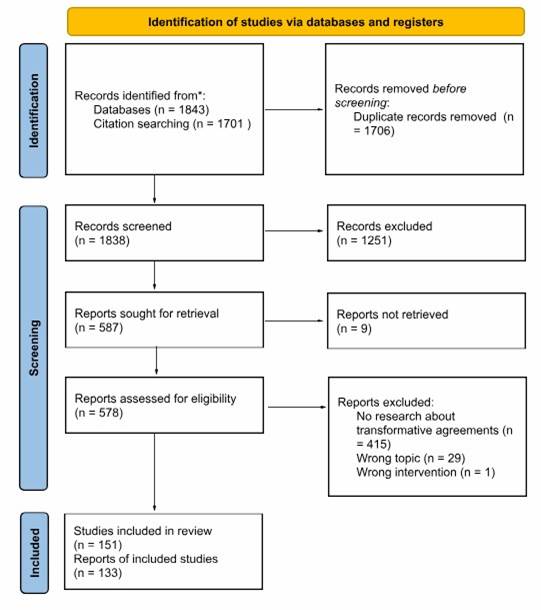
Figure 1
PRISMA flow diagram. See Appendix A for the list of
databases and number of results per database.
Based
on the inclusion and exclusion criteria, we performed masked title and abstract
screening on the 1838 deduplicated records in Covidence. We followed this with
masked full-text screening (n=587), again via Covidence. Interrater reliability
showed moderate agreement for title and abstract screening (Cohen’s 𝛋 = 0.55) and substantial agreement for
full-text (Cohen’s 𝛋 =
0.62) (McHugh, 2012). We settled conflicts identified in Covidence through
discussion. Figure 1 lists reasons for exclusion at the full-text screening
stage. We made exhaustive efforts (e.g., emailing authors, searching
webarchive.org) to acquire irregularly indexed and paywalled full-text copies
of studies. When documents were published in languages other than English, we
relied on Google Translate for translation. We received help refining
translations of studies from colleagues with native language expertise.
Ultimately, the present scoping review includes 133 records. Further analysis
revealed that some documents contained multiple studies and some of the same
studies were represented in multiple documents, which resulted in 151 unique
studies.
Characteristics of Sources of Evidence
Research Design
The
studies included in this review were published between 2015 and 2024 and
encompassed four research designs: case study (n=80), quantitative research
(n=39), qualitative research (n=31), and theory (n=1).
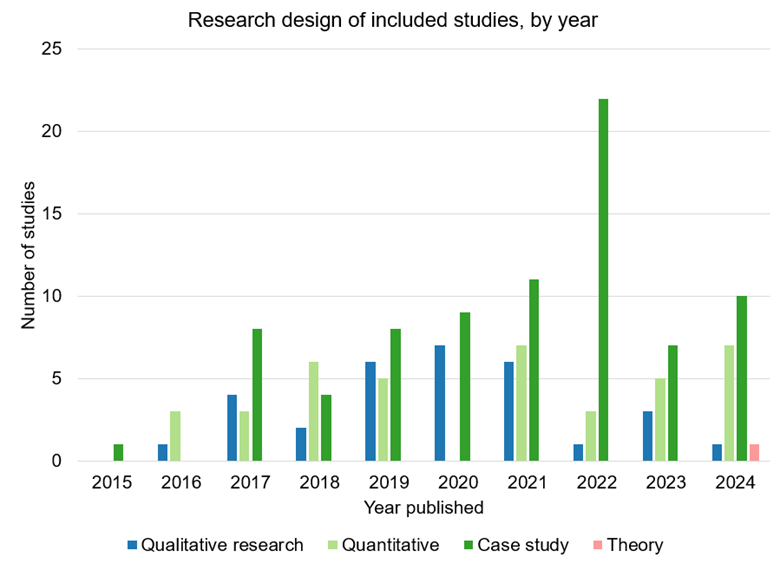
Figure 2
Count of the design of included studies, by year.
2024 represented a partial year since the search was last updated on April 19,
2024.
Related Studies
We
found included studies, across study designs, that were closely related to each
other (i.e., from the same institution or consortium). These included the
following.
●
Annual reports from Jisc
U.K. agreements looking at the years 2015, 2016, and 2017, plus a summary
report (Lawson, 2016, 2017, 2018, 2019).
●
A series of papers from Düsseldorf
Institute for Competition Economics (DICE) using data from the DEAL agreement
plus two from other sources about DEAL agreements (Geschuhn
et al., 2021; Haucap et al., 2021; Karlstrøm &
Andenæs, 2021; Schmal, 2024a; Schmal et al., 2023).
●
Reports about the Bibsam
(Sweden) Springer Compact agreement (Kronman, 2018; Oefelein, 2021; Olsson,
2018).
●
Studies related to the Austrian
transition to OA (AT2OA) project (Fessler & Hölbling,
2019; Kromp et al., 2022; Pinhasi
et al., 2020, 2021).
Publication Type
There
were some differences in predominant publication type across the study designs.
Of the 80 case studies, the most common type of publication was journal article
or preprint (41), both peer reviewed and non-peer reviewed. Nearly half of
these were published in Insights: The
UKSG Journal, a journal that aims to “provide a forum for the communication
and exchange of ideas between the many stakeholders in the global knowledge
community”; case studies are a primary form for sharing in this community. The
next most common types were presentation (slides or recording) (16) and reports
or report chapters (17). The remaining were blog posts, a book chapter, a
guide, and a white paper.
Quantitative
studies were most often published as journal articles (15) and reports or
report chapters (13). Some were blog posts (4), presentation slides, discussion
or white papers (2), and preprints (2).
The
majority of the qualitative studies were published as reports or report
chapters (20). There was a relatively lower proportion of journal articles (6)
compared to the case studies. The remaining case studies were published as
theses (3), blog post (1), or white paper (1).
Geographical Characteristics of Included Studies
We
recorded the country of the first (lead) author on each included study; some
records included multiple studies, which are indicated in Appendices B, C, and
D by individual entries for one record number. The largest number of studies
were by authors from the UK. Jisc, the national
consortium in the UK, published many analyses of their agreements, and U.K.
authors consistently published at least one item per year from 2015 to 2024.
Germany,
Sweden, and Austria were among early adopters of the agreements, and authors
from these countries regularly published research studies, particularly in the
earlier years. Austria began its AT2OA project in 2014, with a goal of
supporting “large-scale transformation of scientific publications from Closed
to Open Access” (Austrian Transition to Open Access, n.d.). Goal 2 of AT2OA
explored funding models for the transition, including TAs, and a number of
studies reported on this project.
The
search was not limited to English-language results. The included records were
primarily in English (130), with additional items in German (7), Chinese (5),
Swedish (4), Russian (2), Spanish (1), Portuguese (1), and Norwegian (1).
Most,
but not all, authors published research about their country or region. Some
studied multiple countries and regions. Europe was the most common population
(included in 109 studies), followed by North America (36), Asia (17), Australia
(8), Africa (3), and South America (2). Fifteen studies did not specify a
population, and the theoretical study did not have a study population by
design.
Terms Used
We
recorded the terms used by record as opposed to by study. In cases where the
original language was not English, we recorded the original term and the
translation. For example, three items originally in Swedish used the term “offsetavtal” or “offsettingavtal,”
which we included under “Offset/offsetting” in Figure 3 (Kronman et al., 2017;
Olsson et al., 2017; Wideberg & Söderbergh Widding, 2018). In
some cases, the term was borrowed and written in English with a study of a
non-English original language.
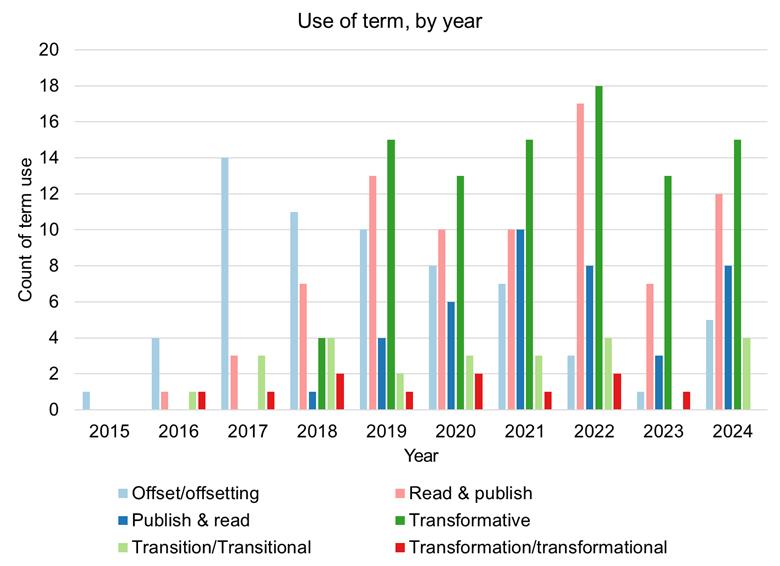
Figure 3
Use of terms to describe agreements, 2015 to 2024.
The
earliest included record is from 2015 and uses the terms “offset agreement” and
“offsetting scheme.” “Offset” was the term used in the earliest agreements
(e.g., Austrian consortium KEMÖ’s 2014 agreements with IOP Publishing and
Taylor & Francis (T&F)). “Offset” was also used in early documentation
from Jisc (2015), and Principles for Offset
Agreements was referenced in subsequent analyses of agreements in the UK.
The
terms “read & publish,” “transformation/transformational,” and
“transition/transitional” first appeared in 2016. “Transformative” appeared
later, in 2018. This is also the year that Plan S was released (cOAlition S, 2025b). From 2019 on, “transformative” is the
term most commonly appearing in records.
The
first mention of “publish & read” in our studies was also in 2018, in a
document providing recommendations from the Chair of the Universities UK Open
Access Coordination Group to follow the P&R negotiations taking place in Germany
at the time (Tickell, 2018).
“Transition/transitional”
appears consistently in records dating from 2016 to 2023 but is overall less
common than the other terms. “Transformation/transformational” are similarly
consistent but less common. “Transitional” appeared before “transformative” but
remained a less frequently appearing term.
Other
terms that appeared included “subscription agreements including an open access
component,” “pay-as-you-publish,” “open access conversion agreement” (a
translation from Chinese) (Earney, 2018; Olsson, 2018; Tian & Li, 2022).
Publisher
Studies
addressed any number of publishers, focusing on a single publisher and up to
more than 30 different publishers. There were also 48 studies that did not
specify any publishers. Springer was addressed in the largest number of items
(72). Some of the earliest TAs were “Springer Compact” agreements. There were
high numbers of studies that included analysis of Springer agreements for the
UK (17), Sweden (12), and Germany (10). Agreements between Springer and
national consortia in these three countries started in 2016 (Sweden/Bibsam), 2016 (UK/Jisc), 2020
(Germany/DEAL) and studies examining these agreements were published soon
after. Wiley was the next most common publisher. It was not until 2018 that
studies included analysis of agreements with Cambridge University Press,
Elsevier, Oxford University Press, and American Chemical Society.
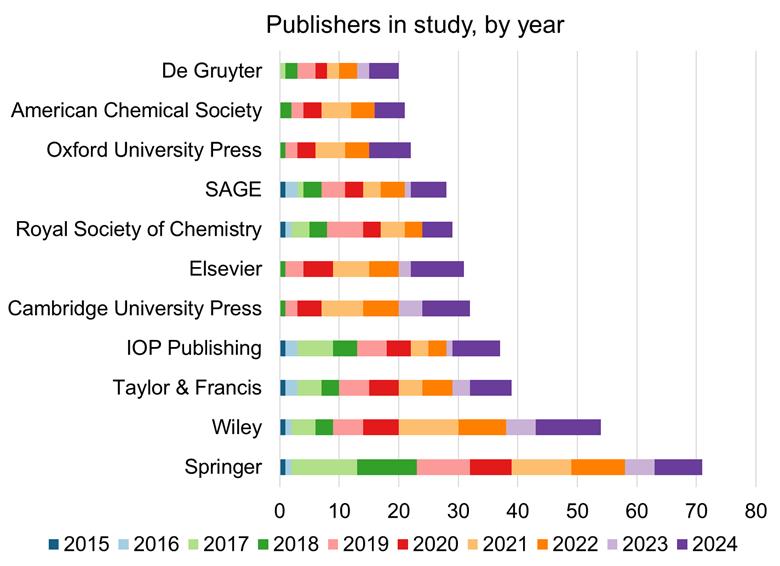
Figure 4
Publishers included in studies, by year, for
publishers included in more than 20 studies.
ESAC Registry
Organizations
that enter into TAs can register them in the ESAC Transformative Agreement
Registry (ESAC Initiative, n.d.). Entries are standardized to a degree, with
data fields such as size (number of articles expected or a limit for capped
agreements), licenses offered, “risk sharing,” and “financial shift.” The earliest entries in the ESAC Registry are for
agreements starting in 2014 (Austria KEMÖ with IOP Publishing and T&F)
(Hall & Kromp, 2017; Kromp
& Ćirković, 2016). A number of the included studies relied on information
in the registry. Sixteen studies reported analysis using data from the ESAC
Registry. Of these, 12 relied or reported on information available in the
registry itself (Asai, 2024; Bansode & Pujar, 2022; Brainard, 2021; Brayman
et al., 2024; Chen, 2023; Drake et al., 2023; Estelle et al., 2021; Frontiers,
2022; Gruenpeter et al., 2021; Kramer, 2024; Moskovkin et al., 2022; Tian & Li, 2022). Two analyzed
the full text of agreements that are linked from the Registry (Borrego et al.,
2020; Li & Lin, 2021). An additional two built quantitative datasets based
on agreements in the Registry (Bakker et al., 2024; Jahn, 2024). These
accounted for a total of 4 qualitative studies, 11 quantitative studies, and 1
case study.
Results of Individual Sources of Evidence
For
more detailed information, see summary tables:
·
Case
Studies Table in Appendix B
·
Qualitative
Summary Table in Appendix C
·
Quantitative
Studies Table in Appendix D
Synthesis of Results
Case Study Findings
Appendix
B contains definitions of the codes and a table with code assignments for each
study.
TA Effects on OA Output
A
number of case studies discussed the effects of TAs on OA publishing output. An
increase in OA publishing demonstrated with quantitative data was reported in
35 studies (Alencar & Barbosa, 2022; Anderson et al., 2022; Bauer, 2017;
Bergel et al., 2021; Dodd, 2024; Drey & Emery, 2022; Earney, 2018; Finnie,
2022; Geschuhn et al., 2021; Hall & Kromp, 2017; Hoogendoorn &
Redvers‐Mutton, 2024; Karlstrøm & Andenæs, 2021; Kendal, 2023; Kromp et al., 2019; Kronman,
2018; Lindelöw, 2019; Marques & Stone, 2020;
McLain & McKelvey, 2024; Moulton, 2022; Olsson et al., 2017; Olsson,
Francke, et al., 2020; Olsson, Lindelöw, et al.,
2020; Olsvik, 2022; Pinhasi
et al., 2020, 2021; Säll & Parmhed,
2020; Schalken, 2022; Steinrisser-Allex
& Grossmaier-Stieg, 2019; Taubert
et al., 2023a; UK Research and Innovation, 2020; Urbán et al., 2020; Vernon et
al., 2021; Walsh et al., 2024; Yuan & Slaght, 2022). An additional case
study by an author from Springer Nature reported on the expected output of the
TA with Projekt DEAL—more than 13,000 hybrid OA articles over the life of the
agreement (Inchcoombe et al., 2021).
Evaluation Criteria
Case
studies explored the criteria by which an institution or consortium evaluated a
TA (19 studies). Criteria included cost of the agreement, particularly in
relation to previous spending, past publication rates, publisher type, how
“transformative” an agreement is, caps on APCs covered, author eligibility
requirements, perpetual access, and cost per use. Three of these studies also
described at least one aspect of the negotiation process.
The
three case studies in Brayman et al. (2024) (University College London, University
of Lancaster, and Edge Hill University) and Earney (2018) addressed evaluating
TAs against Jisc criteria and evaluations conducted
by Jisc. One key criterion related to costs and
whether a TA would increase costs. Two case studies by librarians from University
of Nottingham also described relying on Jisc analyses
and criteria for evaluating TAs (Baldwin & Cavanagh, 2022, 2024). In
Huffman (2022), librarians from a small university reported relying on
evaluations from a larger consortium.
A
librarian from a large U.S. research institution reported relying on similar
criteria, specifically cost neutrality and the ability of the library budget to
cover the cost of the TA, as well as eligibility (of journals and for authors),
limitations on the number of articles that can be made OA (i.e., caps on the
agreement), publisher workflow and management of the workflow, among others
(Hosoi, 2021). Librarians from Sweden, the Canadian Research Knowledge Network
(CRKN), and a group of Canadian national research bodies used similar criteria,
particularly to evaluate costs (Kelley & Bursey, 2022; Lundén
& Wideberg, 2021; Olsvik, 2022).
Other
criteria reported included the license types available for authors, perpetual
access rights, and author eligibility requirements (Schimmer & Campbell,
2021). A smaller research institution in the US also reported using author
licensing options as well as criteria like publishing patterns versus publisher
caps (McLain & McKelvey, 2024).
In
one case study, the authors walk through their evaluation process and conclude
that the TA would be more expensive for all but 3 of the 42 institutions it
analyzed, based on a comparison of the publisher’s TA price to payment per APC
for each article published (Han et al., 2022).
In
addition to the studies that discussed individual institutions relying on consortial (Jisc) criteria and
analyses, University of Melbourne evaluated offers from their national
consortium based on their publishing history, publisher reputation, which
disciplines benefitted, and if Australian journals were covered (Kendal, 2023).
The University of Florida also relied on assessments of agreements from their
consortium and expected that TAs they entered should be easy for the author and
administrator, affordable, and contribute to movement toward full OA (Russell,
2022).
Another
study from a single institution provided examples of analysis of TAs from three
types of publishers: large commercial, university press, and non-profit
society. The library used metrics such as cost per use in addition to values,
concluding that even though the university press agreement had low publishing
from their authors, through the TA they would be contributing to the public
good (Dodd, 2024).
Gustafson-Sundell
et al. (2023) described how evaluating a TA inspired the librarians to consider
aspects relevant for all subscriptions, such as potential issues due to
geographic limitations from publishers that would result in some campuses being
excluded from a system-wide agreement, use rights, and data privacy.
A
few studies were from a consortial perspective. Grogg
et al. (2021) looked at an agreement involving three consortia and found that
one was paying a larger portion of the cost but publishing a smaller amount
than other members. Karlstrøm and Andenæs (2021) provided a list of the joint
Nordic principles for TAs and then described how they were implemented in
negotiations.
Negotiations
Multiple
studies that outlined evaluation criteria provided more detailed descriptions
of negotiations and others focused more directly on the negotiation process
(Karlstrøm & Andenæs, 2021; Kelley & Bursey, 2022; McLain &
McKelvey, 2024; Pinhasi et al., 2020). These included
narrative descriptions of an institution’s negotiation (Hosoi, 2021; Maurer et
al., 2019; McLain & McKelvey, 2024; Walsh et al., 2024) and a description
of the Swedish consortium, Bibsam, cancelling their
Elsevier subscription and how that led to successful TA negotiation (Wideberg & Söderbergh Widding, 2018). Pinhasi et al.
(2018) captured the sentiment of many of these case studies: negotiations are
difficult and “often take place in a politically charged environment, and
against the backdrop of the often ostensibly opposing goals of the publisher
and the University” (p. 9). Negotiations taking a year or more were not
uncommon (Inchcoombe et al., 2021; Karlstrøm & Andenæs, 2021; Lundén & Wideberg, 2021;
Maurer et al., 2019; Olsson, Lindelöw, et al., 2020).
As noted above, Karlstrøm and Andenæs (2021) provided their list of principles
for TAs and then described how they used them in negotiations. A few studies
identified negotiations with Elsevier as more challenging than other publishers
(Karlstrøm & Andenæs,
2021; Olsson, Lindelöw, et al., 2020; Wideberg & Söderbergh Widding, 2018). Both Karlstrøm
and Andenæs and Olsson, Lindelöw,
et al. (2020) found that involving higher level university administrators led
to more successful negotiations.
Studies
from the library perspective described the need for more data for negotiations,
such as publishing output (Kelley & Bursey, 2022; McLain & McKelvey,
2024; Pinhasi et al., 2018, 2019). Historical
publishing data and historical APC spending were common data points,
particularly if negotiating a capped agreement.
Implementation
We
assigned the code “implementation” to 16 case studies. A few studies provided
detailed descriptions of the implementation of a single, new agreement, such as
the pilot UK-Springer Compact (Marques & Stone, 2020), the T&F TA with
Ohio State University (Walsh et al., 2024), and Karger with the University of
Toronto (Yuan & Slaght, 2022). These often included some quantitative data
that the study authors described as necessary for improving the implementation
of future agreements. Yuan and Slaght (2022) noted that implementation became
easier over time. Differences in implementation across institutions in a
consortium was also a topic (Olsson et al., 2017). Kingsley (2017) outlined how
the TA between University of Cambridge and Wiley was implemented, and how
complicated it was to determine how to use the funds that Wiley returned at the
end of the year, based on APCs paid.
Of
the studies that addressed implementation related to authors, there were
differing reports of whether TAs affected author behavior. One reported authors wanting to change corresponding author after learning
of the agreement (Olsson et al., 2017). Bergel et al. (2021) explored
implementation from various perspectives and noted that authors were changing
their behavior to enable eligibility. Baquero-Arribas et al. (2019) also
discussed researcher perspectives—that researchers are in favor of TAs and
would like more publishers and journals to be covered. Similar interest in
authors for more TAs and broader coverage was described in Parmhed
and Säll (2023). In contrast, Kronman (2018) reported
on a survey that indicated that authors did not change their publication
patterns due to the agreement. This was an outstanding question for University
of Toronto in 2022; they intended to create a working group in the library to
consider how an agreement might change author behavior (Yuan & Slaght,
2022).
Multiple
studies mentioned communication challenges. Authors eligible for the Projekt
DEAL agreement with Wiley wanted more communication; some had opted out of OA
publishing because they were not aware of their options. Schalken
(2022) also noted communication challenges, as details about the agreement can
change over time; for example, publishers might change which journals are
included in the TA or a cap might be reached. Communications from publishers
and publisher workflows can also confuse authors, potentially resulting in
drastic differences in author uptake (Jones, 2015; Pinhasi
et al., 2018, 2021). From the publisher perspective, one society publisher
noted the importance of workflow in successful implementation of a TA. Their
implementation relied on automatic approval, but they also conducted manual
checks and offered authors the opportunity to make their article OA
retrospectively (Anderson et al., 2022).
A
few case studies examined other aspects of implementation. One described how
the library publicized TAs on their campus, explaining that they did not do
much promotion so that they could remain “neutral” (Goddard & Brundy,
2024). Walsh et al. (2024) and Parmhed and Säll (2023) also discussed communications on campus, noting
that they did not publicize their intention to cover APCs if the TA cap was
exceeded. Ottesen (2020) discussed how not all journals were covered by
agreements; Geschuhn et al. (2021) reported that the
number of journals increased during the agreement. One library believed that
participating in consortial TAs would increase the
amount of information that the library received about its publishing output
(Ottesen, 2020).
Labor
Another
common topic was the labor required to negotiate, implement, and administer
agreements. Studies addressed the need or perceived need for increased labor,
or more intensive labor, for the institution(s) to enter into TAs, such as the
increase in labor for negotiating TAs (Alkhaja, 2022;
Baldwin & Cavanagh, 2022; Baquero-Arribas et al., 2019; Buck, 2018; Fessler
& Hölbling, 2019; Hall & Kromp,
2017; Jisc, 2022; Jones, 2015; Karlstrøm &
Andenæs, 2021; Kronman et al., 2017; Langrell & Stephenson, 2022; Mongale
& Taylor, 2022; Moulton, 2022; Olsson et al., 2017; Parmhed
& Säll, 2023; Pinhasi
et al., 2018, 2019; Säll & Parmhed,
2020; UK Research and Innovation, 2020; Yuan & Slaght, 2022). Studies
discussed issues such as the need to identify publishers to approach (Goddard
& Brundy, 2024) and to design the actual model (Pinhasi
et al., 2019).
Others
described changes in staff roles due to the implementation of TAs, such as
staff time required to manage the implementation of agreements (Baldwin &
Cavanagh, 2024; Brayman et al., 2024; Craig & Webb, 2017; Goddard &
Brundy, 2024; McLain & McKelvey, 2024; Muñoz-Vélez et al., 2024). For
example, Goddard and Brundy (2024) described the need for staff to ensure that
articles covered through TAs are made OA. Baldwin and Cavanagh (2024) described
the shift from working with funded researchers to pay individual APCs to
managing the implementation of TAs. Publishers also
described increases in labor required to manage TAs (Moulton, 2022), with
smaller publishers particularly concerned about their ability to meet these new
labor requirements (UK Research and Innovation, 2020).
As
in Baldwin and Cavanagh (2024) and Lovén (2019), some
studies described reductions in the amount of labor by staff to manage TAs,
usually compared to managing individual APC payments. TAs reduced the amount of
time needed to monitor OA publishing (Olsson, Francke, et al., 2020). Studies
specifically called out the labor reductions for uncapped TAs, which require
neither the publisher (Anderson et al., 2022) nor institutions (Kronman, 2018)
to monitor usage. The Royal Society case study in Anderson et al. (2022) also
identified R&P agreements as requiring less labor than other OA models
(i.e., subscribe-to-open).
Another
case study describing the pilot UK Springer Compact identified labor reductions
due to automatic deposit into their consortial
repository by the publisher (Marques & Stone, 2020).
Cost Sharing
Fourteen
case studies described how TA costs or benefits were distributed across
institutions in a consortium. These studies noted uneven publishing rates
across members of a consortium, including some institutions not publishing any
articles through a TA (Grogg et al., 2021; Kromp et
al., 2022; Kronman, 2018; Levine-Clark et al., 2022). Kronman (2018) reported
that 9 of 40 institutions participating in the Bibsam
agreement with Springer did not publish at all. This particular agreement was
deemed “oversized” due to low publishing compared to anticipated rates
(Kronman, 2018; Olsson, Francke, et al., 2020) and required the National
Library of Sweden and Swedish Research Council to subsidize the entire
agreement (Lovén, 2019). Pinhasi
et al. (2021) also discussed using funding outside of library budgets,
providing an overview of Austria's AT2OA project.
Some
created tiered models to distribute costs across high- to low-publishing
institutions (Kronman et al., 2017; Muñoz-Vélez et al., 2024; Schimmer &
Campbell, 2021; Vernon et al., 2021). Studies discussed capped agreements and
the challenges in distributing APC “credits,” as well as costs across
institutions (Earney, 2017; Schimmer & Campbell, 2021), with Schimmer and
Campbell (2021) noting that high publishing institutions would not be able to
pay for all of their articles with their own budget. This was also the case
with the Springer Compact in Sweden (Bergel et al., 2021; Olsson, Francke, et
al., 2020).
Cost Savings/Avoidance
Seven
of the 80 case studies directly addressed cost savings or cost avoidance
achieved or expected through TAs: two described cost increases. Some provided
cost calculations for specific agreements. Of these, three presented this in
terms of cost savings or cost reductions (Marquez Rangel et al., 2023; Olsson, Lindelöw, et al., 2020; Walsh et al., 2024). An update on
the Bibsam agreement with Springer in Kronman et al.
(2017) found that the agreement was more costly than it would have been for
them to keep a subscription, and Yuan and Slaght (2022) calculated that
participating in a TA would have been more expensive than paying an APC for
each publication for all but 3 of 42 institutions (subscription costs would
have been eliminated in the model they were analyzing).
Levine-Clark
et al. (2022) used the term “cost avoidance,” finding that the cost avoidance
reported by publishers was lower than the consortium estimated, but the issue
of how to determine “savings” was implied in other studies. Studies compared
the cost of a TA to the cost of a subscription plus past APC spending (Olsson, Lindelöw, et al., 2020) and quantified savings in terms of
list price APCs not paid individually (Walsh et al., 2024). The question of
what “cost neutral” means was raised explicitly in Pinhasi
et al. (2020) and Pinhasi et al. (2021) and discussed
indirectly in Baquero-Arribas et al. (2019), which considers a number of
different cost comparisons (e.g., cost if an APC were paid for each article,
cost of past APC spending plus subscription to the price of a TA).
(Lack of) Transformation of the Publishing System
Several
studies discussed a lack of transformation from hybrid to full OA—either of
journals covered by the agreement or the journal publishing system overall—and
the potential for TAs to become simply formalized double-dipping (i.e., when
publishers take payment twice—for OA fees and subscription charges for the same
content). Concerns about double-dipping reach back to the first study in our
set, from 2015 (Jones, 2015). The aim of full transformation of the publisher
as a part of criteria for evaluating TAs was mentioned in several of the
studies involving Jisc criteria (Baldwin &
Cavanagh, 2024; Brayman et al., 2024; Earney, 2018; Jones, 2015). Jones (2015)
in particular identified double-dipping as a concern, after seeing that
subscription prices had been lowered for some journals included in Wiley,
T&F, and Sage TAs, but noting that it was a small percentage of included
titles and a small reduction. In 2019, librarians from the University of Vienna
noted concerns that publishers might be “increasing their income by accepting
more OA articles without reducing the share of pay walled content” (Pinhasi et al., 2019, slide 22), and librarians from
Medical University Graz in Steinrisser-Allex and Grossmaier-Stieg (2019) concluded that although TAs are
good for increasing OA rates, hybrid models are expensive and the transition to
OA is slow. Librarians from Uppsala University questioned whether the focus of
TAs on hybrid journals over fully OA journals indicated a reliance by
publishers on income from double-dipping (Bergel et al., 2021). Authors from
Sweden questioned how library budgets could manage sustained increases without
the reduction in subscription prices that was anticipated due to the transformation
of the system (Ottesen, 2020).
Other (Case Studies)
Studies
reported on the support that consortia provided for their members. Most
discussed this in terms of evaluation support (Baldwin & Cavanagh, 2022;
Brayman et al., 2024; Fessler & Hölbling, 2019;
Russell, 2022). Fessler and Hölbling (2019) and
Muñoz-Vélez et al. (2024) discussed the work of
consortia in managing TAs. Urbán et al. (2020) was
written by a consortium and proposed that TAs might make joining the consortium
more attractive for institutions. From the publisher perspective, Hoogendoorn
and Redvers‐Mutton (2024) expressed belief that TAs are more effective in
regions with consortia.
Nine
case studies raised the question of what license would apply for articles
published through TAs. In some cases, they simply
reported that there was an increase in output with a specific Creative Commons
(CC) license applied (Marques & Stone, 2020; Ottesen, 2020; Vernon et al.,
2021) or that a CC license was available (Langrell & Stephenson, 2022;
Olsson, Lindelöw, et al., 2020; Urbán et al., 2020). Lundén and Wideberg (2021)
described specific CC licenses as a negotiation objective, and Schalken (2022) tied CC license discussions to Plan S
requirements.
Although
TAs generally combine subscription, or “reading,” access and costs with
publishing access and costs, few of the case studies included any discussion of
the value of reading access. Five studies ascribed an increase in reading usage
to an overall increase in the number of journals included under the agreement
(Dodd, 2024; Drey & Emery, 2022; Levine-Clark et al., 2022; Steinrisser-Allex & Grossmaier-Stieg,
2019; Geschuhn et al., 2021).
Two
studies described a cap being exceeded and potentially having to pay for
additional articles to be published OA. Vernon et al. (2021) and Kelley and
Bursey (2022) expressed concerns about the potential for exceeding a cap as
well as cost sharing across TA participants. The remaining items included
status updates on a number of agreements (Bansode & Pujar, 2022; Langrell
& Stephenson, 2022), a brief description of the decision not to enter into
TAs (Buck, 2018), and a study looking into whether the share of OA via subject
repositories was affected by TAs that found that there was no evidence to
support this hypothesis (Taubert et al., 2023b).
Qualitative Study Findings
Appendix
C contains the code definitions and a table with code assignments for each
study. Of the 31 qualitative studies, the following research designs were used:
survey (n=19), interview (n=4), content analysis (n=4), focus group (n=3), and
multi-methods (n=1).
Content Analysis
Four
qualitative studies conducted a content analysis on existing TAs in the ESAC
Registry. They investigated aspects such as the OA model (e.g., R&P,
offsetting), caps or other limits, license stipulations, read access coverage,
specified licenses (e.g., CC-BY), and opt-in and opt-out provisions. Three
considered information from the registry entries (Gruenpeter
et al., 2021; Li & Lin, 2021; Tian & Li, 2022). Borrego et al. (2020)
analyzed 36 agreements linked from the registry and classified them within
three categories: how agreements grant OA (e.g., unlimited/no caps, discounts),
how the cost is balanced between read-and-publish fees, and OA mode (hybrid or
hybrid and gold). Although there are similarities and differences across
agreements, overall, there is no standard transformation model. The analyzed
content was primarily from European agreements.
Perceptions of Publishers
Qualitative
studies discussed publisher perspectives on TAs, such as the challenges for
smaller publishers to engage in TA models. Reasons included lack of staffing
and mechanisms for supporting new workflows (Estelle et al., 2021; Wise &
Estelle, 2019b). Smaller publishers expressed the difficulty with negotiating
TAs with individual libraries and consortia (Estelle et al., 2021; Wise &
Estelle, 2020). Many publishers, especially smaller publishers, had concerns
about the potential need for cost cutting and re-evaluating existing revenue
streams (Estelle et al., 2021; Van Barneveld-Biesma
et al., 2020; Wise & Estelle, 2019b, 2020). Other smaller publishers were
concerned about price setting of TA models and how TAs have the potential to
shift “one captive budget (subscriptions) into another (OA) during the
transition, which may keep problematic profit margins and price increases baked
into these deals” (Higton et al., 2020; Wise & Estelle, 2019a, p. 112).
Smaller
publishers had less interest in pursuing TAs compared to larger publishers.
Large publishers’ perceptions varied, per Estelle et al. (2021). Overall, large
publishers, especially those already participating in Tas, had more positive
perceptions about competition compared to small publishers (Van Barneveld-Biesma et al., 2020). Studies reported that large
publishers had concerns about revenue streams despite being “best positioned in
such a system, although their profit and income is expected to decrease – an
expectation expressed by all publishers” (Van Barneveld-Biesma
et al., 2020, pp. 51–52).
Experiences of Publishers
Qualitative
studies captured information about publishers’ experiences with TAs. In a survey conducted in 2015, 73% of publishers did
not provide offset arrangements; 70% of those were unsure if they would in the
next 1 to 3 years (Smith et al., 2016). Another 15% said they would not be
offering TAs, and 15% said that they would. Another study published the
following year reported higher levels of experience—45% of their respondents
had experience with a TA (Estelle et al., 2021). Smaller publishers had less
experience, in part due to a lack of interest or an inability to manage TA, but
some were interested. Workflows were a common topic in the qualitative studies,
and Geschuhn and Stone (2017) focused on
library/consortia’s needs for publishers to improve their systems.
Ideas
related to transparency were raised in a few studies. Wise and Estelle (2019b)
discussed price setting and the differences between publisher and library
expectations and desires for transparency. Estelle et al. (2021) also discussed
price transparency, with smaller publishers wanting more transparency around
TAs negotiated by their larger publisher partners. Brayman et al. (2024)
reported on a survey of 21 publishers conducted to understand how transparent
they were about their future plans. Of those, 12 had a clear plan for
transitioning to full OA and 5 made their plan publicly available. Seven of 12
had set a target but 5 said that there was limited interest in OA and TAs
globally, preventing them from creating a clear plan. The authors noted that
survey respondents “were keen to stress that this does not reflect a lack of
commitment to OA” (Brayman et al., 2024, p. 84).
Perceptions of Learned Societies
Similarly
to publisher perceptions, societies’ perceptions of TAs included concerns about
negotiations with library consortia and costs (Estelle et al., 2021; Wise &
Estelle, 2019a, 2020). For societies working with larger publishing partners,
there was a desire for greater transparency of OA agreements in terms of total
revenue and how it is allocated to journal titles (Estelle et al., 2021).
One
study showed 60% of societies would consider transformative OA models (Wise
& Estelle, 2020). One society (FWF) expressed interest in pursuing TAs
because some authors did not have funding to pay for APCs (Wise & Estelle,
2020). Some societies stated that they are not observing TAs in their
discipline (e.g., history) and are skeptical about TAs working for their
purposes without institutional support and grant funding (Finn, 2019).
Other
societies expressed concerns about outside factors influencing their uptake of TAs. Some examples included Brexit (Finn, 2019), compliance
with Plan S (Wise & Estelle, 2019a), funders not paying for APCs (Wise
& Estelle, 2019b), and conditions on the use of funder money (Higton et al.,
2020). Learned societies with in-house publishing arms (82%) and learned
societies that outsourced publishing (83%) had the opinion that UK Research and
Innovation (UKRI, a U.K. government funding body) OA funds should support OA
for hybrid journals (Higton et al., 2020).
Perceptions of Libraries, Consortia, and Institutions
Qualitative
studies reported that librarians and representatives of higher education
institutions were, overall, less favorable toward TAs than other groups
(Government of Canada, 2023; Higton et al., 2020; Monaghan et al., 2020). As
noted by individuals interviewed in Monaghan et al. (2020), some “librarians
have their guard up and are suspicious” about TAs (p. 33) and “guess many other
librarians are worried about the financial consequences and probably would like
to see a few examples of how this will work out” (p. 29).
Studies
expressed concern that TAs maintain negative aspects of the current publishing
system, particularly the potential to leave out smaller publishers, whether
because they may not be able to develop needed workflows or because increasing
proportions of library budgets will be consumed by TAs with the largest
commercial publishers (Brayman et al., 2024; Van Barneveld-Biesma
et al., 2020). Other concerns included that agreements
are generally unaffordable and also are not available for researchers in all
disciplines (Estelle et al., 2021; Van Barneveld-Biesma
et al., 2020).
It
should be noted that libraries did express a desire for and an expectation of
reallocation of funding from subscriptions toward OA publishing agreements and
reported feeling that participating in consortial OA
agreements was important for their institution (Maron et al., 2021; Pampel,
2021).
One
qualitative study explored library consortia perceptions of TAs (Morais et al.,
2019). They reported perceived benefits of TAs such as controlled or possibly
reduced costs, supporting the transition to OA, improving administrative
procedures, improving negotiations, reducing or preventing double-dipping, and
benefits for researchers. Identified drawbacks included the potential for more
expensive agreements and more complex negotiations, maintaining the status quo
of dominance by a few large publishers, entrenching the hybrid model and its
associated double-dipping, and hindering the development of different OA
publishing models.
Experiences of Libraries, Consortia, and Institutions
Similar
to studies of publishers, earlier studies of libraries reported lower uptake of
TAs. In Pampel’s (2021) survey, conducted in 2018,
roughly 80% of responses were from central facilities (including libraries) and
approximately 13% had agreements with publishers that they categorized as
offsetting agreements. Monoghan et al. (2020) reported 10 of 16 institutions
had a TA.
A
common positive aspect of TAs for librarians was improvements in workflows over
managing individual APCs, but some noted that there was still room for
improvement (Brayman et al., 2024; Geschuhn &
Stone, 2017; Monaghan et al., 2020; Šimukovič, 2023).
A reduction in burden of managing OA payments to publishers was a common
positive theme among librarians (Brayman et al., 2024; Monaghan et al., 2020).
This is achieved through publisher workflows; however, these do not eliminate
staff resources required to manage the agreements. and studies reported that
there is still much room for improvement in these workflows. A particular
challenge facing libraries is managing the differences between publisher
workflows and interfaces (Brayman et al., 2024; Geschuhn
& Stone, 2017; Monaghan et al., 2020). As noted in Monaghan et al. (2020),
“each publisher’s deal has different features and conditions, which complicates
workflow procedures. Not only is the content of the
publishers’ deals different, but also the workflows between the publishers on
the one hand and the libraries on the other” (Monaghan et al., 2020, p. 28).
Librarians have pointed to workflows being a challenge for authors as well,
with an interviewee in Šimukovič (2023) suggesting that
low uptake of an agreement was due to the publisher’s workflow.
Libraries
also reported experiencing budgetary challenges with TAs, particularly for
institutions that are high publishing or had small subscription budgets with
proportionally high publishing (Brayman et al., 2024; Higton et al., 2020;
Monaghan et al., 2020). For example, one survey participant in Higton et al.
(2020) identified an increase of 9.45% in costs of a R&P agreement over the
previous year and a potential 20% increase for another TA in the next year.
Respondents to Marques’s (2017a) survey also reported concerns about the high
costs of TAs, including what the effects would be on pricing of future
agreements and long-term sustainability.
Perceptions of Researchers
Findings
from studies reporting on researcher perspectives of TAs varied. In Government
of Canada (2023), researchers were less favorable toward TAs as a route to OA
publishing than publishers were. However, van Barneveld-Biesma
et al. (2020) found that authors appreciated R&P and P&R agreements
because they expected their OA publishing costs to decrease, and Olsson (2018)
found that researchers who had published through a TA had overall positive
feelings toward the agreements. Although most researchers had overall positive
feelings, some had concerns about costs and wanted non-commercial options
(Olsson, 2018). That there exists variation in the perceptions of TAs across
researchers was one of the findings of Schuchardt (2023).
Disciplinary
differences in perceptions were reported, with Higton et al. (2020) finding
that some arts and humanities and social sciences researchers were concerned
that TAs were too focused on science, technology, engineering, and mathematics
subjects.
Experiences of Researchers
A
common theme in the qualitative studies was researchers reporting that their
publishing choices were not influenced by the availability of a TA (Olsson,
2018; Schuchardt, 2023; Šimukovič,
2023; van der Graaf et al., 2017). In fact, as was also noted by librarians, authors
were often unaware of the TAs at their institution (Johnson et al., 2017;
Olsson, 2018; Schuchardt, 2023).
There
were five qualitative studies looking at researcher usage of TAs. Those studies analyzed different aspects such as
motivations for publishing via a TA, usage totals, and TAs as a share of a
variety of funding options. As Olsson (2018) reported, only 17% of authors
listed the TA as a reason for choosing to publish in a journal. Some indicated
that they wanted to benefit from visibility and impact but did not have funding
to pay APCs on their own, while 39% of respondents indicated that they would
have or maybe would have paid an APC had there not been an agreement in place
(Olsson, 2018). Some authors found the TAs to be a pleasant surprise where they
did not need to pay APCs (van der Graaf et al., 2017).
Two
studies noted low usage of TAs. There was low usage
of the VSNU-Elsevier agreement in the first year where one of three researchers
used the agreement, but this increased by providing retroactive OA and by
publisher improvements to workflow issues noted by library staff (Šimukovič, 2023). Johnson et al. (2017) found that about
10% of survey respondents (n=310) had used vouchers or offsetting agreements
but that authors used personal or grant funds to pay for OA fees more often
than they used vouchers or offsetting agreements. Authors indicated that they
used a variety of funding mechanisms to pay for OA fees such as grant funding,
institutional funds, personal funds, and TAs wherein there was no dominant
source of funding to cover the costs of publishing OA, and some considered TAs
as a way to consolidate the multiple funding sources (Monaghan et al., 2020).
Other (Qualitative)
Three
studies surveyed Europe-based populations and reported findings that did not
fit with any other codes. A 2016 study surveyed a group of Science Europe member
organizations and found that they were beginning to consider TAs, with the hope
that they alter the status quo of OA publishing (Kita et al., 2016). A 2018
study of National Rectors’ Conference members on their “big deals” found that
around 11% included APCs in their big deals and 4% had an “offsetting
provision” of some type (Morais et al., 2018). Respondents were considering
these options for the future, and some were already in discussions with
publishers. In Fosci et al. (2019), a group of
European funders was surveyed about their intentions to support various OA
publishing models. Two-thirds reported that they were not working on TAs,
others were negotiating through consortia or directly with publishers, nine
were collecting data on publishing models, and eight were developing
negotiation guidelines. The study reported findings by grouping respondents
based on their level of support, or lack of support, for Plan S. Respondents
that were aligned with or more favorable toward Plan S were more likely to be
engaging with TAs in some way, whereas the funders that did not support Plan S
were not engaging.
Finally,
in addition to the findings described above, Šimukovič
(2023) provided a narrative history of the negotiations between Elsevier and
the Dutch consortium VSNU for a TA. Through interviews, librarians on the
negotiating team discussed the importance of having university
administration-level representation on the negotiating team.
Quantitative Study Findings
Appendix
D contains the code definitions and a table with code assignments for each
study.
Cost of TAs
Twelve
quantitative studies looked at the cost of TAs, either broadly or for specific
aspects including country, publisher, publishing fee, reading fee, and
administrative costs. At the broad end of the spectrum, Bosch et al. (2023)
used EBSCO data to determine that R&P price increases were lower (2.83%)
than non-R&P deals. The study deduced that this might be due to the
publishing industry aggressively incentivizing a shift to the R&P model.
The
four reports (2016-2019) about Jisc’s TAs each
discussed the potential administrative cost savings of TAs (Lawson, 2016, 2017,
2018, 2019). Using an estimate of £88 per article, Lawson calculated
hypothetical administrative costs of processing each OA article published
through the agreement as an individual APC. For four agreements, there would
have been administrative costs of £50,952 in 2015 (Lawson, 2016), increasing to
£327,536 in 2017, based on data from 34 and 53 institutions, respectively (Lawson,
2019). However, he notes that this value ignores the costs associated with
setting up and implementing the agreements or the administrative costs of
communicating with researchers about the agreements.
It
was challenging to synthesize studies analyzing cost of TAs by publisher for
studies including data for more than one publisher. The agreement stipulation
and years being analyzed varied and it was difficult to disentangle what the
study authors’ claim to be cost, cost avoidance, and calculated “value” of TAs. The four Jisc reports showed
an increase in the number of TAs from five (Wiley, T&F, SAGE, IOP, RSC) in
2015 to six (Wiley, T&F, Springer, SAGE, IOP, RSC) in 2016 (Lawson, 2016,
2017, 2018, 2019). The report of the 2017 data addressed six publishers (Wiley,
T&F, Springer, Sage, IOP, De Gruyter) and the summary published in 2019
covered TAs with all seven publishers (Wiley, T&F, Springer, Sage, IOP, De
Gruyter, RSC) (Lawson, 2018, 2019). The reports provided the total spend on the
agreement (subscriptions + APCs); for example, £1,712,935 for IOP compared to
£7,582,157 for Springer (Lawson, 2018). Brayman et al. (2024) looked at many
publishers’ TAs from Jisc institutions and found that
the “[t]otal 2022 expenditure via Jisc
on TAs was £137m” (p. 12). The report compares TA costs for 37 publishers to
expected costs if the TA had not been in place and APCs for a portion of
articles were paid.
For
studies analyzing TA costs by country, Nazarovets and
Skalaban (2019) estimated hypothetical OA publishing
costs if all articles from Belarus and Ukraine were published OA, as a basis
for considering TAs. Chen (2023) looked at publishing
output and Cambridge University Press TAs in the UK, US, Canada, Australia,
Germany, France, Japan, and Singapore to compare against publishing rates and
TA offered to Chinese institutions. It was more common for TA costs to be
discussed in studies by one country about one country.
Several
quantitative studies reported on prospective costs of TAs by analyzing
publishing patterns and APC costs. For example, Tickell (2018) modeled a
spending decrease in 2019 to £250 million with an increase to £336 million
anticipated in 2028. Brayman et al. (2024) modelled TA costs for 2020 through
2024 and compared them to hypothetical spending without TAs.
The models showed an increase in TA costs from £35 million in 2020 to £103
million in 2024 and a cost avoidance of £5.98 million in 2020 to £49 million in
2024. Nazarovets and Skalaban
(2019) indicated that this approach was a means for information gathering
pre-negotiations.
Additionally,
Olsson (2018) and Kramer (2024) discussed the conceptualization of “read” costs
versus “publish” costs. In Olsson (2018), Bibsam
costs were based on a per publication charge of €2200 plus a reading fee for
the Springer Compact resulting in the average reading cost per year during the
agreement of €525,309 compared to a subscription price of €2,267,728 in the
year before the agreement (i.e., for reading). The average publish fee was
€3,662,560 per year (for up to 4,126 articles). Kramer (2024) analyzed European
countries in the ESAC Registry and found that a small number of agreements
included read versus publishing costs.
Cost Savings/Avoidance
Eight
quantitative studies discussed cost avoidance or cost savings through TAs. Lawson (2017) explained the difference: “savings” are
“the amounts that institutions might have paid in the absence of offset
agreements,” but because authors may not have chosen to publish OA, and thus
pay an APC, if the agreement hadn’t been in place, it is “probably more
accurate to regard the value of the deals as cost avoidance rather than
savings”(p. 12).
In
the series of annual reports of Jisc offsetting
agreements, Lawson (2016, 2018) reported increasing cost avoidance between 2015
and 2017, from £2.5 million through via TAs to £9 million in 2017 through 6 TAs. Kromp and Ćirković (2016) noted cost “savings” through Austria’s
offsetting agreements with IOP (increasing from 7% to 21% between 2015 and
2016) and T&F (up from 5% in 2015 to 11% in 2016) and a TA with Springer
(€1.2 million in 2016).
Marques
outlined costs avoided via the Jisc Springer compact,
finding that 86% of 91 participating institutions had some level of cost
avoidance when comparing the number of OA articles published via the agreement
to the number of APCs paid in the year before the agreement started (Marques,
2016, 2017b).
Brayman
et al. (2024) an intensive study of all of Jisc’s TAs
and estimated that cost avoidance increased from £6 million in 2020 to £42
million in 2022 and estimated avoidance of £49.1 million for 2024. However,
they noted that this was across the consortium and varied for individual
institutions.
Number of Articles
Twelve
quantitative studies reported the number of articles published via the TA by
discipline. We mapped the disciplines to the six Fields of R&D
classification defined in the Organisation for Economic Co-operation and
Development (OECD)’s Frascati Manual (OECD, 2015). The manual defines
six classifications: natural sciences, engineering and technology, medical and
health sciences, agricultural and veterinary sciences, social sciences, and
humanities and the arts. Overall, it was not surprising that many studies
reported on natural sciences (10 of 12) and medical and health sciences (10)
because, as a whole, studies have suggested that these disciplines are more
likely to be covered by a TA. There were also many studies looking at
disciplines in the social sciences (10) and engineering and technology (9)
categories. Interestingly, humanities were reported in 8 of 12 studies. We
found fewer studies related to disciplines in the agricultural sciences
category. This could be because not all institutions have agricultural sciences
programs or because researchers were including these disciplines under other
categories in their analyses.
There
were increases in the number and/or proportion of OA articles following the
start of a TA reported in all studies, although the size of the increase varied
by discipline. Which disciplines benefited most, in terms of hybrid OA output,
varied across studies. Some reported that the largest number of articles were
published in medicine and biomedical life sciences (Kromp
& Ćirković, 2016). Kromp
and Ćirković (2016) also noted large numbers of
articles in natural sciences and engineering and technology disciplines, while
Marques (2017b) reported the highest OA output in medicine and public health,
followed by life sciences, biomedicine, and philosophy. Marques (2016) also
found high amounts of OA output in medicine, biomedical and life sciences, as
well as education, earth and environmental science, chemistry and materials
science, engineering, and mathematics and statistics. Jahn et al. (2021) found
that articles were predominately invoiced to agreements for energy and chemical
engineering. Wenaas (2022) found the lowest levels of OA in humanities and
social sciences.
Some
studies reported changes in the proportion of OA pre-agreement and during a TA.
Bakker et al. (2024) found that the largest changes when a TA started were in
proportion for social science followed by natural science, while Jahn (2024)
found that hybrid OA increased in physical science journals, largely increased
in humanities and social sciences, and “played a comparably lesser role” (p.
20) in life sciences and health sciences compared to humanities and social
sciences. Calder et al. (2018) observed large increases in OA in mathematics
and humanities and a smaller increase in life and health sciences. These
findings might be due to the overall higher proportion of OA articles in the
areas of life and health sciences before an agreement.
DEAL
(formerly Projekt DEAL, now the DEAL Consortium, a national body in Germany
that negotiates with publishers) agreements with Wiley and Springer Nature
appeared to affect author choice in some disciplinary categories but not all (Haucap et al., 2021; Schmal, 2024a); researchers also found
that DEAL agreements affected journal choices among economists, to different
levels in a male/female gender binary (Schmal et al., 2023).
Studies
primarily reported on the number of hybrid OA articles published through agreements,
but some also reported on publications in other modes of OA. Correlations
between the start of a TA and an increase in hybrid OA with a decrease in green
OA were found in Wenaas (2022) and Bakker et al. (2024). This, in part, may
have been due to articles being assigned only one OA mode. Brayman et al.
(2024) reported that for most of the TA publishers, articles that were OA
through the agreement were also available in repositories.
A
number of studies included publisher-level article data for multiple publishers
(Table 1). The most commonly represented publishers were Wiley, Springer,
Elsevier, and T&F. IOP and RSC, two publishers that had early TA programs,
were also represented. Brayman et al. (2024) is a comprehensive study of 10
years of Jisc TAs and included article publication
data for 37 publishers.
Table 1
Studies Comparing Publication Data Across Multiple
Publishers
|
Publisher |
Studies |
|
Wiley |
Brayman
et al., 2024; Frontiers, 2022; Jahn, 2024; Lawson, 2016, 2017, 2018, 2019; Mittermaier,
2021; Schmal, 2024a |
|
Springer/
Springer Nature |
Brayman
et al., 2024; Frontiers, 2022; Jahn, 2024; Kromp
& Ćirković, 2016; Lawson, 2017, 2018, 2019;
Mittermaier, 2021; Schmal, 2024a |
|
SAGE |
Brayman
et al., 2024; Lawson, 2016, 2017, 2018, 2019 |
|
Elsevier |
Brayman
et al., 2024; Frontiers, 2022; Jahn, 2024; Lawson, 2017; Mittermaier, 2021 |
|
RSC |
Brayman
et al., 2024; Lawson, 2016, 2017, 2019 |
|
IOP |
Brayman
et al., 2024; Kromp & Ćirković,
2016; Lawson, 2016, 2019 |
|
T&F |
Frontiers,
2022; Lawson, 2016, 2018, 2019; Mittermaier, 2021 |
Studies
also explored the number of articles published across a time period. This was
by month of agreement in Kromp and Ćirković (2016), Oefelein (2021), Marques (2017b), and
Marques (2016) and by year in Wenaas (2022), Brayman et al. (2024), Jahn
(2024), Lawson (2019), Olsson (2018), Broschinski
(2019), Calder et al. (2018), and Mittermaier (2021). These were for a single
publisher or multiple publishers, except for (2024), which presented data by
country and by discipline. There were generally few conclusions beyond an
increase in the number of hybrid articles published over time.
Some
studies reported on the number of articles published by institutions
participating in consortial agreements. Data were
presented for all 47 Swedish institutions participating in the Springer
agreement with Bibsam, 9 of which published more than
50 articles in 2020 (Oefelein, 2021). For a Jisc
agreement with Springer, with 90 participating institutions, Marques (2017b)
provided data for the 18 highest publishing institutions, publishing between
roughly 60 to 218 publications in 2016. Other articles relied on data from a
subset of institutions but did not present data individually (Lawson, 2016,
2017, 2018, 2019). Another study reported on the number of articles covered by
agreements from several countries with a single publisher (Chen, 2023).
Quantitative
studies looked at larger groupings as well, by country or by geographic region.
Bakker et al. (2024) reported on the total number of articles published through
TAs by continent, while Kramer (2024) and Jahn (2024) grouped results by region
(European regions, BRICS and OECD countries). Jahn (2024) looked at many
countries, while others looked at subsets of countries or reported on a mix of
country and region-level data (Jahn et al., 2021; Mittermaier, 2021; Schmal,
2024a). These generally found more TAs and more articles published OA through
TAs from European countries, particularly the UK, Germany, Sweden, and the
Netherlands.
Not
all researchers chose to use a TA even when eligible. Brayman et al. (2024)
found that approximately 14,000 articles were eligible for a TA but were not
published OA, perhaps due to opt-outs or caps on agreements. They found that
overall opt-outs decreased by 200% for Springer Nature from 2019 to 2022 and by
about 300% for Wiley from 2020 to 2022. The decrease in opt-outs may have been
due to improved workflows and increased author awareness. Marques (2017b)
analyzed OA articles and found that 19.6% of the total were truly authors
opting out. Jahn et al. (2021) looked at Elsevier article sponsor metadata to
try to distinguish if OA was funded by TAs or other means and found that for
2015 to 2019 invoicing through TAs slightly increased from 31.6% to 32.4%.
Alternatively, Jahn et al. found that most APCs (n = 41,725; 58.2%) were
invoiced to the author during the time period of 2015 to 2019. Calder et al.
(2018) found that while some U.K. corresponding authors were opting out of the
Springer Compact, 75% and 84% published via the Compact in 2016 and 2017
respectively.
Other
quantitative studies took unique approaches. Two projected future OA output due
to new TAs (Broschinski, 2019; Estelle et al., 2021).
Pieper and Broschinski (2018) and Jahn (2024) looked
at the number of articles published via TAs by journal. One article explored
the effects of TAs on publication choices based on author gender for German
authors in the field of economics. Papers with a majority of female authors
were more likely to take up the DEAL agreements, particularly for journals from
the highest SJR quartile. Groups of male authors tended to publish in journals
covered by the DEAL agreements, but single authors did not (Schmal et al.,
2023).
Number of TAs
Much
of the research studying the number of TAs is based on data from the ESAC
Registry. As Drake et al. (2023) noted, “data on transformative agreements is
murky with of [sic] 836 on the ESAC registry but up to 2,146 according to
annual publisher reports” (p. 8).
Of
the studies looking at the number of TAs in the ESAC Registry over time,
Brainard (2021) reported that the number of agreements had grown to 137 in
2020; Brayman et al. (2024) calculated a 21,200% increase in the number of TAs
in the registry between 2014 and 2022, and Kramer (2024) noted the growth in
TAs from 2014 to 2023, when there were 337 TAs that were active. Moskovkin et al. (2022) reported on the number of
publishers with TAs, which increased from 32 in September 2020 to 50 in October
2021. Tickell (2018) studied only agreements in the UK and reported an increase
of 178 institutions participating in 2 Jisc TAs in
2013 to 759 institutions participating in 8 agreements as of 2017. On a smaller
scale, one society publisher reported increasing their number of TAs from 50 institutions
in 2020 to over 200 in 2021 (Doddy, 2021).
In
addition to finding an increase in the number of publishers with at least one
TA over time, Moskovkin et al. (2022) found that the
top 10 publishers account for a little more than half the number of TAs and
over 90% of the annual publications. Kramer (2024) identified a group of
publishers with TAs in the largest number of countries, which included the
three largest publishers (Wiley, Elsevier, and Springer Nature). Morais et al.
(2019) gathered country-level data and reported on the number of big deals
containing an OA component for a number of publishers (Elsevier, Springer,
T&F, and ACS).
Four
quantitative studies included data on the number of TAs per country for
different subsets of the world. Moskovkin et al.
(2022) provided data for 37 countries and Kramer (2024) for 30. Asai (2024) had
a unique study design that looked at the effects of TAs on OA choices in hybrid
journals, finding that “11 countries have journals with the largest number of authors
of open access articles” (p. 5) and that 7 of the 11 countries had a TA with
Elsevier in 2021. Brayman et al. (2024) presented information geographically
and included multiple panels for each year 2014 to 2022.
Other (Quantitative)
A
few studies provided other types of quantitative data. Shamash (2017) attempted
to measure the effect of TAs on the cost of APCs and claimed that APC spending
data showed that offsetting deals were keeping costs down: T&F and RSC had
offsetting agreements and their APCs fell below average. Another study, Marques
et al. (2019), looked at the metadata publishers provided to consortia
participating in TAs, finding that some publishers did not provide the level of
metadata proposed by the Knowledge Exchange or ESAC Initiative recommendations.
Harris et al. (2024) compared articles funded by the Fonds de recherche du
Québec to determine how many would have been covered under Canadian Research
Knowledge Network TA. A final quantitative study reported on uptake of
agreements for a single society, the Geological Society of London (Simmons
& Strachan, 2023).
Theoretical Study
There
was only one theoretical study that met the inclusion criteria of this review
(Schmal, 2024b). In this study, the author explored P&R agreements and how
publishers can design them for maximum benefit (i.e., income). As publishers
are the ones to set prices, they can put more emphasis on either the “read” or
“publish” component of the per article fee to maintain their desired level of
income from an institution. They further concluded that P&R agreements are
likely to make it more difficult for new, fully OA models to emerge and despite
“[i]ntending to lower costs
for the universities, their libraries, and, ultimately, the taxpayers, this PAR
fee contract design of transformative agreements might cause the opposite”
(Schmal, 2024b, p. 1).
Discussion
Summary of Evidence
The
results showed the heterogeneity of methods and findings of research on TAs,
which makes synthesis challenging. Beyond the heterogeneity of methods and
results, the research corpus looked at different time periods, publishers,
agreements, agreement stipulations, currencies, and participating institutions.
Even the results of individual studies were complex and not easily summarized,
limiting the possibility of synthesizing swaths of research. The studies were
also packaged for different intended audiences and published in several
different languages. We surmise that the topic of TAs and OA funding more
broadly is a valued topic at institution-, consortia-, country-, and
regional-levels, which influences research dissemination.
Themes
emerged despite the heterogeneity. That TAs increase the amount of OA
publishing from the participating institutions was a common finding across
studies. Since TAs are intended to increase OA, this can be considered a
positive finding.
The
increase in OA through TAs was generally limited to hybrid OA, unless fully OA
(usually referred to as “gold” OA in studies) journals were included in the TA.
Studies raise concerns over TAs resulting in a decrease in green OA. Other
studies raised questions over whether the emphasis on hybrid OA by TAs have the
potential to make it more difficult for new fully OA models to succeed.
Quantitative
studies found that TAs had varying effects on the number of OA articles
published across disciplines, often noting differences in TA coverage of
journals in different disciplines. This was noted by researchers, who reported
concerns with TAs due to perceived differences in coverage by discipline,
although authors indicated more interest in TAs that offer broader coverage.
Many
studies reported results for a single consortium, and additional studies
reported findings related to the importance of consortia, in part due to the
support consortia can provide to institutions in evaluating and managing
agreements. Case studies and quantitative studies addressed how costs and
benefits were distributed across members of a consortium, with members of
different sizes and levels of publishing output. It was found to be challenging
to determine how to fairly distribute costs and benefits, particularly for
agreements covering a capped number of articles. Studies of all methods noted
that high publishing institutions would find it difficult or impossible to
manage the costs of OA for all of their output, implying that without balancing
costs across consortium members, TAs may not be a valid option. These findings
highlight the limitations of the 2015 MPDL white paper from Schimmer et al.—the
calculations in the paper do not reflect the reality of how the money is spread
across the system. Although consortia can agree to distribute costs across
sizes and types of institutions, the lack of agreement, globally, that TAs are
the best path forward means that a system-wide transition could be implemented.
Many
studies addressed the implementation of agreements, including positive and
negative aspects of workflows. Case studies discussed the labor required to
negotiate, implement, and administer agreements, generally with the conclusion
that TAs are labor intensive. Those reporting reduction in labor were generally
in comparison to managing the invoicing of individual APCs for an entire
institution. Studies noted a need for different types of labor and different
classes of staff involved, with three studies specifically noting the importance
of having high-level university administrators involved in negotiations
(Olsson, Lindelöw, et al., 2020; Schimmer &
Campbell, 2021; Šimukovič, 2023). Publisher systems
introduced challenges: librarians and staff who manage the implementation of
TAs noted the amount of effort required to manage each publisher’s unique
workflow. These differences in workflows also were noted to be confusing to
authors, in some cases resulting in authors not taking advantage of their OA
option.
We
identified themes relating to author/researcher impressions of and experiences
with TAs across study types. Studies reported generally favorable views,
appreciating the elimination of author-facing OA fees, but as a whole, study
authors were not convinced that TAs are the best way forward. As described
earlier, TA coverage by discipline varied and researchers had concerns about
this. “Opt-outs” (i.e., researchers not selecting OA even though they are
eligible under a TA) were a topic in a number of studies. Quantitative studies
showed decreases in opt-out rates over time, including studies that found that
small portions of authors who opted out intentionally chose to publish their
article closed. Rates may have decreased because of improved publisher
workflows and communications and increases in general awareness of TAs.
A
common point of discussion in the OA community is whether TAs affect where
authors choose to publish. Earlier studies by Olsson (2018), Kronman (2018),
and van der Graaf (2017) reported authors being unaware of TAs, thus TAs were
not a factor in deciding where they would publish. However, later quantitative
studies found some evidence of the German DEAL agreements with Wiley and
Springer Nature having an effect on journal choices in different disciplines (Haucap et al., 2021; Schmal, 2024a; Schmal et al., 2023).
It is unclear if the change is due to geography, discipline, or simply that TAs
have become more common.
Many
studies addressed costs, cost savings, and cost avoidance. Criteria used to
evaluate TAs often required a reduction in cost, or “cost neutrality.” Although
studies reported cost data, they did not necessarily provide a comparison
value. Some case studies and quantitative studies presented cost data in terms
of “savings” or “avoidance” by comparing the price of the TA to the
subscription plus some amount of APCs, whether it was a value based on
historical APC payments or an estimate of the cost of the APCs for all articles
covered under an agreement. Without having a clear definition of what the price
of a TA should be compared to, it is not possible to provide an accurate
assessment of the value of these agreements. An additional layer that is not
often discussed is the difference between cost and price. The costs reported
were typically APC prices, but publishers have stated that their APC prices are
not based on costs, but rather what the market will allow, and as APC prices
continue to increase, TAs may appear to be providing increasing “value,”
despite not providing any more tangible benefits (Butler et al., 2024; Informa
UK Limited, 2022; Tan et al., 2021).
Across
different research designs, a lack of transparency and standardization of TAs
was observed. Studies found that TAs and publishers were not transparent, and
other studies indicated stakeholder concerns and frustrations around a lack of
transparency around pricing, total revenue, and publishers’ plans to transition
to full OA (Brayman et al., 2024; Estelle et al., 2021; Kramer, 2024; Marques
et al., 2019; Wise & Estelle, 2019a, 2019b). From the executive summary of
the EU’s Study on Scientific Publishing in Europe: Development, Diversity,
and Transparency of Costs:
With the growth of open access,
financial flows have become progressively complex. They are also in large part
untransparent, especially where they are tied to previous subscription
spending. Academics, researchers, librarians, and eventually national funders,
often lack information on how public money is being spent in publishing
research, and what conditions are attached. (Kramer, 2024, p. 5)
TAs
are meant to be “transformative” and transitional, yet many studies reported a
lack of transformation. Case studies discussing this topic described TAs as
essentially formalizing double-dipping, meaning that publishers are using TAs
to increase their income. Steinrisser-Allex and Grossmaier-Stieg (2019) raised concerns in 2019 that if TAs
remain expensive and do not lead to a transformation, they may become a “luxury
good” that not all institutions can afford. A comprehensive study of TAs in the
UK, published in early 2024, found that many publishers did not have clear
plans, or were not able to publicly share their plan, for flipping to full OA
(Brayman et al., 2024). Despite studies reporting libraries and consortia
desiring a reallocation of subscriptions toward OA publishing, the lack of
evidence of a shift in the system despite years of TAs was a concern. Libraries
and some publishers (generally smaller publishers or learned societies)
expressed concern that TAs will continue to take larger portions of library
budgets, without the promised transformation, resulting in even more
consolidation with large commercial publishers.
The
spread and level of “transformation” of TAs also impact the potential for a
transformation of the publishing system. Studies reported the number of TAs at
various points in time, with various publishers, and in various countries,
although much of this is based on data from the ESAC Registry, which relies on
voluntary entry and thus does not contain all TAs.
The geographical distribution of the populations included in this review
reflected the skewed nature of TA uptake, with 145 of 151 studies looking at
data from Europe and North America. The content analysis studies demonstrated
the high variability of TA designs: there is no standard model. With some TAs
appearing to be more transformative than others, it is unclear whether current
practices will lead to a full transformation (Borrego et al., 2020).
Limitations
Although
quality appraisal is not a required component of this review type, we observed
varying levels of rigor within the included studies. Data extraction and the
resulting synthesis was difficult because the individual studies did not always
disclose pertinent information such as sample size and dates of agreements.
Langham-Putrow et al. (2021) noted a similar issue of
suboptimal reporting of bibliometric studies in a recent systematic review.
Standards are needed and currently lacking for bibliometric research, but
guidelines are in development, and the authors look forward to future
bibliometric research adhering to these guidelines (Ng, 2022).
As
stated, synthesizing across, or even comparing, these vastly different studies
was difficult. Some of the studies may have been agenda-driven—with authors or
funding from for-profit entities directly involved in negotiating and
supporting TAs.
While
we were very dedicated to identifying all relevant literature on the topic via
electronic searches as well as forward and backward citation chaining, due to
dissemination practices and irregular indexing, it is possible that some
studies were not discovered. The literature on this topic continues to grow and
therefore future studies should include the influx of new research.
Conclusion
For
this review, we retrieved and synthesized a diverse body of literature on TAs. The 151 studies identified encompassed a wide range of
aspects of these agreements. Studies used a range of methods and reported
varied findings.
TAs
have been around for over 10 years, and this review shows how their design has
changed and numbers have increased over time. With more data now in hand, we
conclude that there is no evidence based or validated way to measure the
effectiveness of TAs. We hope to see more thorough
analyses of TAs that measure effectiveness against a well-defined goal. Before
that can be done, a consensus needs to be reached as to what the goals of the
agreements are. The expectations that TAs would “transform” the system from
subscription to full OA have not been met. However, it is no longer clear that
such a transition is the ultimate goal; rather, the transition is now sometimes
described as simply for individual institutions or consortia’s budgets (ESAC
Initiative, 2022).
When
Plan S was announced in 2018, much of the discussion around it was about TAs
and Plan S’s requirement to end funding for TAs by the end of 2024. At present,
it is clear that TAs have not ended, and even if cOAlition
S members were to stop funding them entirely, few agreements are directly
supported by funding agencies. There is, however, a new emphasis on diamond OA
(i.e., OA models that have no author-facing charges), from cOAlition
S and throughout the world (cOAlition S, 2025a).
Studies will be needed to understand the costs, benefits, and sustainability of
both TAs and other OA models. Narrower foci in future evidence synthesis on
this topic would enable meta-analytic methods on certain aspects of TAs within
the quantitative research base.
Author Contributions
Amy Riegelman:
Conceptualization, Data curation, Formal analysis, Investigation,
Methodology, Writing - original draft, Writing - Review & editing Allison
Langham-Putrow: Conceptualization,
Data curation, Formal analysis, Investigation, Writing - original
draft, Writing - Review & editing
Data Availability
Appendix
A contains the full search strings for reproducibility. Appendices B through D
contain data tables for all 151 included studies.
Funding
None
Acknowledgements
The
authors would like to thank Shuqi Ye for her help
with refining translations of studies originally written in Chinese. They thank
Sebastian Scholz for his help with refinements of studies originally written in
German. And they would like to thank author 2’s TI-81 and TI-85 for their 33 and
27 years of service, respectively.
References
An
asterisk indicates references included in the scoping review.
*Alencar, B. N.,
& Barbosa, M. C. (2022). Guidelines to sign read and publish agreements in
Brazil from the analysis of the transformative agreements of Germany and
Colombia. Transinformação, 34. https://doi.org/10.1590/2318-0889202234e220020
*Alkhaja, A. (2022). Using
agile methods to navigate complex publisher open access workflows: The case of
the Qatar National Library open access fund. First Annual Forum for Open
Research in MENA (FORM). https://doi.org/10.5281/zenodo.7307318
*Anderson, G.,
Heyman, J., & Simmons, M. (2022). How transformative agreements are
actually transforming the subscription system: A society publisher’s perspective.
Insights: The UKSG Journal, 35. https://doi.org/10.1629/uksg.579
Arksey, H.,
& O’Malley, L. (2005). Scoping studies: Towards a methodological framework.
International Journal of Social Research Methodology, 8(1),
19–32. https://doi.org/10.1080/1364557032000119616
*Asai, S.
(2024). Choice of open access in Elsevier hybrid journals. Publishing Research Quarterly, 1–10. https://doi.org/10.1007/s12109-024-09978-0
*Austrian Transition to Open Access. (n.d.). About AT2OA. https://at2oa.univie.ac.at/en/about.html
*Bakker, C.,
Langham-Putrow, A., & Riegelman, A. (2024). The
impact of transformative agreements on publication patterns: An analysis based
on agreements from the ESAC Registry. International
Journal of Librarianship, 8(4),
67–96. https://doi.org/10.23974/ijol.2024.vol8.4.341
*Baldwin, J.,
& Cavanagh, P. (2022). “Transforming
decision-making in the library”: The University of Nottingham perspective on read
and publish agreements. The UKSG 45th Annual Conference and Exhibition. https://doi.org/10.6084/m9.figshare.22001717.v2
*Baldwin, J.,
& Cavanagh, P. (2024). When will we be transformed? Reflections on the
experience of working with transformative agreements as a cross-library working
group. Insights: The UKSG Journal, 37(1). https://doi.org/10.1629/uksg.645
*Bansode, S. Y.,
& Pujar, S. (2022). Open access and transformative agreements: A study. Annals of Library & Information Studies,
69(1), 59–65. https://doi.org/10.56042/alis.v69i1.57094
*Baquero-Arribas,
M., Dorado, L., & Bernal, I. (2019). Open access routes dichotomy and
opportunities: Consolidation, analysis and trends at the Spanish national
research council. Publications, 7(3). https://doi.org/10.3390/PUBLICATIONS7030049
*Bauer, B.
(2017). Open access in Österreich. In K. Söllner
& B. Mittermaier (Eds.), Praxishandbuch open access (pp. 207–214). De Gruyter
Saur. https://doi.org/10.1515/9783110494068-024
*Bergel, E.,
Byström, K., Dahrén, B., Lindström, L., Wiberg, N.,
& Åkesson Kågedal, E. (2021). Öppet, hållbart och forskarnära:
En konsekvensanalys för framtida arbete
med avtal och publiceringsstöd vid Uppsala universitetsbibliotek.
Uppsala Universitet. https://web.archive.org/web/20220709210445/https://www.diva-portal.org/smash/get/diva2:1537734/FULLTEXT01.pdf
*Borrego, Á.,
Anglada, L., & Abadal, E. (2020). Transformative
agreements: Do they pave the way to open access? Learned Publishing, 34(2),
216–232. https://doi.org/10.1002/leap.1347
*Bosch, S.,
Romaine, S., Albee, B., & Cynthia M., E. (2023, April 11). Going for gold,
deep in the red. Library Journal. https://www.libraryjournal.com/story/going-for-gold-deep-in-the-red
*Brainard, J.
(2021). Open access takes flight. Science,
371(6524), 16–20. https://doi.org/10.1126/science.371.6524.16
*Brayman, K.,
Devenney, A., Dobson, H., Marques, M., Vernon, A., Maw, L., Milloy, C., Reeve,
H., & Pollock, D. (2024). A review of
transitional agreements in the UK. Jisc. https://doi.org/10.5281/zenodo.10787391
*Broschinski, C. (2019). Springer
Compact coverage analysis. https://www.ub.uni-bielefeld.de/~cbroschinski/presentations/slidy/2019_01_17_Workshop_for_OA_data_experts.xhtml#(1)
*Buck, S.
(2018). The “upside down”: Exploring offset pricing models and article deposit
terms at King Abdullah University of Science and Technology (KAUST). Insights: The UKSG Journal, 31, 1–9. https://doi.org/10.1629/uksg.438
Budapest Open
Access Initiative (BOAI). (2022, March 15). The
Budapest open access initiative: 20th anniversary recommendations. https://www.budapestopenaccessinitiative.org/boai20/
*Butler, L.-A.,
Hare, M., Schönfelder, N., Schares, E., Alperin, J. P., & Haustein, S.
(2024). An open dataset of article
processing charges from six large scholarly publishers (2019-2023) (No.
arXiv:2406.08356). arXiv. https://doi.org/10.48550/arXiv.2406.08356
*Calder, C.,
Lucraft, M., Monaghan, J., Pyne, R., & Spinka, V. (2018). Gold open access in the UK: Springer
Nature’s transition. Springer Nature. https://figshare.com/articles/Gold_Open_Access_in_the_UK_Springer_Nature_s_Transition/6230813
*Chen, J.
(2023). Case study and inspiration of open access publishing and transformation
of Cambridge University Press. Journal of
Academic Libraries, 41(1), 61–69.
https://doi.org/10.16603/j.issn1002-1027.2023.01.009
cOAlition S. (2025a). Diamond open access. https://www.coalition-s.org/diamond-open-access/
cOAlition S. (2025b). “Plan S” and “cOAlition
S” – Accelerating the transition to full and immediate open access to
scientific publications. https://www.coalition-s.org/
COAR &
UNESCO. (2016). Joint COAR-UNESCO
statement on open access. https://web.archive.org/web/20160902115340/http://www.unesco.org/new/fileadmin/MULTIMEDIA/HQ/CI/CI/pdf/news/coar_unesco_oa_statement.pdf
*Craig, E.,
& Webb, H. (2017). Bringing together the work of subscription and open
access specialists: Challenges and changes at the University of Sussex. Insights, 30(1). https://doi.org/10.1629/uksg.337
*Dodd, A.
(2024). Navigating open access and transformative agreements: A case study of
the University of Maryland. Library
Resources & Technical Services, 68(1).
https://doi.org/10.5860/lrts.68n1.8219
*Doddy, J.
(2021). Our path to open scholarship: Read & publish from the Biochemical
Society and Portland Press. Biochemist,
43(2), 76–78. https://doi.org/10.1042/bio_2021_130
*Drake, T.,
Gulliver, S., & Harle, J. (2023). Research
publishing is an under-recognised global challenge:
Opportunities for the G20 to act (No. 306; CGD Policy Paper). Center for
Global Development. https://policycommons.net/artifacts/4813136/research-publishing-is-an-under-recognised-global-challenge/
*Drey, J., &
Emery, C. (2022). Creating new pathways:
The Springer Nature and Jisc transformative agreement.
Springer Nature. https://figshare.com/articles/journal_contribution/Creating_new_pathways_the_Springer_Nature_and_Jisc_Transformative_Agreement/21196111/1
*Earney, L.
(2017). Offsetting and its discontents: Challenges and opportunities of open
access offsetting agreements. Insights: The UKSG Journal, 30(1),
11–24. https://doi.org/10.1629/uksg.345
*Earney, L.
(2018). National licence negotiations advancing the
open access transition—A view from the UK. Insights:
The UKSG Journal, 31, 1–6. https://doi.org/10.1629/uksg.412
ESAC Initiative.
(n.d.). Transformative agreements. https://esac-initiative.org/about/transformative-agreements/
ESAC Initiative.
(2022, April). How transformative is it?
A spectrum of transformation drivers leading to an open scholarly publishing
paradigm. https://esac-initiative.org/wp-content/uploads/2022/04/ESAC_HowTransformativeIsIt_Apr2022.pdf
*Estelle, L.,
Jago, D., & Wise, A. (2021, June 2). How
to enable smaller independent publishers to participate in OA agreements. cOAlition S and The Association of Learned &
Professional Society Publishers. https://policycommons.net/artifacts/2203865/how-to-enable-smaller-independent-publishers-to-participate-in-oa-agreements-_-2-june-2021-_-final/
European Science
Foundation. (2023). cOAlition S confirms the end of its financial support
for open access publishing under transformative arrangements after 2024.
Plan S. https://www.coalition-s.org/coalition-s-confirms-the-end-of-its-financial-support-for-open-access-publishing-under-transformative-arrangements-after-2024/
Farley, A.,
Langham-Putrow, A., Shook, E., Sterman, L., &
Wacha, M. (2021). Transformative agreements: Six myths, busted: Lessons
learned. College & Research Libraries
News, 82(7), 298-301. https://doi.org/10.5860/crln.82.7.298
*Fessler, G., & Hölbling, L. (2019). Ausbau von open access an den österreichischen Universitäten: Budgetärer
Mehrbedarf für die Jahre 2019–2021. Zenodo. https://doi.org/10.5281/ZENODO.2621015
Finch, J.
(2012). Accessibility, sustainability,
excellence: How to expand access to research publications. http://www.sconul.ac.uk/sites/default/files/documents/finch-report-final.pdf
*Finn, M.
(2019). Plan S and the history journal
landscape. Royal Historical Society. https://policycommons.net/artifacts/1803188/plan-s-and-the-history-journal-landscape/
*Finnie, E.
(2022). UC transformative agreements as a
tool for global OA: What we are learning. NASIG. https://nasig.figshare.com/articles/presentation/Another_Week_Another_Transformative_Open_Access_Agreement/21304893/1
*Fosci, M., Richens, E., & Johnson, R. (2019). Insights into European research funder open
policies and practices. Zenodo. https://doi.org/10.5281/zenodo.3401277
*Frontiers.
(2022, June). It is not transformation if
nothing changes. Frontiers. https://www.researchinformation.info/sites/default/files/content/white-paper/pdfs/Frontiers_transformative_agreements_whitepaper_2022.pdf
*Geschuhn, K. K., Campbell, C., White, N., Stimson, L.,
Lehnert-Bechle, M., Gaston, T., & Peck, L. (2021). Monitoring the transition to open access: The 2019-2020 Projekt
DEAL–Wiley transformative agreement report. John Wiley & Sons and Max Planck
Digital Library. https://policycommons.net/artifacts/3757988/monitoring-the-transition-to-open-access-the-2019-2020-projekt-deal-wiley-transformative-agreement-report/
*Geschuhn, K., & Stone, G. (2017). It’s the workflows,
stupid! What is required to make “offsetting” work for the open access
transition. Insights: The UKSG Journal,
30(3), 103–114. https://doi.org/10.1629/uksg.391
*Goddard, M. W.,
& Brundy, C. (2024). Open access workflows for academic libraries. College & Research Libraries, 85(4), 503–515. https://doi.org/10.5860/crl.85.4.503
*Government of
Canada. (2023). Tri-agency open access
policy on publications: Policy review survey results. https://science.gc.ca/site/science/en/interagency-research-funding/policies-and-guidelines/open-access/tri-agency-open-access-policy-publications-policy-review-survey-results
*Grogg, J.,
Price, J. S., Rickards, L., Rouhi, S., Young, C., & Kati, R. (2021). How do
we ensure “read” institutions can still contribute to a “publish”-oriented OA
ecosystem? Serials Librarian, 80(1–4), 65–68. https://doi.org/10.1080/0361526X.2021.1865762
*Gruenpeter, N., Rycko, N.,
Siewicz, K., & Szprot, J. (2021). Transformative agreements: Overview, case
studies, and legal analysis. Wydawnictwa
ICM. https://doi.org/10.5281/zenodo.4543421
*Gustafson-Sundell,
N., Rusch, E., & Lienemann, P. (2023). Thirteen ways of looking at a
license. Journal of Academic
Librarianship, 49(4). https://doi.org/10.1016/j.acalib.2023.102737
*Hall, S., &
Kromp, B. (2017). Two perspectives on offsetting from
one of the earliest experiments: Austria and IOP Publishing. In 13th Berlin Open Access Conference. https://oa2020.org/wp-content/uploads/pdfs/B13_Steven_Hall_Brigitte_Kromp.pdf
*Han, Z., Yan,
Q., & Tian, T. (2022). Game analysis of database procurement prices based
on open access conversion agreements—Taking the ACM OPEN Model as an example. Journal of Academic Libraries, 40(5), 48–56. https://doi.org/10.16603/j.issn1002-1027.2022.05.006
*Harris, R.,
Lange, J., & Lasou, P. (2024). Plan S and open access (OA) in Quebec: What
does the revised FRQ OA policy mean for researchers? Evidence Based Library & Information Practice, 19(1), 35–57. https://doi.org/10.18438/eblip30413
*Haucap, J., Moshgbar, N., &
Schmal, W. B. (2021). The impact of the German “DEAL” on competition in the
academic publishing market. Managerial
Decision Economics, 42(8),
2027–2049. https://doi.org/10.1002/mde.3493
*Higton, J.,
Welford, J., Pinfield, S., Wilsdon, J., Steer, R.,
& Birkin, G. (2020). UKRI open access review: Consultation analysis.
UK Research and Innovation. https://policycommons.net/artifacts/2444932/ukri-060821-ukriopenaccessreviewconsultationanalysis-final/
Hirt, J.,
Nordhausen, T., Fuerst, T., Ewald, H., Appenzeller-Herzog, C., & TARCiS study group (2024). Guidance on terminology,
application, and reporting of citation searching: The TARCiS
statement. BMJ, 385. https://doi.org/10.1136/bmj-2023-078384
*Hoogendoorn,
C., & Redvers‐Mutton, G. (2024). Scaling up open access publishing through
transformative agreements: Results from 2019 to 2022. Learned Publishing, 37(2),
125–129. https://doi.org/10.1002/leap.1601
*Hosoi, M.
(2021). Negotiating open access journal agreements: An academic library case
study. Pennsylvania Libraries: Research & Practice, 9(1),
49–61. https://doi.org/10.5195/palrap.2021.252
*Huffman, J.
(2022). E-journal package renewal through a transformative agreement: Our first
experience. Journal of Electronic
Resources Librarianship, 34(3),
276–279. https://doi.org/10.1080/1941126X.2022.2099055
*Inchcoombe, S., Winter, S., Lucraft, M., & Baker, K.
(2021). Transforming transformative agreements. LOGOS: The Journal of the World Book Community, 32(4), 7–14. https://doi.org/10.1163/18784712-03104023
*Informa UK
Limited. (2022). Taylor & Francis
position on open access pricing. Taylor & Francis. https://web.archive.org/web/20221004131122/https:/taylorandfrancis.com/our-policies/open-access-pricing/
IOP Publishing.
(2014, February 5). New open access
funding pilot for Austria. https://ioppublishing.org/news/austria-open-access/
*Jahn, N.
(2024). How open are hybrid journals included in transformative agreements? arXiv. https://doi.org/10.48550/arXiv.2402.18255
*Jahn, N.,
Matthias, L., & Laakso, M. (2021). Toward transparency of hybrid open
access through publisher‐provided metadata: An article‐level study of Elsevier.
JASIST: Journal of the Association
for Information Science & Technology, 73(1), 104–118. Advance online publication. https://doi.org/10.1002/asi.24549
*Jisc. (2015). Principles for offset agreements. https://www.jisc-collections.ac.uk/Global/News%20files%20and%20docs/Principles-for-offset-agreements.pdf
*Jisc. (2022). Working
with transitional agreements. https://beta.jisc.ac.uk/guides/working-with-transitional-agreementshttps://www.jisc.ac.uk/guides/working-with-transitional-agreements
*Jobmann, A.
(2018). Analysing the article coverage of offsetting
contracts. National Contact Point Open
Access OA2020-DE. https://oa2020.ub.uni-bielefeld.de/en/blog/2018/03/23/analysing-article-coverage-offsetting-contracts/
*Johnson, R., Fosci, M., Chiarelli, A., Pinfield,
S., & Jubb, M. (2017). Towards a
competitive and sustainable open access publishing market. https://doi.org/10.5281/zenodo.401029
*Jones, F.
(2015). Open access good practice
project: GW4 offset implementation review. https://gw4openaccess.wordpress.com/wp-content/uploads/2015/11/open-access-good-practice-project-gw4-offset-implementation-review-v3.docx
Jussieu Call. (2017, October
10). Jussieu call for open science and bibliodiversity.
https://jussieucall.org/jussieu-call/
*Karlstrøm, N.,
& Andenæs, N. (2021). Norway. In N. Gruenpeter, N. Rycko, K.
Siewicz, & J. Szprot (Eds.), Transformative agreements: Overview, case studies, and legal analysis.
Wydawnictwa ICM. https://doi.org/10.5281/zenodo.4543421
*Kelley, A.,
& Bursey, N. (2022). An introduction
to transformative agreements in Canada: Federal Science Library Network (FSLN)
Springer Transformative Agreement. https://www.crkn-rcdr.ca/sites/crkn/files/2022-05/An%20Introduction%20to%20Transformative%20Agreements%20in%20Canada_EN.pdf
*Kendal, Z.
(2023, February 28). Open access at the
University of Melbourne. Digital Science APAC Showcase 2023. https://melbourne.figshare.com/articles/presentation/Open_Access_at_the_University_of_Melbourne_-_Digital_Science_APAC_Showcase_2023/22181731/1
Kiley, R.
(2024). Transformative journals: Analysis
from the 2023 reports. Plan S. https://www.coalition-s.org/blog/transformative-journals-analysis-from-the-2023-reports/
*Kingsley, D.
(2017). Whose money is it anyway?
Managing offset agreements. Unlocking Research. https://web.archive.org/web/20210419045952/https://unlockingresearch-blog.lib.cam.ac.uk/?p=1458
*Kita, J.-C., Duchange, N., & Ponsati, A.
(2016). Open access publishing policies in Science Europe member organisations: Key results from Science Europe and global
research council surveys. Science Europe.
http://hdl.handle.net/10261/138242
*Kramer, B.
(2024). Study on scientific publishing in
Europe: Development, diversity, and transparency of costs. Directorate
General for Research and Innovation (European Commission). https://data.europa.eu/doi/10.2777/89349
*Kromp, B., Blechl, G., & Pinhasi,
R. (2019, April 29). Transformative publishing agreements within the context of
“Plan S.” In Präsentation im Rahmen der Veranstaltungsreihe
Rethinking Academia. Rethinking Academia, University of Vienna. https://rethinkingacademia.files.wordpress.com/2019/05/kromp_cc-by.pptx
*Kromp, B., & Ćirković, S. (2016, September 27). Open
access: Road to nowhere or stairway to heaven? Transformationsmodelle
mit verlagen in Österreich.
In ODOK 2016. ODOK 2016, Eisenstadt,
Austria. https://open-access.network/fileadmin/oat/oat16/Dokumente/OAT16_Kromp_Cirkovic.pdf
*Kromp, B., Hölbling, L., & Pinhasi, R. (2022). Sharing
the costs of transition from closed to open: The quest for a fair cost
allocation model in Austria. UKSG 45th Annual Conference and Exhibition,
Telford, UK. https://at2oa2.univie.ac.at/wp-content/uploads/Sharing-the-costs-of-transition-from-Closed-to-Open.pdf
*Kronman, U.
(2018). Evaluation of offset agreements–report 3: Springer compact. Technical Report. https://www.kb.se/download/18.2705879d169b8ba882a5560/1556566760356/Evaluation_of_offset_agreements_SC_Report_3.pdf
*Kronman, U.,
Olsson, L., Aldberg, H., Francke, H., & Willén,
N. (2017). Utvärdering av offset-avtal–delrapport 2: Springer Compact och Institute of Physics.
Kungliga Biblioteket. https://www.kb.se/download/18.2705879d169b8ba882a5563/1556566786235/Utva%CC%88rdering-av-offset-avtal-SC-och-IOP-delrapport-2.pdf
Langham-Putrow, A., Bakker, C., & Riegelman, A. (2021). Is the
open access citation advantage real? A systematic review of the citation of
open access and subscription-based articles. PLOS ONE, 16(6),
e0253129. https://doi.org/10.1371/journal.pone.0253129
Langham-Putrow, A., & Riegelman, A. (2023). Transformative agreement effects: A scoping
review. OSF Registries. https://doi.org/10.17605/OSF.IO/3VFKW
*Langrell, K.,
& Stephenson, C. (2022, May 11). The
regional consortia experience so far with Royal Society Journals R&P and
Microbiology Society Journals P&R. CRKN Transformative Agreement
Webinar Series. https://www.crkn-rcdr.ca/sites/default/files/2022-05/CRKN%20Transformative%20Agreements%20Webinar%201%20COPPUL%20slides_EN.pdf
*Lawson, S.
(2016). Report on offset agreements:
Evaluating current Jisc collections deals. Year 1 –
evaluating 2015 deals. Jisc. https://dx.doi.org/10.6084/m9.figshare.4047777.v1
*Lawson, S.
(2017). Report on offset agreements:
Evaluating current Jisc collections deals. Year 2 –
evaluating 2016 deals. Jisc. https://hcommons.org/deposits/item/hc:22847/
*Lawson, S.
(2018). Report on offset agreements:
Evaluating current Jisc collections deals. Year
3–evaluating 2017 deals. http://eprints.bbk.ac.uk/id/eprint/26075/
*Lawson, S.
(2019). Evaluating UK offset agreements (2015–17). University of London. https://doi.org/10.5281/zenodo.3256642
*Levine-Clark,
M., McDonald, J., Price, J., Staines, H., & Rapoza, D. (2022, May 24). Using data to determine value for both read
and publish agreements [Video].
YouTube. https://www.youtube.com/watch?v=nvPGKhokp2I
*Li J., &
Lin M. (2021). Library journal contracts in transition: A preliminary study on
subscription and contribution pricing items. Educational Materials and Library Science, 58(1), 123–150. https://doi.org/10.6120/JoEMLS.202103_58(1).0002.OR.AM
*Lin, M.-L.
(2022). Understanding the OA2020 and ESAC initiatives: The reflection of
transformative agreements in Taiwan. Journal
of Educational Media & Library Sciences, 59(3), 347–376. https://doi.org/10.6120/JoEMLS.202211_59(3).0038.OR.AM
*Lindelöw, C. (2019). Expenditure
on scholarly publishing: Swedish universities and university colleges 2017.
Kungliga biblioteket.
*Lovén, L. (2019). Monitoring open access publishing costs
at Stockholm University. Insights the
UKSG Journal, 32, 3. https://doi.org/10.1629/uksg.451
*Lundén, A., & Wideberg, B.-M.
(2021). Sweden. In N. Gruenpeter, N. Rycko, K. Siewicz, & J. Szprot
(Eds.), Transformative agreements:
Overview, case studies, and legal analysis. Wydawnictwa
ICM. https://doi.org/10.5281/zenodo.4543421
*Maron, N.,
Alperin, J. P., & Shockey, N. (2021). COVID
impact survey: Better understanding libraries’ approach to navigating the
pandemic and its impact on support for open initiatives. Scholarly
Publishing and Academic Resources Coalition. https://policycommons.net/artifacts/1815759/sparc-covid-impact-survey-092021/view/
*Marques, M.
(2016, July 6). The Springer Compact offset model: Update on progress. Jisc Scholarly Communications. https://scholarlycommunications.jiscinvolve.org/wp/2016/07/06/the-springer-compact-offset-model-update-on-progress/
*Marques, M.
(2017a). Findings from institutional
survey on the Springer Compact agreement. Jisc
Scholarly Communications. https://scholarlycommunications.jiscinvolve.org/wp/2017/07/12/institutions-survey-on-the-springer-compact-agreement/
*Marques, M.
(2017b). Springer Compact agreement:
First year evaluation. Jisc Scholarly
Communications. https://scholarlycommunications.jiscinvolve.org/wp/2017/03/06/compact-agreement-first-year-evaluation/
*Marques, M.,
& Stone, G. (2020). Transitioning to open access: An evaluation of the UK
Springer Compact agreement pilot 2016-2018. College
& Research Libraries, 81(6),
913–927. https://doi.org/10.5860/crl.81.6.913
*Marques, M., Woutersen-Windhouwer, S., & Tuuliniemi,
A. (2019). Monitoring agreements with open access elements: Why article-level
metadata are important. Insights: The
UKSG Journal, 32. https://doi.org/10.1629/uksg.489
*Marquez Rangel,
S., Juárez Santamaria, B., & Plata García, J. E. (2023). La iniciativa del Plan S en la
Universidad Nacional Autónoma de México. Ibersid, 17(1), 81–88. https://doi.org/10.54886/ibersid.v17i1.4827
*Maurer, J.,
Sykes, A., Majors, R., & Willmott, M. (2019, December 17). Developing open access partnerships and
transformative agreements [Video].
Charleston Hub. YouTube. https://www.youtube.com/watch?v=8vBQLg5flBY
McHugh, M. L.
(2012). Interrater reliability: The kappa statistic. Biochemia Medica, 22(3), 276–282. https://hrcak.srce.hr/89395
*McLain, R.,
& McKelvey, H. (2024). Shifting the collection development mindset: Moving
from traditional journal subscriptions to transformative agreements. Library Resources & Technical Services,
68(1). https://doi.org/10.5860/lrts.68n1.8218
*Mellins-Cohen, T., & Redvers-Mutton, G. (2020).
Transformation: The future of society publishing. Insights: The UKSG Journal, 33(1).
https://doi.org/10.1629/uksg.486
Ministère de lʼEnseignement
Supérieur et de la Recherche. (2016). Amsterdam call for action on open science.
Ouvrir La Science. https://www.ouvrirlascience.fr/amsterdam-call-for-action-on-open-science-2/
*Mittermaier, B.
(2021). Transformationsverträge–Stairway to heaven oder highway to hell? Zeitschrift Für Bibliothekskultur,
8(2). https://0277.pubpub.org/pub/9dl74haa/release/1
*Monaghan, J.,
Lucraft, M., & Allin, K. (2020). “APCs
in the wild”: Could increased monitoring and
consolidation of funding accelerate the transition to open access? https://figshare.com/articles/journal_contribution/_APCs_in_the_Wild_Could_Increased_Monitoring_and_Consolidation_of_Funding_Accelerate_the_Transition_to_Open_Access_/11988123/4
*Mongale, H.,
& Taylor, W. (2022). Assessing and managing transitional read and publish
deals: A University of Salford case study. Insights:
The UKSG Journal, 35(1), 1–7. https://doi.org/10.1629/uksg.581
*Morais, R.,
Bauer, J., & Borrell-Damián, L. (2018). EUA
big deals survey report—The first mapping of major scientific publishing
contracts in Europe. European University Association. https://eua.eu/resources/publications/321:eua-big-deals-survey-report-the-first-mapping-of-major-scientific-publishing-contracts-in-europe.html
*Morais, R.,
Stoy, L., & Borrell-Damián, L. (2019). 2019
big deals survey report—An updated mapping of major scholarly publishing contracts
in Europe. European University Association. https://policycommons.net/artifacts/3786847/2019-big-deals-survey-report/
*Moskovkin, V. M., Saprykina, T.
V., & Boichuk, I. V. (2022). Transformative agreements in the development
of open access. Journal of Electronic
Resources Librarianship, 34(3),
165–207. https://doi.org/10.1080/1941126X.2022.2099000
*Moulton, O. C.
(2022). Transformative agreements: Just
how transformative are they proving to be in practice? The view from a small
not-for-profit publisher. NASIG. https://nasig.figshare.com/articles/presentation/Another_Week_Another_Transformative_Open_Access_Agreement/21304893/1
*Muñoz-Vélez,
H., Pallares, C., Echavarría, A. F., Contreras, J.,
Pavas, A., Bello, D., Rendón, C., Calderón-Rojas, J., & Garzón, F. (2024).
Strategies for negotiating and signing transformative agreements in the Global
South: The Colombia Consortium experience. Journal
of Library Administration, 64(1),
80–98. https://doi.org/10.1080/01930826.2023.2287945
*Nazarovets, S., & Skalaban,
A. (2019). Plan S pardon impossible to execute. S&I, 12(202), 80–84. https://doi.org/10.29235/1818-9857-2019-12-80-84
Ng, J. Y.
(2022). GLOBAL – Guidance List for the repOrting of Bibliometric AnaLyses.
EQUATOR Network. https://www.equator-network.org/library/reporting-guidelines-under-development/reporting-guidelines-under-development-for-other-study-designs/#GLOBAL
OA2020. (2024). Expression of interest in the large-scale
implementation of open access to scholarly journals. OA2020. https://oa2020.org/mission/
OECD. (2015). Frascati manual 2015: Guidelines for
collecting and reporting data on research and experimental development.
OECD. https://doi.org/10.1787/9789264239012-en
*Oefelein, T.
(2021). BIBSAM compact 2019-2020 impact
study. Springer Nature. https://figshare.com/articles/dataset/BIBSAM_Compact_2019-2020_Impact_Study_pdf/14573190/1
*Olsson, L.
(2018). Evaluation of offset agreements–report
4: Springer Compact. https://www.kb.se/download/18.2705879d169b8ba882a5561/1556566760424/Evaluation_of_offset_agreements_SC_Report_4-20181008.pdf
*Olsson, L.,
Aldberg, H., Francke, H., Kronman, U., Neidenmark,
T., & Willén, N. (2017). Utvärdering av Springer Compact–halvårsrapport 1. https://www.kb.se/download/18.2705879d169b8ba882a5562/1556566786206/springer_compact_evaluation_report1.pdf
*Olsson, L.,
Francke, H., Lindelöw, C. H., & Willén, N. (2020). The first Swedish read & publish
agreement: An evaluation of the Springer Compact pilot. Liber Quarterly: The Journal of European Research Libraries, 30(1), 1–33. https://doi.org/10.18352/lq.10309
*Olsson, L., Lindelöw, C. H., Österlund, L., & Jakobsson, F. (2020).
Cancelling with the world’s largest scholarly publisher: Lessons from the
Swedish experience of having no access to Elsevier. Insights: The UKSG Journal, 33.
https://doi.org/10.1629/UKSG.507
*Olsvik, C.
(2022, May 11). An introduction to
transformative agreements in Canada [Video]. Vimeo. https://vimeo.com/710838132
*Ottesen, L.
(2020). Fra abonnement til åpen
tilgang: Et blikk på Units konsortieavtaler med krydder fra UiT.
Ravnetrykk,
39, 44-52. https://doi.org/10.7557/15.5498
*Pampel, H.
(2021). Strategische und operative handlungsoptionen
für wissenschaftliche einrichtungen zur gestaltung der open-access-transformation
[Dissertation]. Humboldt Universitaet zu Berlin. https://edoc.hu-berlin.de/bitstream/handle/18452/23636/dissertation_pampel_heinz.pdf?sequence=3
*Parmhed, S., & Säll, J.
(2023). Transformative agreements and their practical impact: A librarian
perspective. Insights: The UKSG Journal,
36. https://doi.org/10.1629/uksg.612
Peters, M. D.
J., Marnie, C., Tricco, A. C., Pollock, D., Munn, Z.,
Alexander, L., McInerney, P., Godfrey, C. M., & Khalil, H. (2020). Updated
methodological guidance for the conduct of scoping reviews. JBI Evidence Synthesis, 18(10),
2119–2126. https://doi.org/10.11124/jbies-20-00167
*Pieper, D.,
& Broschinski, C. (2018). OpenAPC:
A contribution to a transparent and reproducible monitoring of fee-based open
access publishing across institutions and nations. Insights the UKSG Journal, 31,
39. https://doi.org/10.1629/uksg.439
*Pinhasi, R., Blechl, G., Kromp,
B., & Schubert, B. (2018). The weakest link—Workflows in open access
agreements: The experience of the Vienna University Library and recommendations
for future negotiations. Insights: The
UKSG Journal, 31. https://doi.org/10.1629/uksg.419
*Pinhasi, R., Hölbling, L., & Kromp, B. (2021). Austrian transition to open access: A
collaborative approach. Insights: The
UKSG Journal, 34, 1–12. https://doi.org/10.1629/uksg.561
*Pinhasi, R., Kromp, B., &
Blechl, G. (2019). Are we “Plan S” ready?
Level of compliance at the University of Vienna. LIBER 2019, Dublin. https://openaccess.univie.ac.at/news-events/detailansicht/news/are-we-plan-s-ready-level-of-compliance-at-the-university-of-vienna/
*Pinhasi, R., Kromp, B., Blechl,
G., & Hölbling, L. (2020). The impact of open
access publishing agreements at the University of Vienna in light of the Plan S
requirements: A review of current status, challenges and perspectives. Insights: The UKSG Journal, 33. https://doi.org/10.1629/UKSG.523
Royal Society of
Chemistry. (2012, July). RSC launches £1
million gold for gold initiative as open access transition begins. https://www.rsc.org/news-events/articles/2012/07-july/rsc-launches-1-million-gold-for-gold-initiative-as-open-access-transition-begins/
*Russell, J.
(2022). Transformative agreements: Just
how transformative are they proving to be? The view from an academic library at
a large public research university. NASIG. https://nasig.figshare.com/articles/presentation/Another_Week_Another_Transformative_Open_Access_Agreement/21304893/1
*Säll, J., & Parmhed, S.
(2020). Transformative agreements and
their headaches: New roles for librarians. https://www.doria.fi/bitstream/handle/10024/178317/NOAF_%20Transformative_agreement_and_their_headaches.pdf?sequence=1
*Schalken, A. (2022). Five ways to optimize open access
uptake after a signed read and publish contract: Lessons learned from the Dutch
UKB consortium. Insights: The UKSG
Journal, 35. https://doi.org/10.1629/uksg.595
*Schimmer, R.,
& Campbell, C. (2021). Germany. In N. Gruenpeter,
N. Rycko, K. Siewicz, & J. Szprot
(Eds.), Transformative agreements:
Overview, case studies, and legal analysis. Wydawnictwa
ICM. https://doi.org/10.5281/zenodo.4543421
*Schimmer, R., Geschuhn, K. K., & Vogler, A. (2015). Disrupting the
subscription journals’ business model for the necessary large-scale
transformation to open access. MPG.PuRe. https://doi.org/10.17617/1.3
*Schmal, W. B.
(2024a). How transformative are transformative agreements? Evidence from
Germany across disciplines. Scientometrics, 129(3),
1863–1889. https://doi.org/10.1007/s11192-024-04955-y
*Schmal, W. B.
(2024b). The “must stock” challenge in
academic publishing: Pricing implications of transformative agreements v. 1.
arXiv. https://arxiv.org/abs/2403.03597v1
*Schmal, W. B., Haucap, J., & Knoke, L. (2023). The role of gender and
coauthors in academic publication behavior. Research
Policy, 52(10), 104874. https://doi.org/10.1016/j.respol.2023.104874
*Schuchardt, A.
(2023). Deal or no deal?
Humboldt-Universität zu Berlin.
Science Europe.
(2018). cOAlition S: Making full and immediate open access a
reality. https://web.archive.org/web/20190207020007/https://www.coalition-s.org/wp-content/uploads/271118_cOAlitionS_Guidance.pdf
*Shamash, K.
(2017). Article processing charges in
2016. Jisc. https://scholarlycommunications.jiscinvolve.org/wp/2017/08/23/article-processing-charges-in-2016/
*Simmons, M.,
& Strachan, R. (2023, March 1). The
Society’s journey towards open access publishing. Geoscientist. https://geoscientist.online/sections/news/the-societys-journey-towards-open-access-publishing/
*Šimukovič, E. (2023). Of
hopes, villains, and Trojan horses: Open access academic publishing and its
battlefields. Universität Wien. https://digitalcollection.zhaw.ch/server/api/core/bitstreams/7f3e69c1-fd1d-4dad-ac0d-dab025791392/content
*Smith, M.,
Anderson, I., Bo-Christer, B., McCabe, M., Solomon, D., Tananbaum,
G., Tenopir, C., & Willmott, M. (2016). Pay it forward: Investigating a sustainable
model of open access article processing charges for large North American research
institutions. Mellon Foundation. https://escholarship.org/uc/item/8326n305
Springer (2015,
October 21). Max Planck Society
researchers to benefit from open access agreement with Springer. Springer. https://www.springer.com/gp/about-springer/media/press-releases/corporate/max-planck-society-researchers-to-benefit-from-open-access-agreement-with-springer--/835358?srsltid=AfmBOoq6XsW72DQRDmUeVanshhEdz_comLN2PHyavmtYDPCAE__4ibEq
*Steinrisser-Allex, G., & Grossmaier-Stieg,
K. (2019). Open access an der Medizinischen
Universität Graz – Therapieentscheidungen im spannungsfeld zwischenfForschung und klinischem
alltag. GMS Medizin-Bibliothek-Information,
19(1/2), 1–10. https://doi.org/10.3205/mbi000437
*Tan, S.,
Eickhoff, S., Fabiani, M. & Moore, A. J. (2021, April 6). Maximizing the transition to open access:
Your questions answered. Wiley. https://web.archive.org/web/20230119161458/https:/www.wiley.com/en-us/network/publishing/research-publishing/editors/maximizing-the-transition-to-open-access-your-questions-answered
*Taubert, N.,
Hobert, A., Jahn, N., Bruns, A., & Iravani, E. (2023a). Understanding
differences of the OA uptake within the German university landscape
(2010–2020): Part 1—Journal-based OA. Scientometrics, 128(6),
3601–3625. https://doi.org/10.1007/s11192-023-04716-3
*Taubert, N.,
Hobert, A., Jahn, N., Bruns, A., & Iravani, E. (2023b). Understanding differences of the OA uptake
within the Germany university landscape (2010-2020)—Part 2: Repository-provided
OA. arXiv. https://doi.org/10.48550/arXiv.2308.11965
*Tian, X., &
Li, X. (2022). Contents, cases and implications of open access conversion
agreements. Journal of Academic Libraries,
40(2), 76–86. https://doi.org/10.16603/j.issn1002-1027.2022.02.010
*Tickell, A.
(2018, June). Open access to research:
Independent advice—2018. https://www.gov.uk/government/publications/open-access-to-research-independent-advice-2018
Tricco, A. C., Lillie,
E., Zarin, W., O’Brien, K. K., Colquhoun, H., Levac, D., Moher, D., Peters, M.
D. J., Horsley, T., Weeks, L., Hempel, S., Akl, E. A., Chang, C., McGowan, J.,
Stewart, L., Hartling, L., Aldcroft, A., Wilson, M.
G., Garritty, C., … Straus, S. E. (2018). PRISMA extension for scoping reviews
(PRISMA-ScR): Checklist and explanation. Annals of Internal Medicine, 169(7), 467–473. https://doi.org/10.7326/M18-0850
*UK Research and
Innovation. (2020, December). Economic
implications and benefits of updated UKRI open access policy. UK Research
and Innovation. https://www.ukri.org/publications/economic-implications-and-benefits-of-updated-ukri-open-access-policy/
*Urbán, K., Lencsés, Á., Sütő, P., Dániel, Á., Ujházi-Patrus, O., & Faragó, D. (2020, July 17). Milestones from the recent history of EISZ project. EISZ. https://eisz.mtak.hu/index.php/en/389-milestones-from-the-recent-history-of-eisz-project.html
Valente, A.
(2021, May 23). Wiley. DEAL Konsortium. https://deal-konsortium.de/en/agreements/wiley
*Van
Barneveld-Biesma, A., Campbell, C., Dujso, E., Ligtvoet, A., Scholten, C., Velten, L., van der Vooren, R.,
& van der Veen, G. (2020, July). Read
& publish contracts in the context of a dynamic scholarly publishing system.
Technopolis Group. https://www.eua.eu/images/read_and_publish_contracts_in_the_context_of_a_dynamic_scholarly_publishing_system.pdf
Van Den Akker,
O. R., Peters, G.-J. Y., Bakker, C. J., Carlsson, R., Coles, N. A., Corker, K.
S., Feldman, G., Moreau, D., Nordström, T., Pickering, J. S., Riegelman, A.,
Topor, M. K., Van Veggel, N., Yeung, S. K., Call, M., Mellor, D. T., &
Pfeiffer, N. (2023). Increasing the transparency of systematic reviews:
Presenting a generalized registration form. Systematic
Reviews, 12(1), 170. https://doi.org/10.1186/s13643-023-02281-7
*van der Graaf, M., Johnson, R., & Chiarelli, A. (2017). The role of hybrid open access in extending
author choice. The Publishing Research Consortium. https://zenodo.org/record/3958621
*Vernon, A.,
Devenney, A., White, N., Gaston, T., & Peck, L. (2021). Monitoring the transition to open access: Jisc-Wiley transitional agreement. Jisc.
https://repository.jisc.ac.uk/8348/
*Walsh, M. P.,
Springs, G. R., & Foster, A. K. (2024). Exploring a read and publish
agreement: The three-year Taylor & Francis pilot. Library Resources & Technical Services, 68(1). https://doi.org/10.5860/lrts.68n1.8213
*Wenaas, L.
(2022). Choices of immediate open access and the relationship to journal
ranking and publish-and-read deals. Frontiers
in Research Metrics and Analytics, 7,
943932. https://doi.org/10.3389/frma.2022.943932
*Wideberg, B.-M., & Söderbergh
Widding, A. (2018). Verksamhetsberättelse 2017: Bibsamkonsortiet,
2018. National Library of Sweden. https://urn.kb.se/resolve?urn=urn:nbn:se:kb:publ-557
*Wise, A., &
Estelle, L. (2019a). How libraries can support society publishers to accelerate
their transition to full and immediate OA and Plan S. Insights: The UKSG Journal, 32.
https://doi.org/10.1629/uksg.477
*Wise, A., &
Estelle, L. (2019b). Society publishers
accelerating open access and Plan S (SPA OPS). cOAlition
S. https://wellcome.figshare.com/articles/Society_Publishers_Accelerating_Open_Access_and_Plan_S_-_Final_Project_Report/9805007
*Wise, A., &
Estelle, L. (2020). How society publishers can accelerate their transition to
open access and align with Plan S. Learned
Publishing, 33(1), 14–27. https://doi.org/10.1002/leap.1272
*Yuan, W., &
Slaght, G. (2022, May 11). A read &
publish open access agreement for Karger journals [Webinar]. CRKN
webinar—An introduction to transformative agreements in Canada. https://www.crkn-rcdr.ca/en/crkn-webinar-series-transformative-agreements
Appendix A
Electronic Search Strategy Details
Databases
Academic Search Premier (Ebsco)
- TI
( ("read & publish" OR "publish & read" OR
"read and publish" OR "publish and read" OR "Read-and-Publish"
OR "Publish-and-Read" OR "transformative agreement*"
OR "offset agreement*" OR "offsetting agreement*" OR
"transitional agreement*") ) OR AB ( ("read &
publish" OR "publish & read" OR "read and
publish" OR "publish and read" OR "Read-and-Publish"
OR "Publish-and-Read" OR "transformative agreement*"
OR "offset agreement*" OR "offsetting agreement*" OR
"transitional agreement*") ) OR KW ( ("read &
publish" OR "publish & read" OR "read and
publish" OR "publish and read" OR
"Read-and-Publish" OR "Publish-and-Read" OR
"transformative agreement*" OR "offset agreement*" OR
"offsetting agreement*" OR "transitional agreement*")
)
- Limit
to 2012-present
n=121
Last
searched 20240419
Africa-Wide Information (Ebsco)
- TI
( ("read & publish" OR "publish & read" OR
"read and publish" OR "publish and read" OR
"Read-and-Publish" OR "Publish-and-Read" OR
"transformative agreement*" OR "offset agreement*" OR
"offsetting agreement*" OR "transitional agreement*")
) OR AB ( ("read & publish" OR "publish &
read" OR "read and publish" OR "publish and read"
OR "Read-and-Publish" OR "Publish-and-Read" OR
"transformative agreement*" OR "offset agreement*" OR
"offsetting agreement*" OR "transitional agreement*")
) OR KW ( ("read & publish" OR "publish &
read" OR "read and publish" OR "publish and read"
OR "Read-and-Publish" OR "Publish-and-Read" OR
"transformative agreement*" OR "offset agreement*" OR
"offsetting agreement*" OR "transitional agreement*")
)
- Limit
to 2012-present
n=4
Last
searched 20240419
African Journals Online (AJOL)
("read
& publish" OR "publish & read" OR "read and
publish" OR "publish and read" OR "Read-and-Publish"
OR "Publish-and-Read" OR "transformative agreement*" OR
"offset agreement*" OR "offsetting agreement*" OR
"transitional agreement*")
Ignore
publications pre-2012.
n=2
Last
searched 20240419
Anthropology Plus (Ebsco)
- TI
("read & publish" OR "publish & read" OR
"read and publish" OR "publish and read" OR
"Read-and-Publish" OR "Publish-and-Read" OR
"transformative agreement*" OR "offset agreement*" OR
"offsetting agreement*" OR "transitional agreement*")
- Limit
to 2012-present
n=0
Last
searched 20240419
APA PsycINFO (Ovid)
- ("read & publish" OR
"publish & read" OR "read and publish" OR
"publish and read" OR "Read-and-Publish" OR "Publish-and-Read"
OR "transformative agreement*" OR "offset agreement*"
OR "offsetting agreement*" OR "transitional
agreement*").ti,ab,id.
- Limit
1 to yr="2012-2024"
n=14
Last
searched 20240419
Applied Science & Technology Source (Ebsco)
- TI
( ("read & publish" OR "publish & read" OR
"read and publish" OR "publish and read" OR
"Read-and-Publish" OR "Publish-and-Read" OR
"transformative agreement*" OR "offset agreement*" OR "offsetting
agreement*" OR "transitional agreement*") ) OR AB (
("read & publish" OR "publish & read" OR
"read and publish" OR "publish and read" OR
"Read-and-Publish" OR "Publish-and-Read" OR
"transformative agreement*" OR "offset agreement*" OR
"offsetting agreement*" OR "transitional agreement*")
) OR KW ( ("read & publish" OR "publish &
read" OR "read and publish" OR "publish and read"
OR "Read-and-Publish" OR "Publish-and-Read" OR
"transformative agreement*" OR "offset agreement*" OR
"offsetting agreement*" OR "transitional agreement*")
)
- Limit
to 2012-present
n=49
Last
searched 20240419
Business Source Premier (Ebsco)
- TI
( ("read & publish" OR "publish & read" OR
"read and publish" OR "publish and read" OR
"Read-and-Publish" OR "Publish-and-Read" OR
"transformative agreement*" OR "offset agreement*" OR
"offsetting agreement*" OR "transitional agreement*")
) OR AB ( ("read & publish" OR "publish &
read" OR "read and publish" OR "publish and read"
OR "Read-and-Publish" OR "Publish-and-Read" OR
"transformative agreement*" OR "offset agreement*" OR
"offsetting agreement*" OR "transitional agreement*")
) OR KW ( ("read & publish" OR "publish &
read" OR "read and publish" OR "publish and read"
OR "Read-and-Publish" OR "Publish-and-Read" OR
"transformative agreement*" OR "offset agreement*" OR
"offsetting agreement*" OR "transitional agreement*")
)
- Limit
to 2012-present
n=56
Last
searched 20240419
CAB Abstracts (Ovid)
- ("read
& publish" OR "publish & read" OR "read and
publish" OR "publish and read" OR
"Read-and-Publish" OR "Publish-and-Read" OR
"transformative agreement*" OR "offset agreement*" OR
"offsetting agreement*" OR "transitional agreement*").ab,id,ti.
- limit 1 to yr="2012-2023"
n=3
Last
searched 20240419
Chicano Database (Ebsco)
- TI ( ("read & publish" OR
"publish & read" OR "read and publish" OR
"publish and read" OR "Read-and-Publish" OR
"Publish-and-Read" OR "transformative agreement*" OR
"offset agreement*" OR "offsetting agreement*" OR
"transitional agreement*") ) OR AB ( ("read &
publish" OR "publish & read" OR "read and
publish" OR "publish and read" OR
"Read-and-Publish" OR "Publish-and-Read" OR
"transformative agreement*" OR "offset agreement*" OR
"offsetting agreement*" OR "transitional agreement*")
)
- Limit
to 2012-present
n=0
Last
searched 20240419
CINAHL Ultimate (Ebsco)
- TI
( ("read & publish" OR "publish & read" OR "read
and publish" OR "publish and read" OR
"Read-and-Publish" OR "Publish-and-Read" OR
"transformative agreement*" OR "offset agreement*" OR
"offsetting agreement*" OR "transitional agreement*")
) OR AB ( ("read & publish" OR "publish &
read" OR "read and publish" OR "publish and read"
OR "Read-and-Publish" OR "Publish-and-Read" OR
"transformative agreement*" OR "offset agreement*" OR
"offsetting agreement*" OR "transitional agreement*")
)
- Limit
to 2012-present
n=7
Last
searched 20240419
Communication &
Mass Media Complete (Ebsco)
- TI ( ("read & publish" OR
"publish & read" OR "read and publish" OR
"publish and read" OR "Read-and-Publish" OR
"Publish-and-Read" OR "transformative agreement*" OR
"offset agreement*" OR "offsetting agreement*" OR
"transitional agreement*") ) OR AB ( ("read &
publish" OR "publish & read" OR "read and
publish" OR "publish and read" OR
"Read-and-Publish" OR "Publish-and-Read" OR
"transformative agreement*" OR "offset agreement*" OR
"offsetting agreement*" OR "transitional agreement*")
) OR KW ( ("read & publish" OR "publish &
read" OR "read and publish" OR "publish and read"
OR "Read-and-Publish" OR "Publish-and-Read" OR
"transformative agreement*" OR "offset agreement*" OR
"offsetting agreement*" OR "transitional agreement*")
- Limit
to 2012-present
n=5
Last
searched 20240419
Criminal Justice Database (Proquest)
- abstract((
("read & publish" OR "publish & read" OR
"read and publish" OR "publish and read" OR
"Read-and-Publish" OR "Publish-and-Read" OR
"transformative agreement*" OR "offset agreement*" OR
"offsetting agreement*" OR "transitional agreement*")
) ) OR title(( ("read & publish" OR "publish &
read" OR "read and publish" OR "publish and read"
OR "Read-and-Publish" OR "Publish-and-Read" OR
"transformative agreement*" OR "offset agreement*" OR
"offsetting agreement*" OR "transitional agreement*")
) )
- Limit
to 2012-present
n=1
Last
searched 20240419
eBook Collection (Ebsco)
- TX ("read & publish" OR
"publish & read" OR "read and publish" OR
"publish and read" OR "Read-and-Publish" OR
"Publish-and-Read" OR "transformative agreement*" OR
"offset agreement*" OR "offsetting agreement*" OR
"transitional agreement*")
- Limit
to 2012-present
n=46
Last
searched 20240419
eBook Open Access (OA) Collection (Ebsco)
- TX ("read & publish" OR
"publish & read" OR "read and publish" OR
"publish and read" OR "Read-and-Publish" OR
"Publish-and-Read" OR "transformative agreement*" OR
"offset agreement*" OR "offsetting agreement*" OR
"transitional agreement*")
- Limit
to 2012-present
n=29
Last
searched 20240419
EconLit (Proquest)
- summary(
("read & publish" OR "publish & read" OR
"read and publish" OR "publish and read" OR
"Read-and-Publish" OR "Publish-and-Read" OR
"transformative agreement*" OR "offset agreement*" OR
"offsetting agreement*" OR "transitional agreement*"))
OR title( ("read & publish" OR "publish &
read" OR "read and publish" OR "publish and read"
OR "Read-and-Publish" OR "Publish-and-Read" OR
"transformative agreement*" OR "offset agreement*" OR
"offsetting agreement*" OR "transitional agreement*"))
- Limit
to 2012-present
n=4
Last
searched 20240419
Education Source (Ebsco)
- TI ( ("read & publish" OR
"publish & read" OR "read and publish" OR
"publish and read" OR "Read-and-Publish" OR
"Publish-and-Read" OR "transformative agreement*" OR
"offset agreement*" OR "offsetting agreement*" OR
"transitional agreement*") ) OR AB ( ("read &
publish" OR "publish & read" OR "read and
publish" OR "publish and read" OR
"Read-and-Publish" OR "Publish-and-Read" OR
"transformative agreement*" OR "offset agreement*" OR
"offsetting agreement*" OR "transitional agreement*")
) OR KW ( ("read & publish" OR "publish &
read" OR "read and publish" OR "publish and read"
OR "Read-and-Publish" OR "Publish-and-Read" OR
"transformative agreement*" OR "offset agreement*" OR
"offsetting agreement*" OR "transitional agreement*")
- Limit
to 2012-present
n=35
Last
searched 20240419
EMBASE (Ebsco)
- ("read
& publish" or "publish & read" or "read and
publish" or "publish and read" or
"Read-and-Publish" or "Publish-and-Read" or
"transformative agreement*" or "offset agreement*" or
"offsetting agreement*" OR "transitional agreement*").ab,kf,ti.
- Limit
1 to yr="2012-2023"
n=15
Last
searched 20240419
ERIC (Ebsco)
- TI ( ("read & publish" OR
"publish & read" OR "read and publish" OR
"publish and read" OR "Read-and-Publish" OR
"Publish-and-Read" OR "transformative agreement*" OR
"offset agreement*" OR "offsetting agreement*" OR
"transitional agreement*") ) OR AB ( ("read &
publish" OR "publish & read" OR "read and
publish" OR "publish and read" OR
"Read-and-Publish" OR "Publish-and-Read" OR
"transformative agreement*" OR "offset agreement*" OR
"offsetting agreement*" OR "transitional agreement*")
) OR KW ( ("read & publish" OR "publish &
read" OR "read and publish" OR "publish and read"
OR "Read-and-Publish" OR "Publish-and-Read" OR
"transformative agreement*" OR "offset agreement*" OR
"offsetting agreement*" OR "transitional agreement*")
- Limit
to 2012-present
n=3
Last
searched 20240419
Fish, Fisheries & Aquatic Biodiversity Worldwide (Ebsco)
- TI
( ("read & publish" OR "publish & read" OR
"read and publish" OR "publish and read" OR
"Read-and-Publish" OR "Publish-and-Read" OR
"transformative agreement*" OR "offset agreement*" OR
"offsetting agreement*" OR "transitional agreement*")
) OR AB ( ("read & publish" OR "publish &
read" OR "read and publish" OR "publish and read"
OR "Read-and-Publish" OR "Publish-and-Read" OR
"transformative agreement*" OR "offset agreement*" OR
"offsetting agreement*" OR "transitional agreement*")
) OR KW ("read & publish" OR "publish & read"
OR "read and publish" OR "publish and read" OR
"Read-and-Publish" OR "Publish-and-Read" OR
"transformative agreement*" OR "offset agreement*" OR
"offsetting agreement*" OR "transitional agreement*")
- Limit
to 2012-present
n=0
Last
searched 20240419
GreenFILE (Ebsco)
- TI
( ("read & publish" OR "publish & read" OR
"read and publish" OR "publish and read" OR
"Read-and-Publish" OR "Publish-and-Read" OR
"transformative agreement*" OR "offset agreement*" OR
"offsetting agreement*" OR "transitional agreement*")
) OR AB ( ("read & publish" OR "publish & read"
OR "read and publish" OR "publish and read" OR
"Read-and-Publish" OR "Publish-and-Read" OR
"transformative agreement*" OR "offset agreement*" OR
"offsetting agreement*" OR "transitional agreement*")
) OR KW ( ("read & publish" OR "publish &
read" OR "read and publish" OR "publish and read"
OR "Read-and-Publish" OR "Publish-and-Read" OR
"transformative agreement*" OR "offset agreement*" OR
"offsetting agreement*" OR "transitional agreement*")
)
- Limit
to 2012-present
n=1
Last
searched 20240419
History of Science, Technology & Medicine (Ebsco)
- TI
( ("read & publish" OR "publish & read" OR
"read and publish" OR "publish and read" OR
"Read-and-Publish" OR "Publish-and-Read" OR
"transformative agreement*" OR "offset agreement*" OR
"offsetting agreement*" OR "transitional agreement*")
) OR AB ( ("read & publish" OR "publish &
read" OR "read and publish" OR "publish and read"
OR "Read-and-Publish" OR "Publish-and-Read" OR
"transformative agreement*" OR "offset agreement*" OR
"offsetting agreement*" OR "transitional agreement*")
)
- Limit
to 2012-present
n=0
Last
searched 20240419
IEEE Xplore
- ("Publication
Title":("read & publish" OR "Publication Title":"publish & read" OR
"Publication Title":"read and
publish" OR "Publication Title":"publish
and read" OR "Publication Title":"Read-and-Publish"
OR "Publication Title":"Publish-and-Read"
OR "Publication Title":"transformative
agreement*" OR "Publication Title":"offset
agreement*" OR "Publication Title":"offsetting
agreement*" OR "Publication Title":"transitional
agreement*")) OR ("Abstract":("read &
publish" OR "Abstract":"publish
& read" OR "Abstract":"read
and publish" OR "Abstract":"publish
and read" OR "Abstract":"Read-and-Publish"
OR "Abstract":"Publish-and-Read"
OR "Abstract":"transformative
agreement*" OR "Abstract":"offset
agreement*" OR "Abstract":"offsetting
agreement*" OR "Abstract":"transitional
agreement*")) OR ("Author Keywords":("read &
publish" OR "Author Keywords":"publish
& read" OR "Author Keywords":"read
and publish" OR "Author Keywords":"publish
and read" OR "Author Keywords":"Read-and-Publish"
OR "Author Keywords":"Publish-and-Read"
OR "Author Keywords":"transformative
agreement*" OR "Author Keywords":"offset
agreement*" OR "Author Keywords":"offsetting
agreement*" OR "Author Keywords":"transitional
agreement*"))
- Refine
to 2012-present
n=0
Last
searched 20240419
JSTOR
- (ab:"("read
& publish" OR "publish & read" OR "read and
publish" OR "publish and read" OR
"Read-and-Publish" OR "Publish-and-Read" OR
"transformative agreement*" OR "offset agreement*" OR
"offsetting agreement*" OR "transitional
agreement*")")
- Refine
to 2012-present
n=3
Last
searched 20240419
- (ti:"("read & publish" OR
"publish & read" OR "read and publish" OR
"publish and read" OR "Read-and-Publish" OR
"Publish-and-Read" OR "transformative agreement*" OR
"offset agreement*" OR "offsetting agreement*" OR
"transitional agreement*")")
- Refine
to 2012-present
n=17
Last
searched 20240419
Library & Information Science Source (Ebsco)
- TI
( ("read & publish" OR "publish & read" OR
"read and publish" OR "publish and read" OR "Read-and-Publish"
OR "Publish-and-Read" OR "transformative agreement*"
OR "offset agreement*" OR "offsetting agreement*" OR
"transitional agreement*") ) OR AB ( ("read &
publish" OR "publish & read" OR "read and
publish" OR "publish and read" OR "Read-and-Publish"
OR "Publish-and-Read" OR "transformative agreement*"
OR "offset agreement*" OR "offsetting agreement*" OR
"transitional agreement*") ) OR KW ( ("read &
publish" OR "publish & read" OR "read and
publish" OR "publish and read" OR
"Read-and-Publish" OR "Publish-and-Read" OR
"transformative agreement*" OR "offset agreement*" OR
"offsetting agreement*" OR "transitional agreement*")
)
- Limit
to 2012-present
n=91
Last
searched 20240419
Library, Information Science & Technology Abstracts (Ebsco)
- TI
( ("read & publish" OR "publish & read" OR
"read and publish" OR "publish and read" OR
"Read-and-Publish" OR "Publish-and-Read" OR
"transformative agreement*" OR "offset agreement*" OR
"offsetting agreement*" OR "transitional agreement*")
) OR AB ( ("read & publish" OR "publish &
read" OR "read and publish" OR "publish and read"
OR "Read-and-Publish" OR "Publish-and-Read" OR
"transformative agreement*" OR "offset agreement*" OR "offsetting
agreement*" OR "transitional agreement*") ) OR KW (
("read & publish" OR "publish & read" OR
"read and publish" OR "publish and read" OR
"Read-and-Publish" OR "Publish-and-Read" OR
"transformative agreement*" OR "offset agreement*" OR
"offsetting agreement*" OR "transitional agreement*")
)
- Limit
to 2012-present
n=91
Last
searched 20240419
OpenDissertations (Ebsco)
- TI
( ("read & publish" OR "publish & read" OR
"read and publish" OR "publish and read" OR
"Read-and-Publish" OR "Publish-and-Read" OR
"transformative agreement*" OR "offset agreement*" OR
"offsetting agreement*" OR "transitional agreement*")
) OR AB ( ("read & publish" OR "publish &
read" OR "read and publish" OR "publish and read"
OR "Read-and-Publish" OR "Publish-and-Read" OR
"transformative agreement*" OR "offset agreement*" OR
"offsetting agreement*" OR "transitional agreement*")
)
- Limit
to 2012-present
n=0
Last
searched 20240419
Ovid MEDLINE All
- ("read & publish" OR
"publish & read" OR "read and publish" OR
"publish and read" OR "Read-and-Publish" OR
"Publish-and-Read" OR "transformative agreement*" OR
"offset agreement*" OR "offsetting agreement*" OR
"transitional agreement*").tw,kf.
- limit
1 to yr="2012-2024"
n=18
Last
searched 20240419
PAIS Index (Proquest)
- abstract(("read
& publish" OR "publish & read" OR "read and
publish" OR "publish and read" OR "Read-and-Publish"
OR "Publish-and-Read" OR "transformative agreement*"
OR "offset agreement*" OR "offsetting agreement*" OR
"transitional agreement*" )) OR title(("read &
publish" OR "publish & read" OR "read and
publish" OR "publish and read" OR "Read-and-Publish"
OR "Publish-and-Read" OR "transformative agreement*"
OR "offset agreement*" OR "offsetting agreement*" OR
"transitional agreement*")) OR if(("read &
publish" OR "publish & read" OR "read and
publish" OR "publish and read" OR
"Read-and-Publish" OR "Publish-and-Read" OR
"transformative agreement*" OR "offset agreement*" OR
"offsetting agreement*" OR "transitional agreement*"))
- Limit
to 2012-present
n=0
Last
searched 20240419
Policy Commons
- title:("read
& publish" OR "publish & read" OR "read and publish"
OR "publish and read" OR "Read-and-Publish" OR
"Publish-and-Read" OR "transformative agreement*" OR
"offset agreement*" OR "offsetting agreement*" OR
"transitional agreement*") OR summary:("read &
publish" OR "publish & read" OR "read and
publish" OR "publish and read" OR
"Read-and-Publish" OR "Publish-and-Read" OR
"transformative agreement*" OR "offset agreement*" OR
"offsetting agreement*" OR "transitional agreement*")
- Limit
to 2012-present
n=270
Last
searched 20240419
Proquest Global Dissertations & Theses
abstract(("read
& publish" OR "publish & read" OR "read and
publish" OR "publish and read" OR "Read-and-Publish"
OR "Publish-and-Read" OR "transformative agreement*" OR
"offset agreement*" OR "offsetting agreement*" OR
"transitional agreement*")) OR title(("read & publish"
OR "publish & read" OR "read and publish" OR
"publish and read" OR "Read-and-Publish" OR
"Publish-and-Read" OR "transformative agreement*" OR "offset
agreement*" OR "offsetting agreement*" OR "transitional
agreement*"))
Limit
to 2012-present
n=9
Last
searched 20240419
Redalyc
- "read and publish" OR "publish and read"
OR "Read-and-Publish" OR "Publish-and-Read" OR
"transformative agreement*" OR "offset agreement*" OR
"offsetting agreement*" OR "transitional agreement*"
- Refine
to 2012-present
n=21
Last
searched 20240419
SciELO
"read
& publish" OR "publish & read" OR "read and
publish" OR "publish and read" OR "Read-and-Publish"
OR "Publish-and-Read" OR "transformative agreement*" OR
"offset agreement*" OR "offsetting agreement*" OR
"transitional agreement*"
n=1
Last
searched 20240419
Scopus
- TITLE-ABS-KEY
( ( "read & publish" OR
"publish & read" OR "read and publish" OR
"publish and read" OR "Read-and-Publish" OR
"Publish-and-Read" OR "transformative agreement*" OR
"offset agreement*" OR "offsetting agreement*" OR
"transitional agreement*" ) ) AND PUBYEAR > 2011 AND PUBYEAR
< 2024
n=132
Last
searched 20240419
Sociological Abstracts (Proquest)
- abstract(("read
& publish" OR "publish & read" OR "read and
publish" OR "publish and read" OR
"Read-and-Publish" OR "Publish-and-Read" OR
"transformative agreement*" OR "offset agreement*" OR
"offsetting agreement*" OR "transitional agreement*")
) OR title(("read & publish" OR "publish &
read" OR "read and publish" OR "publish and read"
OR "Read-and-Publish" OR "Publish-and-Read" OR
"transformative agreement*" OR "offset agreement*" OR
"offsetting agreement*" OR "transitional agreement*")
) OR if(("read & publish" OR "publish & read"
OR "read and publish" OR "publish and read" OR "Read-and-Publish"
OR "Publish-and-Read" OR "transformative agreement*"
OR "offset agreement*" OR "offsetting agreement*" OR
"transitional agreement*"))
- Limit
to 2012-present
n=0
Last
searched 20240419
SPORTDiscus with Full Text (Ebsco)
- TI
( ("read & publish" OR "publish & read" OR
"read and publish" OR "publish and read" OR
"Read-and-Publish" OR "Publish-and-Read" OR
"transformative agreement*" OR "offset agreement*" OR
"offsetting agreement*" OR "transitional agreement*")
) OR AB ( ("read & publish" OR "publish &
read" OR "read and publish" OR "publish and read"
OR "Read-and-Publish" OR "Publish-and-Read" OR
"transformative agreement*" OR "offset agreement*" OR
"offsetting agreement*" OR "transitional agreement*")
) OR KW ( ("read & publish" OR "publish & read"
OR "read and publish" OR "publish and read" OR
"Read-and-Publish" OR "Publish-and-Read" OR
"transformative agreement*" OR "offset agreement*" OR
"offsetting agreement*" OR "transitional agreement*")
)
- Limit
to 2012-present
n=1
Last
searched 20240419
TRANSPORT Database (Ovid)
- ("read
& publish" or "publish & read" or "read and
publish" or "publish and read" or
"Read-and-Publish" or "Publish-and-Read" or
"transformative agreement*" or "offset agreement*" or
"offsetting agreement*" OR "transitional agreement*").ab,ti.
- Limit
1 to yr="2012-2024"
n=1
Last
searched 20240419
Web of Science Core Collection
Exact
search turned on
- TI=(("read & publish" or "publish
& read" or "read and publish" or "publish and
read" or "Read-and-Publish" or "Publish-and-Read"
or "transformative agreement*" or "offset agreement*"
or "offsetting agreement*" OR "transitional
agreement*"))
- AB=(("read & publish" or "publish
& read" or "read and publish" or "publish and
read" or "Read-and-Publish" or "Publish-and-Read"
or "transformative agreement*" or "offset agreement*"
or "offsetting agreement*" OR "transitional
agreement*"))
- AK=(("read & publish" or "publish
& read" or "read and publish" or "publish and
read" or "Read-and-Publish" or "Publish-and-Read"
or "transformative agreement*" or "offset agreement*"
or "offsetting agreement*" OR "transitional
agreement*"))
- #1
OR #2 OR #3
- Limit
to 2012-present
n=96
Last
searched 20240419
WOS
CC includes:
Science Citation Index Expanded
(SCI-EXPANDED)--1900-present
Social Sciences Citation Index
(SSCI)--1900-present
Arts & Humanities Citation
Index (AHCI)--1975-present
Conference Proceedings Citation
Index – Science (CPCI-S)--1990-present
Conference Proceedings Citation
Index – Social Science & Humanities (CPCI-SSH)--1990-present
Book Citation Index – Science
(BKCI-S)--2005-present
Book Citation Index – Social
Sciences & Humanities (BKCI-SSH)--2005-present
Emerging Sources Citation Index
(ESCI)--2005-present
Current Chemical Reactions
(CCR-EXPANDED)--1985-present
Index Chemicus
(IC)--1993-present
Wildlife & Ecology Studies Worldwide (Ebsco)
- TI
( ("read & publish" OR "publish & read" OR
"read and publish" OR "publish and read" OR
"Read-and-Publish" OR "Publish-and-Read" OR
"transformative agreement*" OR "offset agreement*" OR
"offsetting agreement*" OR "transitional agreement*")
) OR AB ( ("read & publish" OR "publish &
read" OR "read and publish" OR "publish and read"
OR "Read-and-Publish" OR "Publish-and-Read" OR
"transformative agreement*" OR "offset agreement*" OR
"offsetting agreement*" OR "transitional agreement*")
) OR KW ( ("read & publish" OR "publish &
read" OR "read and publish" OR "publish and read"
OR "Read-and-Publish" OR "Publish-and-Read" OR
"transformative agreement*" OR "offset agreement*" OR
"offsetting agreement*" OR "transitional agreement*")
)
- Limit
to 2012-present
n=4
Last
searched 20240419
Women's Studies
International (Ebsco)
- TI
( ("read & publish" OR "publish & read" OR
"read and publish" OR "publish and read" OR
"Read-and-Publish" OR "Publish-and-Read" OR
"transformative agreement*" OR "offset agreement*" OR
"offsetting agreement*" OR "transitional agreement*")
) OR AB ( ("read & publish" OR "publish &
read" OR "read and publish" OR "publish and read"
OR "Read-and-Publish" OR "Publish-and-Read" OR
"transformative agreement*" OR "offset agreement*" OR
"offsetting agreement*" OR "transitional agreement*")
)
- Limit
to 2012-present
n=0
Last
searched 20240419
World Politics
Review (Ebsco)
- TI
( ("read & publish" OR "publish & read" OR
"read and publish" OR "publish and read" OR
"Read-and-Publish" OR "Publish-and-Read" OR
"transformative agreement*" OR "offset agreement*" OR
"offsetting agreement*" OR "transitional agreement*")
) OR AB ( ("read & publish" OR "publish &
read" OR "read and publish" OR "publish and read"
OR "Read-and-Publish" OR "Publish-and-Read" OR
"transformative agreement*" OR "offset agreement*" OR
"offsetting agreement*" OR "transitional agreement*")
) OR KW ("read & publish" OR "publish & read"
OR "read and publish" OR "publish and read" OR
"Read-and-Publish" OR "Publish-and-Read" OR
"transformative agreement*" OR "offset agreement*" OR
"offsetting agreement*" OR "transitional agreement*")
- Limit
to 2012-present
n=1
Last
searched 20240419
Worldwide Political Abstracts (Proquest)
- summary(("read
& publish" OR "publish & read" OR "read and
publish" OR "publish and read" OR
"Read-and-Publish" OR "Publish-and-Read" OR
"transformative agreement*" OR "offset agreement*" OR
"offsetting agreement*" OR "transitional agreement*")
) OR title(("read & publish" OR "publish &
read" OR "read and publish" OR "publish and read"
OR "Read-and-Publish" OR "Publish-and-Read" OR
"transformative agreement*" OR "offset agreement*" OR
"offsetting agreement*" OR "transitional agreement*")
) OR if(("read & publish" OR "publish & read"
OR "read and publish" OR "publish and read" OR
"Read-and-Publish" OR "Publish-and-Read" OR
"transformative agreement*" OR "offset agreement*" OR "offsetting
agreement*" OR "transitional agreement*") )
- Limit
to 2012-present
n=6
Last
searched 20240419
Grey Literature
AgEcon Search
"read
& publish" OR "publish & read" OR "read and
publish" OR "publish and read" OR "Read-and-Publish"
OR "Publish-and-Read" OR "transformative agreement*" OR
"offset agreement*" OR "offsetting agreement*" OR
"transitional agreement*" site:ageconsearch.umn.edu
n=3
results from 2012-present
Last
searched 20240419
arXiv
- title="read
& publish" OR "publish & read" OR "read and
publish" OR "publish and read" OR
"Read-and-Publish" OR "Publish-and-Read" OR "transformative
agreement*" OR "offset agreement*" OR "offsetting
agreement*" OR
"transitional agreement*" OR abstract="read &
publish" OR "publish & read" OR "read and
publish" OR "publish and read" OR
"Read-and-Publish" OR "Publish-and-Read" OR
"transformative agreement*" OR "offset agreement*" OR
"offsetting agreement*"
OR "transitional agreement*"
n=13
Last
searched 20231030, not updated in 2024 due to overlapping coverage in Web of
Science Preprint Citation Index
OSF Preprints
"read
& publish" "publish & read" "read and publish"
"publish and read" "Read-and-Publish"
"Publish-and-Read" "transformative agreement*" "offset
agreement*" "offsetting agreement*" "transitional
agreement*"
n=0
Last
searched 20240419
Europe PMC
- (ABSTRACT:"("read
& publish" or "publish & read" or "read and
publish" or "publish and read" or
"Read-and-Publish" or "Publish-and-Read" or
"transformative agreement*" or "offset agreement*" or
"offsetting agreement*" OR "transitional
agreement*")" OR TITLE:"("read & publish" or
"publish & read" or "read and publish" or
"publish and read" or "Read-and-Publish" or
"Publish-and-Read" or "transformative agreement*" or
"offset agreement*" or "offsetting agreement*" OR
"transitional agreement*")") AND (SRC:"PPR") AND
(FIRST_PDATE:[2012-01-01 TO 2026-12-31])
n=0
Last
searched 20240419
Web of Science Preprints Citation Index
Using
Exact Search
- TI=(("read & publish" or "publish
& read" or "read and publish" or "publish and
read" or "Read-and-Publish" or "Publish-and-Read"
or "transformative agreement*" or "offset agreement*"
or "offsetting agreement*" OR "transitional
agreement*"))
- AB=(("read & publish" or "publish
& read" or "read and publish" or "publish and
read" or "Read-and-Publish" or "Publish-and-Read"
or "transformative agreement*" or "offset agreement*"
or "offsetting agreement*" OR "transitional
agreement*"))
- AK=(("read & publish" or "publish
& read" or "read and publish" or "publish and
read" or "Read-and-Publish" or "Publish-and-Read"
or "transformative agreement*" or "offset agreement*"
or "offsetting agreement*" OR "transitional
agreement*"))
- #1
OR #2 OR #3
- Limit
to 2012-present
n=3
Last
searched 20240419
Handsearching
https://openaccess.univie.ac.at/ueber-uns/publikationen-und-vortraege/
n=33
Last
searched 20240131
Zenodo
Hand
searched in Google Scholar
("read
& publish" OR "publish & read" OR "read and
publish" OR "publish and read" OR "transformative agreement*"
OR "offset agreement*" OR "offsetting agreement*" OR
"transitional agreement*") source:zenodo
n=5
Last
searched 20240419
Figshare
Hand
searched in Google
("read
& publish" OR "publish & read" OR "read and
publish" OR "publish and read" OR "transformative
agreement*" OR "offset agreement*" OR "offsetting
agreement*" OR "transitional agreement*") site:figshare.com
n=18
Last
searched 20240419
Appendix B
Case Studies
Table
B1
Case
Study Codes
|
Code |
Description |
|
TA effects on OA publishing |
Changes in OA publishing due to TA; can be modified with
(positive) for increases in OA publishing and/or (quantitative) when
quantitative data is provided |
|
Labor |
Description of (human) labor involved in negotiating, implement,
and administer TAs; can be (labor intensive) when difficulties or additional
requirements are added, (labor reduction) when the TA is noted to have eased
labor, or (change in staff roles) when institutions change their operations
to accommodate a TA. |
|
Implementation |
Details of how the agreement is implemented, including topics
such as opt-out rates, workflows (human labor goes under Labor intensity),
difficulty in communicating with authors |
|
Evaluation criteria |
Description of criteria used to evaluate offers or reliance on
consortium criteria. Other codes may arise as an evaluation factor, these are
not included unless there is substantial detail. |
|
Cost sharing/APC distribution |
Generally for a report on a consortial TAs,
describes how costs are distributed across institutions (by some criteria) or
for a capped TA how the APC credits are distributed across institutions |
|
Negotiation (process) |
Describes negotiation process at a level of detail deeper than
providing criteria |
|
Cost savings/cost avoidance |
Describes cost savings or cost avoidance an agreement has over
the OA financing model |
|
Lack of transformation/double dipping |
Claims of a lack of transformation across the system or within a
publisher's portfolio. Also includes concerns about TAs maintaining
double-dipping by publishers; Can include publishers flipping journals but
prices not changing |
Table
B2
Case
Studies With Codes
|
Citation |
Lead author country / Original
language |
Population type |
Publisher/s |
Document type |
Short summary |
Codes |
|
Alencar, 2022 |
Brazil / Portuguese |
One consortium |
Multiple/many publishers |
Journal article |
Project DEAL agreements with Wiley and Springer increased OA
publishing. They achieved their goal of more than 10,000 OA articles per year
with Wiley. For Springer Nature, the increase was primarily in their hybrid
journals. |
TA effect on OA output (positive) |
|
Alkhaja, 2022 |
Qatar / English |
One consortium |
Multiple/many publishers |
Presentation slides |
Qatar National Library has up to 15 TAs.
It is difficult to manage the different models across publishers. There can
be delays in approving articles. |
Labor (intensive) |
|
Anderson et al., 2022 |
United Kingdom / English |
Publisher perspective |
One publisher |
Journal article |
Geological Society had its first TAs in 2021 (25 TAs).
Agreements are uncapped and they have not seen an unsustainable increase in
submissions. Uncapped agreements reduce administration. |
Labor (reduced), Publisher perspective |
|
Anderson et al., 2022 |
United Kingdom / English |
Publisher perspective |
One publisher |
Journal article |
The amount of OA content increased along with the number of OA
articles through PAR agreements. The Jisc example
shows increase in OA and decreases in closed articles and OA with individual
APCs paid. |
TA effect on OA output (positive), Publisher perspective |
|
Anderson et al., 2022 |
United Kingdom / English |
Publisher perspective |
One publisher |
Journal article |
The Royal Society decided on R&P model, thinking it easier
than S2O or PAR. Institutions who have signed up have published more OA
articles [not quantitative]. They have a price transparency mechanism. They
note the importance of workflow and have automatic approval but manually
check and offer retrospective OA. Number of TA institutions increased from
~170 to ~320 from 2021 to 2022. In first year with TAs (2021), published more
than half of articles OA. |
TA effect on OA output (positive), Labor (reduced),
Publisher perspective |
|
Baldwin & Cavanagh, 2022 |
United Kingdom / English |
One institution |
Unspecified publisher(s) |
Presentation slides |
University of Nottingham was participating in 25 TAs and
considering 5 more. They created a group to review R&P options. Review
and implementation are challenging and labor intensive. Evaluation criteria
include: how many publishers benefit, equity of benefits across authors,
meeting funder requirements, total cost, and others. They review offers
through Jisc. |
Labor (intensive), Evaluation criteria, Consortial
support |
|
Baldwin & Cavanagh, 2024 |
United Kingdom / English |
One institution |
Unspecified publisher(s) |
Journal article |
University of Nottingham has a TA review group that has reviewed
69 agreements (33 in place at time of article). Evaluation criteria for
"read" include cost per use, campuses covered, accessibility and
COUNTER standard compliance. Criteria for "publish" include cost
(including VAT), historical publishing, author experience/options. Labor has
moved from working with funded researchers to managing TAs.
They are concerned about costs and transition to full OA. |
Labor (change in staff roles), Evaluation criteria, Lack of
transformation |
|
Baquero-Arribas et al., 2019 |
Spain / Russian |
One institution |
Multiple/many publishers |
Journal article |
Researchers like TAs want more publishers and journals to be
included. Libraries struggle with funding TAs and managing additional
workload they create. If they paid for publishing for all corresponding
author articles, they estimate they would pay €1 million less than they had
paid for subscriptions + APCs for corresponding author articles made OA in
2017. |
Labor (intensive), Implementation, Cost savings/ avoidance |
|
Bansode & Pujar, 2022 |
India / English |
Multiple institutions |
Multiple/many publishers |
Journal article |
Most agreements in the ESAC Registry lack real transparency (no
full text). TAs in the Registry are mostly between research intensive
universities and commercial publishers. There are opportunities for negative
effects of TAs (e.g., increased prices despite promise of cost neutrality,
difficulty for libraries to sustain increasing costs). Common facets of
agreements include quotas for things like number of OA articles, limits on
eligible journals for publication, restriction on publication type. There
were 7 TAs in India (with CUP and Springer), but they are not in the ESAC
Registry. |
Other |
|
Bauer, 2017 |
Unspecified / German |
One consortium |
One publisher |
Book chapter |
The KEMÖ agreement with Springer (Springer Compact) led to the
publication of 461 articles from 23 (of 58) KEMÖ members in the first half of
2016. |
TA effect on OA output (positive) |
|
Bergel et al., 2021 |
Sweden / Swedish |
One institution |
Multiple/many publishers |
Report/ Report chapter |
Uppsala's agreements have increased OA publishing with those
publishers. For most the library pays more for the subscription and APCs
(paid by publishers). They saved money by cancelling their agreement with
Elsevier and using that to fund TAs. Agreements cost
less than paying APCs individually. Journals are removed from the agreement
when they flip from hybrid to fully OA. Uppsala is one of the highest
publishing institutions in Bibsam and they need
extra funds for some agreements. They want to avoid having researchers pay.
The library changed its budget model due to TAs.
Authors changed behavior (choosing corresponding author) due to the
agreements, they find the agreements complicated to understand. There is some
concern not paying APCs directly from grants could cause issues if grant
funding decreases, but costs do not. |
TA effect on OA output (positive), Implementation, Cost sharing/
APC distribution, Lack of transformation, Survey/interview (author) |
|
Brayman et al., 2024
[Edgehill University] |
United Kingdom / English |
One institution |
Multiple/many publishers |
Report/ Report chapter |
Edge Hill University (UK) is a low publishing institution and
did not participate in any Jisc agreements that
increased their previous costs (subscriptions + APCs paid). They were using
their subscription budget to pay for TAs because they did not receive UKRI
blog grants. Edge Hill will look into the rights retention route of OA
compliance and want more transparency in TAs. |
Evaluation criteria, Consortial
support |
|
Brayman et al., 2024 [University College London] |
United Kingdom / English |
One institution |
Multiple/many publishers |
Report/ Report chapter |
University College London participates in the ACM agreement that
does not meet cost reduction principles because of its design. They created
new systems for paying the "publish” of agreements (needed due to VAT on
publishing) and have had changes in staff requirements to manage
implementation. When UKRI and Wellcome funding for
TAs ends they will only support TAs with the journals their authors publish
most with. UCL relies on Jisc assessments of
agreements and want evidence that publishers are not double dipping. |
Labor (change in staff roles), Evaluation criteria, Consortial support, Lack of transformation |
|
Brayman et al., 2024 [University of Lancaster] |
United Kingdom / English |
One institution |
Multiple/many publishers |
Report/ Report chapter |
University of Lancaster has experimented with agreements that
have increased costs (subscription + APCs previously paid) when the increase
was less than £3,000. They keep their "read" and
"publish" amounts separated in their budgets and they rely on Jisc analysis to determine whether to participate in
agreements. Lancaster will look into rights retention policy when UKRI
funding ends. |
Evaluation criteria, Consortial
support |
|
Buck, 2018 |
Saudi Arabia / English |
One institution |
Multiple/many publishers |
Journal article |
KAUST evaluated four agreements and decided against entering
into any because they were seen as labor intensive, there was the possibility
of overpaying (i.e., having credits left at the end of the year), or faculty
were not convinced of the model. |
Labor (intensive), Other |
|
Craig & Webb, 2017 |
United Kingdom / English |
One institution |
Unspecified publisher(s) |
Journal article |
University of Sussex library is considering making changes in
who manages TAs. They have offset agreements with
Wiley and IOP and find it challenging to figure out what to do with the money
that is returned to them. Agreements are hard to communicate about and some
researchers have concerns about the costs of TAs. |
Labor (change in staff roles), Survey/interview (author) |
|
Dodd, 2024 |
United States / English |
One institution |
Unspecified publisher(s) |
Journal article |
Narrative of University of Maryland negotiations with a
non-profit society publisher, through a consortial
agreement with a large commercial publisher, and through a consortial agreement with a university press. They looked
at past publishing patterns and subscription prices. Non-profit society: TA
price was 158% increase from previous year’s subscription. Large commercial
publisher: cost per use was higher than with the non-profit society,
agreement increased OA output by 96%. University press: Subscription price
went up. Overall the low publishing rate raised
questions about the value of the agreement but felt university press support
is a "public good" |
TA effect on OA output (positive), Evaluation criteria, Reading
usage |
|
Drey & Emery, 2022 |
Unspecified / English |
One consortium |
One publisher |
Report/ Report chapter |
Springer Nature analysis of Jisc
Springer Compact shows a compound annual growth rate for OA articles of 12%
(from 3,088 to 4,356) comparing 2015 to 2016-2021. Opt-outs decreased from
34.5% in 2016 to 4.6% in 2021. Provides analysis of the reading (usage)
component. |
TA effect on OA output (positive), Reading usage, Publisher
perspective |
|
Earney, 2017 |
United Kingdom / English |
One consortium |
One publisher |
Journal article |
On TAs overall: expenditures have not decreased meaning
offsetting agreements are "nothing more than an ‘advantageous lock-in
for status quo publishers'". TAs are "a very profitable additional
revenue stream" with the publishers who already dominate the subscription
market dominating the OA market. Allocating costs across institutions
(in Jisc) is difficult--historic print spend does
not align with publication output. The cost of the agreement was less than
paying for 3,000 OA articles published between October 2015 and November
2016, but this was cost avoided, not cost savings. |
Cost sharing/ APC distribution |
|
Earney, 2018 |
United Kingdom / English |
One consortium |
One publisher |
Journal article |
Through Jisc, the number of
subscriptions with an OA component increased from 2013 to 2017. The increase
has resulted in savings and cost avoidance. TAs can maximize OA output,
constrain costs, lessen administrative burden, and reduce author confusion.
The Springer Compact resulted in 2085 OA articles in 2016 and 3817 in 2017,
by over 200%. "we also note that it does little
to address the concern of many about the absence of a competitive market
demonstrating real price sensitivity" (p. 4). |
TA effect on OA output (positive), Evaluation criteria, Lack of
transformation |
|
Fessler, 2019 |
Austria / English |
One country |
Multiple/many publishers |
Report/ Report chapter |
Austrian Science Fund (FWF) provided funding to support TAs
through AT2OA. KEMÖ is essential for managing TAs; individual institutions
could not manage alone. TAs are the most cost-saving and efficient way to
achieve more OA but promote more market concentration with the largest
publishers and support the hybrid model over fully OA projects. |
Labor (intensive), Consortial support |
|
Finnie, 2022 |
United States / English |
One institution |
Multiple/many publishers |
Presentation slides |
UC uses a "multi-payer model". TAs have increased OA
output from single digits to ~50%, authors. Managing workflow, metadata and
identifiers, and messaging is important. |
TA effect on OA output (positive) |
|
Geschuhn et al., 2021 |
Germany / English |
One consortium |
Multiple/many publishers |
Report/ Report chapter |
OA publishing increased during the DEAL-Wiley agreement while
closed decreased. Author uptake was high. An author survey (by Wiley) found
that authors who opted out mainly did not understand their options or opted
out accidentally; 2% did not want their article OA. Authors wanted more
communication. They could not determine if total publishing with Wiley
increased because of COVID effects. The TA increased usage, likely because
there was more access to subscription content. Wiley increased the number of
OA journals during the agreement. |
TA effect on OA output (positive), Implementation, Reading
usage, Survey/interview (author) |
|
Goodard & Brundy, 2024 |
United States / English |
One institution |
Unspecified publisher(s) |
Journal article |
Library workflows changed due to TAs.
They identify publishers to negotiate with. They do not do much promotion so
they can remain "neutral". Librarians check that each article
published through the TA is actually made OA. |
Labor (change in staff roles), Implementation |
|
Grogg et al., 2021 |
United States / English |
One consortium |
Unspecified publisher(s) |
Journal article |
SCELC is paying two to three times more to read than they would
under a pay to publish model (SCELC publishes 15-20% of the output across
three major California consortia but pays 30-65% of the costs for the top
three journal publishers). SCELC will be avoiding multi-year deals unless
they are transformative and are working with the other California consortia
on TAs |
Cost sharing/ APC distribution |
|
Gustafson-Sundell et al., 2023 |
United States / English |
One institution |
Unspecified publisher(s) |
Journal article |
MNSU evaluated an offer from a "major publisher" that
offered OA publishing at no additional cost. |
Evaluation criteria |
|
Hall & Kromp, 2017 |
Austria / English |
One consortium |
One publisher |
Presentation slides |
The agreement with IOP Publishing was more labor intensive than
some other agreements. There were increases in OA output of ~150 articles in
Q1 of 2015 compared to Q1 2016 (and a decrease of ~125 non-OA articles) and
~235 articles between Q2 of 2015 to 2016 (and a decrease of ~150 non-OA
articles). The agreement would be more effective if license fees were more
closely aligned with "value" (e.g., weighting fees according to
research intensity or number of staff in physics instead of historical print
spending). |
TA effect on OA output (positive), Labor (intensive) |
|
Han et al., 2022 |
China / Chinese |
One country |
One publisher |
Journal article |
Evaluation of the ACM model for 42 Chinese universities. If ACM
flips all of their journals to full OA 2025, only three universities
(Tsinghua, Peking, and Shanghai Jiao Tong) would pay less in the ACM Open
model than they would if they paid an individual APC for each article. |
Evaluation criteria, Cost savings/ avoidance |
|
Hoogendoorn & Redvers-Mutton, 2024 |
United Kingdom / English |
Publisher perspective |
One publisher |
Journal article |
Publisher perspective on R&P implementation: OA Output
increased from ~40% in 2019 to between ~55-75% (2021-2022) after R&P
agreements were implemented. TAs are most effective in regions with high
research funding and output and consortia. They are considering alternative
models for regions with low funding and research output and lack of
consortia. |
TA effect on OA output (positive), Consortial
support, Publisher perspective |
|
Hosoi, 2021 |
United States / English |
One institution |
Multiple/many publishers |
Journal article |
Penn State's negotiation team used criteria to evaluate offers
from publishers, including cost neutrality (based on previous subscription +
APC costs) and the ability for the library budget to cover the cost, which
journals are eligible for publishing, caps, author eligibility, and how the
publisher will manage the agreement, among others. |
Evaluation criteria, Negotiation |
|
Huffman, 2022 |
United States / English |
One institution |
One publisher |
Journal article |
UW Stevens Point describes their experience evaluating a TA with
Wiley that was negotiated through the UW flagship campus with the BTAA. They
accepted the agreement |
Evaluation criteria |
|
Inchcoombe et al., 2021 |
Unspecified / English |
Publisher perspective |
One publisher |
Journal article |
Springer Nature reports the negotiations
and agreements with VSNU, Bibsam, Projekt DEAL, and University of California. VSNU had
published ~14,000 articles through TAs (2015 to 2021), the Springer; Projekt
DEAL negotiation took 3 years and will cover 13,000+ hybrid articles from
900+ German institutions each year. The average length of negotiation was 12
months. |
TA effect on OA output, Negotiation, Publisher perspective |
|
Jisc, 2022 |
United Kingdom / English |
One institution |
Unspecified publisher(s) |
Guide |
Description University of Liverpool's evaluation process.
Collecting and checking data is the most time consuming, standardized data
from publishers would reduce this. |
Labor (intensive) |
|
Jones, 2015 |
United Kingdom / English |
Multiple institutions |
Multiple/many publishers |
White paper |
GW4 institutions [UK] participate in some TAs but they do not
meet all of the Jisc offsetting criteria.
Implementation is not smooth for all agreements and librarians and authors
have had difficulties. |
Labor (intensive), Implementation, Lack of transformation |
|
Karlstrøm, & Andenæs, 2021 |
Norway / English |
One consortium |
Multiple/many publishers |
Report/ Report chapter |
Norway had labor intensive negotiations with Elsevier and Wiley,
Springer Nature, and T&F. The Elsevier and Wiley agreements start in 2019
and cover 2100 and 1250 articles. Springer Nature and T&F agreements
start in 2020 and cover 725 and 900 articles. Negotiations were strengthened
by participation of vice-chancellors from four universities. Provides list of
Norway's negotiation objectives. |
TA effect on OA output (positive), Labor (intensive,
negotiating), Evaluation criteria, Negotiation |
|
Kelley & Bursey, 2022 |
Canada / English |
One consortium |
One publisher |
Presentation slides |
Government of Canada's Chief Science Advisor released the
Roadmap for Open Science in 2020 and FLSN started TA negotiations with
Springer that year. Their negotiation objectives were OA publishing and fair
and sustainable pricing. They agreed to a capped agreement based on
historical publishing rates. They were on track to use all APC credits for
the first year. Their estimated cost avoidance is $1.3 million (USD).
Administration is easy for authors and librarians. However, it is difficult
to manage cost sharing, to predict future publishing and how to manage
credits. Concerns about reaching the cap and whether they would have to find
funding or change implementation. |
Evaluation criteria, Negotiation, Cost sharing/ APC distribution |
|
Kendal, 2023 |
Australia / English |
One institution |
Multiple/many publishers |
Presentation slides |
University of Melbourne evaluates offers from CAUL based on
cost, value based on publishing history, publisher reputation, which
disciplines benefit, and if/how Australian journals are covered. They
estimate 40.5% of publications will be covered by TAs, an increase of 15.6%
for 2023. |
TA effect on OA output (positive), Evaluation criteria |
|
Kingsley, 2017 |
United Kingdom / English |
One institution |
Multiple/many publishers |
Blog post |
Cambridge uses subscription funding to pay for the reading part
of the TAs, they use COAF and RCUK funding to pay the publishing portion. For
their T&F TA they have to manage individual APCs; Wiley returns money to
them at the end of the year based on APCs paid. They had to determine how to
use the returned money. |
Implementation |
|
Kromp et al. 2022 |
Austria / English |
One country |
One publisher |
Presentation slides |
AT2OA institutions had 56% coverage of publications in 2022. The
cost sharing model was updated from the 2016-2018 Springer Compact to the
20119-2021 agreement because "APC market value" varied across
different types of institutions. |
Cost sharing/ APC distribution |
|
Kromp et al., 2019 |
Austria / English |
One consortium |
One publisher |
Presentation slides |
The Springer Compact increased OA publishing from KEMÖ
institutions from 2013 to 2015 (10%-13%) to 2016 to 2018 (81% to 88%). |
TA effect on OA output (positive) |
|
Kronman, 2017 |
Sweden / Swedish |
One consortium |
One publisher |
Report/ Report chapter |
In the first year (2017) of the Bibsam
Springer Compact, 1232 OA articles were published in hybrid journals compared
to 220-230 previous years. The number of OA articles was 20% less than they
had anticipated and paid for. They created a new cost distribution model
because the agreement price is primarily due to the publishing component.
Labor intensity varies by institution publishing rates. Results of an author
survey: 25% knew of the TA before submitting, 15% said it was a factor in
journal choice; 67% said they will look favorably on covered journals in the
future. 88% would like more TAs. The Springer TA is
easier to implement than the IOP agreement. |
Labor (intensive), Cost sharing/ APC distribution,
Survey/interview (author) |
|
Kronman, 2018 |
Sweden / English |
One consortium |
One publisher |
Report/ Report chapter |
For the Springer Compact, Bibsam
prepaid for 4162 articles to be OA over 2.5 years. The TA increased OA
publishing, controlled publishing expenditures, was easy for authors to use,
and flipped part of their payment from reading to publishing. But the
agreement was expensive and oversized; institutions published 20% less than
expected and there was no rollover or return. They estimate the Compact cost
42% to 51% more than if they had paid for only the number of articles
published OA in previous years (with some growth over years). They published
1399 articles in 2017 compared to 162 in the year before the TA. They used a
tired model for distributing costs but 9 of 40 institutions did not publish
at all. Administrators did not spend much time implementing the agreement.
Most authors surveyed did not change their publication patterns due to the
agreement. Authors liked the agreement, but 8% said they needed more
information to be able to determine if the agreement is good (negatives:
costs of APCs, green OA alternative, academic publishing should not be
commercial). Comparisons of Compacts with Netherlands, UK, Max Planck, and
Austria |
TA effect on OA output (positive), Labor (reduced), Implementation,
Cost sharing/ APC distribution, Survey/interview (author) |
|
Langrell & Stephenson, 2022 |
Canada / English |
One consortium |
Multiple/many publishers |
Presentation slides |
Two consortia negotiated TAs in Canada. One included hybrid and
fully OA journals and price was based on a 5% discount from subscription
prices for current subscribers, but non-subscribing institutions had to pay.
The other was based on a 20% discount off the previous subscription plus what
APCs had been paid in the previous years. They had different experiences with
the publishers. It was difficult to get and organize publishing data,
multiple librarians needed to be involved in the discussion, there were concerns
about the costs of switching to a TA and sustainability of the pricing.
Needed increased communications with vendors, across consortia, and within
institutions. |
Labor (intensive), Other |
|
Levine-Clark et al., 2022 |
United States / English |
One consortium |
One publisher |
Presentation recording |
The TA increased OA content for institutions but it was less
than 50% for two. Some institutions did not publish any OA during the
agreement. And cost avoidance reported in the publisher data was generally lower
than what they estimated APC spending would have been. They propose a method
for calculating total value by including subscription, APCs, and reading cost
per use and "Read Cost Per Controlled Use". |
Cost sharing/ APC distribution, Cost savings/ avoidance, Reading
usage |
|
Lin, 2022 |
Taiwan / Chinese |
One consortium |
Multiple/many publishers |
Journal article |
There was an increasing rate of articles published OA through
TAs starting around 2018. The largest proportion of articles (per ESAC
registry) was from the UK. CONCERT (Taiwan) had 4 TAs plus discounts on a few
hybrid journals and fully OA journals. Interviews of librarians reported that
it was possible to enter TAs with their current funding but researcher
budgets were separate and it was unclear how they would work together. An
agreement of the Chinese Academy of Sciences reached consensus in 2021 but
was cancelled because the funding source did not support paying OA. |
Survey/interview (administrators/libraries/institutions) |
|
Lindelöw, 2019 |
Sweden / English |
One consortium |
Multiple/many publishers |
Report/ Report chapter |
Bibsam's expenditures on TAs were ~8% of the total; 85 organizations
participated in at least one. Updates on agreements (cost and number of
articles) with IOP, RSC, Springer. Used 1399 of 1600 Springer Compact APC
credits. Compact subsidized by the National Library and Swedish Research
Council. Efforts underway to capture and estimate APC spending. |
TA effect on OA output (positive) |
|
Lovén, 2019 |
Sweden / English |
One institution |
Multiple/many publishers |
Journal article |
Stockholm University tracked publishing with Springer the year
before the agreement. The Springer Compact increased the amount of OA in
Springer journals. Agreements make it easier for the University to monitor OA
costs. The Springer Compact is subsidized by the National Library of Sweden
and Swedish Research Council. |
Labor (reduced), Cost sharing/ APC distribution |
|
Lundén, & Wideberg, 2021 |
Sweden / English |
One consortium |
Multiple/many publishers |
Report/ Report chapter |
Using the assumptions in the MPDL white paper, Sweden would be
able to cover OA publication with their existing subscription budget. Bibsam's three main objectives for agreements are
immediate OA (CC-BY license) for hybrid and fully OA journals, reading access
to the publishers' entire portfolio, and sustainable prices. Negotiations
have been difficult in Sweden, with one agreement taking one year to
negotiate and six months post-start date to finalize. They cancelled their
Elsevier agreement in 2018 because they could not get an OA provision. |
Evaluation criteria, Negotiation, CC licenses |
|
Marques & Stone, 2020 |
United Kingdom / English |
One consortium |
One publisher |
Journal article |
UK-Springer Compact Pilot providing data needed to improve
implementation of future agreement. Some data provided, number of
institutions participating increased 2016-2018; cost avoidance for 2016-2018
was $27 million; OA increased from 23% pre-Compact to over 72% in 2018.
Articles were rejected due to author ineligibility, opt-out rate was higher
in the first year but decreased. |
TA effect on OA output (positive), Labor (reduced),
Implementation, CC licenses |
|
Marquez Rangel et al., 2023 |
Mexico / Spanish |
One institution |
Multiple/many publishers |
Journal article |
Describes existing agreements between UNAM and many publishers,
in light of Plan S. They estimate they will save more than half a million
dollars in APCs in the first year; and with the signing of three-year
contracts, the savings can be doubled in the medium term. |
Cost savings/ avoidance |
|
Maurer et al., 2019 |
United States / English |
One institution |
One publisher |
Presentation slides |
It took nearly a year for the University of California-Cambridge
University Press (CUP) agreement to be developed. It required changes to CUPs
systems and processes. |
Negotiation |
|
McLain & McKelvey, 2024 |
United States / English |
One institution |
One publisher |
Journal article |
Montana State University formed a group to negotiate TAs. Evaluation criteria include: fit with publishing
patterns, caps, copyright options, and more. Two librarians manage
agreements. They published 52 articles through agreements with CUP, Royal
Society, T&F, and Wiley. They did not publish any articles with three
other publishers. They claim cost savings of $290,000. Challenges include
lack of buy-in from constituents, differing perspectives on TAs,
relationships with publishers. |
TA effect on OA output (positive), Labor (change in staff
roles), Evaluation criteria, Negotiation |
|
Mellins-Cohen & Redvers-Mutton, 2020 |
United Kingdom / English |
Publisher perspective |
One publisher |
Journal article |
Microbiology designed their model by analyzing the market, testing
pricing, and comparing PAR revenue to subscription revenue. They will need a
tiered pricing model. Institutions that were interested were those that
published 4 corresponding author articles per year. Feedback responses
mentioned budget challenges but 22% of respondents said they did not expect
budget issues with the PAR model. |
Publisher perspective, survey/interview
(administrators/libraries/institutions) |
|
Mongale & Taylor, 2022 |
United Kingdom / English |
One institution |
Unspecified publisher(s) |
Journal article |
University of Salford had challenges in implementing TAs because
of caps, author confusion of journals included, time-consuming for staff.
They hoped for but are not seeing decreases in APC spending due to TAs. |
Labor (intensive) |
|
Moulton, 2022 |
Unspecified / English |
Publisher perspective |
One publisher |
Presentation slides |
Company of Biologists launched R&P agreements for hybrid
journals in 2019 (uncapped and "cost-neutral"). Increase in number
of institutions covered by TAs from 10 in and number of countries from 1
January 2020 to 415 in 32 countries in January 2022. Journal OA content
increased between 10% to 15% across hybrid journals. OA output from Canada
and US increased between 2020 and 2021 mostly due to TAs.
Managing TAs is labor intensive for publishers. |
TA effect on OA output (positive), Labor (intensive, publisher),
Publisher perspective |
|
Muñoz-Vélez et al., 2024 |
Colombia / English |
One consortium |
Multiple/many publishers |
Journal article |
Eight members of the Colombia Consortium implementation of
2022-2024 agreements. They set specialized personnel at the consortium to
manage the TAs. They created two tiers of
institutions based on publishing output and split APC credits based on these. |
, Labor (change in staff roles), Cost sharing/ APC distribution,
Consortial support |
|
Olsson et al., 2017 |
Sweden / Swedish |
One consortium |
One publisher |
Report/ Report chapter |
Bibsam published 528 OA articles in the second half of 2016 through
the Springer Compact, compared between 133 and 176 for 2013 to 2015.
Administrators manually approve each article. Workflows are more complicated
at a large institution (Stockholm University) compared to a smaller one
(University of Borås). Administrators have had challenges with determining
author affiliation and authors wanting to change corresponding author upon
learning of the agreement. |
TA effect on OA output (positive), Labor (intensive), Implementation |
|
Olsson et al., 2020 |
Sweden / English |
Multiple consortia |
One publisher |
Journal article |
Sweden published less OA than the UK and the Netherlands did
through their Springer Compacts. The Swedish Springer Compact was more
expensive than it would have been to pay individual APCs. Smaller and
non-publishing institutions have helped finance the agreement. Administrative
time was minimal, less than processing individual APC invoices. |
TA effect on OA output (positive), Labor (reduced), Cost sharing/
APC distribution, Survey/interview (administrators/libraries/institutions) |
|
Olsson et al., 2020 |
Sweden / English |
One consortium |
One publisher |
Journal article |
Bibsam cancelled their Elsevier subscription after failed
negotiations. Elsevier did not offer an acceptable TA. They negotiated an
unlimited OA agreement for hybrid and fully OA journals 17 months later. They
estimate cost reduction of 1.7 million EUR compared to subscription + APCs
paid. They found the cancellation improved communications between the
vice-chancellors and libraries, and this could lead to a "more efficient
transition" to OA. |
TA effect on OA output (positive), Negotiation, Cost savings/
avoidance, CC licenses |
|
Olsvik, 2022 |
Canada / English |
One consortium |
Multiple/many publishers |
Presentation slides |
CRKN had 3 TAs in 2022. The most expensive subscription was not
with a TA. When evaluating an offer they look at
current subscription spending, number of articles published, TAs with other
consortia, publisher type (including country). For some agreements there were
cost increases (due to an increased number of participating institutions and
to include APCs paid by authors previously). TAs increased percent of OA
publishing. |
TA effect on OA output (positive), Evaluation criteria |
|
Ottesen, 2020 |
Norway / Norwegian |
One institution |
Multiple/many publishers |
Journal article |
Norway has guidelines saying that R&P agreements must be
cost neutral and transparent, but not all are. They are not sure how
libraries should manage increased costs. Not all journals are covered by
their agreements and the agreements benefit some disciplines over others.
Participating in the TAs will increase the amount of information UiT has about publishing. |
Implementation, CC licenses, Lack of transformation |
|
Parmhed & Säll, 2023 |
Sweden / English |
One institution |
Unspecified publisher(s) |
Journal article |
Librarians from two institutions identify challenges with TAs:
keeping information updated and disseminating it, difficult to determine
eligibility, publishers can change which journals are included or what types
of articles. More articles have been published in the agreements and authors
have started asking which journals they can publish without paying an OA. TAs
benefit hybrid journals and larger publishers. |
Labor (intensive), Implementation, Survey/interview (author) |
|
Pinhasi et al., 2019 |
Austria / English |
One institution |
Multiple/many publishers |
Presentation slides |
Negotiating TAs is time and labor intensive, requiring new types
of data, new licensing terminology, and new business models. There is not a
clear definition of "cost neutral" (e.g., is it based on historic
spending, publishing output, APCs paid to date?). University of Vienna has
some concerns that publishers are double dipping. |
Labor (intensive, negotiating), Lack of transformation |
|
Pinhasi et al., 2018 |
Austria / English |
One institution |
Multiple/many publishers |
Journal article |
Publisher mechanisms for identifying eligibility can drastically
affect uptake (86% for one publisher versus 4% for another). Publisher
workflow (timing of when authors get information), words used, metadata
quality can influence author uptake. OA support staff could never interact
with every author about each agreement. University of Vienna’s library
prefers agreements that eliminate APC invoices but most offsetting and gold
publishing agreements do not do this. Negotiations are difficult and
"often take place in a politically charged environment, and against the
backdrop of the often ostensibly opposing goals of the publisher and the
University". |
Labor (intensive), Implementation, Negotiation |
|
Pinhasi et al., 2020 |
Austria / English |
One institution |
Unspecified publisher(s) |
Journal article |
For AT2OA, Austria analyzed publication rates in hybrid and
fully OA papers, funding sources. They find that OA articles increase with a
TA, but TAs are difficult and time consuming to negotiate, are challenging to
implement, and it is hard to find funding (cost neutrality is not clearly
defined and for fully OA agreements additional funding is needed). Publishers
want to keep hybrid and fully OA journals in separate agreements. |
TA effect on OA output (positive), Negotiation, Cost savings/
avoidance |
|
Pinhasi, Hölbling, & Kromp,
2021 [SP1] |
Austria / English |
One country |
Unspecified publisher(s) |
Journal article |
For Austria, if all relevant expenditures were repurposed for
publishing, they could have a cost-neutral transition to OA if the average
APC was €2,476 or less. This value varies significantly on an institutional
and cluster level. |
Cost savings/ avoidance |
|
Pinhasi, Hölbling, & Kromp,
2021 [SP2] |
Austria / English |
One consortium |
One publisher |
Journal article |
AT2OA analysis of the Wiley agreement found that 74% OA output
for KEMÖ agreement, compared to 10% worldwide. The articles (26%) that were
not OA include authors who chose not to publish OA or were not identified by
Wiley. Over the agreement non-OA decreased due to improved workflows and
communication. They moved to a new cost sharing model, based on publication
output, because AT2OA funding was ending. |
TA effect on OA output (positive), Implementation, Cost sharing/
APC distribution |
|
Russell, 2022 |
United States / English |
One institution |
One publisher |
Presentation slides |
University of Florida has criteria for how TAs should work
(e.g., easy for authors, affordable, low administrator burden, movement
towards full OA). They have agreements mostly with smaller/society publishers
with moderate costs. UF asked for ASERL evaluations of 5 agreements; they
joined 4. |
Evaluation criteria, Consortial
support |
|
Säll & Parmhed, 2020 |
Sweden / English |
Multiple institutions |
Multiple/many publishers |
Presentation slides |
Librarians from Karolinska (large university) and Södertörn
(smaller institution) compare experiences, workloads of TA. TAs have
increased the total number of articles published with those publishers. TAs
have had mixed effects on author choices and most authors would like more TAs. |
TA effect on OA output (positive), Labor (intensive),
survey/interview (author) |
|
Schalken, 2022 |
Netherlands / English |
One consortium |
Unspecified publisher(s) |
Journal article |
Agreement information can change over time: publishers can
change which journals are included, there could be a cap that is reached. OA
uptake can be reduced based on publisher communication to authors. Of ~200
UKB authors surveyed, only one deliberately chose not to use the agreement;
others were confused by wording of the offer. Uptake of UKB agreements
increased over the three years. Publisher data is not always accurate, so
they collect their own, and also collect grant funding. UKB worked with
publishers to get authors to choose the license required by their funder. |
TA effect on OA output (positive), Implementation, CC licenses,
Survey/interview (author) |
|
Schimmer & Campbell, 2021 |
Germany / English |
One consortium |
Multiple/many publishers |
Report/ Report chapter |
DEAL used publication data (by publisher, institution,
corresponding author, hybrid/fully OA journals) to estimate APCs paid and use
this to negotiate agreements. They set criteria including license type,
perpetual access, cost, and author eligibility. The Wiley agreement is a
P&R agreement starting in 2019 that is based on a price of €2750 per
article. The cost allocation model will spread costs across participating
institutions as high publishing institutions would not be able to pay for all
of their articles. |
Evaluation criteria, Cost sharing/ APC distribution, CC licenses |
|
Steinrisser-Allex & Grossmaier-Stieg, 2019 |
Austria / German |
One institution |
Multiple/many publishers |
Journal article |
The Austrian Springer Compact increased the number of OA
articles in Springer journals by Medical University of Graz, but they do not
like that it does not include Nature journals. Reading usage has increased.
Wiley OA content increased and Wiley data suggests there is OACA and Altmetric advantages for articles published OA through
the agreement. |
TA effect on OA output (positive), Lack of transformation,
Reading usage |
|
Taubert et al., 2023a |
Germany / English |
One country |
Multiple/many publishers |
Preprint |
There does not seem to be a relationship between the share of
publication output covered by a TA and the share of OA in the institutional
repository. There is no evidence that TAs affect differences in the share of
OA in subject repositories. |
Other |
|
Taubert et al., 2023b |
Germany / English |
One consortium |
Multiple/many publishers |
Journal article |
The DEAL agreements (Germany) have a positive effect on the
share of hybrid OA publications in Springer Nature and Wiley journals. |
TA effect on OA output (positive) |
|
UK Research and Innovation, 2020 |
United Kingdom / English |
One consortium |
One publisher |
Report/ Report chapter |
Wiley-Jisc TA started in March 2020
and published 3600 articles in the first 6 months, 78% articles published
with Wiley were OA compared to 30% in the same period of 2019. UKRI modeled a
scenario where UKRI funds OA in journals that are covered by TAs; at the time
this would have meant 44% of articles would not be compliant with UKRI
policy. Publishers like TAs because they provide constant revenue; funders
like TAs because they stop double dipping; Small publishers worry about
sustainability and their ability to comply with UKRI policy. TAs require
labor on the publisher part (e.g., training sales staff, approval portals,
submission system upgrades). |
TA effect on OA output (positive), Labor (intensive, publisher),
survey/interview (funder) |
|
Urbán et al., 2020 |
Hungary / English |
One consortium |
Multiple/many publishers |
Blog post |
Hungarian institutions think that their TAs will be cost
neutral. They currently cover ~25% of their output and expect to increase to
~75% by 2020. The TAs make joining the consortium more attractive. |
TA effect on OA output (positive), Consortial
support, CC licenses |
|
Vernon et al., 2021 |
United Kingdom / English |
One consortium |
One publisher |
Report/ Report chapter |
The Jisc-Wiley agreement started in
March 2020 and 5,220 articles were published OA in 2020, a 68% increase from
2019. The TA covered 6,838 articles, but there were more articles submitted
and a higher opt-in rate so they had to put limits on eligibility by June.
There are 11 bands based on institution size, with only 5 having published OA
with Wiley in the past. Contains many details of publishing rates. |
TA effect on OA output (positive), Cost sharing/ APC
distribution, CC licenses |
|
Walsh et al., 2024 |
United States / English |
One institution |
One publisher |
Journal article |
Narrative description of the OSU negotiation with Taylor &
Francis: OSU proposed it in 2019; finalized in April 2020. Chose T&F
because it had the highest share of ILL and journals were most requested.
Agreement based on previous publishing patterns, was capped. They exceeded
the cap in 2021 and 2022. Pre-agreement 19% of T&F articles had an OSU
corresponding author and 2% were published OA; during the agreement 63% of
552 eligible articles were published OA (waiving $1.06 million). More details
of implementation (opt-outs, ineligible articles, disciplinary differences) |
TA effect on OA output (positive), Implementation, Negotiation,
Cost savings/ avoidance |
|
Wideberg & Söderbergh Widding,
2017 |
Sweden / Swedish |
One consortium |
Multiple/many publishers |
Report/ Report chapter |
Bibsam undertook internal preparations for transition from
subscription to OA publishing. Bibsam agrees with
the MPDL white paper ("enough money in the system"), but Elsevier
disagreed and was unwilling to do an offsetting agreement. Bibsam has agreements with T&F (offsetting, "aim
of moving to" R&P); Royal Society of Chemistry (R&P with 13
institutions, uncapped); De Gruyter (90% discount on APCs); Springer Compact
(40 institutions, ~1900 articles published 2016-07 to 2017-12). |
Negotiation |
|
Yuan & Slaght, 2022 |
Canada / English |
One institution |
One publisher |
Presentation slides |
University of Toronto had the first TA in Canada; with Karger.
It was an experiment to test library OA workflows. They wanted the TA to be
cost neutral, include all journal types and all article types, direct deposit
to their IR. The TA increased OA articles in Karger journals. It became
easier to implement over time but there were concerns over managing
eligibility and costs, communications on campus took a lot of time. The
library created a working group to consider TAs, how they might affect author
behavior and what will happen post-transformation. |
TA effect on OA output (positive), Labor (intensive),
Implementation, CC licenses |
Appendix C
Qualitative Studies
Table
C1
Qualitative
Codes
|
Code |
Definition |
|
Publisher-perceptions |
Descriptions of publishers' expectations, concerns, expected
challenges, expected benefits, levels of interest in entering into TAs. Includes negotiations. |
|
Publisher-experiences |
Descriptions of publishers' experiences entering into and
managing TAs. |
|
Societies-perceptions (2025/01/09) |
Descriptions of learned societies' expectations, concerns,
expected challenges, expected benefits, levels of interest in entering into TAs. Includes discussions of learned societies partnering
with larger publishers. |
|
Librarians-perceptions |
Descriptions of libraries', consortia, and institutions'
expectations, concerns, expected challenges, expected benefits, levels of
interest in entering into TAs. Includes
negotiations. |
|
‘Institution’ refers to studies where data from higher education
institutions is reported, without specifying a unit within the institution. |
|
|
Librarians-experiences |
Descriptions of libraries', consortia, and institutions'
experiences entering into and managing TAs.
Includes issues of workflow and uptake. |
|
‘Institution’ refers to studies where data from higher education
institutions is reported, without specifying a unit within the institution. |
|
|
Researchers-perceptions |
Descriptions of researchers' (i.e., authors' or potential
authors') expectations, concerns, expected challenges, expected benefits of
the TA model. |
|
Researchers-experiences |
Descriptions of researchers' (i.e., authors') experiences
publishing through TAs. Includes TA availability on
publishing choices. |
|
Researcher usage |
Subcode of researchers-experiences indicating descriptions of
how researchers/authors use TAs |
|
Content analysis |
Studies analyzing the content of entries in the ESAC Registry or
the full text of agreements available through the ESAC Registry |
Table
C2
Qualitative
Studies With Codes
|
Citation |
Lead author country / Original
language |
Country or countries of institution/s
included in study |
Year |
Qualitative Method |
Codes |
|
Borrego et al., 2020 |
Spain/ English |
Australia, Austria, Finland, France, Germany, Greece, Hungary,
Ireland, Netherlands, Norway, Qatar |
2020 |
Content analysis |
Content analysis (Agreements) |
|
Brayman et al., 2024 |
United Kingdom/ English |
United Kingdom |
2024 |
Survey |
Publisher-experiences, Librarian-perceptions,
Librarian-experiences |
|
Estelle et al., 2021 |
United Kingdom/ English |
Unspecified |
2021 |
Survey |
Publisher-perceptions, Societies-perceptions,
Librarian-perceptions |
|
Estelle et al., 2021 |
United Kingdom/ English |
Unspecified |
2021 |
Multi-Methods (Interview, Focus Group, Survey) |
Publisher-perceptions, Publisher-experiences |
|
Finn, 2019 |
Unspecified/ English |
United Kingdom |
2019 |
Survey |
Societies-perceptions |
|
Fosci et al., 2019 |
Unspecified/ English |
Many European countries |
2019 |
Survey |
Funders experiences |
|
Geschuhn & Stone, 2017 |
Germany/ English |
Many (Europe, United States, Japan) |
2017 |
Focus Group |
Librarian-experiences |
|
Government of Canada, 2023 |
Canada/ English |
Canada |
2023 |
Survey |
Librarian-perceptions, Researchers-perceptions |
|
Gruenpeter et al., 2021 |
Poland/ English |
Hungary, Finland, Austria, Germany, Norway, Sweden, Netherlands |
2021 |
Content analysis |
Content analysis (Agreements) |
|
Higton et al., 2020 |
United Kingdom/ English |
United Kingdom |
2020 |
Survey |
Publisher-perceptions, Societies-perceptions,
Librarian-perceptions, Librarian-experiences, Researchers-perceptions |
|
Johnson et al., 2017 |
Netherlands/ English |
Many European countries |
2017 |
Survey |
Researchers-experiences, Researcher usage |
|
Kita et al., 2016 |
Belgium/ English |
Many (all European) |
2016 |
Survey |
Science Europe Member Organisations perceptions |
|
Li & Lin, 2021 |
Taiwan/ Chinese |
Taiwan, United States, Netherlands, Ireland |
2021 |
Content analysis |
Content analysis (Agreements) |
|
Maron et al., 2021 |
United States/ English |
United States; Canada |
2021 |
Survey |
Librarian-perceptions |
|
Marques, 2017a |
United Kingdom/ English |
United Kingdom |
2017 |
Survey |
Librarian-experiences, |
|
Monaghan et al., 2020 [Part 1] |
Unspecified/ English |
Many/Unspecified |
2020 |
Survey |
Researchers-experiences, Researcher usage |
|
Monaghan et al., 2020 [Part 2] |
Unspecified/ English |
Australia, Austria, China, Netherlands, Norway, Sweden, United
Kingdom, United States, Qatar |
2020 |
Interview |
Librarian-perceptions, Librarian-experiences |
|
Morais et al., 2018 |
Unspecified/ English |
Many European countries |
2018 |
Survey |
National Rectors’ Conference members experiences |
|
Morais et al., 2019 |
Unspecified; EUA based in Belgium and Switzerland/ English |
The countries that are represented in the European University
Association |
2019 |
Survey |
Library consortia perceptions |
|
Olsson, 2018 |
Sweden/ English |
Sweden |
2018 |
Survey |
Researchers-perceptions, Researchers-experiences, Researcher
usage |
|
Pampel, 2021 |
Germany/ German |
Germany |
2021 |
Survey |
Librarian-perceptions, Librarian-experiences |
|
Schuchardt, 2023 |
Germany/ German |
Germany |
2023 |
Interview |
Researchers-perceptions, Researchers-experiences |
|
Šimukovič, 2023 |
Austria/ English |
Netherlands |
2023 |
Interview |
Publisher-perceptions, Librarian-experiences,
Researchers-experiences, Researcher usage |
|
Smith et al., 2016 |
United States/ English |
United States |
2020 |
Survey |
Publisher-experiences |
|
Tian & Li, 2022 |
China/ Chinese |
Many |
2022 |
Content analysis |
Content analysis (Agreements) |
|
van Barneveld-Biesma et al., 2020 |
Unspecified/ English |
Unspecified |
2020 |
Survey |
Publisher-perceptions, Librarian-perceptions,
Researchers-perceptions |
|
van der Graaf et al., 2017 |
Netherlands/ English |
United Kingdom, Netherlands, Germany |
2017 |
Interview |
Researchers-experiences, Researcher usage |
|
Wise & Estelle, 2019a |
United Kingdom/ English |
Many |
2019 |
Survey |
Publisher-perceptions, Societies-perceptions |
|
Wise, 2019b |
United Kingdom/ English |
Unspecified |
2019 |
Focus Group |
Societies-perceptions |
|
Wise, 2019b |
United Kingdom/ English |
Unspecified |
2019 |
Focus Group |
Publisher-perceptions, Publisher-experiences |
|
Wise & Estelle, 2020 |
United Kingdom/ English |
Many |
2020 |
Survey |
Publisher-perceptions, Societies-perceptions |
Appendix D
Quantitative Studies
Table
D1
Quantitative
Codes
|
Code |
Subcodes |
|
Number of articles published through a TA |
By discipline |
|
By time |
|
|
By institution or consortium (if more than one
institution/consortium) |
|
|
By country or region (if more than one country or region) |
|
|
By OA mode (if other than hybrid) |
|
|
By gender |
|
|
Articles per publisher (if more than one publisher) |
|
|
Articles opted-out |
|
|
Projection |
|
|
Number of transformative agreements |
Analysis of ESAC agreements |
|
By time period |
|
|
By country (if more than one country) |
|
|
By publisher (if more than one publisher) |
|
|
Costs of transformative agreements |
By publisher (if more than one publisher) |
|
By country (if more than one country) |
|
|
Administrative costs |
|
|
Prospective/simulated |
|
|
Read v. publish costs |
|
|
Cost avoidance or cost savings |
|
Table
D2
Quantitative
Studies With Codes
|
Citation |
Reported disciplinary category |
Lead author country / Original
language |
Country or countries of institution/s
included in study |
Year |
Document type |
Population type |
Codes |
|
Asai, 2024 |
Natural sciences; Engineering and technology; Medical and health
sciences; Agricultural and veterinary sciences, Social
sciences; Humanities and the arts |
Japan / English |
Many |
2024 |
Journal article |
Multiple countries; Multiple publishers |
Number of TAs (by country) |
|
Bakker et al., 2024 |
Natural sciences; Engineering and technology; Medical and health
sciences; Agricultural and veterinary sciences, Social
sciences; Humanities and the arts |
Canada / English |
Many |
2024 |
Journal article |
Multiple countries; Multiple publishers |
Number of articles via TA (by discipline, by country/ region, by
OA mode) |
|
Bosch et al., 2023 |
Natural sciences; Engineering and technology; Medical and health
sciences; Agricultural and veterinary sciences, Social
sciences; Humanities and the arts |
United States / English |
Unspecified |
2023 |
Journal article |
Multiple countries; Unspecified publisher(s) |
Costs of TAs |
|
Brainard, 2021 |
Unspecified |
Unspecified / English |
Germany; Unspecified |
2021 |
Journal article |
Multiple countries; Unspecified publisher(s) |
Number of TAs (by time period) |
|
Brayman et al., 2024 |
Unspecified |
United Kingdom / English |
United Kingdom |
2024 |
Report |
One consortium and Multiple countries; Multiple publishers |
Number of articles via TA (by time, by OA mode, by publisher,
opted-out), Number of TAs (by time period, by country), Costs of TAs (By
publisher, Projected), Cost avoidance/ savings |
|
Broschinski, 2019 |
Unspecified |
Unspecified / English |
United Kingdom, Germany, Netherlands, Austria, Sweden |
2019 |
Presentation slides |
Multiple countries; One publisher |
Number of articles via TA (by time, projected) |
|
Calder, 2018 |
Natural sciences; Engineering and technology; Medical and health
sciences; Agricultural and veterinary sciences, Social
sciences; Humanities and the arts |
Unspecified / English |
United Kingdom |
2018 |
Report |
One consortium; One publisher |
Number of articles via TA (by discipline, by time, opted-out) |
|
Chen, 2023 |
Unspecified |
China / Chinese |
China, United Kingdom, United States, Canada, Australia,
Germany, France, Japan, Singapore |
2023 |
Journal article |
Multiple consortia; One publisher |
Number of articles via TA (by institution/ consortium), Costs of
TAs (By country) |
|
Doddy, 2021 |
Natural sciences |
United Kingdom / English |
Many |
2021 |
Journal article |
Publisher perspective/Multiple institutions; One publisher |
Number of TAs (by time period) |
|
Drake et al., 2023 |
Unspecified |
United States / English |
Agreements in the ESAC Registry |
2023 |
White paper |
Multiple countries; Unspecified publisher(s) |
Number of TAs |
|
Estelle et al., 2021 |
Unspecified |
United Kingdom / English |
Unspecified |
2021 |
Report |
Multiple consortia; Unspecified publisher(s) |
Number of articles via TA (projected) |
|
Frontiers, 2022 |
Unspecified |
Unspecified / English |
Unspecified |
2022 |
Report |
Multiple countries; Multiple publishers |
Number of articles via TA (by publisher) |
|
Harris et al., 2024 |
Unspecified |
Canada / English |
Canada |
2024 |
Journal article |
One country; Multiple publishers |
Other |
|
Haucap et al., 2021 |
Natural sciences |
Germany / English |
Germany |
2021 |
Report |
One consortium; Multiple publishers |
Number of articles via TA (by discipline) |
|
Jahn, 2024 |
Natural sciences; Engineering and technology; Medical and health
sciences; Social sciences; Humanities and the arts |
Germany / English |
Many |
2024 |
Preprint |
Multiple countries; Multiple publishers |
Number of articles via TA (by discipline, by time, by country/
region, by publisher) |
|
Jahn et al., 2021 |
Natural sciences; Engineering and technology; Medical and health
sciences; Agricultural and veterinary sciences, Social
sciences; Humanities and the arts |
Germany / English |
United Kingdom, Netherlands, United States, Norway, Hungary,
Poland, Unspecified |
2021 |
Journal article |
Multiple countries; One publisher |
Number of articles via TA (by discipline, by country/ region,
opted-out) |
|
Jobmann, 2018 |
Unspecified |
Germany / English |
Germany, Austria, Netherlands, Sweden, United Kingdom |
2018 |
Blog post |
Multiple consortia; One publisher |
Number of articles via TA (by journal) |
|
Kramer, 2024 |
Unspecified |
Netherlands / English |
30 European countries |
2024 |
Report |
Multiple countries; Multiple publishers |
Number of articles via TA (by country/ region), Number of TAs
(by time period, by country, by publisher), Costs of TAs (Read v. publish) |
|
Kromp & Ćirković, 2016 |
Unspecified |
Austria / German |
Austria |
2016 |
Presentation slides |
One consortium; Multiple publishers |
Number of articles via TA (by discipline, by time, by
publisher), Costs of TAs, Cost avoidance/ savings |
|
Lawson, 2016 |
Unspecified |
United Kingdom / English |
United Kingdom |
2016 |
Report |
One consortium; Multiple publishers |
Number of articles via TA (by publisher), Costs of TAs
(Administrative costs, By publisher), Cost avoidance/ savings |
|
Lawson, 2017 |
Unspecified |
United Kingdom / English |
United Kingdom |
2017 |
Report |
One consortium; Multiple publishers |
Number of articles via TA (by publisher), Costs of TAs
(Administrative costs, By publisher), Cost avoidance/ savings |
|
Lawson, 2018 |
Unspecified |
United Kingdom / English |
United Kingdom |
2018 |
Report |
One consortium; Multiple publishers |
Number of articles via TA (by publisher), Costs of TAs
(Administrative costs, By publisher), Cost avoidance/ savings |
|
Lawson, 2019 |
Unspecified |
United Kingdom / English |
United Kingdom |
2019 |
Report |
One consortium; Multiple publishers |
Number of articles via TA (by time, by publisher), Costs of TAs
(Administrative costs, By publisher), Cost avoidance/ savings |
|
Marques, 2016 |
Natural sciences; Engineering and technology; Medical and health
sciences; Social sciences; Unspecified |
United Kingdom / English |
United Kingdom |
2016 |
Blog post |
One consortium; One publisher |
Number of articles via TA (by discipline, by time) Cost
avoidance/ savings |
|
Marques, 2017 |
Natural sciences; Engineering and technology; Medical and health
sciences; Social sciences; Humanities and the arts |
United Kingdom / English |
United Kingdom |
2017 |
Blog post |
One consortium; One publisher |
Number of articles via TA (by discipline, by time, by
institution/ consortium opted-out) Cost avoidance/ savings |
|
Marques et al., 2019 |
Unspecified |
United Kingdom / English |
United Kingdom, Netherlands, Finland, France, Germany |
2019 |
Journal article |
Multiple countries; Unspecified publisher(s) |
Other |
|
Mittermaier, 2021 |
Unspecified |
Germany / German |
Germany, Austria, Switzerland |
2021 |
Journal article |
Multiple countries; Multiple publishers |
Number of articles via TA (by time, by country/ region, by
publisher) |
|
Morais et al., 2019 |
Unspecified |
Unspecified / English |
The countries that are represented in the European University
Association |
2019 |
Report |
Multiple countries; Multiple publishers |
Number of TAs (by publisher) |
|
Moskovkin et al., 2022 |
Unspecified |
Russia / English |
Many |
2022 |
Journal article |
Multiple countries; Unspecified publisher(s) |
Number of TAs (by time period, by country, by publisher) |
|
Nazarovets & Skalaban, 2019 |
Unspecified |
Ukraine / Russian |
Belarus; Ukraine |
2019 |
Preprint |
Multiple countries; One publisher |
Costs of TAs (By country, Projected) |
|
Oefelein, 2021 |
Natural sciences; Engineering and technology; Medical and health
sciences; Agricultural and veterinary sciences, Social
sciences; Humanities and the arts |
Unspecified / English |
Sweden |
2021 |
Presentation slides |
One consortium; One publisher |
Number of articles via TA (by discipline, by time, by
institution/ consortium) |
|
Olsson, 2018 |
Unspecified |
Sweden / English |
Sweden |
2018 |
Report |
One consortium; One publisher |
Number of articles via TA (by time, by publisher), Costs of TAs
(Read v. publish) |
|
Pieper & Broschinski, 2018 |
Unspecified |
Germany / English |
Germany, Austria, United Kingdom, Sweden, Netherlands |
2018 |
Journal article |
Multiple consortia; One publisher |
Number of articles via TA (by journal) |
|
Schmal, 2024 |
Natural sciences; Engineering and technology; Medical and health
sciences; Social sciences; Humanities and the arts |
Germany / English |
Germany |
2024 |
Journal article |
Multiple countries; Multiple publishers |
Number of articles via TA (by discipline, by country/ region, by
publisher) |
|
Schmal et al., 2023 |
Social sciences |
Germany / English |
Germany |
2023 |
Discussion paper |
One Country; Multiple publishers |
Number of articles via TA (by discipline, by gender) |
|
Shamash, 2017 |
Unspecified |
United Kingdom / English |
United Kingdom |
2017 |
Blog post |
One consortium; Multiple publishers |
Other |
|
Simmons & Strachan, 2023 |
Natural sciences; Engineering and technology |
United Kingdom / English |
Unspecified |
2023 |
Journal article |
Publisher perspective/Multiple institutions; One publisher |
Other |
|
Tickell, 2018 |
Unspecified |
United Kingdom / English |
United Kingdom |
2018 |
Report |
One consortium; Unspecified publisher(s) |
Number of TAs (by time period), Costs of TAs (Projected) |
|
Wenaas, 2022 |
Natural sciences; Engineering and technology; Medical and health
sciences; Social sciences; Humanities and the arts |
Norway / English |
Norway |
2022 |
Journal article |
One Country; Multiple publishers |
Number of articles via TA (by discipline, by time, by OA
mode) |