Research Article
Engagement Practices of Canadian Academic Libraries for the Advancement of Student Voices
Sarah Guay
Science Liaison Librarian
University of Toronto Scarborough Library
Toronto, Ontario, Canada
Email: sarah.guay@utoronto.ca
Received: 28 Feb. 2025 Accepted: 17 Nov. 2025
 2026 Guay. This
is an Open Access article distributed under the terms of the Creative Commons‐Attribution‐Noncommercial‐Share
Alike License 4.0 International (http://creativecommons.org/licenses/by-nc-sa/4.0/),
which permits unrestricted use, distribution, and reproduction in any medium,
provided the original work is properly attributed, not used for commercial
purposes, and, if transformed, the resulting work is redistributed under the
same or similar license to this one.
2026 Guay. This
is an Open Access article distributed under the terms of the Creative Commons‐Attribution‐Noncommercial‐Share
Alike License 4.0 International (http://creativecommons.org/licenses/by-nc-sa/4.0/),
which permits unrestricted use, distribution, and reproduction in any medium,
provided the original work is properly attributed, not used for commercial
purposes, and, if transformed, the resulting work is redistributed under the
same or similar license to this one.
DOI: 10.18438/eblip30735
Abstract
Objective – Student engagement is an integral part of the mission and function of academic libraries, with powerful potential to impact decision-making across various facets of governance, operations, services, and space design. Despite its importance, however, “student engagement” is a broad and highly contested term, even within the domain of libraries. While recent efforts have been made to categorize the concept of “student engagement” in this context and numerous case studies exist to highlight individual libraries’ efforts, successes, and challenges, there is a lack of existing studies involving a cohesive exploration across Canadian academic libraries. In response to this gap, this research details a national-level investigation of how academic libraries in Canada are approaching student engagement, with specific attention towards use of student voices as a feedback mechanism for decision-making.
Methods – Using a combination of a national virtual survey and semi-structured interviews/focus groups with library employees, this study explores specific engagement strategies and processes used by academic libraries, as well as the perceived challenges and benefits of this work.
Results – Sample findings indicate that, while library staff are generally enthusiastic about engagement and voice-seeking work, limited time, resources, and complex organizational cultures can limit activities and alienate students. Despite challenges, participants highlighted numerous benefits, including increased proximity and relevance to students, upholding of the key mission and goals of academic libraries, enhanced quality assessment and improvement of library operations through evidence based decision-making, and bolstered ability to pursue authentic equity, diversity, inclusion, and accessibility (EDIA) commitments. Feedback mechanisms, student employment, and teaching and learning interactions were the most reported strategies for engagement, though opportunities for other engagement domains remain.
Conclusion – Implications of these findings are discussed in the broader context of library and information science and student engagement literature, followed by recommendations for academic libraries to take action via the integration of user-centred library cultures and co-developed communities/partnerships on campus.
Introduction
Students are a key priority in the mission and mandates of academic libraries, often comprising the largest user base of our spaces and services. Student engagement, by consequence, is a natural avenue for libraries seeking to better connect with students through various means of both formal and informal dialogue. While generally viewed as a beneficial practice for both students and libraries, engagement work does carry risk of harm, especially for student populations who have been underserved or marginalized. To address historical and perpetuated harms, academic libraries must be proactive in navigating engagement interactions responsibly, with deliberate mechanisms in place to integrate care into their voice-seeking practices. With these broader considerations in mind, this research aims to contribute to the knowledge base of Library and Information Science (LIS) literature exploring the topic of student engagement in academic libraries. Specific attention was given to perceived challenges and benefits of this work, as well as investigating what strategies and processes are being employed across Canada to understand and elevate student voices.
Literature Review
Numerous case studies have emerged over the years that detail individual libraries’ efforts, successes, and challenges with student engagement. While it is apparent that academic libraries are carrying out this work, there is lack of clarity or consensus around how to conceptualize the topic of student engagement, both within and beyond libraries (Eshbach, 2020; Matthews et al., 2024; Pittaway, 2016). Broad, fuzzy, and inconsistent definitions present a challenge to libraries looking to more strategically set goals around their student engagement efforts, which in turn creates difficulties for overall evaluation and authentic voice-seeking.
Recent efforts have been made to contextualize the concept of student engagement in academic libraries. Following an investigation of keystone engagement literature and LIS literature, Schlak (2018) identified five categories that encompass librarians’ writing about student engagement: 1. Student learning, 2. Citizenship and service-based learning, 3. Library as engaging place and space, 4. Engagement through technology and programming learning experiences, and 5. Relational engagement. He further noted that student engagement efforts, while varied, are generally characterized by: a) meaningful student involvement in library- and information literacy-related learning, b) the knowledgeable role of librarians in their local institutional contexts, c) library contributions to broader student learning via the provision of spaces and services, and d) shifting library services away from a transactional approach towards a student partnership-oriented one (pp. 135-137).
In a subsequent paper, Appleton (2020) conducted a literature review on student engagement and academic libraries, denoting four broad categories within this space: 1. Student engagement with learning, 2. Student partnerships and collaborations, 3. Student voice and opinion, and 4. Methods and techniques for student engagement (pp. 196-207). One prominent finding of both authors is that student engagement has expanded beyond its roots in the teaching and learning sphere, where grade achievement and academic retainment was a prominent focus. Another common thread across both investigations is the movement towards more holistic, relationships-based models of engagement rather than transactional ones, with Schlak detailing shifts from behavioural to psychological to socio-cultural models and Appleton highlighting the rise of relational engagement.
Tied to the emergence of relational models, active student participation (e.g. as library employees or student representatives) features prominently as a method for student engagement. Traditionally, students employed at academic libraries have tended to “low-level” routine tasks, such as shelving and circulation-related duties (Black, 2020). Much work exists discussing library training programs and best practices for engaging student employees (Cady et al., 2023; Kohler, 2016; Mitola et al., 2018), and in more recent years, there has been a call to move from transactional activities to more transformative experiences. Tomlinson and Arnold-Garza (2022) offer ten principles to help libraries more meaningfully engage with their student employees, such as providing leadership roles and evidence based decision-making opportunities that apply critical thinking skills, building in reflective practices, constructing holistic experiences and mentorship opportunities, facilitating interactions with diverse individuals, and fostering a work relationship characterized by clear communication, empowerment, trust, and encouragement towards creativity and innovation (pp. 584-585).
Representative roles provide an additional avenue for students to make their voices heard in the library through involvement in advisory groups, committees, and boards. While their specific forms and functions vary depending on the nature and context of a particular academic library, generally Student Advisory Boards (SAGs) and their equivalents can be defined as “a group of students who meet with library staff on a regular basis to discuss and provide advice on library policies, resources, and strategies” (Lindsay et al., 2016, p. 56). SAGs offer a variety of reported benefits, including raised awareness and advocacy for library services, resources, and spaces; supporting student voices while understanding their needs and concerns; providing formal avenues for shared input and enacting change; targeted assessment and quality assurance; rapport development; experiential learning; increased communication skills; and a deeper sense of connection and ownership towards the library and the broader institution (Barham et al., 2018; Browndorf, 2014; Colby & Gruber, 2025; Holmes-Price et al., 2022; Lindsay et al., 2016; Lindsay & Datig, 2015; Matthews & Dollinger, 2023). Establishing strong relationships characterized by a sense of trust is key to healthy group dynamics, as is providing multiple avenues for students to submit feedback and ensuring that the library responds in actionable ways (Hall, 2022).
Recent LIS literature has seen a trend of libraries shifting from consultative to collaborative, co-creation-based models, where students are elevated into two-way, reciprocal engagement. Islam et al. (2015) define co-creation in libraries as “the joint, collaborative creation of value between the library and the user, where a dialogical, personalized user-library interaction plays a major role,” and where “value co-creation is bidirectional (created jointly by the library and the user)” (p. 640). They noted that library-user dialogue is a key requirement in fostering the co-creation approach, with benefits tied to gap-identification and services innovation (p. 655). Blake et al. (2020) further build on the discussion around co-creation through detailing a case study at their university library, which aimed to move students from a collaboration role into one of partnership. They provide critiques of the traditional “consultative model” of student engagement (pp. 420-421) and showcase the benefits of a co-creation approach, which empowers students and centres them in a peer-to-peer learning process.
Student partnerships, commonly denoted as Students as Partners (SaP), have gained particular traction in recent years following this movement. Fundator et al. (2024) define SaP as “a pedagogical approach where students and instructors learn from one another and contribute to educational decision-making as respected partners” (p. 217) and describe it as process-oriented, rather than being strictly focused on outcomes (Halliday et al., 2024; Matthews & Dollinger, 2023). This relational approach is characterized by shared responsibility, mutual respect, equal decision-making, and upholding student value through co-creation, setting it apart from more traditional, one-sided modes of engagement (Cornelius-Bell et al., 2023; Blake et al., 2020; Dollinger et al., 2023). In a case study at La Trobe University in Australia, Salisbury et al. (2020) outline a model for six domains of practice for student partnership in the library: challenges and opportunities for space transformation, library governance, service excellence, resource design, research, and collection renewal (pp. 309-314). This work was further built upon by Dollinger et al. (2023) in a national survey exploring student partnerships at Australian academic libraries. They found that, much like transformative student engagement, library staff struggle to conceptualize authentic partnership, which in turn has implications for SaP in practice (p. 298). SaP was also found to predominantly occur in the library teaching and learning dimension; by contrast, spaces characterized by politics and power dynamics (e.g., governance) saw little uptake (p. 299).
Equity, diversity, inclusion, and accessibility (EDIA) also feature prominently in discussions around student engagement, especially regarding efforts to engage with representative student voices. LIS literature has taken great strides in addressing EDIA considerations and a variety of commentaries exist on their implementation into academic libraries, including but not limited to: the creation of critical and inclusive library cultures (Ball & Fuchs, 2024; Ferretti, 2020), establishing care-based ethics and pedagogies (Bruce, 2020; Donald, 2024; Greer, 2023; Yazdani, 2024), practicing individual and library-focused self-reflective practice (Bastone & Clement, 2022; Gupta et al., 2023; Lowe, 2023; Saunders, 2017), and implementing social justice-informed practices (Bramley & Morrison, 2023). Ciszek (2020) advocates for beginning locally, encouraging libraries to “become aware of our own privilege and craft ways to use it to dismantle our own racist, misogynistic, and homophobic systems, policies, and practices as we advocate for doing the same throughout our institutions and communities” (p. 9). This in turn paves the way for libraries to become change agents, moving outward into their institutions and the profession at large to lead advocacy and create meaningful engagement.
Despite ongoing efforts to refine student engagement within the realm of academic libraries, challenges in this space remain and frameworks continue to evolve. The present study is particularly interested in addressing silos in this space by showcasing student engagement activities occurring at academic libraries across Canada and highlighting practical strategies for library employees to facilitate this work.
Aims
To the author’s knowledge, there are no existing studies involving a cohesive investigation of student engagement perceptions and practices across Canadian academic libraries. In response to this gap, this paper seeks to address three primary research questions:
· RQ1: How do individuals employed at Canadian academic libraries conceptualize the topics of “student engagement” and “student voices” within the context of academic libraries?
· RQ2: What engagement strategies are Canadian academic libraries using to understand and amplify student voices?
· RQ3: What are the perceived challenges and benefits of Canadian academic libraries engaging with student voices to inform decision-making?
Methods
This mixed methods investigation was carried out across two phases: a national virtual survey (Phase 1) and semi-structured interviews and focus groups (Phase 2). The bilingual English-French survey was built using REDCap software and ran for six weeks in Spring/Summer 2024. Survey instrumentation adapted and expanded on the work of Dollinger et al. (2023), based on their exploration of Students as Partners in Australian university libraries, and features branching survey logic reflective of respondents’ job roles as Library Leadership (LL) or Librarians/Library Staff (LS) to ensure a broad participant sampling. In addition to basic library/institutional demographic data, questions were designed to gauge various facets around elevating student voices, including: conceptualizing engagement and voice-seeking; types of engagement strategies used; impact on library decision-making and strategic planning; perceived challenges; and perceived benefits. The draft survey was piloted with seven academic library employees internal to the investigator’s institution, representing various roles and responsibilities across library leadership, librarians, and library staff/technicians. Minor changes were made to question wording, section labels, and multiple-choice response options to ensure questionnaire readability and cohesiveness.
Once finalized, the survey was distributed to libraries connected to the 97 member institutions of the Association of Universities and Colleges of Canada (AUCC), primarily through tailored emails to individuals in library leadership roles, as well as those with student engagement, student experience, and user experience-related responsibilities (based on an audit of job titles on library websites). In addition to targeted email outreach to approximately 275 individuals, 5 academic library-oriented electronic mailing lists across Canada were contacted with an invitation to distribute the survey to their members. A copy of the final English survey instrumentation is available in Appendix A and a French version is available by request to the author.
As part of the Phase 1 survey, participants were invited to submit an Expression of Interest form to take part in a semi-structured interview or focus group for Phase 2 of the study. This portion expanded on questions asked in Phase 1 of the study and included additional focus on topics such as: sources of inspiration and methods for gauging engagement success, sharing out engagement success stories, and future goals/directions for student engagement. Virtual discussions conducted in August 2024 ran for up to one hour on Zoom and participants were compensated with a $100 virtual Amazon gift card as thanks for their time. A copy of the interview / focus group guide is available in Appendix B.
Phase 1 applied a combination of quantitative and qualitative data analysis, using both descriptive statistics and inductive coding to evaluate survey responses. Inductive coding was also used to analyze cleaned-up Zoom transcripts imported into NVivo. Both Phase 1 and Phase 2 used reflective thematic analysis (TA) as outlined by Braun and Clarke (2019) to code qualitative data, which is distinct from other forms of TA based in coding reliability or codebook development. Rather than focusing on accuracy, reliability, or consensus achievement, reflexive TA is built for organic iteration and centres the value of solo researchers as capable analysts with deeply reflective knowledge expertise (p. 593). They further emphasize this in a follow-up paper, noting that reflexive TA approaches “fully embrace qualitative research values and the subjective skills the researcher brings to the process – a research team is not required or even desirable for quality” (Braun & Clarke, 2021, p. 333). In cases where a research team is involved, coding is focused on collaboration with more deeply enriched TA, rather than aiming for consensus achievement (Braun & Clarke, 2019, p. 594). Following these tenets, the researcher took great effort to develop codes and themes through multiple rounds of reflective iteration, further contextualized through in-depth reviews of surrounding LIS and student engagement literature.
Results
The following results and subsequent discussion focus on key findings that arose relating to the study’s three main research questions. Supplemental documentation and additional findings from the broader research study are available by request from the author.
A total of 121 responses were received; of these, 25 blank submissions were removed from the dataset, leaving a total of 96 responses (74 completed and 47 partially completed). All partially completed responses were kept in for final analysis, as they had sufficient data to inform one or more of the study’s research questions. Respondents across both groups, those in Library Leadership (LL) or Librarians and Library Staff (LS) positions, were primarily employed at institutions across Ontario, British Columbia, and Quebec (Figure 1). Following an initial 23 Expressions of Interest in the Phase 1 national survey, there were a total of 19 final participants in Phase 2, split across 11 solo interviews and 4 focus group pairs. Participants came from a mix of job roles, including those in leadership roles as well as liaisons and subject specialists, learning and accessibility specialists, and digital and user experience librarians.
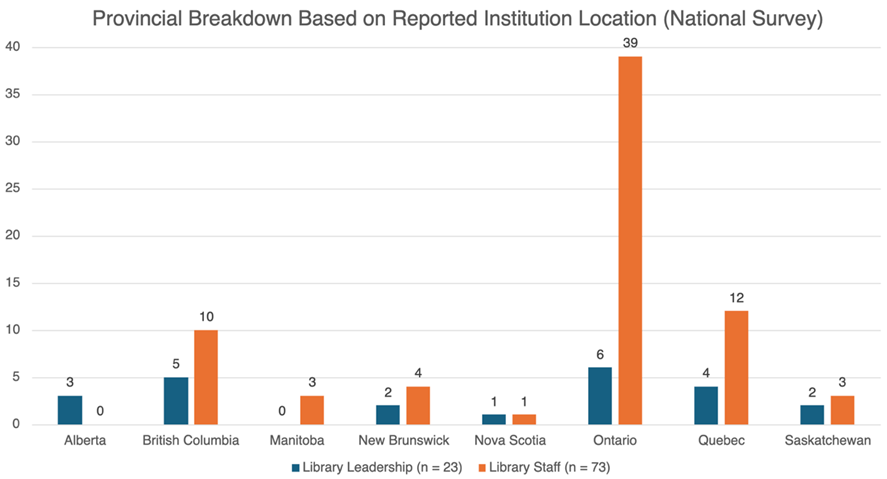
Figure 1
Provincial breakdown of national survey respondents based on reported institution.
Defining Terminology (RQ1)
As part of the broader goals of this project, this research study explored how library employees conceptualize terminology, particularly given the lack of consensus in existing literature around the topic of student engagement. To accomplish this, participants in both Phases 1 and 2 were invited to describe their interpretations of the meaning and significance of the terms “student engagement” and “student voices” within the context of academic libraries. Of the 68 open-ended survey responses, 38 provided differentiation between the 2 terms (10 Library Leaders and 28 Librarians or Library Staff). Several themes emerged across participant groups in both phases for this topic:
Terminology is Hard to Define
· Student engagement and student voices are vague, messy concepts; they can be situational and occur on a spectrum
· There is lack of consensus on how to define these terms, and there are many ways that they can overlap and interchange with each other
o This creates barriers for developing engagement roles and strategies within libraries
· Student engagement and student voices can be contextual, and different communities and units on campus will approach these ideas from their own frameworks
o Factors like campus and library size can also shift the definitions of these terms and how they operate in theory vs. in practice
· Adjacent terminologies work in tandem with these concepts, such as: outreach, marketing, community development, community-led, user experience (UX), organizational analysis
· Students generally are looking for empathy, for their voiced needs and concerns to be heard, and for concrete actions to be taken when they share them
Unique Distinctions and Nuances
· Despite prominent overlap, distinctions exist between student engagement and student voices
· Student engagement involves supporting the learning, wellbeing, and overall academic journey of students via their uptake of library resources and services
o It involves how students interact with the library and how the library provides mechanisms that support student voices
· Student voices are the explicit needs, experiences, perspectives, and expectations directly provided by students
o Student voices are direct in that they come specifically from students themselves, rather than being processed through institutional or library lenses
o Student voices are experience- and values-driven; they can also be comprised of individual or collective input
· Student voices are generally viewed to have a more direct impact on library operations and decision-making compared to the broader concept of student engagement
o Student engagement may thus be seen to have less of a transformational component compared to student voices, though this warrants more investigation across a larger pool of academic library staff
Fostering Connections Through Relationship-Building is Key
· The visibility of library staff matters (e.g. showing up regularly, having a physical presence)
· There are benefits of relationship-building outside of library spaces and events (e.g. within departments, in classes, at campus events, etc.)
· Looking for synergy and collaborating with other units on campus can strengthen engagement efforts
· Concrete communication strategies are also useful; libraries need to focus messaging, be strategic about outreach channels, and build in functions that support two-way communication
o Directionality of communication efforts matters; strictly library-outward is not considered as effective as bringing students inward to have a part in directly influencing the transformation of library resources and services
Importance of Student-Library Interactions
· Libraries should foster open communication lines, regular check-ins, and proactively provide opportunities for meaningful conversations with students who are viewed as holistic individuals, not just academics
· It’s important to craft safe communities where students are active participants; when offering formal and informal spaces to create meaningful dialogue, build a sense of empathy, trust, and security
· Take on proactive advocacy roles and be mindful of how various communities have experienced harm and reprisal in the past, with attentiveness to minimizing or eliminating future harms
· Students value demonstrated action over lip service platitudes, as well as having direct involvement instead of limited consultation
o Equip students to have tangible impacts that influence library processes and decision-making; this can boost student empowerment and sense of ownership/belonging in the library
o Financial investment and carving out dedicated job roles for student positions is a common way for libraries to demonstrate their commitment in this space
Engagement Strategy Usage (RQ2)
Survey participants were asked to report on types of engagement strategies used by their library to understand and amplify student voices, using a list of five key approaches: (1) Feedback Mechanisms such as surveys/questionnaires, interviews, focus groups, and/or user experience (UX) research methodologies; (2) Research Collaborations, e.g. students as co-investigators on research projects; (3) Student Employment, e.g. library assistants, work study and internship opportunities, etc.; (4) Student Representation, such as involvement on advisory groups or boards, student ambassadors, etc.; and (5) Teaching and Learning Interactions, such as information literacy workshops. Respondents were also provided with “None” or “Not sure” options if they lacked or were unaware of library engagement activities.
As seen in Figure 2, Student Employment, Feedback Mechanisms, and Teaching and Learning Interactions were the top three strategies reported across both groups. While these approaches are consistent with those commonly highlighted in surrounding literature, it should be noted that most survey respondents work within areas such as Teaching and Learning (n = 40) or User Services/its equivalent (n = 33); as such, responses may lean towards student interactions typical in those departments. In both groups, approximately half reported Student Representation as a voice-seeking strategy.
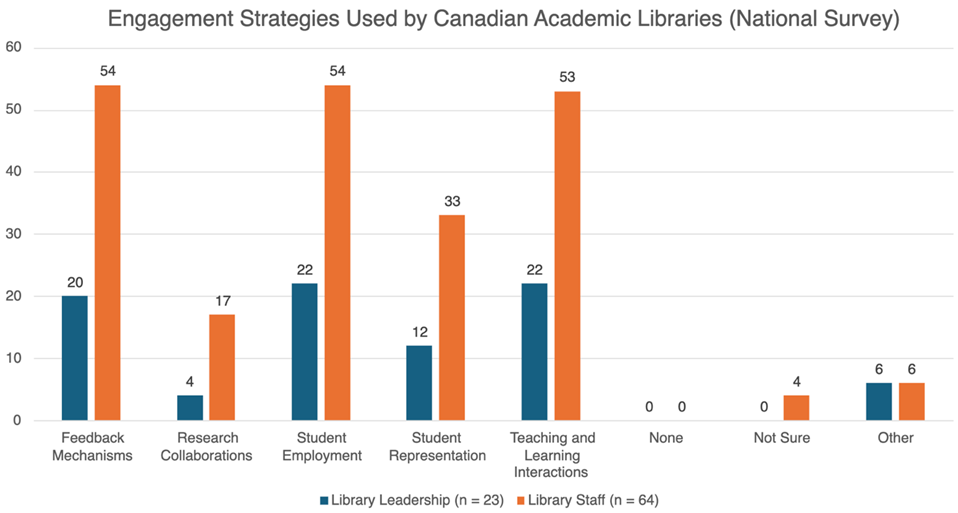
Figure 2
Engagement strategy usage as reported by national survey respondents.
Open-ended responses across Phases 1 and 2 produced additional themes around engagement strategies, pertaining to both practical considerations for conducting this type of work, as well as specific examples of strategies used within various academic libraries. A subset of the most prominent findings are presented here:
Feedback Mechanisms
· Participants pointed to a variety of qualitative and quantitative methods for conducting student engagement work; most common were surveys, interviews, focus groups, user interaction statistics, and usability studies
· Applying several methods at a time via triangulation can be helpful, as it provides multiple data points to gauge the efficacy of engagement activities
· Libraries should be strategic with when and how often to collect feedback, prioritizing what information is necessary vs. nice-to-have
· Frustration and discouragement can occur when feedback is solicited but ultimately not actionable; libraries should thus make efforts to minimize the risk of stagnate data
Student Participation
· Direct student involvement is a key priority when deciding on strategies for voice-seeking work
· Student participation is highly varied and flexible, including both paid and volunteer roles within the library or across campus through involvement on committees, working groups, and team projects
· Student hires are of great benefit, both as a direct source of feedback and questions, as well as facilitating peer-to-peer learning with student visitors to the library
· Participants emphasized the importance of intentional hiring and allowing students the opportunity to shape their job roles and responsibilities
· Examples of student employment: Student Library Assistants (SLAs), emerging professionals and work study programs, students with disabilities in co-designed accessibility roles, students partnering with departments and IT while embedded in the library, and research assistants
· Examples of student representatives: student and library advisory groups/boards/ committees; library ambassador programs; library hiring committees; student engagement teams; community engagement teams; user experience (UX) teams; and teaching and learning teams
While direct student involvement is undoubtedly valuable, participations commonly noted that consistent participation is a recurring challenge and that students often struggle to adhere to the commitment expectations of their representative roles. Additional influencing factors include:
· Competing time priorities, perceived relevance of the activities to students, and social/power dynamics
· Dynamics are particularly critical, as student voices are at risk of getting drowned out or overshadowed by more privileged voices at the academic table
o Facilitation practices should be built into engagement activities for students to contribute their voice (e.g., inviting input during pre-meeting agenda distribution, calling on students during gatherings if they haven’t had a chance to speak up)
o Alternatively, library staff may wish to build separate, more tailored groups for students if their voices are consistently being reduced or unattended to in existing channels
· Library employees should also determine when they need to directly oversee activities versus when they can let others lead engagement initiatives
· Attempts to apply engagement strategies without established relationships may be unsuccessful, or in more serious scenarios, can backfire and breed distrust, disengagement, or even harm
Teaching and Learning Interactions
· Formal and informal teaching and learning activities create opportunities to directly interact with students, making it a popular avenue for engagement
· Library liaisons have unique positionality as conduits between students and libraries, due to their access to classrooms and research consultations
o Faculty buy-in and collaboration opportunities for curriculum embeddedness are valuable ways to pursue out-of-library engagement
· Building liaison presence and rapport, as well as prioritizing strong relationship-building, are key goals in this space
· There are limitations in traditional approaches to information literacy, such as the one-shot model of instruction
· There is a developing trend of having liaison positions that are directly tied to engagement, teaching, and learning as a complement to liaisons that work with specific subjects and departments
Perceived Challenges and Benefits (RQ3)
Participants in Phases 1 and 2 were asked to share their experiences with the positive and negative aspects of student engagement and voice-seeking work. The inherent value of this work featured prominently, and such activities are perceived to align with the goals and mission of academic libraries; however, the logistics of pursuing student engagement can be difficult in day-to-day practice. Thematic highlights of these key challenges and benefits are presented below:
Perceived Challenges
· “Fuzzy” terminology parameters around student engagement are prominent; when definitions are lacking, it is extremely difficult to develop engagement strategies and implement them into library practice
· Lack of change willingness, especially from library leadership or institutional barriers, creates difficulties in acting on student engagement findings (or even conducting engagement in the first place)
· Care and justice models are valuable ways to mitigate some of these challenges and to better frame student engagement work done by libraries, but more training needs to be done in formal education programs and library-wide professional development activities
o Sample training topics mentioned: sexual and gender diversity, racial inequalities, accessibility and disability
In addition to these broad challenges, participants highlighted unique challenges that exist for sub-communities in academic environments:
· Student-specific challenges: lack of time and capacity leading to engagement fatigue; lack of meaningful engagement that comes across as performative, where students are consulted selectively, late, or not at all; accuracy of student perceptions of the library and academia (e.g. lack of understanding about the role and function of academic libraries, which can lead to unfeasible requests during engagement and voice-seeking activities)
· Library-specific challenges: organizational structure/culture characterized by change animosity and power dynamics that favour certain employee voices over others; risk of retribution for “rocking the boat;” job precarity and portfolio constraints; budget cuts and understaffing; feeling of disconnect from students, especially those outside of the library (i.e. irregular or non-library users); ensuring voice diversity and representativeness; following proper human ethics around data collection to minimize risk of harm to students; navigating workplace ableism experienced by library staff to address accessibility barriers that can impact engagement efforts
· Institution-specific challenges: administrative-level tendencies to characterize students as unengaged or ignorant; competing priorities relating to a complex and varied stakeholder base, which can lead to deprioritizing students (especially undergraduates); misalignment between strategic goals of the institution versus the desired engagement goals of the library; changes to senior leadership that can disrupt established engagement activities and require reestablishing relationships and realigning missions/goals; procedural-related constraints (e.g. survey approval and distribution policies, participant compensation protocols, etc.); small campus size, which can limit resourcing for engagement opportunities and creates greater risk of hearing from the same voices over and over
Perceived Benefits
· Increased proximity and relevance to students, with the ability to implement and act on evidence based decision-making informed by the expressed wants and needs of students
o Seeking out systematic feedback as opposed to relying on anecdotal remarks or observations allows library staff to challenge assumptions and create accountability mechanisms
· Being intentional, consistent, and responsive about engagement positions the library to respond dynamically to evolving needs and changes over time
o in turn, increased student awareness leads to higher uptake of resources and services
· The library’s position as a more “neutral” space (e.g., not directly tied to grades or tuition) gives it opportunity to foster community and sense of belonging
o student collaborations and co-creation roles can foster sense of ownership; ideally these should be paid positions which span entire project lifecycles from inception to conclusion
· Having a culture of diversity and developing a holistic rather than strictly academic view of students
· Sample benefits of a holistic view: improved outcomes around learning and success, academic retention, mental health, and celebrations of students (e.g., competitions, receptions, monetary rewards); minimizing the need for backtracking and retroactive changes; Staff can develop a better understanding of barriers faced by diverse populations of students and actively work to reduce/remove them
· Sample activities where participants reported quality enhancements in their own libraries:
o Physical and virtual spaces, resources, services, collections, policies, EDI initiatives, information literacy instruction workshops, and programming activities
o They also reported stronger uptake in library space usage, as well as higher rates of event attendance and information literacy engagement
Discussion
Terminology Considerations
A key broader goal of this project was to better understand how Canadian academic libraries conceptualize the meaning and significance of terminologies, with particular focus on student engagement and student voices. This is inherently complex work, as such concepts come with varied meanings and situational nuance, which can make consensus difficult. These findings are consistent with existing LIS literature that denote the challenges of definitional work around student engagement (Pittaway, 2016; Schlak, 2018). Relational engagement, a component of student engagement characterized by collaboration, relationship-building, and the holistic student experience (Appleton, 2020; Schlak, 2018), featured prominently in participants’ answers and was a top priority across both Phase 1 and Phase 2 of the study.
Study participants also highlighted how related concepts frequently overlap with student engagement, which further muddies the waters around defining terminology. Other authors have presented similar findings, such as Appleton (2020) who notes that “situating student engagement in academic libraries can cross over into several areas and fields of study within academic librarianship including: marketing and communications; information literacy; teaching and learning; performance measurement; quality assurance; user experience; space design and planning; access and inclusion; service model design; customer service” (p. 195). A starting point for academic libraries wishing to pursue student engagement and voice-seeking work could thus be to delineate some of these surrounding domains and what current activities or collaborations exist with the library, as well as to set targets for future goals around stakeholder partnerships and relationship-building.
Lastly, a common lamentation that arose across participants in this study was feelings of frustration and isolation when trying to approach definitional work, with lack of directionality in the broader LIS profession. Many expressed a desire to collaborate with other libraries and there were several calls for action for Canadian library leadership to discuss these topics at a national level, perhaps through an association, task force, or committee work. While this research was intended to be an initial exploratory study, it would greatly benefit from replication or extension given its limited sample size; as such, any leadership or collective interested in building on this study’s work or initial findings is highly welcomed.
Engagement Strategies
Feedback Mechanisms
Many of the engagement strategies reported by libraries in this study are well established in existing LIS literature, with feedback mechanisms such as focus groups, interviews, surveys, and ethnographic/UX techniques featuring prominently (see Appleton 2018; Appleton, 2020). While surveys are a popular means of gathering larger-scale feedback, they are particularly prone to disadvantages such as student survey fatigue, overreliance as a proxy to authentic student voices, lack of opportunity to build trust, and data collection capabilities that are limited by instrument wording and question design (Appleton, 2018; Decker 2020; Dollinger et al., 2023). UX and ethnographic approaches have gained increasing traction in libraries, both for their user-centred ideologies and their ability to enhance evidence based practice. Much like student engagement however, leadership support is critical to advancing the UX “maturity” of a library, along with dedicated budget and staff capacity (see Gullikson, 2020; Young et al., 2020).
Student Participation
Direct student involvement through library employment as well as both formal and informal representative functions is another common engagement strategy. Integral to these activities is that they give students a direct stakeholder voice that holds influencing power within the library. Browndorf (2014) highlights the importance of these decision-making capabilities, as it allows students to more strongly “value the library and feel ownership of the institution and make decisions that best suit themselves, their peers, and the library as a whole” (p. 88). A key benefit study participants mentioned regarding student employees is that they offer a bridge between student and library perspectives, which can also create opportunities for peer-to-peer learning. Team-based, collaborative learning is particularly valuable to student employees, as it helps foster a sense of community (Cady et al., 2023) and provides practical experience in collaborative problem-solving. Tomlinson and Arnold-Garza (2022) further highlight the potential for role evolution, where experienced student employees can have direct involvement in the planning and provision of student worker training (p. 580).
Integrating student representation, while featured less prominently in this study’s findings compared to student employment, is another common means of facilitating library involvement. Like student employment, advisory groups grant students opportunities to have their voices heard, with the ability to directly influence library policies, collections, and programming (Lindsay et al., 2016). In spite of benefits, however, advisory groups come with challenges as well. Participants in this study noted that students often struggled with meeting the expectations of their representative roles, typically due to time demands or lack of perceived relevance. Time commitment is also a challenge for library staff looking to facilitate or advise these groups (Colby & Gruber, 2025), in addition to frequent student turnover and combating stereotypes towards the library (Lindsay et al., 2016). Several study participants cautioned about over-reliance on these students when conducting engagement and voice-seeking work, which is warranted given that such representatives are typically already keen on the library and are not necessarily reflective of the broader student population (Hall, 2022; Sexton, 2022). This is especially important in the context of underserved and marginalized student groups that exist on campus.
Teaching and Learning Interactions
Teaching and learning interactions are a well-established mechanism for student engagement where academic libraries have historically focused and excelled. Liaison librarians and library instructors can facilitate direct access to students that other staff may not necessarily have, which provides unique opportunities for engagement and voice-seeking work. Engagement techniques related to active learning, flipped classrooms, and gamification are but a sample of the myriad methods employed in this domain. While it is not feasible to provide a comprehensive discussion in the context of this paper, there are emerging trends in information literacy and library instruction that connect to this study’s key thematic findings. Design justice, educational justice, disability justice, inclusive pedagogies, cultural pedagogies, and critical information literacy (CIL) and its accompanying pedagogies are some of the prominent frameworks gaining traction as a means to counter the predominantly white, ableist, and heteronormative cultures that exist within academic spaces and instruction (for further reading, see Ferretti, 2020; Moreno, 2024; Novosel, 2023; Whitver, 2020).
Tackling Challenges to Maximize Benefits
Rather than address specific perceived challenges and benefits that arose during the study, this section will focus on practical applications for academic libraries based on overall thematic findings.
Develop a User-Focused Library Culture
Participants reported that students face recurrent frustrations around lack of meaningful engagement at their institution. Their onset of involvement is often delayed (if it occurs at all) and they frequently feel that feedback they do share is not acted on or listened to. They noted that this can sour students’ perceptions towards consultation and engagement work as performative; as a consequence, students may disengage from current or future initiatives. Such sentiments are echoed in other literature (Decker, 2020; Pittaway, 2016) and critiques of consultative models are on the rise. Blake et al. (2020) note that, while these models recognize students’ expertise and value their insights and experiences, they ultimately remain one-way relationships in which students are designated as “stakeholders” or “others” (p. 420). Sense of empowerment, ownership, and belonging within the library are compromised and further chances to engage are diminished. Crafting a safe and welcoming library environment that is conducive to voice-seeking is thus a critical first step for impactful student engagement.
Sample enabling activities to move towards a more user-centred culture include:
· Be conscientious
of intention versus impact: While engagement work often comes from a
“good” place, libraries need to be mindful of the equitable distribution of
benefits and risks when pursuing these activities, especially with underserved
groups. Student voices can come from places of pain, fear, and exclusion, and
as such, engagement work carries risk of exposure to past as well as new harms.
Boost the relevance of engagement activities and scope what activities are
necessary/needs-based versus nice to have to help maximize relevance.
· Prioritize
equity, diversity, inclusion, and accessibility (EDIA): Co-create
authentic, holistic opportunities for equity-deserving communities, such as
students who are Black, Indigenous, or People of Colour (BIPOC). Develop a
culture of empowerment and shared responsibility among library staff. Enhance
professional education/development around topics such as sexual and gender
diversity, racial inequalities, and accessibility/disability. It is imperative
for library staff to understand how these topics intersect with academic
bureaucracy, and to ensure they are equipped with proper tools and knowledge in
these areas before engaging with students.
· Integrate existing frameworks and best practices: Ease user burdens through reliance on established practices/protocols. Implement listening infrastructures and formal feedback channels that offer more consistency, with a focus on systems that facilitate sustainable, ongoing voice-seeking. Look to existing domains for guidance on conducing ethical voice-seeking work, such as:
o Community justice, social justice, and anti-racist approaches
o User experience and accessibility best practices
o International standards (e.g., ISO 9241-210:2019, see International Organization for Standardization, 2019)
Build Community and Co-Develop Partnerships
A core defining theme of this study was the importance of relationship building. Participants cautioned on the danger of libraries existing in silos, as this puts them at risk of being misunderstood or dismissed as irrelevant. Through early and ongoing partnerships, libraries can help shape student and unit perceptions of our role on campus, which in turn can boost relevance and increase uptake of our resources and services. When seeking partnerships with students specifically, libraries must be cautious of falling into transactional habits. Authentic, partnership-based student engagement is distinct from mere consultation (Halliday et al., 2024; Pittaway, 2016) and should instead prioritize a relational approach characterized by human connection and care (Matthews et al., 2024). The Students as Partners (SaP) model is oft featured as a means for facilitating relational engagement, where student expertise is highly valued and directly integrates into library practice (Blake et al., 2020). Libraries wishing to integrate the SaP model should pursue engagement activities in a way that reflects the core values of SaP, including a commitment to mutual respect and decision-making, shared responsibility and co-creation, a spirit of reciprocity, and actively combating power imbalances (Dollinger et al., 2023; Fundator et al., 2024; Matthews & Dollinger, 2023)
Sample enabling activities to foster community and partnerships include:
· Look for shared goals and synergies: Seek out collaborations within/beyond campus built on a shared vision and be more tactical about gathering feedback in general. This includes being mindful of maintaining balance in goals and workloads (e.g. adding to the library’s plate without taking other things away). Centre relationship-building and promote library champions, especially in senior-level roles. Prioritize listening, mutual respect, and shared trust to build authenticity. Demonstrate leadership in student engagement initiatives to inspire other units on campus and position the library as a valuable partner.
· Shape perceptions early and show up consistently: Cultivate a regular presence on campus and set expectations about the library’s roles/responsibilities to minimize disappointment when requests need to be declined. When going beyond the library’s confines, be strategic about when and how to show up in other spaces, as appearing in unexpected places can lead to confusion (i.e., “What is the library doing here?”). Integrate into existing spaces with care, recognizing that “outsider” presence can lead to tonal shifts and adjusted behaviour for members of pre-existing communities.
· Mature liaison programs and instruction: Apply the unique expertise of liaisons and instructors to foster stronger connections. Scaffold instruction in a more meaningful way and better navigate the growing multi/interdisciplinarity amongst students, faculty, and higher education programs. Consider the ongoing challenge of one-shots, especially 30-60-minute sessions. Integrate gamification for engagement and explore student-led workshops where appropriate.
Limitations and Future Directions
A key objective of this study was to pursue a national-level investigation around student engagement perceptions and processes in Canadian academic libraries. While substantial efforts were made to distribute the Phase 1 survey across a comprehensive network of academic electronic mailing lists and tailored individual contacts, it is hindered by a limited and self-selected sample. As such, the findings should be considered exploratory and cannot be broadly representative of Canadian academic libraries as a collective. Furthermore, they may also be reflective of those with stronger investment or involvement in student engagement and voice-seeking work. While the research was successful in addressing the outlined research questions as a whole, it would greatly benefit from replication or extension, ideally with a more representative sample size.
Another possible factor in limited response rates was the length and construct of the survey instrument. While designed to be completed within a maximum of 15 to 20 minutes, it did feature a number of open-ended questions around engagement terminology, challenges, and benefits. This was deliberate so as not to be prescriptive and to avoid “leading” participants towards certain answers, however modifications to include more closed-ended questions may have helped bolster survey uptake and completion. By not providing a universal definition to terms such as “student engagement” and “student voices,” it’s also likely that participants were operating from different frameworks of understanding around these terms, which would influence subsequent answers across both branches of the virtual survey. This again was intentional given the current contention around terminology in this space, but providing some guiding principles or examples around student engagement in future research may help establish a more consistent baseline to participant responses, which could in turn offer benefits for data analysis.
For future directions beyond study replication and extension, there is opportunity to conduct further investigation into students’ perceptions of engagement and voice-seeking as related to academic libraries, given this study’s focus on library employees. Following the key findings of this study, however, such research should be mindful of the scope and ethics of conducting research with a student audience, especially given their experiences with engagement burnout and risk of harm exposure.
Conclusion
This study sought to investigate engagement strategies used by academic libraries across Canada to understand and amplify student voices, with a focus on perceived benefits and challenges of this work to inform decision-making. To the author’s knowledge, this is the first attempt to consolidate research findings on this topic in a Canadian context, offering a unique contribution to the overarching LIS literature. There was a rich variety of engagement strategies reported, particularly relating to feedback mechanisms, student employment, and teaching and learning interactions. Authentic engagement and voice-seeking produces many holistic benefits for both students and libraries, which can foster empathy, co-creation, boosted agency, and reciprocal empowerment. Key challenges that hold back this work include “fuzzy” parameters around the terminology and its accompanying strategies, as well as lack of change willingness (especially at the leadership level) and the need for more inclusive operation frameworks. Developing a user-focused library culture and prioritizing co-developed communities and partnerships are two key recommendations for academic libraries looking to take greater responsibility in how they approach student engagement.
Acknowledgements
Funding for this project was graciously provided through a research fund allotted by the University of Toronto Scarborough’s Office of the Vice-Principal Academic & Dean.
References
Appleton, L. (2018). Qualitative methods for engaging students in performance measurement. Information and Learning Science, 119(1/2), 64–76. https://doi.org/10.1108/ILS-09-2017-0093
Appleton, L. (2020). Academic libraries and student engagement: A literature review. New Review of Academic Librarianship, 26(2–4), 189–213. https://doi.org/10.1080/13614533.2020.1784762
Ball, H. F., & Fuchs, C. (2024). Engaging to empower: Honouring student sentiment and voices to implement a holistic approach in creating an inclusive and anti-racist library. New Review of Academic Librarianship, 30(2–3), 191–201. https://doi.org/10.1080/13614533.2024.2381516
Barham, R., Keshmiripour, S., Ramin, L., & Venner, M. A. (2018). Student library advisory boards: Engaging students in the library experience and communicating the library's value. In P. Keeran & C. Forbes (Eds.), Successful campus outreach for academic libraries: Building community through collaboration (pp. 185–202). Rowman & Littlefield.
Bastone, Z., & Clement, K. (2022). Serving everyone or serving no one? Examining the faux-equity of the one-shot. College & Research Libraries, 83(5), 780–794. https://doi.org/10.5860/crl.83.5.780
Black, E. L. (2020). Library student employment and educational value beyond the paycheck. In S. Vong & M. Vrkljan (Eds.), Learning beyond the classroom: Engaging students in information literacy through co-curricular activities (pp. 57–73). Association of College and Research Libraries
Blake, J. R. S., Aston, S., & Grayson, N. (2020). From the outside in: Bringing student engagement to the centre. New Review of Academic Librarianship, 26(2–4), 419–432. https://doi.org/10.1080/13614533.2020.1777172
Bramley, C., & Morrison, K. (2022). Student engagement, higher education, and social justice: Beyond neoliberalism and the market. Routledge.
Braun, V., & Clarke, V. (2019). Reflecting on reflexive thematic analysis. Qualitative Research in Sport, Exercise and Health, 11(4), 589–597. https://doi.org/10.1080/2159676X.2019.1628806
Braun, V., & Clarke, V. (2021). One size fits all? What counts as quality practice in (reflexive) thematic analysis? Qualitative Research in Psychology, 18(3), 328–352. https://doi.org/10.1080/14780887.2020.1769238
Browndorf, M. (2014). Student library ownership and building the communicative commons. Journal of Library Administration, 54(2), 77–93. https://doi.org/10.1080/01930826.2014.903364
Bruce, S. (2020, February 6). Teaching with care: A relational approach to individual research consultations. In the Library with the Lead Pipe. https://www.inthelibrarywiththeleadpipe.org/2020/teaching-with-care/
Cady, J. E., Beavers, K., Jiang, A., & McCoy, L. (2023). Developing a meaningful student employment experience for students’ success on campus. (2023). New Review of Academic Librarianship, 29(2), 189–202. https://doi.org/10.1080/13614533.2022.2122852
Ciszek, M. P. (2020). Moving from diversity to equity and inclusion with social justice as the goal: A new framework for an expansive definition of diversity. In C. Bombaro (Ed.), Diversity, equity, and inclusion in action: Planning, leadership, and programming (pp.1–12). American Library Association.
Colby, K., & Gruber, A. M. (2025). A textbook equity student advisory board. Journal of Open Educational Resources in Higher Education, 3(1), 182–199. https://doi.org/10.31274/joerhe.17910
Cornelius-Bell, A., Bell, P. A., & Dollinger, M. (2023). Deterritorialising student voice and partnership in higher education. Higher Education, 86(6), 1293–1305. https://doi.org/10.1007/s10734-022-00972-z
Decker, E. N. (2020). Engaging students in academic library design: Emergent practices in co-design. New Review of Academic Librarianship, 26(2–4), 231–242. https://doi.org/10.1080/13614533.2020.1761409
Dollinger, M., Salisbury, F., & Davis, K. (2023). Unrealised potential: A survey of students as partners in Australian university libraries. New Review of Academic Librarianship, 29(3), 288–303. https://doi.org/10.1080/13614533.2022.2138477
Donald, R. (2024). “Helping people be human”: Academic librarians and a pedagogy of care (Publication No. 31240962) [Doctoral dissertation, Trinity International University]. ProQuest Dissertations & Theses Global.
Eshbach, B. E. (2020). Supporting and engaging students through academic library programming. The Journal of Academic Librarianship, 46(3), 102129. https://doi.org/10.1016/j.acalib.2020.102129
Ferretti, J. A. (2020). Building a critical culture: How critical librarianship falls short in the workplace. Communications in Information Literacy, 14(1), 134–152. https://doi.org/10.15760/comminfolit.2020.14.1.10
Fundator, R., LeGrand, S., Permenter, S., & Weiss, B. (2024). Students as partners in the library: Perspectives of partnering to develop a new information literacy undergraduate research program. International Journal for Students as Partners, 8(2), 217–225. https://doi.org/10.15173/ijsap.v8i2.5725
Greer, K. S. (2023). A pedagogy of care for information literacy and metaliteracy asynchronous online instruction. The Journal of Academic Librarianship, 49(3), 102676. https://doi.org/10.1016/j.acalib.2023.102676
Gullikson, S. (2020). Structuring and supporting UX work in academic libraries. Weave: Journal of Library User Experience, 3(2). https://doi.org/10.3998/weave.12535642.0003.202
Gupta, A., Liu, Y., Lin, T-C., Zhong, Q., & Suzuki, T. (2024). Listening to diverse voices: Inclusive pedagogy and culturally responsive teaching for library interactions. Reference Services Review, 52(1), 66–85. https://doi.org/10.1108/RSR-04-2023-0042
Hall, A. R. (2022). Towards a modern, inclusive library advisory board. In Proceedings of the 2022 Library Assessment Conference: Building Effective, Sustainable, Practical Assessment (pp. 1–3). https://www.libraryassessment.org/wp-content/uploads/2023/04/182-Hall-Towards-a-Modern-Inclusive-Library.pdf
Halliday, K., Courage, K., Matthews, C., & Globerson, N. (2024). Decolonising and diversifying the Library through student partnerships. New Review of Academic Librarianship, 30(2/3), 153–167. https://doi.org/10.1080/13614533.2023.2287470
Holmes-Price, O., Kannegiser, S., Pitsker, E., & Wilkinson, Z. T. (2022). Small actions, big impact: Centering student voices and advocacy with a library student advisory board. College & Research Libraries News, 83(3), 105–109. https://doi.org/10.5860/crln.83.3.105
International Organization for Standardization. (2019). Ergonomics of human-system interaction: Part 210: Human-centred design for interactive systems (ISO Standard No. 9241-210:2019). https://www.iso.org/standard/77520.html
Islam, A., Agarwal, N. K., & Ikeda, M. (2015). How do academic libraries work with their users to co-create value for service innovation? A qualitative survey. Qualitative and Quantitative Methods in Libraries, 4(3), 637–658. https://qqml-journal.net/index.php/qqml/article/view/274
Kohler, J. P. (2016). Training engaged student employees: A small college library experience. College & Undergraduate Libraries, 23(4), 363–380. https://doi.org/10.1080/10691316.2015.1049316
Lindsay, B. D., & Datig, I. (2015). Friends with benefits: Fostering community in an academic library with a student advisory group. In S. Bonnand & M. A. Hansen (Eds.), Innovative solutions for building community in academic libraries (pp. 56-72). IGI Global.
Lindsay, B. D., Datig, I., Johnston, L., & Lupold, A. (2016). Optimizing library services--SAGs to the rescue: Student advisory groups in the library. Against the Grain, 28(1), 56–57. https://doi.org/10.7771/2380-176X.7287
Lowe, T. (2023). Advancing student engagement in higher education. In T. Lowe (Ed.), Advancing student engagement in higher education: Reflection, critique and challenge (pp. 1–17). Routledge. https://doi.org/10.4324/9781003271789
Matthews, K. E., & Dollinger, M. (2023). Student voice in higher education: The importance of distinguishing student representation and student partnership. Higher Education, 85(3), 555–570. https://doi.org/10.1007/s10734-022-00851-7
Matthews, K. E., Lodge, J. M., & Johnstone, M. (2024). The relational turn in student engagement. In C. Stone & S. O’Shea (Eds.), Research handbook on student engagement in higher education (pp. 28–38). Edward Elgar Publishing. https://doi.org/10.4337/9781035314294.00012
Mitola, R., Rinto, E., & Pattni, E. (2018). Student employment as a high-impact practice in academic libraries: A systematic review. The Journal of Academic Librarianship, 44(3), 352–373. https://doi.org/10.1016/j.acalib.2018.03.005
Moreno, T. H. (2024). Centering justice/decentering whiteness: The case for abolition in information literacy pedagogical praxis. Reference Services Review, 52(1), 133–148. https://doi.org/10.1108/RSR-03-2023-0028
Novosel, E. (2023). Let’s talk about disability: Disability justice in engineering librarianship. In 2023 ASEE Annual Conference & Exposition Proceedings, 43456. https://doi.org/10.18260/1-2--43456
Pittaway, S. (2016). Engaging students, shaping services: The changing face of student engagement at The Hive. Insights: The UKSG Journal, 29(3), 249–257. https://doi.org/10.1629/uksg.315
Salisbury, F., Dollinger, M., & Vanderlelie, J. (2020). Students as partners in the academic library: Co-designing for transformation. New Review of Academic Librarianship, 26(2–4), 304–321. https://doi.org/10.1080/13614533.2020.1780275
Saunders, L. (2017). Connecting information literacy and social justice: Why and how. Communications in Information Literacy, 11(1), 55–75.
Schlak, T. (2018). Academic libraries and engagement: A critical contextualization of the library discourse on engagement. The Journal of Academic Librarianship, 44(1), 133–139. https://doi.org/10.1016/j.acalib.2017.09.005
Sexton, M. (2022). Convenience sampling and student workers: Ethical and methodological considerations for academic libraries. The Journal of Academic Librarianship, 48(4), 102539. https://doi.org/10.1016/j.acalib.2022.102539
Tomlinson, C., & Arnold-Garza, S. (2022). Library employment practices that support student engagement. Portal: Libraries and the Academy, 22(3), 571–594. https://doi.org/10.1353/pla.2022.0027
Whitver, S. M. (2020). Accessible library instruction in practice. Portal: Libraries and the Academy, 20(2), 381–398. https://doi.org/10.1353/pla.2020.0019
Yazdani, N. (2024). A pedagogy of care in academic libraries: A framework to increase underrepresented communities’ sense of belonging and engagement. Journal of the Australian Library and Information Association, 73(4), 505–528. https://doi.org/10.1080/24750158.2024.2391224
Young, S. W. H., Chao, Z., & Chandler, A. (2020). User experience methods and maturity in academic libraries. Information Technology and Libraries, 39(1). https://doi.org/10.6017/ital.v39i1.11787
Appendix A
Virtual National Survey (English Version)
Information and Consent Form
Engagement Practices of Canadian Academic Libraries for the Advancement of Student Voices: A National Survey
Pour répondre au sondage en français, veuillez sélectionner "English > Français."
Researcher
Sarah Guay, Science Liaison Librarian, University of Toronto Scarborough Library (sarah.guay@utoronto.ca)
Purpose
This survey seeks to explore what engagement practices and strategies are used by Canadian academic libraries to better understand and amplify student voices. It also aims to gauge perceived benefits and challenges of student engagement to inform library decision-making.
This study has been approved by the University of Toronto Research Oversight and Compliance Office - Human Research and Ethics Unit (Protocol number 00046620).
Conditions for Participating
This survey includes a combination of demographic information and reflective questions around student engagement that should take no more than 20 minutes to complete.
Participation in this study is optional and anonymous; in cases where identifying information is voluntarily provided, submissions will be confidential and de-identified. If you agree to participate, you may cease participation without consequence at any time prior to or during the survey by exiting this page. Due to the nature of the data collected, anonymous responses cannot be withdrawn after survey completion/submission.
Risks and Benefits
The risk level for participating in this study is low and will ask you to reflect on student engagement practices in your library. If at any time you experience emotions that affect you in a negative way while completing the survey, you are encouraged to seek help:
· Government of Canada's Mental Health Support web page - includes supports at the national, provincial, and territorial level
While there are no immediate personal benefits upon completion of this survey, final scholarly outputs from this research are intended to benefit the profession by painting a picture of what is happening at the national level around engagement practices to elevate student voices in Canadian academic libraries. Individual libraries may also benefit from broad findings to inform their own activities and decision-making practices.
Access to Information, Confidentiality, and Publication of Results
Completed data collected from this study will be kept indefinitely on a secure, password-protected computer issued by the University of Toronto Scarborough, accessible only to the investigator. Research results will be published, if appropriate, in scholarly outputs such as journal articles and/or conference presentations. No identifying information will be included in any internal or external reports or publications and a summary of the research results can be obtained by contacting Sarah Guay after the study's completion.
Participant Declaration
Submitting a completed survey indicates that you consent to participate in this study. Please save or print a copy of this information and consent form for your own records.
If you have questions about this research study, you are encouraged to contact the Principal Investigator (Sarah Guay, sarah.guay@utoronto.ca) before or after deciding to consent.
If you have any questions or concerns about the ethical nature of this research or your rights as a participant, you may contact the University of Toronto Research Oversight and Compliance Office - Human Research and Ethics Unit by email (ethics.review@utoronto.ca) or by phone (416-946-3273).
I have read and understand the conditions of this research and agree to participate:
o Yes, I agree to participate in this research
o No, I do not agree to participate in this research
National Survey
Thank you for your participation in this national survey of
engagement practices at Canadian academic libraries to understand and amplify
student voices (University of Toronto ethics Protocol number 00046620).
This survey includes a combination of demographic
information and reflective questions around student engagement at your library.
Demographic questions pertaining to your institution, library, and job role are
included to a) gauge the response rate and responsibilities of academic
libraries across Canada and b) compare/consolidate responses received from
within the same library. Individual names will not be included in the survey
results or any resulting scholarly outputs, and specific institutions/academic
libraries will be de-identified during the data analysis process.
The Principal Investigator, Sarah Guay
(sarah.guay@utoronto.ca), is available if you have any questions about details
within the survey.
Please select your role at your institution:
o Library Leadership (e.g. University Librarian, Associate University Librarian, Chief Librarian, Dean of Libraries, etc.)
o Librarian or Library Staff
Branch 1: Library Leadership
Please select your institution of employment (this is for tracking response rates and will be de-identified during data analysis):
[list of drop-down options]
Other:
Please list the library at which you currently work (this is for consolidation purposes and will be de-identified during data analysis):
[text box]
How many years have you worked at your current academic library, across any and all job roles?
o Less than 1 year
o 2 to 3 years
o 4 to 6 years
o 7 to 9 years
o 10 or more years
As part of the broader goals of this project, this survey is interested in how individuals with library leadership positions conceptualize certain terminologies. Please describe your interpretation of the meaning and significance of the terms "student engagement" and "student voices," within the context of academic libraries:
[text box]
What types of engagement strategies does your academic library use to understand and amplify student voices? Select all that apply:
q Feedback mechanisms (e.g. surveys/questionnaires, interviews, focus groups, user experience (UX) research, etc.)
q Research collaborations (e.g. students as co-investigators on research projects)
q Student employment (e.g. library assistants, work study, internships, etc.)
q Student representation (e.g. advisory groups or boards, ambassadors, etc.)
q Teaching and learning interactions (e.g. information literacy workshops)
q None
q Not sure
q Other (please specify):
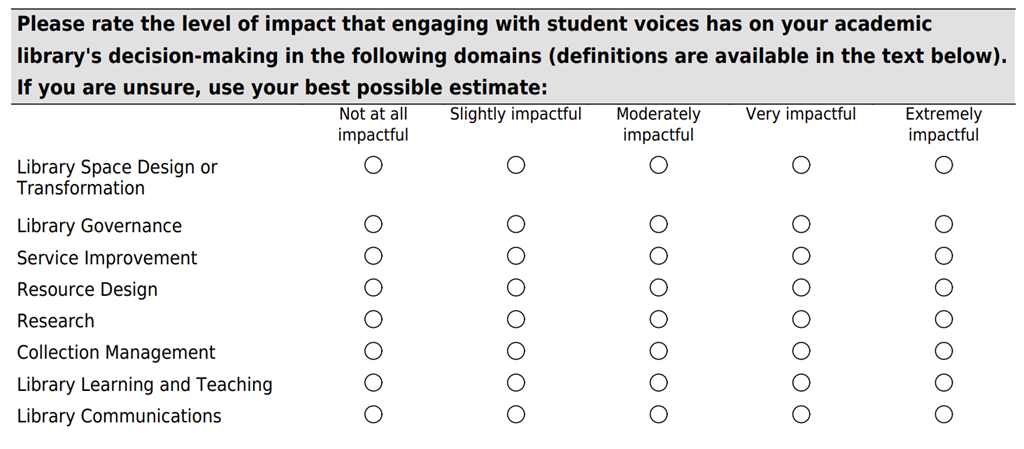
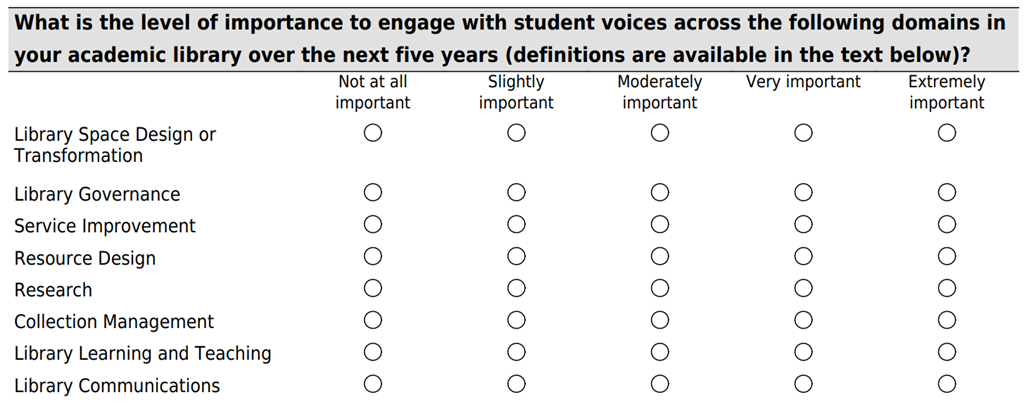
Definitions
Library Space Design or Transformation: Relates directly to the changing or reimagining of library
space; this could be relevant to creating a specific space in the library,
changing of furniture, or having a completely new build.
Library Governance: Relates to the strategic directions and planning of the
library, redesigning or introducing new policy, and/or specific committee
groups.
Service Improvement: Relates to service design, support, or evaluation of
services managed by the library.
Resource Design: Relates to the creation of instructional or support
resources (not collection materials) for the library, either physical or
online.
Research: Relates
to including students as co-investigators for research undertaken by library
staff, with the ability to inform/participate in different phases of the
research process (e.g. research question formation, methodology selection, data
collection, data analysis, dissemination, etc.).
Collection Management: Relates to the collection management of books, journals,
audio-visual media, equipment, technology, and any other materials managed by
the library.
Library Learning and Teaching: Relates to teaching provided by library staff, including
study support workshops.
Library Communications: Relates to communicating the library's mission, values,
priorities, and goals within the library, campus, university, and community;
includes promotion and social media.
For any domains ranked as very or extremely important, please explain why you selected this rating:
[text box]
For any domains ranked as slightly or not at all important, please explain why you selected this rating:
[text box]
Does your library's strategic plan (or equivalent) incorporate engaging with student voices to inform library decision-making?
o Yes
o No
o Not sure
If there are any targets or goals from your library's strategic plan (or equivalent) that you'd like to highlight relating to student engagement, please list them here:
[text box]
What do you perceive to be the benefits of engaging with student voices to impact library decision-making?
[text box]
What do you perceive to be the challenges of engaging with student voices to impact library decision-making?
[text box]
If there are any examples or initiatives that illustrate how your academic library engages with student voices that you'd like to share, please include them here (can include links). You are also welcome to reach out to the Principal Investigator separately by email (sarah.guay@utoronto.ca) if preferred.
[text box]
Branch 2: Librarians or Library Staff
Please select your institution of employment (this
is for tracking response rates and will be de-identified during data analysis):
[list of drop-down options]
Other:
Are you currently a student at this or another institution?
o Yes (undergraduate)
o Yes (graduate)
o No
Please list the library at which you currently work (this is for consolidation purposes and will be de-identified during data analysis):
[text box]
Which of the following best describes your department or area? Select all that apply:
q Administration and Operations
q Archives and Special Collections
q Cataloguing
q Collections and Acquisitions
q Creative Technologies - e.g. Makerspaces, Media Labs
q Research and Scholarly Communication
q Systems and Information Technology
q Teaching and Learning
q User Services (or equivalent)
q Other (please specify):
How many years have you worked at your current academic library, across any and all job roles?
o Less than 1 year
o 2 to 3 years
o 4 to 6 years
o 7 to 9 years
o 10 or more years
Do you interact directly with students in your day-to-day role? (face-to-face or online)
o Yes
o No
As part of the broader goals of this project, this survey is interested in how individuals with librarian and library staff positions conceptualize certain terminologies. Please describe your interpretation of the meaning and significance of the terms "student engagement" and "student voices," within the context of academic libraries:
[text box]
What types of engagement strategies does your academic library use to understand and amplify student voices? Select all that apply:
q Feedback mechanisms (e.g. surveys/questionnaires, interviews, focus groups, user experience (UX) research, etc.)
q Research collaborations (e.g. students as co-investigators on research projects)
q Student employment (e.g. library assistants, work study, internships, etc.)
q Student representation (e.g. advisory groups or boards, ambassadors, etc.)
q Teaching and learning interactions (e.g. information literacy workshops)
q None
q Not sure
q Other (please specify):
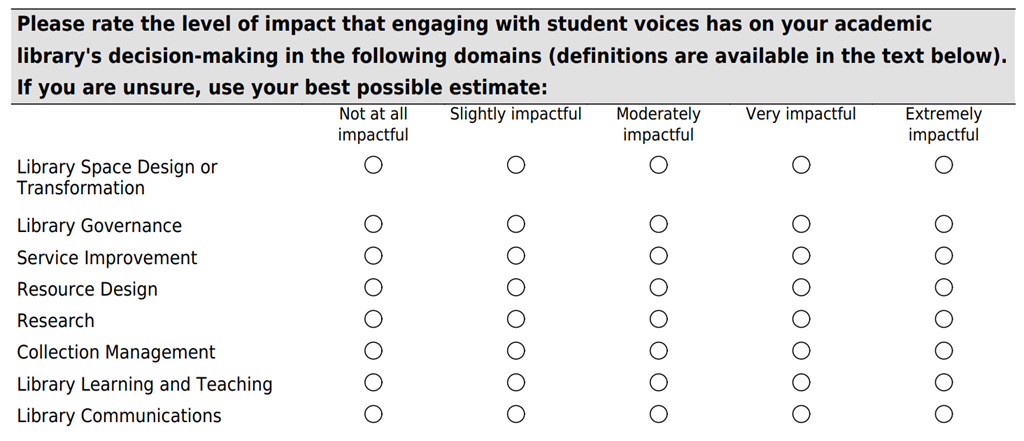
Definitions
Library Space Design or Transformation: Relates directly to the changing or reimagining of library
space; this could be relevant to creating a specific space in the library,
changing of furniture, or having a completely new build.
Library Governance: Relates to the strategic directions and planning of the
library, redesigning or introducing new policy, and/or specific committee
groups.
Service Improvement: Relates to service design, support, or evaluation of
services managed by the library.
Resource Design: Relates to the creation of instructional or support
resources (not collection materials) for the library, either physical or
online.
Research: Relates
to including students as co-investigators for research undertaken by library
staff, with the ability to inform/participate in different phases of the
research process (e.g. research question formation, methodology selection, data
collection, data analysis, dissemination, etc.).
Collection Management: Relates to the collection management of books, journals,
audio-visual media, equipment, technology, and any other materials managed by
the library.
Library Learning and Teaching: Relates to teaching provided by library staff, including
study support workshops.
Library Communications: Relates to communicating the library's mission, values,
priorities, and goals within the library, campus, university, and community;
includes promotion and social media.

What do you perceive to be the benefits of engaging with student voices to impact library decision-making?
[text box]
What do you perceive to be the challenges of engaging with student voices to impact library decision-making?
[text box]
If there are any examples or initiatives that illustrate how your academic library engages with student voices that you'd like to share, please include them here (can include links). You are also welcome to reach out to the Principal Investigator separately by email (sarah.guay@utoronto.ca) if preferred.
[text box]
Conclusion (branches re-merge)
This research project is interested in building on this survey through conducting compensated interviews or focus groups using representative members from responding Canadian academic libraries. Would you be interested in participating in an interview or focus group?
o Yes
o No
o Maybe
If you are interested in participating in a follow-up focus group or interview, please fill out this separate form [link to form below]. Please note that interviews/focus groups and their accompanying scheduling will be conducted in English.
Phase 2 Expression of Interest Form
Expression of Interest: Engagement Practices of Canadian Academic Libraries for the Advancement of Student Voices
Thank you for your interest in participating in a focus group or interview as part of the research project: Engagement Practices of Canadian Academic Libraries for the Advancement of Student Voices. This is an extension of the phase one national survey. If you have not yet completed the phase one survey [link to survey], please take a moment to do so before proceeding with this form. Note that responses to the national survey are anonymous and are not connected to any identifying information in this follow-up form.
This form is intended as an initial expression of interest and is not a commitment to formal participation. If you change your mind about participation after survey submission, you are welcome to let the Principal Investigator, Sarah Guay (sarah.guay@utoronto.ca), know by September 1, 2024 and your name will be removed from consideration.
Final participants will be contacted separately to provide a full overview of this phase of the project, including an Information and Consent Form for a focus group or interview. Please note that focus groups/interviews and their accompanying scheduling will be conducted in English and will run for up to one hour. Focus groups/interviews are expected to take place between mid-summer to early fall, pending participant availability.
Sarah Guay
Science Liaison Librarian
University of Toronto Scarborough Library
Please indicate your first and last name:
[text box]
Please select your institution:
[dropdown box]
Other:
Please list the library at which you currently work:
[text box]
Please indicate your job title:
[text box]
Do you have any preference for participating in a focus group vs. an interview?
o Focus group
o Interview
o No preference
Please provide the preferred email address to contact you about focus group/interview participation:
[text box]
Appendix B
Interview / Focus Group Consent Form and Semi-Structured Guide
Consent Form
Study Title
Engagement Practices of Canadian Academic Libraries for the Advancement of Student Voices
Researcher
Sarah Guay, Science Liaison Librarian, University of Toronto Scarborough Library (sarah.guay@utoronto.ca)
Purpose
You are invited to participate in a virtual [interview / focus group] that explores the engagement practices and strategies used by Canadian academic libraries to better understand and amplify student voices. It also aims to gauge perceived benefits and challenges of student engagement to inform library decision-making. This research is an extension of the earlier national survey on this topic.
This study has been approved by the University of Toronto Research Oversight and Compliance Office - Human Research and Ethics Unit (Protocol number 00046620).
Conditions for Participating
As part of this study, [you will be placed in a virtual group of 2-5 individuals and] the facilitator (Sarah Guay) will ask a series of questions pertaining to your experiences with student engagement and voice-seeking. Please note that [the interview / focus groups] will be conducted in English. Sessions will take no more than 60 minutes and you will have seven days following completion of the [interview / focus group] to contact the facilitator to add to, revise, or omit anything you said.
Your participation in this study is optional and you may leave the focus group at any time without consequence. If you wish to withdraw following completion of the [interview / focus group], you may contact the Principal Investigator by December 1, 2024 to request having your responses removed, also without consequence.
Risks and Benefits
No risks are anticipated beyond those expected during an average conversation and you do not have to answer any questions that make you feel uncomfortable or that you find too upsetting. Expectations and group norms will be discussed at the beginning of the focus group session to establish an open and collegial environment.
While there are no immediate personal benefits upon participation in this [interview / focus group], final scholarly outputs from this research are intended to benefit the profession by painting a picture of what is happening at the national level around engagement practices to elevate student voices in Canadian academic libraries. Individual libraries may also benefit from broad findings to inform their own activities and decision-making practices.
Access to Information, Confidentiality, and Publication of Results
[Interviews / Focus groups] will be video recorded using Zoom and all resulting footage will be stored for up to five years on a secure, password-protected computer / OneDrive space issued by the University of Toronto, accessible only to the Principal Investigator. Virtual discussions will be transcribed and coded to identify themes and trends around student engagement, and all identifying information such as name, job role, and place of employment will be removed during the data analysis stage.
Please note that absolute anonymity cannot be guaranteed, given [the identifying nature of interviews / that other participants will be present]; however, confidentiality will be maintained for any data gathered during the session. [focus groups only: All participants are asked to respect the privacy of other focus group participants; by participating in this focus group, you are expected to keep all identifying information related to other individuals in the study confidential.]
You will be compensated with a virtual $100 Amazon gift card for participation in the [interview / focus group]. Your name and institutional email address will be stored in a compensation file separate from the study's data files and will be used to issue the gift card. Details in the compensation file will be accessible only to the Principal Investigator and the University of Toronto Scarborough Library's Business Officer.
Research results will be published, if appropriate, in scholarly outputs such as journal articles and/or conference presentations. No identifying information will be included in any internal or external reports or publications and a summary of the research results can be obtained by contacting Sarah Guay after the study's completion.
Participant Declaration
Submitting this form indicates that you consent to participate in this [interview / focus group] and its accompanying terms. Please save or print a copy of this information and consent form for your own records.
If you have questions about this research study, you are encouraged to contact the Principal Investigator (Sarah Guay, sarah.guay@utoronto.ca) before or after deciding to consent.
If you have any questions or concerns about the ethical nature of this research or your rights as a participant, you may contact the University of Toronto Research Oversight and Compliance Office - Human Research and Ethics Unit by email (ethics.review@utoronto.ca) or by phone (416-946-3273).
Please indicate your first and last name:
[text box]
Please indicate your institutional email address:
[text box]
I have read and understand the conditions of this research and agree to participate:
o Yes, I agree to participate in this research
o No, I do not agree to participate in this research
Semi-Structured Guide
Introduction
Welcome [everyone] and thank you for joining, it’s great to have you! My name is Sarah Guay, I’ll be leading our discussion today for the research study on “Engagement Practices of Canadian Academic Libraries for the Advancement of Student Voices.”
The research goals of this project are to learn about strategies used by academic library staff to engage with students and amplify their voices, as well as to understand the perceived challenges and benefits of engagement and voice-seeking to inform library decision-making.
Within the next hour, I’ll be asking a series of questions to learn about your thoughts and experiences in these areas. All information collected here today is confidential and any identifying information such as names, job titles, employment location, etc. will be removed during the data analysis stage.
Before we jump into the questions, I’ll quickly review some guidelines to help with our discussion:
- Please take care of your comfort needs throughout our chat today; if you need to step away, just let me know.
- [focus group only] Everyone is invited to express their opinions about today’s topics, and there are no right or wrong answers.
- [focus group only] Feel free to agree or disagree with what other people say, but all are expected to listen and share respectfully.
- [focus group only] If someone speaks to an idea or experience that you want to expand on, you are encouraged to do so; I recommend using Zoom’s built in Raise Hand function [describe where to find] if you would like to respond to something another participant has said. Once they have finished speaking, I will call on you to follow up.
- [focus group only] Out of respect for everyone’s privacy, please do not share identifying details or information discussed in the focus group beyond today’s session.
- Please stick to making verbal comments over mic rather than using the Zoom chat, as that will streamline generating a transcript for data analysis.
- You are welcome to “pass” at any time if there are questions you’d prefer not to comment on.
- As moderator, there may be times when I need to interrupt to either redirect us back to the topic of conversation or to move on to another question, just to make sure we cover everything in our agenda.
- I will read the questions out loud and can paste written copies into the chat at your request.
- If there are any tech issues or internet hiccups, please try reconnecting to the Zoom call within a minute or two. If more than five minutes passes, I’ll get in touch with you over email for next steps.
- As mentioned in the Information and Consent form, today’s session will be recorded to assist with note-taking and data analysis. Is [it / everyone] ok if I start the recording?
[START ZOOM RECORDING]
Sample Questions
To get things rolling, it would be great if we could do a quick introduction to help me understand your work context. So could you tell me a bit about the role you hold at your academic library and some of your key responsibilities?
Alright, thanks! Now we’ll start digging into some questions. I’m going to start us off very broadly to talk about terminology – you may have noticed that when describing this study both today as well as in the national survey that I didn’t provide definitions around the concepts of student engagement, student voices, voice-seeking, etc.
That’s because, when I looked at the literature, there was a myriad of definitions, with little consensus. So rather than providing a definition, I thought it would be helpful to talk about these concepts and see what you think about them.
- What do the terms “student engagement” and “student voices” mean to you, within the context of academic libraries?
- Using your understanding of these concepts, what are some of the ways that your library pursues student engagement and voice-seeking?
o Follow-up: What do you think are the key benefits of these activities? This could be for students, the library, the institution, externally, etc.
- If you were to highlight one example of a time you felt your library really effectively engaged with students, what would it be? What makes it stand out in your mind?
o Follow-up: How do you gauge ‘success’ in the context of student engagement and voice-seeking? What factors contribute to ‘success’?
- Are there any ways that your library shares out success stories when it comes to student engagement or voice-seeking?
o Follow-up: Is this done on an ongoing basis? Internal (to the library, the institution) vs. external sharing?
- Are there any times where an attempt at student engagement or voice-seeking didn’t go well? If so, what happened?
o Follow-up: What were your takeaways? Is it something you’d try again?
- Is there anything that you’ve wanted to pursue around student engagement/voice-seeking that you haven’t been able to? If so, could you tell us a bit more about your idea(s) and what barriers you’ve faced?
o Follow-up: Are there any other pain points or barriers you or your library face when it comes to student engagement and voice-seeking?
- We’ve talked about past and current experiences when it comes to student engagement and voice-seeking. What comes next? Are there any future directions that you would like to share?
o Follow-up: Are there any sources of inspiration that you look to for ideas and examples of student engagement/voice-seeking?
- We’re reaching the end of our chat today, so I wanted to give everyone/you a chance to share anything else that’s on your mind regarding student engagement and voice-seeking. Are there any final thoughts you’d like to share?
Wrap-Up / Debrief
Thanks so much [everyone] for taking the time to meet with me today to share your thoughts around student engagement and voice-seeking.
[summarize any key highlights from the session + how they will help inform the study]
For next steps, if there’s anything else you’d like to add to, revise, or omit from your comments today, please let me know within the next seven days and I will make note of these changes for data analysis.
[focus group only: Please note that I can only do this for your specific comments and cannot adjust others’ responses to original comments made during today’s session.]
As thanks for your time, you’ll [each] receive a virtual Amazon gift card for $100 dollars that will be sent to your email address. If you have any further questions or comments after today’s session, feel free to reach out and I’d be happy to chat.
Thanks again and have a great rest of your day!
[STOP ZOOM RECORDING]