Research Article
Back to Normal?
Perspectives of Faculty and Teaching Librarians on Information Literacy
Instruction After the Lockdowns
Catherine
Baird
Online
and Outreach Services Librarian
Harry
A. Sprague Library
Montclair
State University
Montclair,
New Jersey, United States of America
Email:
bairdc@montclair.edu
Cara
Berg
Business
Librarian
David
& Lorraine Cheng Library
William
Paterson University
Wayne,
New Jersey, United States of America
Email:
bergc1@wpunj.edu
Anthony
C. Joachim
Reference
& Instructional Design Librarian
David
& Lorraine Cheng Library
William
Paterson University
Wayne,
New Jersey, United States of America
Email:
joachima1@wpunj.edu
Drew
Wallace
Research
& Instruction Librarian
Harry
A. Sprague Library
Montclair
State University
Montclair,
New Jersey, United States of America
Email:
wallaced@montclair.edu
Received: 2 June 2025 Accepted: 28 Oct. 2025
 2025 Baird, Berg, Joachim, and Wallace. This is an Open
Access article distributed under the terms of the Creative Commons‐Attribution‐Noncommercial‐Share Alike License 4.0
International (http://creativecommons.org/licenses/by-nc-sa/4.0/),
which permits unrestricted use, distribution, and reproduction in any medium,
provided the original work is properly attributed, not used for commercial
purposes, and, if transformed, the resulting work is redistributed under the
same or similar license to this one.
2025 Baird, Berg, Joachim, and Wallace. This is an Open
Access article distributed under the terms of the Creative Commons‐Attribution‐Noncommercial‐Share Alike License 4.0
International (http://creativecommons.org/licenses/by-nc-sa/4.0/),
which permits unrestricted use, distribution, and reproduction in any medium,
provided the original work is properly attributed, not used for commercial
purposes, and, if transformed, the resulting work is redistributed under the
same or similar license to this one.
DOI: 10.18438/eblip30773
Abstract
Objective – While LIS scholars have extensively studied the widespread disruptions
to library instruction during the lockdown period of the COVID-19 pandemic,
there is a relative dearth of research concerning the longer-term implications
for teaching information literacy (IL). This exploratory survey sought to
examine how faculty have introduced IL skills to students before, during, and
after the COVID-19 lockdowns. After returning to in-person operations in 2021,
the authors observed a change in how faculty have engaged with libraries to
teach IL to their students.
Methods – Utilizing
parallel survey instruments, we asked faculty and librarians for their
perceptions of current and past practices with scheduling library IL sessions,
evaluating student research skills and considering how they acquired those
skills.
Results
– Although responses showed an unsurprising decrease
in library instruction requests during the pandemic lockdowns, faculty
respondents noted a return to nearly pre-pandemic norms after the resumption of
in-person operations. Teaching modality and use of research assignments did not
appear to impact faculty IL scheduling behaviors, but differences in faculty
and librarian responses highlighted potential disagreements about the impact of
COVID-19 on faculty use of library instruction. Additional questioning
indicates a disconnect between how faculty perceive student research skills and
their reasons for scheduling library instruction, which suggests misperceptions
of librarian expertise and differences in understanding how librarians should
teach information literacy. Open-ended responses provided additional context to
these issues, while identifying potential barriers and opportunities.
Conclusion – Overall, our findings
indicate that, rather than fundamentally altering faculty approaches to
information literacy, the COVID-19 disruptions revealed and exacerbated endemic
problems with the prevalent one-shot model of library instruction.
Introduction
Instruction
librarians are often in a complex and unique situation as teachers. Their
teaching schedules emerge dynamically throughout an academic term, they often
navigate their content and pedagogy with another teacher (the instructor of
record for a class), and they usually have no students and no classroom until
they are invited as guests. This is not the experience of most other teachers
in higher education. As Yousefi sums up,
We are told and trained to build
relationships, to advocate, to try and get a seat at this and that table just
to do the job we were hired to do. No physicist, historian, or geographer on
our campuses teaches that way. No physicist, historian, or geographer who is
responsible for teaching physics, history, or geography is going around begging
people for the opportunity to do their job. (2022, p. 18)
Since
faculty and course instructors (hereafter referred to as faculty) mediate
access to students and the classroom, they can help or hinder the fulfillment
of the responsibilities of many teaching librarians. For this reason,
librarian-faculty relationships have been an ongoing area of interest in both
research and practice.
As
such, circumstances outside the librarians’ control - like the COVID-19
pandemic - could have an impact on their information literacy instruction
(hereafter ILI) scheduling and practice. With the large upheaval that pandemic
closures had on universities and the inevitable impact on faculty classrooms,
teaching librarians also found their work disrupted. The authors of this study
primarily sought to investigate whether, since the return from pandemic
lockdowns, there had been a shift in how faculty teach research and information
literacy, while also exploring how these potential changes intersect with the
perceptions of librarians.
The
COVID-19 pandemic created extreme conditions that exposed the large crack in
many academic libraries’ information literacy foundations. This should hardly
be surprising since widespread crises like pandemics have historically revealed
underlying social inequities (Sayed et al., 2021). Our findings confirm what
others have observed before us, that information literacy teaching is
incredibly varied on our campuses and lacks a structural home in the
curriculum. As such, the one-shot model of ILI is distinctly vulnerable to
disruptive events like COVID-19, which should prompt librarians and
administrators to focus more of their efforts on promoting the curricular
integration of information literacy at their institutions.
Literature
Review
The
teaching of information literacy is a collaborative endeavor, with librarians
and disciplinary faculty each playing a role. However, the small number of
teaching librarians at most institutions, relative to the number of
instructors, significantly limits the reach of subject/liaison librarians into
course-integrated teaching (Taylor, 2023), which has contributed to the
continued invisibility of information literacy teaching among faculty (Badke,
2011; Hardesty, 1995). Furthermore, librarians frequently perceive that their
work is misunderstood by faculty and administrators due to a combination of
widespread vocational ambiguity and institutional cultures that devalue
librarianship (Becksford, 2022; Goodwin & Afzal,
2023; McCartin & Wright-Mair, 2022; Polger,
2024). Because librarians are not structurally embedded in the curriculum at
most colleges and universities, teaching ILI requires librarians to navigate
these common misperceptions and cultivate direct interpersonal relationships
with faculty, which usually revolves around librarians proving their own
competence to gain the trust of faculty (Baer, 2024). Building productive
relationships with faculty requires librarians to invest considerable time and
energy, and the underlying expectations often discourage librarians from
innovating their teaching practices (Galoozis, 2019),
which can limit their professional development. The pressure to cultivate these
relationships leads many librarians to engage in “deference behaviors,” ceding
power and authority to faculty, which can further undermine the perception of
librarian expertise and status as faculty peers (McCartin & Wright-Mair,
2022).
Academic
librarianship has undergone a period of rapid transformation since the early
2000s, driven largely by the digitization of information resources and the
shift from bibliographic instruction to ILI (Baer, 2021; Polger,
2024). Corresponding to this vocational realignment is the trend of librarians
increasingly self-identifying as teachers (Antonesa,
2007; Baer, 2024; Gill & Springall, 2021). Notably, the librarian’s
teaching identity is not universal and tends to strongly correlate with
professional experience (Baer, 2021; Nichols Hess, 2020; Polger,
2024). However, while librarians tend to strongly identify as teachers, they
overwhelmingly believe that faculty do not perceive librarians as teachers (Becksford, 2022; Polger, 2024).
According to librarians, most faculty view them as database demonstrators
(Baer, 2021, 2024; Becksford, 2022) or IT support
clerks (Polger, 2024) rather than teachers. This is a
particularly important distinction, as faculty perceptions of librarian
expertise- or lack thereof- may influence their decisions regarding research
assignments and ILI in their courses.
Several
investigations have attempted to gain a better picture of how disciplinary
faculty perceive and teach information literacy, as well as their perceptions
of their students’ skills. Leckie and Fullerton (1999) and McGuinness (2006)
found that some faculty teach information literacy themselves, and it is also
the case that faculty see their information literacy teaching as integrated
with their disciplinary teaching and difficult to tease apart (Cope &
Sanabria, 2014; Dawes, 2019). Moran (2019) found that faculty in certain
disciplines (English/Composition, Literature) saw teaching information literacy
as their disciplinary responsibility, whereas other disciplines were less
inclined to see ILI in this way. Kuglitsch (2015)
advocates for an integrated approach that recognizes the “generalizable nature
of information literacy” (p. 457) as well as a situated lens for information
literacy (i.e. disciplinary), arguing that this creates the potential for
greater transfer of information literacy learning between different contexts. We have learned that faculty value the
information literacy development of their students, but more than half of
faculty think students lack research skills (Blankstein, 2022; Bury, 2011,
2016; Cope & Sanabria, 2014; Saunders, 2012; Weetman DaCosta, 2010).
Weetman DaCosta (2010) reported that faculty considered students weakest in
information evaluation and comparison while Bury (2016) found that searching
and critically questioning sources were areas of weakness. Moran (2019)
revealed faculty perceived student weaknesses in citation, synthesizing
information and using library databases.
There
is a notable dearth of studies investigating librarian perceptions of student
information literacy skills, but the most prevalent theme throughout the extant
literature suggests that librarians share mixed views of student IL
competencies. Latham et al. (2024) investigated lower division community
college student IL skills and found a widespread sense of student
overconfidence, poor understanding of the research process, difficulty with
basic research concepts and synthesizing information, and related deficits
associated with the digital divide and underdeveloped reading comprehension
skills. In their study of upper division students, Squibb and Zanzucchi (2020) observed that students value databases and
other library resources but experience similar difficulties with effectively
using them and adequately understanding scholarly sources. Furthermore, these
students tend to adopt an instrumentalized approach to IL driven by perceived
faculty expectations and assignment needs rather than intellectual curiosity.
Conversely, Nierenberg et al. (2024) studied a cohort of students over three
years and found that IL skills increased considerably over time within the same
population. Given the increasing diversity of student populations signified by
geographic, cultural, economic, and other characteristics, it is understandably
difficult to draw specific conclusions about faculty and librarian perceptions
of student IL skills.
Some
evidence points to faculty valuing librarian expertise, and their role in
helping students achieve greater success (Stonebraker
& LeMire, 2023), while other evidence suggests
librarian work is often devalued, with faculty holding the power (i.e., the
final say on assignment design) (Becker et al., 2022), even after librarians
have done the work of making their “intellectual contributions” apparent (Sloniowski, 2016, p. 660).
Many
faculty integrate ILI into their teaching – either by themselves or in
collaboration with librarians – but lack time/skills to effectively do so,
while some see less need (Bury, 2011, 2016; Gruber, 2018; Kim et al., 2023;
Moran, 2019). Some studies point to the different library and research
terminology used by faculty, librarians, and library users, which could have an
impact on how students learn about these concepts (Kupersmith, 2012; McDonald
& Trujillo, 2024; O’Neill & LeBlanc, 2023).
Information
literacy is “intertwined” with courses, but faculty are divided on whether it
is an important learning outcome (Cope & Sanabria, 2014; Cox et al., 2023;
Dawes, 2019). There is agreement that students learn information literacy over
time through coursework and assignments, but faculty say it is dependent on
their personal motivation (Dawes, 2019; McGuinness, 2006). Surprisingly, while
faculty are concerned about misinformation and disinformation on social media,
they see this as less of an issue within their disciplines. The majority of
faculty do not work with a librarian on this issue (Saunders, 2022).
Unsurprisingly,
many academic libraries saw a significant decrease in overall library
instruction sessions during the COVID-19 pandemic, in addition to an increase
in virtual instruction as a modality (Taylor, 2023). During the initial switch
to remote learning, many librarians felt like an “afterthought” as overwhelmed
faculty members rushed to transition their courses, and assignments were
changed to omit the research component in favor of summative assessment (Bury,
2024). The pandemic also highlighted the impact that “lifeload”
has on student engagement and learning. Lifeload is
the big picture of a student’s life, with all pressures, not just learning
pressures, taken into consideration. In an Australian study, researchers found
that students “overwhelmingly suggested they know how they learn best, but they
do not choose to learn that way. This is due to their prioritisation of lifeload over learning load,” (Hews et al., 2022).
This
study was designed in response to the disruption of the COVID-19 pandemic,
emergency switch to remote instruction, and the “new normal” of instruction
practices. While the pandemic and associated lockdowns caused a global
disruption of education at all levels, ILI’s structurally precarious nature and
dependence on interpersonal relationships render it distinctly vulnerable,
which highlights the importance of this study and others like it for multiple
reasons. First, there continues to be a heterogeneity in the way in which
information literacy is perceived and taught by faculty; second, information
literacy teaching occupies an informal space in the curriculum (it remains part
of the hidden curriculum); and third, the low numbers of librarians relative to
faculty result in diminished capacity for librarians to reach students
directly.
Aims
The
present study seeks to explore the perceptions of both disciplinary faculty and
librarians across the five year period around the
COVID-19 pandemic (2018-2023) in the following areas: current and past practices
for teaching research skills (including library instruction and research
assignments); their perceptions of students’ skills; and their perceptions and
practices with regards to faculty-librarian collaborations. Explicitly, we are
guided by the following three research questions:
1. Have faculty changed the way they
teach research-based components of their courses and if so, how?
2. How do the faculty perceptions of
their students’ skills influence the ways they are formulating their courses around
research content?
3. How are faculty teaching their
students information literacy and how are they collaborating with the library
to do so?
Methods
The
research team was composed of four faculty librarians from two peer
institutions in New Jersey: Montclair State University and William Paterson
University. Each member has extensive experience teaching information literacy.
This
study used a similar approach to Moran (2019), which surveyed both faculty and
librarians in their exploration of perspectives about information literacy.
Using two parallel, exploratory questionnaires—one for faculty and the other
for academic teaching librarians—this research instead sought to better
understand the enduring effects of the pandemic on faculty engagement with the
library and how they were teaching IL to their students. Both survey
instruments were created in Qualtrics and focused on the following broad areas
of questioning: changes to teaching modality, changes in the scheduling of
library instruction, perceptions of student research skills, and changes in the
utilization of research assignments. This study received IRB approval from both
institutions.
A
purposive sample of 608 faculty who had requested library instruction between
the fall 2018 and spring 2023 semesters was drawn from the home institutions of
the research team—two four-year public universities in New Jersey. Considering
the small number of librarians at the research team’s respective institutions,
the librarian survey was sent to 143 librarians from all eleven four-year
public universities in New Jersey to create a more robust population for this
study. Private and two-year colleges were eliminated to try to keep the
population comparable. Recipients of the librarian survey were collected from institutional
website directories and included all individuals who were explicitly identified
as librarians or archivists, while omitting directors, deans, and other
administrators from the survey population.
Recipient
email addresses were used to generate unique survey links through Qualtrics,
and each survey was shared by email in early February 2024, followed by two
reminders. No identifiable information was collected, including IP Addresses.
Of
the 608 recipients of the faculty survey, there were 54 respondents who
consisted primarily of full-time faculty (62.9%; tenured or tenure-track), with
lesser representation by adjunct faculty, non-tenure track teaching
professionals, instructional specialists, staff, or administrators. One respondent chose not to answer this
question. The librarian survey was sent to 143 individual emails, from which 26
completed surveys were received from respondents at eight out of eleven
institutions. The relatively small
number of responses may reflect how individual librarians identify as
instructors, with those who teach infrequently or not at all opting not to
respond. Each survey contained a
combination of open and closed-ended questions, and therefore both qualitative
and quantitative methods were used to analyze response data. Multi-part Likert
and multiple-choice questions were used to identify patterns between responses,
while open-ended questions were designed to better understand these
quantitative results. For the multi-part Likert scale questions, these percentages
were compared over three time periods: Pre-COVID
(2018 to March 2020), Pandemic (March
2020 through Summer 2021), and Post-Lockdown
(Fall Semester 2021 to December 2023).
Incomplete multi-part questions were omitted from analysis, and results
were then compared across each time period.
All
the open-ended questions were hand-coded by the research team using principles
of applied thematic coding (Guest et al., 2012). Three members of the research
team independently reviewed the data to identify themes. After individual
analysis was completed, a preliminary codebook was developed, and each data
point was reviewed consensus on the corresponding codes. Following this
process, the codebook was revised, updated, and finalized collectively, and the
codes were then grouped into overarching themes.
Results:
Quantitative Data
Both
the faculty and the librarian surveys were distributed concurrently in February
2024 and prompted respondents to reflect on the survey questions (see appendix)
across the three time periods to help explain the impact of pandemic
disruptions. While our analysis primarily focused on the responses of faculty
members at two institutions, librarian responses provide additional context to
this discussion and denote areas where the perspectives of each group align and
diverge.
Perceptions of Student Research Skills
When
asked to reflect on the impact of COVID-19 on students, respondents to both
surveys noted a decrease in student research skills overall. Nearly forty-five
percent of faculty (n=49) and fifty-five percent of librarians (n=18) reported
that students had weaker research skills than they did prior to the pandemic.
Of the remaining responses, only a small number of faculty (6.1%) felt that
student skills had become stronger. All other responses to both surveys indicated
that respondents had either not noticed a change or that they were unsure.
Respondents
were also asked to identify research skills where they felt students needed
improvement. Skills were selected from a predefined list of ten common
information literacy concepts, and respondents were allowed to select multiple
options, including an Other category (as shown
in Figure 1). Both faculty (n=50) and librarians (n=19) identified the same
priority areas, although in different orders: Searching, Citing, Source
Evaluation, Literature Review, using Specialized Sources, and
Keyword Development. Of those choosing Other, faculty also noted AI
literacy and time management, while librarians identified student reluctance to
do library research following COVID-19, a reliance on Google searches, and the
need for better critical reading skills.
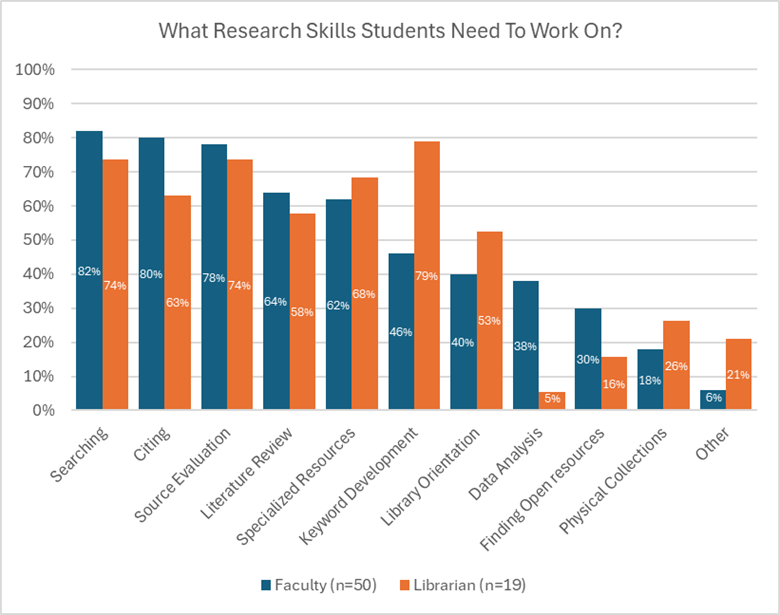
Figure 1
Areas where student research skills can be
improved.
Additionally,
respondents were asked to indicate where and how they believed students learn
the research skills necessary to complete assignments, based on a list of six
supplied options (as shown in Figure 2).
The question allowed for multiple selections, and included an Other category for
additional responses. Both faculty (n=49) and librarians (n=20) perceived that
students were either taught research skills as part of class or through
partnership with a librarian, although with differing levels of importance.
These differences are likely related to the different roles that each plays, with faculty ranking the in-class research skills
training highest (72%) and librarians rating librarian-lead instruction (80%)
as the primary mechanism for acquiring these skills.
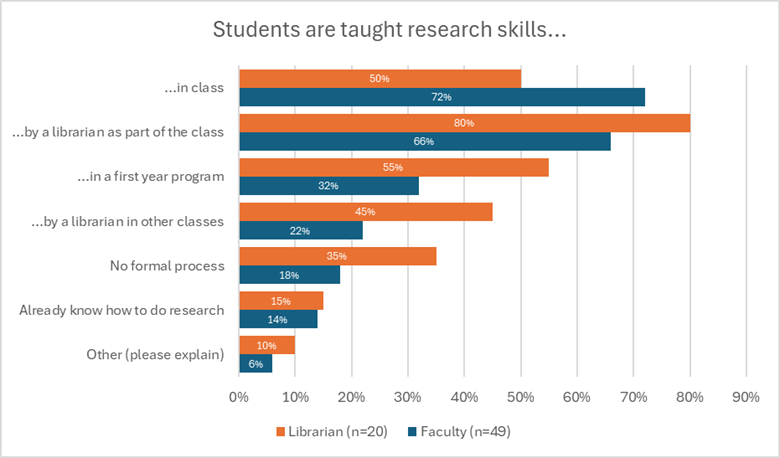
Figure 2
When, where and how student research skills are
taught.
Other
responses suggested that students learn research skills elsewhere, as part of
first-year programming, by librarians in other classes, or that students
already possess the necessary research skills. Faculty also noted other ways
that students acquire these skills, including co-curricular research
opportunities, standalone modules, or that they teach research skills
themselves. Alternately, one librarian respondent noted that while faculty
often teach basic skills, librarians are better suited for more advanced
research.
Notable
among both surveys is the number of faculty (18%) and librarians (35%) who
indicated that they were unaware of any formal process through which students
learn research skills. It should also be stressed that the interpretation of
some of the available options may be ambiguous to some readers. For instance,
respondents who indicated that students who already know how to do research may
believe that this teaching took place in first-year programming or another
class.
Changes in Frequency of Library Instruction
Respondents
were asked to reflect on ILI scheduling during the three predefined time
periods to determine possible changes in frequency following COVID-19
lockdowns. Faculty respondents (n=43) reported on the frequency of library
instruction as a part of their courses during each of the three defined
periods. Reflecting prior to the pandemic, nearly half (48.8%) reported that
fewer than half of their courses incorporated librarian-led instruction, while
a relatively small number (14%) indicated that library instruction was not part
of any course. All other responses (37.2%) reported that library instruction
was incorporated into at least half of their courses.
During
the Pandemic period, responses reflected a shift away from library instruction
requests, with nearly forty percent (39.5%) indicating that none of their
courses included ILI sessions. These responses were drawn primarily from those
who previously reported that fewer than half of courses incorporated
information literacy instruction. Across all three periods, responses
indicating that library instruction was included in at least half of courses
remained relatively consistent. Notably, Post-Lockdown results were nearly
identical to pre-COVID percentages. While responses to this question reflect
little change between the two periods overall, a clarifying, multiple-choice
question provides a more nuanced picture. Both faculty and librarians were
asked to reflect on how ILI scheduling had changed since the onset of COVID-19.
Faculty reported on their own scheduling practices, while librarians indicated
observed changes in scheduling by faculty.
The
same faculty respondents from the previous question (n=43) indicated that 53.5%
scheduled roughly the same number of sessions, while 30.2% reported requesting
fewer or no sessions compared to the pre-COVID period. A small number of
respondents (16.3%) also noted that they scheduled more sessions following the
Pandemic period. This shows a more pronounced decrease than the previous
question and supports the researchers’ observations of a reduction in
scheduling patterns caused by COVID-19.
Providing
additional support, librarian respondents (n=19) observed a more pronounced
decrease in ILI requests, with 47.4% reporting that faculty scheduled fewer
sessions Post-Lockdown, with the remaining noting
roughly the same number as pre-COVID (52.6%). Results of the librarian survey
cannot be directly compared to those of the faculty survey, but present a
general perception of decreased use of library instruction following the
Pandemic.
Influence of Instructional Modality and Research-Based Assignments
In
exploring the reasons for noted changes in the scheduling of library
instruction, two possible factors were identified: changes to faculty teaching
modalities and faculty use of research-based assignments.
Changes
to instructional modalities showed an expected shift from in-person to online
instruction following the onset of COVID-19. In reflecting on the three time
periods, faculty respondents (n=45) indicated that the majority (82.2%) had
taught either primarily or exclusively in-person prior to the pandemic, at
which point most academic institutions moved to online instruction. During the
Pandemic period, most respondents (64.4%) reported a shift to either mostly or
entirely online instruction, and the number of responses reporting an equal
amount of in-person and online teaching more than doubled (26.7%). There was a slight shift back to in-person
instruction during the Post-Lockdown period, although
most respondents (77.9%) indicated that teaching was a combination of in-person
and online. Librarian survey results (n=22) mirrored those of the faculty,
reflecting a sharp shift from in-person to online library instruction during
the Pandemic, followed by a more centered combination of these modalities, Post-Lockdown.
These
results present a shift to a more hybrid teaching modality which may have had
some impact on the perceived reduction in ILI session requests by the
researchers.
Respondents
were also asked to reflect on the average use of research-based assignments in
their courses, to identify possible changes over time that might contribute to
reduced ILI scheduling. Faculty responses (n=46) showed little variation across
the three defined periods. While the majority indicated that research
requirements were included in most or all classes throughout all three surveyed
periods, there was a slight decline between pre-COVID (67.4%) and Post-Lockdown (60.9%).
Few respondents indicated that none of their courses involved
research-based assignments prior to (2.2%) or during (6.5%) the Pandemic
period, and this number dropped to zero following the return to in-person
operations.
Librarians
(n=19) responded to a similar question, with most respondents (84.2%) noting
that at least half of instruction requests included research-based assignments
prior to the Pandemic period. This number decreased slightly during the
Pandemic period (73.7%), but returned to nearly pre-COVID numbers (79.0%)
during the Post-Lockdown period.
Results
of this question do not seem to indicate a connection between the use of
research assignments and the perceived reduction in ILI session requests.
Reasons for Scheduling Library Instruction
Respondents
indicated the reasons for requesting library instruction for courses, selecting
from a predefined list of ten common information literacy concepts (as shown in
Figure 3). The question allowed for multiple selections and included an Other category for
additional information. Both faculty and
librarians identified the same five reasons for scheduling as Searching, Specialized Resources, Literature
Review, Citing, and Library Orientation---although ranking
them differently. Faculty respondents
who chose Other noted the specific
needs of graduate students, the presence of computers in the library, and
specific assignments (legal and tax research), while one librarian respondent
noted the role of library instruction in reducing student anxiety associated
with research.
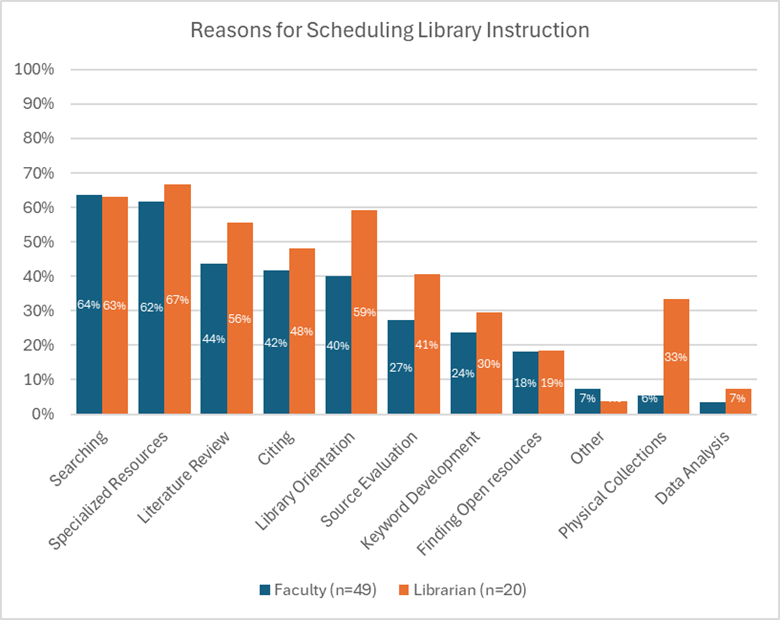
Figure 3
Reasons for scheduling library instruction.
When
compared with faculty-identified research skills where students needed
improvement, the reasons for scheduling ILI followed similar priority, with
some notable differences (as shown in Figure 4). Reasons for scheduling were
often reported at a lower percentage than student research needs, and some
skills presented large gaps between the two measures. Citing, data analysis,
and keyword development, presented
the most notable discrepancies, with lesser gaps for searching, literature review,
and keyword development.
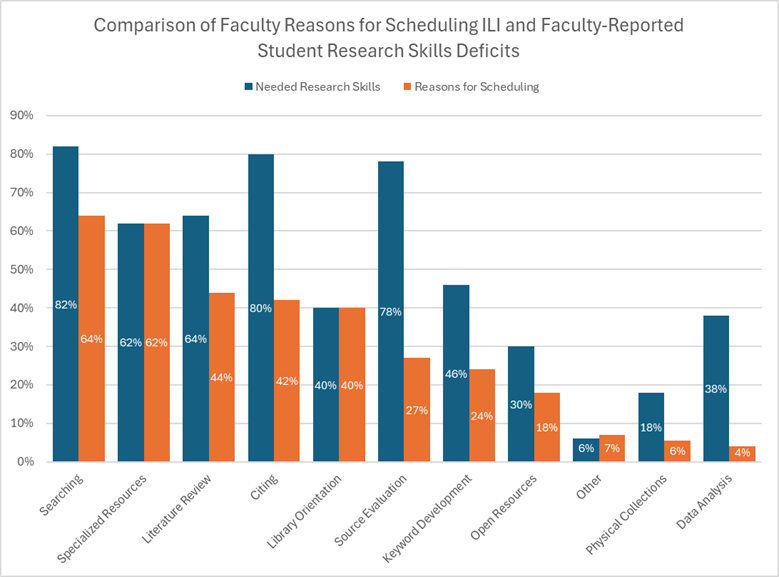
Figure 4
Faculty-reported reasons for scheduling ILI and
student research skills deficits.
Results:
Qualitative Data
In
the analysis of the qualitative data, three main themes were found: disruptors
and responses, perceptions of students and their needs, and perceptions of
librarian work.
Disruptors and Responses
In
alignment with the existing literature, our results indicate a demonstrated
impact on instruction requests during the lockdown period as faculty and
librarians noted decreased instruction requests overall. While qualitative
responses from faculty indicated that instruction requests returned to
pre-COVID levels after the return to in-person operations, the disruption was
felt and noted by both faculty and librarians.
Some
faculty mentioned that students didn’t have enough time to learn about research
face to face following the shift to more virtual instruction during the
pandemic. Some also commented that they themselves also struggle with not
having enough time to teach all their classes and do their work, so library
classes drop off their syllabus as a result. Faculty reported that changes made
to teach online during the pandemic have persisted in their current teaching
practices. Some acknowledged that they need to scaffold or weave in research
skill instruction throughout their asynchronous courses.
When
asked what the library could do differently to increase the frequency of ILI
for students, some faculty said they currently use or would like to use video
tutorials to teach this type of content throughout the semester (the authors
infer that these videos would be used outside of class time). Such materials
were described by faculty as “self-paced, mini lessons, small training
modules,” which aligns with the theme of time constraint appearing in the
textual comments. One respondent also wanted the library to issue a receipt
when the students completed the work. While perhaps not intentional, the
suggested modules would replace the in-person instruction component. This view
also reflects the notion from the literature that librarians are more like IT
professionals or content creators than teachers.
Librarians
wrote that instructors don’t want to give up any class time for ILI, reflecting
a desire for asynchronous, self-paced instruction. Like faculty, librarians
also observed that the shift to online learning, compressed schedules, and
larger enrollments in classes had created time constraints for faculty, leaving
fewer opportunities for librarians to work directly with students in their
courses.
An
interesting finding was the unprompted mention of artificial
intelligence—specifically generative AI—in the qualitative responses. The
research team did not design the study to ask about disruptions outside of the
pandemic; however, several respondents mentioned it on their own, demonstrating
the seismic effect generative AI can have on information literacy in higher
education. Some librarians and faculty indicated they were staunchly against
using AI, while others embraced it and wanted to see librarians include more AI
discussions in IL sessions. One faculty member stated, “after AI became popularized I reduced ‘research paper’ assignments due to
the increase in undetected plagiarism”.
Many
of the responses reflect the reality that both the pandemic and AI have had
direct impacts on faculty and librarians as they wrestle with teaching
information literacy and research skills to students.
Perceptions of Students and Their Needs
Faculty
and librarians both reported a deficit in the perceived levels of student
research skills. Some faculty commented that students did not need dedicated
ILI sessions, though they would direct students to library resources and
librarians when needed. Others noted that ILI should take place outside of
class, with one suggesting an “open office” approach where librarians schedule
optional sessions for students to attend as needed. Still others said they had
lowered expectations of students since the pandemic but saw their students as
needing more support from the library because of their lack of research skills.
Faculty
also reported on student mental health as a factor when considering ILI for
their courses. Student anxiety and
lowered skill levels mean that there was little time for sessions with a
librarian. One faculty member commented that “students have become a lot more
anxious and require so much more hand holding that I'm finding it difficult to
cover all the necessary materials,” adding that this meant that ILI was dropped
from some lower level courses.
Several
faculty and librarians lowered their expectations of students, with some
providing more scaffold approaches to ILI or changing their pedagogy. A few
faculty commented that students weren’t motivated or interested in learning
research skills and put the onus on students to take advantage of library
services and resources when they needed or wanted it. Librarians commented on
the students' lack of reading, research, and writing skills, and some blamed
the lack of preparedness on the pandemic, especially for incoming students. One
librarian noted while speculating about college-level readiness, “the pandemic
left many students underprepared for research and project-based assignments.
High-school teachers during the pandemic perhaps opted not to teach the
traditional research paper or process.” Another focused on the instruction
itself describing how “I’ve noticed since [the] pandemic that attention spans
of students have shortened dramatically. If I cannot captivate them in the
first few minutes…I begin to lose them.” In response, some librarians wrote
about how they changed their approach to teaching information literacy to
motivate students and address the perceived skill deficit.
Perceptions of Librarian Work
The
responses provided a window into how faculty generally felt about ILI. Several
of the faculty responses praised librarians for the work they did and its
impact on student information literacy skills, including comments praising
their expertise. Some stated that due to circumstances beyond their control,
including lack of time or a change in coursework, that they were not scheduling
instruction as frequently as they used to. Some faculty indicated they had
forgotten that ILI from a librarian was available or that “not all students
need/want library instruction.” However, even with changes in coursework, some
faculty noted that they are requesting more instruction sessions than they had
in previous years. In addition, some of the faculty requested that the
university hire more librarians.
While
there were positive comments, some faculty did share negative experiences with
library instruction, including frustration with the librarian’s teaching. Some
faculty found the actual scheduling frustrating, citing the library instruction
request form being problematic, as well as what was offered, requesting items
such as mini-sessions. However, many of the faculty responses showed positive
feelings towards the library and librarians in general.
Some
of the librarian responses on this theme seem defeated, with one stating “I can
only guess that [faculty] feel capable of doing information literacy
instruction themselves.” Librarians had
a mix of experiences about teaching online, noting both challenges and
opportunities presented by the pandemic. Some noted missing the interpersonal
interactions within a physical classroom while others discussed taking the time
to update their skills and improve their approach to teaching.
Both
faculty and librarians discussed the need for collaboration and outreach between
the library and the general university community. Responses mentioned
librarians visiting department meetings, sending targeted emails, and even
having a required information literacy course. However, some were
unsure what library instruction would entail for asynchronous courses.
Discussion
This
study was designed to explore perceived ILI trends and librarian/faculty
perceptions of student research skills reflecting across the five
year period around the COVID-19 pandemic. Some of the most notable findings
are that 1) while some librarians perceive a decline in ILI requests,
faculty-reported ILI scheduling behaviors have largely returned to their
pre-pandemic norms; 2) both faculty and librarians perceive greater student
information literacy deficits after the lockdowns; and 3) there is an apparent
misalignment between how faculty perceive gaps in student IL competencies and
their approaches to involving librarians in addressing these deficits. To help
contextualize our findings, we now return to our initial research questions:
Have Faculty Changed the Way They Teach Research-Based Components of Their Courses and if so, How?
This
overarching question was intended to broadly examine faculty behaviors
regarding the scheduling of ILI. Overall, reported faculty scheduling
behaviors did not change significantly from the pre-pandemic to post-lockdown
periods. Following a lockdown-era decline, faculty ILI scheduling patterns
mostly returned to pre-pandemic levels; data showed nearly identical numbers in
the pre-COVID and post-lockdown periods. There was a significant and expected
shift to fully online during the lockdown period, a trend noted by Eva (2021)
and Taylor (2023). While faculty reported a return to pre-pandemic scheduling
practices, a higher percentage of librarians believed that faculty are
requesting fewer ILI sessions. This discrepancy between reported librarian
perceptions of scheduling trends and faculty-reported scheduling behaviors
could be explained by the common sentiment documented in the literature that
librarians believe that faculty and administrators do not value their work (Becksford, 2022; Goodwin & Afzal, 2023; McCartin &
Wright-Mair, 2022; Polger, 2024), which may lead some
librarians to naturally assume the worst. Another possible explanation could be
potential self-selection bias among faculty respondents, with “library
champions” being more likely to respond than other faculty. Alternatively, this disconnect could also
result from the asymmetrical nature of the survey instrument, as librarian
responses were recorded at multiple institutions in which faculty were not
surveyed.
While
there wasn’t a significant change in faculty-reported scheduling habits, some
responses indicated that reasons for not scheduling included time constraints,
changes in course design, and other external factors. A few faculty mentioned
not scheduling due to their perception of student research skill deficits and
lack of overall preparedness. The fact that faculty curtailed their use of
library instruction as they perceived decreasing student IL skills could
indicate that they do not sufficiently value or recognize librarian expertise.
In addition, many faculty talked about a shift to asynchronous information
literacy instruction using videos to replace the traditional method of teaching
ILI, a trend which is observed in the literature (Eva, 2021; Goosney, 2024).
How Do the Faculty Perceptions of Their Students’ Skills Influence the Ways They Are Formulating Their Courses Around Research Content?
Both
faculty and librarians reported a decline in student research skills. The
qualitative responses explored this in more depth as both groups reported
additional factors outside of research skills, including students’ lack of
motivation and preparation and, in some cases, anxiety. Faculty used phrases
like “hand-holding,” indicating their feelings toward overall student
well-being and preparedness for college-level research. Accordingly,
librarians changed how they were teaching because students seem less prepared.
Many of the librarians’ comments about student IL gaps identified a lack of
preparation and/or the pandemic as the primary causes of this issue. These
faculty and librarian perceptions largely align with the literature on
widespread learning loss resulting from pandemic disruptions (Agarwala et al,
2022; Engzell et al, 2021). While the questions were
meant to highlight how faculty think of students now (during the post-lockdown
period), pre-pandemic literature also demonstrates faculty perceptions of gaps
in student research skills (Blankstein, 2022; Bury, 2011, 2016; Cope &
Sanabria, 2014; Saunders, 2012; Weetman DaCosta, 2010).
When
asked specifically about deficits in student research skills, both faculty and
librarians had similar responses regarding which skills needed the most
attention - searching, citing, and source evaluation were mentioned
frequently by both groups. However, the librarians focused on keyword development as a skill, which
fewer faculty mentioned, possibly due to a difference of interpretation of this
concept. When faculty were asked why they scheduled ILI, there were notable
discrepancies compared to their perceived student skill deficits. For instance,
only 27% of respondents indicated that source evaluation as a reason for scheduling
with a librarian, but 78% noted that they felt students needed improvement with
this skill. An intriguing finding
from this question is the disconnect between what faculty request for ILI and
where they see their students struggling. If source evaluation is an area where
students need more help, why is it not driving faculty to schedule more library
instruction? In our survey results, faculty prioritized scheduling library
instruction for searching, specialized resources, literature review, citing and
library orientation before source evaluation, even though source evaluation
(along with citing and searching) were noted as areas where students needed the
most improvement. This finding aligns with the widely-reported perception among
librarians that faculty view ILI as procedural, rather than seeing librarians
as teachers with distinctive expertise (Baer, 2021; Becksford,
2022; Galoozis, 2019; Polger
2024). This is an indication that ILI’s structural precarity, rather than
pandemic disruptions, is leading to missed learning opportunities in some
areas.
How Are Faculty Teaching Their Students Information Literacy and How Are They Collaborating With the Library to do so?
Most
faculty respondents indicated research skills are taught in class, with 66%
noting that they include librarians in teaching IL skills. The most common
reasons identified for scheduling ILI for their courses were searching, specialized resources, literature
review, citing, and library orientation. With the exception
of library orientation, these
responses align with IL skills that are reflected in the ACRL Framework.
Librarian responses placed more emphasis on their role in teaching these
skills, with 80% stating that faculty included librarians in teaching ILI.
Divergent responses between faculty and librarians may have resulted from
different interpretations of the questions or from innate differences in the
composition of the two populations. However, it is notable that the faculty,
while speaking highly of librarians, indicated that IL skills are taught “in
class.” While our study did not set out to study faculty misunderstandings of
librarian expertise, our findings suggest that these misperceptions are
impacting librarians’ access to students to teach information literacy.
Some
librarians discussed the shift to online as being a detriment to their overall
teaching experience, indicating how they missed the in-person element and being
able to interact with students. However, some librarians did use the shift to
remote learning to better enhance their pedagogy and develop their teaching
skills, similar to findings in Bury (2024) and Goosney (2024), the latter of
whom found an increase in librarian confidence in online instruction during the
lockdown period. When it came to their teaching, only 41 percent of faculty
named liaison/subject librarians as very/extremely important, and they do not
work regularly with librarians on their syllabi or lesson plans. However, a
large majority of faculty continue to highly value the library to support
teaching and student success, as reflected in Love & Blankenstein (2024).
A
positive trend observed in the data is the rebound of instruction requests after
the COVID-19 pandemic decline. While a small number of faculty may no longer
request ILI from librarians, the responses from the two institutions showed
post-lockdown numbers returning to pre-pandemic levels. Librarians may not be
teaching ILI in entirely the same way, but they are still teaching regularly
and can utilize this information to continue to promote instruction to their
faculty peers. Asynchronous models were something requested by multiple faculty, which may be an avenue for librarians to continue
exploring.
There
was a disconnect where faculty perceive student research skill deficits and why
they schedule ILI. Items like source evaluation showed a large gap - 78% of
faculty mentioned seeing it as a student skill deficit but only 27% requested
library instruction to address it. It’s possible that faculty do not understand
the full range of what information literacy teaching is; instruction librarians
may want to consider better communicating what an information literacy session
could cover as opposed to assuming that faculty know what librarians can teach.
When
asked about increasing library instruction scheduling, many of the responses
included suggestions about curricular integration and collaboration with
different departments; those methods could allow for librarians to become more
involved in teaching those skills faculty noted as deficient. Such suggestions
align with some emerging themes in the literature regarding formalizing the
status of ILI in the curriculum. For example, Gibson and Massey (2024) found
that the collaborative development and co-teaching of a course by a
faculty-librarian team notably enhanced student learning. Similarly, librarians
interviewed by Goodwin and Afzal (2023) suggested that promoting the curricular
integration of ILI will likely improve student learning outcomes. Embedding IL
in the curriculum could also provide librarians with more time to engage in
teaching work since there should be a corresponding reduction in the amount of
time spent engaging in faculty outreach.
As
noted earlier, Generative AI was mentioned frequently in the open-ended
comments without prompting in a study that did not ask questions about
Generative AI, signaling the impact this new technology has already and will
continue to have. Results demonstrate
the impact that Generative AI is having in the space of scholarly conversation
and information literacy. Responses from both faculty and librarians pointed to
fears of plagiarism, with some stating that they had changed their assignments
due to AI tools like ChatGPT. While the data from this study cannot directly
support claims that plagiarism is increasing due to AI, it is possible that if
faculty change or eliminate research-based assignments due to fears of
Generative AI, their usage of library instruction may decrease. Therefore, this study also shows a need to
explore both librarian and teaching faculty attitudes about Generative AI and
how it impacts student research assignments and potentially impacts their
information-seeking behavior.
Limitations and Future Research
Some
notable limitations to this study will now be addressed. In higher education
there are significantly fewer librarians than teaching faculty, and among the
pool of eligible librarians, some may have opted out of the survey because they
do not consider teaching as their primary role. Therefore, the number of
respondents to the librarian survey was quite small in comparison with the
faculty survey. In addition, while faculty responses were drawn from the two institutions
where the research team members are employed, librarian participants were
identified from eleven similar colleges and universities within the state. The
inclusion of these other librarian perspectives reflects experiences from
numerous institutions that may not directly align with those of the faculty
respondents. Librarian responses serve to enrich those of the faculty survey,
but cannot and should not provide a direct comparison. As such, the resulting
data cannot be generalized because of key differences between these groups and
due to the exploratory nature of this study.
While
this research focused on faculty and librarian perceptions, future research
should engage additional stakeholders to better understand the importance of
ILI in higher education. Of note is the predominance of full-time faculty
(tenured and tenure-track) respondents and the lower representation of adjunct
faculty and other teaching professionals. Exploration of how the perceptions of
these two groups differ may add nuance to this research. Additionally, the
voices of students were not included, but are important to better understanding
these issues.
Qualitative
responses from the faculty survey included reflections of how faculty view
librarians and their abilities as teachers. Comments were both positive—praise
for the work they do—and negative—a critical recommendation for improving
librarian teaching skills—and suggest additional areas of research on this
topic. Further studies should explore the impact of formal teacher training and
practical experience on teaching effectiveness of librarians, as relates to
faculty scheduling practices.
Implications
Although
the findings are not generalizable, there are notable implications for
practice. Both librarians and faculty observed a decrease of instruction during
the pandemic; while not unexpected, this has an impact on the number of
students librarians are able to reach, particularly during disruptive periods.
Librarians may want to consider looking at practices that fully embed
information literacy instruction at the course or curricular level which could
help to mitigate the impact of future disruptions. Also, as seen in the
corresponding literature, librarians may encounter faculty who do not fully
comprehend or sufficiently value ILI – or who have had a negative experience
with library instruction. Librarians should therefore consider different ways
of collaboration, communication, and framing their expertise to faculty.
Finally, librarians should align their work to proactively address some of the
most disruptive impacts arising from the proliferation of generative AI, which
could include designing AI-centered lessons and educating faculty about the
tangible ways in which ILI can directly address their concerns about AI and
student research. We cannot assume that faculty or our institutions are aware
that librarians have a role in teaching AI literacy, for example. While the
connection between information literacy and AI literacy may seem obvious to
librarians, it may not be to our faculty and administrators.
The
“new normal” appears to closely resemble the old, and the authors contend that
it is important for librarians to question whether this is a good thing. While
pandemic disruptions led to some notable innovations for teaching ILI, such as
flexible teaching modalities and broader demand for asynchronous content, they
also exposed and amplified existing structural flaws. Now more than ever,
librarian involvement with ILI appears contingent upon developing and sustaining
relationships with faculty who may not understand or value their expertise.
Considering the increasingly disruptive impacts of generative AI represented in
both popular discourse and the results of this study, librarians should
consider ways to highlight the intersection of ILI and AI in their outreach
efforts moving forward. But perhaps more importantly, librarians should
advocate for a more formal role for ILI at both the individual course and
curricular levels to improve student IL comprehension and learning outcomes as
well as demonstrate their own credibility and authority within the higher
education ecosystem.
Conclusion
The
findings of this study show an unsurprising decrease in ILI sessions during the
lockdown period of 2020-2021, followed by a substantial rebound to nearly
pre-pandemic levels after the return to in-person learning. Faculty and
librarian responses were largely aligned in most areas, such as perceived
declines in student preparedness and research skills, but diverged somewhat in
relation to post-lockdown faculty scheduling habits. Furthermore, some
responses suggest a disconnect between faculty perceptions of student IL needs
and their self-reported motives for scheduling library instruction, which may
indicate a misunderstanding of librarian expertise and the benefits of ILI.
The
disruptions caused by COVID-19 highlighted that the current, informal ways in
which information literacy is situated in higher education are neither
sufficient nor sustainable. While the next global pandemic is hopefully far off
in the future, other disruptors—such as the recent arrival of Generative AI—can
greatly impact the work we do as librarians. Therefore, a more holistic
approach to IL, reflecting some degree of curricular integration and more
equitable partnerships between faculty and librarians, should be an
institutional and professional goal.
Author
Contribution
All
authors contributed equally to Conceptualization, Investigation, Methodology,
Writing - original draft, and Writing - review & editing.
References
Agarwala,
V., Sahu, T. N., & Maity, S. (2022). Learning loss amid closure of learning
spaces during the COVID-19 pandemic. International
Journal of Education and Development Using Information and Communication
Technology, 18(3), 93–109.
Antonesa, M.
(2007). Challenging times: Some thoughts on the professional identity of the
academic librarian. SCONUL Focus, 40,
9-11.
Baer,
A. (2021). Academic librarians’ development as teachers: A survey on changes in
pedagogical roles, approaches, and perspectives. Journal of Information Literacy, 15(1), 26–53. https://doi.org/10.11645/15.1.2846
Baer,
A. (2024). The role of librarian-faculty relations in academic instruction
librarians’ conceptions and experiences of teacher agency. portal: Libraries and the Academy, 24(4), 867–891. https://doi.org/10.1353/pla.2024.a938746
Badke,
W. (2011). Why information literacy is invisible. Communications in Information Literacy, 4(2), 129-141. https://doi.org/10.15760/comminfolit.2011.4.2.92
Becksford, L.
(2022). Instruction librarians’ perceptions of the faculty-librarian
relationship. Communications in
Information Literacy, 16(2), 119–150. https://doi.org/10.15760/comminfolit.2022.16.2.3
Becker,
J. K., Bishop Simmons, S., Fox, N., Back, A., & Reyes, B. M. (2022).
Incentivizing information literacy integration: A case study on
faculty-librarian collaboration. Communications
in Information Literacy, 16(2), 167-181. https://doi.org/10.15760/comminfolit.2022.16.2.5
Bury,
S. (2011). Faculty attitudes, perceptions and experiences of information
literacy: A study across multiple disciplines at York University, Canada. Journal of Information Literacy, 5(1),
45–64. https://doi.org/10.11645/5.1.1513
Bury,
S. (2016). Learning from faculty voices on information literacy: Opportunities
and challenges for undergraduate information literacy education. Reference Services Review, 44(3),
237–252. https://doi.org/10.1108/RSR-11-2015-0047
Bury,
S. (2024). Reinventing information literacy instruction during the Covid-19
pandemic: Exploring experiences, evolutions and implications for online
information literacy programming. The
Journal of Academic Librarianship, 50(2), Article 102851. https://doi.org/10.1016/j.acalib.2024.102851
Cope,
J., & Sanabria, J. E. (2014). Do we speak the same language? A study of
faculty perceptions of information literacy. portal: Libraries and the Academy, 14(4), 475-501. https://doi.org/10.1353/pla.2014.0032
Cox,
A., Nolte, A., & Pratesi, A. L. (2023). Investigating faculty perceptions
of information literacy and instructional collaboration. Communications in Information Literacy, 17(2), 407–423. https://doi.org/10.15760/comminfolit.2023.17.2.5
Dawes.
L. (2019). Through faculty’s eyes: Teaching threshold concepts and the
Framework. portal: Libraries and the
Academy, 19(1), 127-153. https://doi.org/10.1353/pla.2019.0007
Engzell, P.,
Frey, A., & Verhagen, M. D. (2021). Learning loss due to school closures
during the COVID-19 pandemic. Proceedings
of the National Academy of Sciences of the United States of America, 118(17),
1–7.
Eva,
N. (2021). Information literacy instruction during COVID-19. Partnership: The Canadian Journal of Library
and Information Practice and Research, 16(1), 1-11. https://doi.org/10.21083/partnership.v16i1.6448
Galoozis, E.
(2019). Affective aspects of instruction librarians’ decisions to adopt new
teaching practices: Laying the groundwork for incremental change. College & Research Libraries, 80(7),
1036–1050. https://doi.org/10.5860/crl.80.7.1036
Gibson,
C. T. & Massey, E. (2024). The power of solidarity: The effects of
professor-librarian collaboration on students’ self-awareness of skill
acquisition. Communications in
Information Literacy, 18(1), 72–93.
Gill,
N., & Springall, E. (2021). Capturing the big picture: Academic library
instruction across an institution. Journal
of Information Literacy, 15(3), 134–142. https://doi.org/10.11645/15.3.3020
Goodwin,
A. & Afzal, W. (2023). Giving voice to regional Australian academic
librarians: Perceptions of information literacy and information literacy
instruction. Journal of Information Literacy,
17(2), 131–149. https://doi.org/10.11645/17.2.11
Goosney,
J. L. (2024). “We learned as we went like everyone else”: Experiences of
librarians teaching information literacy at Canadian universities during the
Covid-19 pandemic. Partnership: The
Canadian Journal of Library & Information Practice and Research, 18(2),
1–36. https://doi.org/10.21083/partnership.v18i2.7537
Gruber,
A. M. (2018). Real-world research: A qualitative study of faculty perceptions
of the library's role in service-learning. portal:
Libraries and the Academy, 18(4), 671-692. https://doi.org/10.1353/pla.2018.0040
Guest, G.,
MacQueen, K. M., & Namey, E. E. (2012). Applied
Thematic Analysis. Sage.
Hews, R.,
McNamara, J., & Nay, Z. (2022). Prioritising lifeload
over learning load: Understanding post-pandemic student engagement. Journal of University Teaching &
Learning Practice, 19(2), 128–146. https://doi.org/10.53761/1.19.2.9
Hardesty, L. L. (1995). Faculty culture
and bibliographic instruction: An exploratory analysis. Library Trends 44(2), 339–367.
Kim, M., Seo,
D., & Damas, M. C. (2023). Community college STEM faculty and the ACRL
Framework: A pilot study. Issues in
Science and Technology Librarianship, 102. https://doi.org/10.29173/istl2714
Kuglitsch, R.
Z. (2015). Teaching for transfer: Reconciling the Framework with disciplinary
information literacy. portal: Libraries
and the Academy, 15(3), 457–470. https://doi.org/10.1353/pla.2015.0040
Kupersmith, J.
(2012). Library terms that users
understand. UC Berkeley: Library. https://escholarship.org/uc/item/3qq499w7
Latham, D.,
Gross, M., & Julien, H. (2024). Community college librarian views of
student information literacy needs. College
& Research Libraries, 85(5), 712–725. https://doi.org/10.5860/crl.85.5.712
Leckie, G. J.,
& Fullerton, A. (1999). Information literacy in science and engineering
undergraduate education: Faculty attitudes and pedagogical practices. College & Research Libraries, 60(1),
9-29. https://doi.org/10.5860/crl.60.1.9
Love, S., &
Blankstein, M. (2024). 2024 US Instructor
Survey. Findings from a national survey. ITHAKA S+ R. https://doi.org/10.18665/sr.321165
McCartin, L. F.,
& Wright-Mair, R. (2022). Manifestations of deference behavior in teaching-focused
academic librarians. The Journal of
Academic Librarianship, 48(6), Article 102590. https://doi.org/10.1016/j.acalib.2022.102590
McDonald, C.,
& Trujillo, N. (2024). Library terms that users (don’t) understand: A
review of the literature from 2012-2021. College
& Research Libraries, 85(6), 906-929. https://doi.org/10.5860/crl.85.6.906
McGuinness, C.
(2006). What faculty think: Exploring the barriers to information literacy
development in undergraduate education. Journal
of Academic Librarianship, 32(6), 573–582. https://doi.org/10.1016/j.acalib.2006.06.002
Moran, C.
(2019). Disconnect: Contradictions and disagreements in faculty perspectives of
information literacy. The Reference
Librarian, 60(3), 149-168. https://doi.org/10.1080/02763877.2019.1572573
Nichols Hess, A.
(2020). Academic librarians’ teaching identities and work experiences:
Exploring relationships to support perspective transformation in information
literacy instruction. Journal of Library
Administration, 60(4), 331–353. https://doi.org/10.1080/01930826.2020.1721939
Nierenberg, E.,
Solberg, M., Låg, T., & Dahl, T. I. (2024). A
three-year mixed methods study of undergraduates’ information literacy
development: Knowing, doing, and feeling. College
& Research Libraries, 85(6), 804–825. https://doi.org/10.5860/crl.85.6.804
O’Neill, B.,
& LeBlanc, A. (2023). A database by any other name: Instructor language
preferences for library resources. New
Review of Academic Librarianship, 29(2), 174–188. https://doi.org/10.1080/13614533.2022.2095290
Polger, M.
A. (2024). The information literacy class as theatrical performance: A
qualitative study of academic librarians’ understanding of their teacher
identity. Journal of Education for
Library and Information Science, 65(2), 137–162. https://doi.org/10.3138/jelis-2023-0009
Saunders, L.
(2012). Faculty perspectives on information literacy as a student learning
outcome. Journal of Academic
Librarianship, 38(4), 226–236. https://doi.org/10.1016/j.acalib.2012.06.001
Saunders, L.
(2022). Faculty perspectives on mis- and disinformation across disciplines. College & Research Libraries, 83(2),
221–245. https://doi.org/10.5860/crl.83.2.221
Sayed, Y., Cooper, A., & John, V. M.
(2021). Crises and disruptions: Educational
reflections, (re)imaginings, and (re)vitalization. Journal of Education (South Africa), 84, 9–30. https://doi.org/10.17159/2520-9868/I84A01
Sloniowski, L. (2016). Affective labor, resistance, and the academic
librarian. Library Trends, 64(4),
645-666. https://doi.org/10.1353/lib.2016.0013
Squibb, S.L.D., & Zanzucchi,
A. (2020). Apprenticing researchers: Exploring upper-division students’
information literacy competencies. portal:
Libraries and the Academy, 20(1), 161-185. https://doi.org/10.1353/pla.2020.0008
Stonebraker, I., & LeMire, S. (2023). Requesting librarian-led information
literacy support: Instructor approaches, experiences, and attitudes. portal: Libraries and the Academy, 23(4),
843–862. https://doi.org/10.1353/pla.2023.a908704
Taylor, L. R.
(2023). 2021 ACRL Academic Library Trends and Statistics Survey: Highlights and
key academic library instruction and group presentation findings. College & Research Libraries News, 84(4),
149–157. https://doi.org/10.5860/crln.84.4.149
Weetman DaCosta,
J. (2010). Is there an information literacy skills gap to be bridged? An
examination of faculty perceptions and activities related to information
literacy in the United States and England. College
& Research Libraries, 71(3), 203–222. https://doi.org/10.5860/0710203
Yousefi, B.
(2022, November 2-4). Four provocations
for the time being [Presentation slides and notes]. Critical Librarianship
& Pedagogy Symposium, Tucson, AZ, United States. http://hdl.handle.net/10150/669864
Appendix
A
Survey Instrument - Faculty
- At which institution(s) are you
employed? (select all that apply)
●
[Institution #1]
●
[Institution #2]
- What is your primary role at your
institution?
೦ Full-time faculty (tenured)
೦ Full-time faculty (tenure track)
೦ Adjunct faculty
೦ Non Tenure Track Teaching Professional (NTTP)
೦ Instructional Specialist
೦ Staff
೦ Administration
೦ Other (please explain)
- What has
been the modality of your teaching?
|
Prior to March 2020 |
From March 2020 through Summer 2021 |
Since the start of the Fall 2021 semester |
|
೦ All Online |
೦ All Online |
೦ All Online |
|
೦ Mostly Online |
೦ Mostly Online |
೦ Mostly Online |
|
೦ Equally Online & In-Person |
೦ Equally Online & In-Person |
೦ Equally Online & In-Person |
|
೦ Mostly In-Person |
೦ Mostly In-Person |
೦ Mostly In-Person |
|
೦ All In-Person |
೦ All In-Person |
೦ All In-Person |
|
೦ N/A |
೦ N/A |
೦ N/A |
- On average,
how many of your courses required research-based assignments, per
semester?
|
Prior to March 2020 |
From March 2020 through Summer 2021 |
Since the start of the Fall 2021 semester |
|
೦ None |
೦ None |
೦ None |
|
೦ Few |
೦ Few |
೦ Few |
|
೦ Half |
೦ Half |
೦ Half |
|
೦ Most |
೦ Most |
೦ Most |
|
೦ All |
೦ All |
೦ All |
|
೦ N/A |
೦ N/A |
೦ N/A |
- How do students learn research
skills to complete assignments?
● Students already know how to do research
● Students are taught research skills in
class
● Students are taught research skills by a
librarian as part of the class
● Students are taught research skills by a
librarian in other classes
● Students are taught research skills in a first year program
● There is not formal process for most
students to learn research skills
● Other (please explain)
- On average,
how many of your courses include a scheduled library instruction lesson,
per semester?
|
Prior to March 2020 |
From March 2020 through Summer 2021 |
Since the start of the Fall 2021 semester |
|
೦ None |
೦ None |
೦ None |
|
೦ Few |
೦ Few |
೦ Few |
|
೦ Half |
೦ Half |
೦ Half |
|
೦ Most |
೦ Most |
೦ Most |
|
೦ All |
೦ All |
೦ All |
|
೦ N/A |
೦ N/A |
೦ N/A |
- Why did you schedule library
instruction for your course(s)? (select all that apply)
● Library Orientation
● Keyword Development
● Searching
● Specialized Resources (e.g. specific databases)
● Source Evaluation
● Citing
● Literature Review
● Physical Collections (e.g. archives or
print materials)
● Data Analysis
● Finding Open Resources
● Other (please explain)
- How did the pandemic change your
approach to scheduling library instruction?
೦ I schedule fewer sessions
೦ I schedule roughly the same number of
sessions
೦ I schedule more sessions
೦ I no longer schedule library instruction
for my classes
- What influenced this change in your
approach to scheduling library instruction?
- Did your approach to teaching
students research skills change in any other way? Please explain.
- Have you noticed a change in your
students' research skills prior to March 2020 compared with the last two
years (starting the Fall 2021 semester)?
೦ Yes, they now have stronger research
skills
೦ Yes, they now have weaker research skills
೦ No, I have not noticed a change
೦ Unsure
- In what areas do your students'
research skills need improvement? (select all that apply)
● Library Orientation
● Keyword Development
● Searching
● Specialized Resources (e.g. specific
databases)
● Source Evaluation
● Citing
● Literature Review
● Physical Collections (e.g. archives or
print materials)
● Data Analysis
● Finding Open Resources
● Other (please explain)
- What could your institution's
library offer to increase the likelihood of scheduling a library
instruction lesson with a librarian?
- Do you have any other ideas or
observations to share?
Appendix
B
Survey Instrument - Librarian
- At which institution(s) are you
employed?
- What has
been the modality of your library instruction?
|
Prior to March 2020 |
From March 2020 through Summer 2021 |
Since the start of the Fall 2021 semester |
|
೦ All Online |
೦ All Online |
೦ All Online |
|
೦ Mostly Online |
೦ Mostly Online |
೦ Mostly Online |
|
೦ Equally Online & In-Person |
೦ Equally Online & In-Person |
೦ Equally Online & In-Person |
|
೦ Mostly In-Person |
೦ Mostly In-Person |
೦ Mostly In-Person |
|
೦ All In-Person |
೦ All In-Person |
೦ All In-Person |
|
೦ N/A |
೦ N/A |
೦ N/A |
- On average,
how many library instruction requests included required research-based
assignments, per semester?
|
Prior to March 2020 |
From March 2020 through Summer 2021 |
Since the start of the Fall 2021 semester |
|
೦ None |
೦ None |
೦ None |
|
೦ Few |
೦ Few |
೦ Few |
|
೦ Half |
೦ Half |
೦ Half |
|
೦ Most |
೦ Most |
೦ Most |
|
೦ All |
೦ All |
೦ All |
|
೦ N/A |
೦ N/A |
೦ N/A |
- How do students learn research
skills to complete assignments?
● Students already know how to do research
● Students are taught research skills in
class
● Students are taught research skills by a
librarian as part of the class
● Students are taught research skills by a
librarian in other classes
● Students are taught research skills in a first year program
● There is not formal process for most
students to learn research skills
● Other (please explain)
- Why do you think faculty schedule
library instruction for your course(s)? (select all that apply)
● Library Orientation
● Keyword Development
● Searching
● Specialized Resources (e.g. specific
databases)
● Source Evaluation
● Citing
● Literature Review
● Physical Collections (e.g. archives or
print materials)
● Data Analysis
● Finding Open Resources
● Other (please explain)
- How did the pandemic change
faculty’s approach to scheduling library instruction?
೦ I schedule fewer sessions
೦ I schedule roughly the same number of
sessions
೦ I schedule more sessions
೦ I no longer schedule library instruction
for my classes
- What do you think has influenced
faculty to change their approach to scheduling library instruction?
- How has the pandemic affected how
you teach library instruction? Please explain.
- Have you noticed a change in
students' research skills prior to March 2020 compared with the last two years
(starting the Fall 2021 semester)?
೦ Yes, they now have stronger research
skills
೦ Yes, they now have weaker research skills
೦ No, I have not noticed a change
೦ Unsure
- In what areas have you observed that
students need improvement? (select all that apply)
● Library Orientation
● Keyword Development
● Searching
● Specialized Resources (e.g. specific
databases)
● Source Evaluation
● Citing
● Literature Review
● Physical Collections (e.g. archives or
print materials)
● Data Analysis
● Finding Open Resources
● Other (please explain)
- What could your library do to
increase the likelihood of scheduling a library instruction lesson with a
librarian?
- Do you have any other ideas or
observations to share?