Review Article
Assessing Formatting Accuracy of APA Style References: A Scoping Review
Laurel
Scheinfeld
Health
Sciences Librarian
Stony
Brook University Libraries
Stony
Brook, New York, United States of America
Email:
laurel.scheinfeld@stonybrook.edu
Health
Sciences Librarian
Stony
Brook University Libraries
Stony
Brook, New York, United States of America
Email:
sunny.chung@stonybrook.edu
Undergraduate
Success Librarian
Stony
Brook University Libraries
Stony
Brook, New York, United States of America
Email:
christine.fena@stonybrook.edu
Head
of Science and Engineering
Stony
Brook University Libraries
Stony
Brook, New York, United States of America
Email:
clara.tran@stonybrook.edu
Head
of Academic Engagement
Stony
Brook University Libraries
Stony
Brook, New York, United States of America
Email:
chris.kretz@stonybrook.edu
Retired
Librarian
North
Babylon, New York, United States of America
Email:
myrar137@yahoo.com
Received: 22 May 2025 Accepted: 6 Oct. 2025
 2025 Scheinfeld,
Chung, Fena, Tran, Kretz, and Reisman. This is an Open Access article
distributed under the terms of the Creative Commons‐Attribution‐Noncommercial‐Share Alike License 4.0
International (http://creativecommons.org/licenses/by-nc-sa/4.0/),
which permits unrestricted use, distribution, and reproduction in any medium,
provided the original work is properly attributed, not used for commercial
purposes, and, if transformed, the resulting work is redistributed under the
same or similar license to this one.
2025 Scheinfeld,
Chung, Fena, Tran, Kretz, and Reisman. This is an Open Access article
distributed under the terms of the Creative Commons‐Attribution‐Noncommercial‐Share Alike License 4.0
International (http://creativecommons.org/licenses/by-nc-sa/4.0/),
which permits unrestricted use, distribution, and reproduction in any medium,
provided the original work is properly attributed, not used for commercial
purposes, and, if transformed, the resulting work is redistributed under the
same or similar license to this one.
Data Availability: Scheinfeld, L., Chung, S., Reisman, M., Tran, C.T., Fena, C., &
Kretz, C. (2023). Assessing Accuracy of APA Style Citations: A Scoping Review
[Protocol registration, searches, and data]. OSF. https://doi.org/10.17605/OSF.IO/ZFJT6
DOI: 10.18438/eblip30800
Abstract
Objective – The objective of this scoping review is to synthesize the existing
literature on the accuracy of formatting American Psychological Association
(APA) Style references, with a focus on how accuracy has been defined and
measured across studies. Specifically, the review aims to identify commonly
reported formatting errors, evaluate the transparency and reproducibility of
research methods, and assess whether standard assessment tools have been
proposed or developed. Additionally, the review gathers the discipline and
geographic location of study authors and examined how issues of diversity,
equity, and inclusion (DEI) are addressed in this body of research.
Methods – The
review followed the JBI methodology for scoping reviews, with a registered
protocol on the Open Science Framework. A comprehensive search strategy was
executed in the following academic databases: Academic Search Complete,
Business Source Complete, CINAHL Plus with Full-Text, Education Source
Complete, LISTA, ProQuest Platform Search, and the Web of Science Core
Collection. This was supplemented with Google and Google Scholar searches. Initial
searches were conducted in May 2023 and updated in November 2024. Eligibility
criteria included English-language studies that assessed APA Style formatting
accuracy in reference list entries. Two independent reviewers conducted all
phases of screening and data extraction, with discrepancies resolved through
consensus or third-party adjudication. Citation searching was also employed,
yielding additional studies. Data extracted included publication details,
source types, accuracy measures, and identified biases.
Results – Out of
the included 32 studies, most were authored by researchers in Library Science
and published in North America between 2006 and 2024. APA Manual editions from
the 3rd to the 7th were represented. Reference sources most often came from
student papers (41%), followed by article reference lists and databases. The
most frequently analyzed source types were journal articles and books. Fourteen
studies evaluated automated tools that create references, including tools
embedded in databases, citation managers, and AI tools such as ChatGPT.
Seventeen types of errors were pre-identified and nine additional error
types were noted from the included studies. However, error classification
terminology varied widely across studies, limiting comparability. While some
studies used comprehensive checklists to assess accuracy, only a few tools were
accessible, and no standardized, widely accepted assessment method emerged.
Formatting accuracy was quantified using 64 different types of metrics, with
inconsistent use of normalized measures. Only one study explicitly addressed a
DEI-related issue—mis-formatting of names from non-Western
cultures—highlighting an underexplored area of concern. Citation searching was
notably effective in identifying studies not indexed in major databases.
Conclusion – This review
reveals a fragmented research landscape regarding how formatting accuracy of
APA references is measured and described. There is no consensus on assessment
methodology, terminology, or reporting metrics, making it difficult to
benchmark or compare results across studies. The findings underscore the need
for standardized, source-specific tools to assess formatting accuracy and call
attention to the role of librarians and educators in addressing this gap. Additionally,
more attention must be paid to equity considerations, particularly related to
name formatting conventions. Consistent terminology, inclusive practices, and evidence
based tools are
essential for advancing citation literacy and supporting academic integrity.
Introduction
Accuracy
of citations is a critical component of scholarly communication, serving both
ethical and practical purposes across academic disciplines. All facets of
citation accuracy are important for demonstrating that the scholarly literature
is supported by evidence. It allows readers to verify an author’s claims and
check the context the citation was used in, as well as assess how timely the
source is. For academics, there is a responsibility to maintain accurate
citations to reflect scholarly integrity and give credit to the original
researchers. Citations provide credit, context, and allow readers to trust and
verify where the references came from.
Among
commonly used citation styles, the American Psychological Association (APA) style
is widely adopted across the social sciences, education, and health sciences
(APA, 2020). For students and researchers alike, adherence to APA guidelines
reflects attention to detail, academic integrity, and scholarly credibility.
However, research has consistently shown that references in student and
published works are frequently flawed, particularly in formatting (Logan et
al., 2023; Ury & Wyatt, 2009). These inconsistencies present challenges not
only for authors but also for librarians, who are frequently tasked with providing
instruction on proper citation practices and assessing citation accuracy.
Academic librarians play a central role in teaching
information literacy skills, which increasingly includes training on citation
management and the responsible use of citation tools (Childress, 2011; Dawe et
al., 2021). As part of reference services, course-integrated instruction, and
research consultations, librarians are often expected to provide citation
support. This support has become more complex with the proliferation of digital
tools that claim to generate references in APA style automatically, such as
reference generators embedded in discovery layers, reference management
software (e.g., Zotero, EndNote, Mendeley), and popular platforms like Google
Scholar or citation features in word processors. While these tools are widely
used by students and researchers, numerous studies have documented their
frequent formatting inaccuracies, omissions, and inconsistencies (Gilmour &
Cobus-Kuo, 2011; Kratochvíl, 2017; Speare, 2018).
A better understanding of the most frequent types of
formatting errors as well as a taxonomy of error categories could help improve
APA citation accuracy in academic writing. Likewise, using a standardized,
validated assessment tool to measure APA style adherence—whether references are
created manually or by software—would enhance instructional effectiveness,
enable benchmarking, and support evidence based
improvements to citation education (Oakleaf, 2011; Savage et al., 2017).
Standardized, evidence informed checklists or tools
would not only support consistency in assessment but also facilitate
cross-study comparisons, enable institutional benchmarking, and help educators
and librarians identify persistent citation challenges. Although there have
been efforts to design assessment tools for specific types of sources or
situations (APA, 2025), no comprehensive, standardized tool exists.
The terms
“reference” and “citation” are often used interchangeably in the literature and
among academics. In the APA 7th edition publication manual, an in-text
“citation” refers to the abbreviated information (usually the author and year
of publication) placed within the body of the work to give credit to the
source. A “reference,” or “reference entry” refers to the more detailed
information necessary for identifying and retrieving the work. References
include the author, date, title and source, and are provided in a list at the
end of a scholarly paper or chapter. This review is focused on what APA refers
to as reference list entries.
Aims
This
scoping review aims to map the current landscape of research related to the
formatting accuracy of APA style references. Specifically, it examines how
accuracy has been defined and measured across studies, what specific kinds of
errors and broader error types are most frequently reported, and whether
standardized assessment tools have been developed or proposed. In order to
gauge the scope of interest in these issues across disciplines, the study also
seeks to identify the disciplines and geographic regions of researchers
conducting these analyses. Finally, in alignment with our institution's
commitment to diversity, equity and inclusion (DEI), we deliberately examined
whether concerns regarding bias have been raised in this context. By
synthesizing the existing literature, this review provides a foundation for
future work to support evidence based instruction and evaluation in
library and educational settings.
We
were guided by the following research questions:
·
What
various criteria have been used to assess the accuracy of APA style reference
entries?
·
Are
the methods used in the included studies for assessing citation accuracy
transparent and reproducible, and could a valid and comprehensive assessment
tool be created based on the synthesis of this evidence?
·
What
geographic locations and disciplines are represented by the authors of this
literature?
·
What
issues of bias or DEI (if any) are addressed?
Methods
This
scoping review was conducted in accordance with the JBI methodology for scoping
reviews (Aromataris & Munn, 2020). A protocol was
registered in the Open Science Framework (OSF) in May 2023 (see Data
Availability statement).
Search Strategy
A
detailed search strategy was developed for the Library, Information Science
& Technology Abstracts (LISTA) database on the EBSCO platform with keywords
and index terms for the concepts of citation accuracy and scholarly publishing.
Once terms were finalized in the primary database, the search string was
translated for the following additional databases: Academic Search Complete
(EBSCO), Web of Science Core Collection (Clarivate, see Appendix A for indexes
included), CINAHL Plus with Full Text (EBSCO), Education Source (EBSCO),
Business Source Complete (EBSCO), and several ProQuest databases (referred to
as ProQuest Basic in Figure 1).
We intended to also search ProQuest’s Dissertations & Theses Global (PQDT)
database but an access issue led to inadvertent searching of an aggregate of
ProQuest databases that our library subscribes to. This aggregate does include
some dissertations but not the specific content in PQDT. The error was not
caught until further along in the review process, so the decision was made to
continue with the searches that were done. The list of ProQuest databases is
included in Appendix B.
Additionally,
we searched Google and Google Scholar and gathered the first 100 results from each. The Google searches
retrieved very high numbers of search results which were impractical to screen
exhaustively so we decided to use a stopping rule of the first 100 results as
has been suggested by others (Godin et al., 2015; Stansfield et al., 2016). All
initial searches were conducted in May 2023 and can be found in OSF (see Data
Availability statement). An update of the search was conducted on November 8,
2024.
All search results were exported into EndNote bibliographic management software
(Clarivate Analytics, PA, USA) and deduplicated using the Bramer method (Bramer
et al., 2016). The remaining results were imported into Rayyan (https://rayyan.ai) for
manual screening.
Eligibility Criteria
English language articles that assessed
the accuracy of APA style formatting in reference entries were included. Given
the linguistic proficiency of the reviewers and the lack of resources for
translation services, we felt this criteria maintained
our ability to execute the search and confidently synthesize the included
articles. Studies that assessed multiple citation styles were included provided
APA was one of the styles. Reports that did not include APA style or that did
not specify citation styles were excluded. Studies that analyzed in-text
citations only and no reference entries were excluded. Studies with either
qualitative or quantitative results were included, but papers that contained
opinions or commentaries only were excluded. No date limitations were used.
Screening
The
deduplicated results were evenly divided into three groups for screening. Two
independent reviewers were assigned to screen the titles and abstracts of each
group of results. To improve interrater reliability, a training set of results
was screened by all reviewers independently. The entire group met to compare
all decisions, discuss inconsistencies, and come to a consensus on the training
set. After the title and abstract screening, disagreements were resolved
through discussion and consensus amongst all reviewers. The included records
were again divided into three groups and once again two independent reviewers
assessed the full text of each study. Reasons for exclusion were recorded
during the full-text phase of screening. Disagreements were again resolved
through discussion and consensus amongst all reviewers.
Two rounds of citation searching, including both backward and forward citation
searching, were conducted on the included studies. The first round of citation
searching consisted of manually screening the reference lists of the included
studies for backwards citation searching, and using Google Scholar’s (https://scholar.google.com/) “Cited
by” feature for forward citation searching on each included study. Citation
Chaser (https://estech.shinyapps.io/citationchaser/) was
used for both backward and forward citation searching in the second round. The
results were deduplicated, followed by full-text screening. Two independent
reviewers assessed each result for inclusion/exclusion and came to a consensus
after discussion if there was disagreement.
Data Extraction
A
draft data extraction form was created and then revised as necessary during the
process of pilot testing 12 articles by two extractors. In order to answer the
main research question “what various criteria have been used to assess the
accuracy of APA style reference entries?,” the extraction form collected the
number and types of reference entries assessed, specific types of errors noted,
any broad error categories used, such as “major vs. minor” errors or “syntax”
errors, the specific measurements used to quantify accuracy, such as “number of
errors per citation.” the edition of the APA manual used, and whether any
rubrics or assessment tools were used to document accuracy. The data extraction
form also included the authors’ geographic locations and disciplines, and
whether any issues of bias or DEI were addressed in the study, in order to
answer those specific research questions. The question, “Are the methods used
in the included studies for assessing citation accuracy transparent and
reproducible, and could a valid and comprehensive assessment tool be created
based on the synthesis of this evidence?,” would be
answered based on whether data for the other research questions were reported
or not, and also if any rubrics or assessment tools were included for review.
Additionally, data was collected on year of publication, whether an automatic
reference generator was assessed, and if any other citation styles were
assessed in addition to APA citation style.
A guidance document was created with further instructions for each section of
the data extraction form and provided to all reviewers.
There were 17 options to select from on the data extraction form for the
description of errors noted in each study. These 17 category options were based
on our review of the literature prior to creating the data extraction form.
Depending on how specifically errors were described in the included studies, an
error could potentially fit into more than one category on our data extraction
form. The data extraction form also included the options of “Other” and “Errors
Not Specified.” There was space on the
data extraction form to describe the errors in the “Other” category.
Data was extracted from each included paper by two independent reviewers. Any
discrepancies between the two reviewers’ extracted data were resolved by a
third reviewer or, when necessary, through additional discussion and consensus
among all reviewers. Appendix C includes a table of extracted data from the
included studies, and this table is also available in OSF (see Data
Availability statement).
Results
The
PRISMA diagram in Figure 1 visually depicts the search and screening process
and provides the number of studies included and excluded during each phase of
screening.
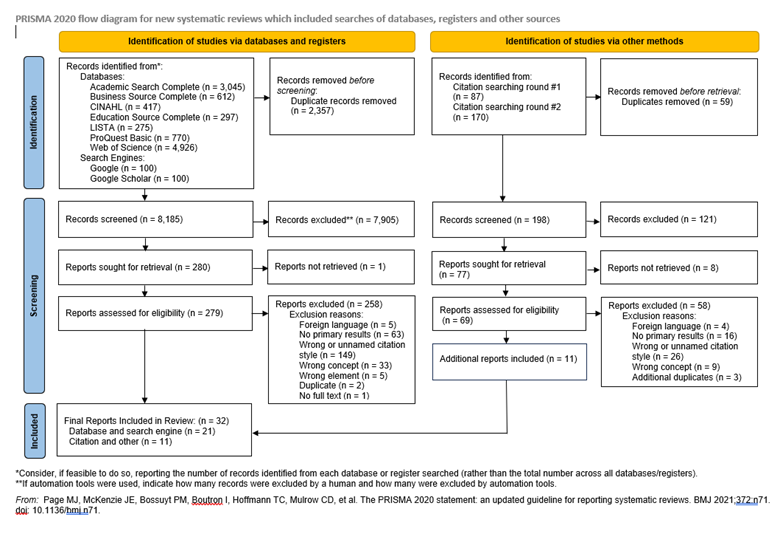
Figure 1
PRISMA 2020 flow diagram.
During the process of screening articles for
inclusion, we identified three distinct ways that the term "accuracy"
is used in the literature and applied to citation analysis.
- Is
the cited source appropriate and relevant to the research?
- Do
the elements of the reference match the original source?
- Do
the elements of the reference conform to the formatting guidelines of the
selected style?
The intention of this scoping review was to assess the third type of accuracy,
but without unique terminology, our search retrieved studies related to all
three accuracy types and required significant time and effort excluding
irrelevant studies. A shared vocabulary denoting the different types of
citation analysis would promote clarity of intent in the future.
Thirty-two studies
were ultimately included in the review. Most
of the included studies were published between 2006-2024 (n=31). One included
study was published much earlier, in 1987. The 3rd through the 7th editions of
the APA Publication Manual were reported to be used for assessing reference
formatting accuracy in the included studies. Six studies did not specify which
edition of the publication manual was used.
The reference
entries analyzed for accuracy originated from a variety of sources.
Predominantly, in 41% (n=13) of the studies, the reference entries came from
student papers or assignments. In the remaining studies, reference entries came
from monographs (n=3), scholarly articles (n=3), unpublished manuscripts (n=3),
databases (n=3), theses/dissertations (n=2), and other sources (n=3). ChatGPT
was used to generate the references in two studies. Giray (2024) reported that
all the journal article references provided by ChatGPT were fabricated, links
did not match existing websites, and references included in the study did not
follow APA 7th guidelines. In the Roygayan (2024)
study, ChatGPT-3.5 generated reference entries for ten non-existent journal
articles that lacked proper italicization, ten web articles that linked to
sources saying “page not found”, and ten reference entries for real books with
incorrect information.
There was a wide
range in the number of references analyzed in the included studies, anywhere
from two references (Stevens, 2016) to 1,432 (Yap, 2020). In nine of the 32
studies (28%), the number of references analyzed was not provided. The
references assessed included many different types of sources. The most common
types of reference sources assessed for accuracy were journal articles (n=26),
books (n=20), and newspapers/magazines (n=8). Other sources assessed were
websites, book chapters, conference proceedings, journal supplements, reference
books, and reports. Studies varied in whether they focused on evaluating
references of one particular source type, a few types of sources, or many. In
seven studies, a single type of source was analyzed. In eight studies, two
types of sources were analyzed. In nine studies, three or more types of sources
were analyzed. In eight studies, the types of sources assessed were not
specified.
Fourteen studies
assessed the accuracy of automated referencing tools. Of those, five assessed a
stand-alone tool (i.e., EasyBib), four assessed
bibliographic management software (i.e., EndNote), three assessed the “cite”
functions in scholarly databases, and two assessed large language models
(ChatGPT).
Our included
studies noted anywhere from zero to over 400 specific types of errors in
reference list entries. Depending on how specifically the errors were described
in the included studies, an error could fulfill more than one of the 17
categories on our data extraction form. For example, in the study by
Onwuegbuzie and Hwang (2013), one of the 50 most common errors listed was
described as “Title of journal article inappropriately capitalized” (p. 4). In
extracting data from this study, this error would be categorized by our team as
a “Journal Title” error and as a “Capitalization or Case” error. Figure 2 shows
the number of our included studies that assessed each of the 17 error
categories. The most common error type
assessed in our review was Author (in 24 studies). At least half of our
included studies assessed errors in the Date, Capitalization or Case, Volume
and/or Issue Numbers, Italicization, DOI/URL or retrieval statement, and
Punctuation. Fifteen studies included errors that could not be categorized
within our 17 options and were therefore categorized as “Other.” There was
space on the data extraction form to describe the errors in the “Other”
category and Figure 3 denotes this. Some of these errors were noted in just one
study each, including Book Title, Editor, Database Information, Layout,
Ampersand, and Genre.
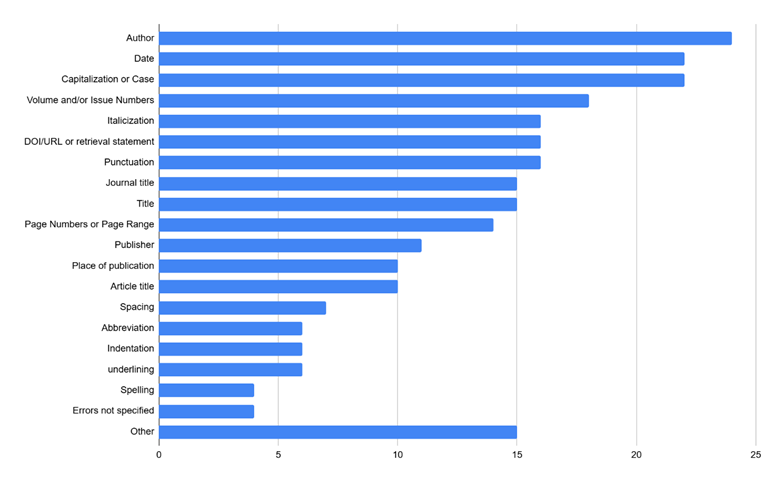
Figure 2
Number of studies noting each of 17 different error categories.
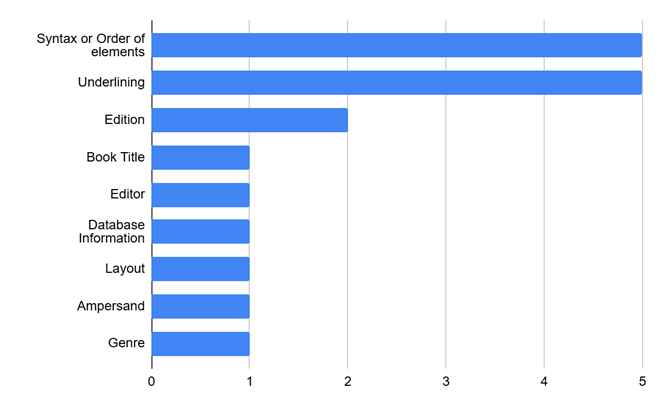
Figure 3
Specific errors described in the “Other” category.
The category
“Error not specified” consisted of four
studies which broadly examined APA reference entry formatting as part of larger
assessments but did not note any specific reference errors (Fallahi et al.,
2006; Franz & Spitzer, 2006; Hously Gaffney, 2015; Zafonte &
Parks-Stamm, 2016). Two additional studies provided selected examples of errors
only (Ernst & Michel, 2006; Onwuegbuzie et al., 2010). Each of these
included reference formatting as a criterion, often using scales or rubrics to
rate performance, but none offered detailed error types or comprehensive lists
of mistakes. In contrast, Onwuegbuzie and Hwang (2013) noted that there were
466 unique reference list errors in their study of unpublished manuscripts,
though they included the top 50 errors only in their published paper.
In addition to
specific errors, we looked for broader categories of errors described in the
included literature. "Syntax" was a term used in 22% (n=7) of the
studies, and “Major” versus “Minor” errors was used in 16% (n=5) of studies.
Sixty-four
different types of measurements were utilized to report accuracy. The most used
in 13 studies was “Total Number of Errors for all References.” The second most
common measurement seen was “Number of Error-free References” reported in nine
studies. Measurements that could be used more readily to compare results across
studies, such as “Total Number of Errors per Reference Entry”, “Average Number
of Errors per Reference Entry,” and “Percentage of Errors for All Reference
Entries” were used less often in eight, six, and six studies, respectively.
As shown above,
the variety of approaches in the studies included in this review demonstrates
that there is no standardized methodology for conducting reference formatting
accuracy research. Some authors demonstrated consistency in their own
methodological approaches across multiple studies. Van Ullen
and Kessler, co-authors of four studies (2005; 2006; 2012; 2016), applied the
same method for categorizing reference entry errors in each. Similarly,
Onwuegbuzie employed a consistent approach across the three studies in which he
was involved (2008; 2010; 2013). Helmiawan (2020)
adopted the methodology used by Stevens (2016), while Ho (2022) based their
error categories on methods drawn from several studies included in this review,
specifically those by Chang (2013), Homol (2014), and Stevens (2016). One study
(Ernst & Michel, 2006) referenced a methodological approach developed by a
researcher not included in this review. The remaining 22 studies did not report
using or adapting any previously established methods of reference entry
collection or error categorization.
Seven studies
reported utilizing tools created to assess reference entries, and four of those
tools were accessible for our team to review, promoting transparency. Two of
the four tools available were detailed checklists designed to assess the
accuracy of a specific type of source—in this case journal articles. These
included the 24-item Full References Checklist in Guinness et al. (2024) and
Scheinfeld and Chung’s (2024) 14-item
Screening Sheet. In both, each item on the checklist was assessed as either
correct or incorrect and accuracy was measured by the number of correct items
compared to the total number of items assessed. These tools may be useful
starting points for creating a comprehensive and standardized tool for
measuring reference entry formatting accuracy. The third tool, used in Jiao et
al. (2008), is an eight-item checklist for any type of source, though just five
of the eight items assess the formatting of the reference list and the other
three items assess the in-text citations. The final tool we reviewed was from
Zafonte and Parks-Stamm (2016) and it broadly examined APA formatting but did
not specify any particular reference errors. Three additional included studies
mentioned using an accuracy assessment tool. In all three, either the tool was
not included in the manuscript, or a link to the tool was broken. However, the
authors’ description of each tool indicated that accuracy was assessed broadly,
and specific errors were not itemized, therefore obtaining these tools was
unnecessary (Foreman & Kirchhoff, 1987; Franz & Spitzer, 2006; Housley
Gaffney, 2015).
Authors of the
included studies were mainly from the disciplines of Library Science (n=16),
Education (n=8), and Psychology (n=5). A smaller number of authors were from
Nursing (n=2), Communications (n=2), Publishing (n=1), Sociology (n=1), English
(n=1) and Teaching English to Speakers of Other Languages (TESOL) (n=1). The
authors were mainly from North America (n=24). Seven studies were conducted by
authors in Asia, and one study was conducted by authors in Africa. Several
authors appear to have a sustained research interest in this topic, as
evidenced by their repeated contributions to the literature. Notably, Jane
Kessler and Mary Van Ullen, librarians at the University at Albany, authored
four of the studies included in this review. Similarly, Anthony Onwuegbuzie, an
educational researcher affiliated with Sam Houston State University,
contributed to three of the studies examined.
The
most common limitations or biases reported by study authors were small sample
size and limited types of sources. Efforts by authors to minimize bias included
“using multiple reviewers, coders or raters,” “random selection of sources,”
and “anonymized sources.” In half of the studies, no limitations or biases were
mentioned.
One of the
included studies (Ho, 2022) surfaced an accuracy issue related to DEI that may
warrant further research. It is an issue that occurs when author names do not
follow the structure that names typically follow in the Global West (i.e.,
first, middle, last). Malaysian names and Indian names were mentioned as
examples (Ho, 2022).
An
item of interest emerged from the results which wasn't directly related to one
of our original research questions. We were not expecting the largest source of
analyzed references to be from student papers and assignments. At 41% (n=13),
this source was greater than the next three largest reference sources combined,
including “article reference lists” (n=3), “monographs” (n=3), and “citations
chosen from a database” (n=3), and so we decided to look at how the source of
the references intersected with the research purpose of the particular study.
To better understand the research purposes of the included studies, we
completed a content analysis by classifying the different research questions of
each study into seven non-exclusive categories, as shown in Figure 4, and found
that only 25% (n=8) of the included studies primarily sought to classify and/or
analyze types of reference errors. This analysis showed that most of the
articles included in our study had a research purpose that was foregrounded in
goals related to education (n=21), not in a general assessment of the
professional literature.
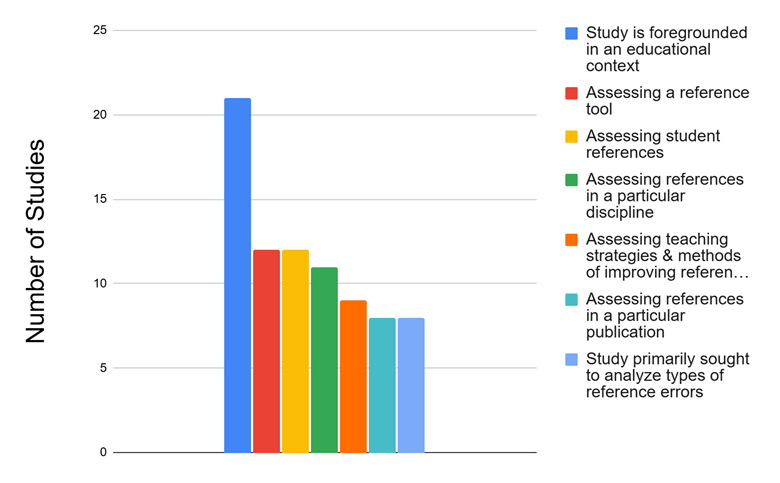
Figure 4
Main purpose(s) of
included studies. This figure shows that reference accuracy studies in
the review were undertaken for a variety of reasons. Categories are non-exclusive.
Discussion
During the
screening process of this scoping review, we observed that the term “citation
accuracy” was used to describe three distinct concepts. For our aims, the
interest was in examining studies that measure the extent to which references
follow the style guidelines of the APA publishing manual, and we included the
32 studies we found that met this definition. The two other types of citation
accuracy studies we came across included those which assess whether references
are appropriate and relevant to the paper, and those that determine if the
elements of a reference entry are reported accurately (such as a reference
entry that includes the wrong journal name). These types of citation accuracy
studies, though equally important components of information literacy, were
excluded from our review. There were no precise terms, either
subject headings or keywords, that could be used in a search to parse these
different types of citation “accuracy,” and this resulted in an initial search
that gathered an excessively broad set of results, increasing the screening
burden. If specific terms were to be adopted for each of these types of
citation accuracy, it could make future research on these topics more precise,
easier to pinpoint in searches, and provide more clarity. We have suggested
standard terminology in Table 1 and encourage its use in future publications.
Table 1
Suggested
Terminology for Different Types of Citation “Accuracy” Analysis
|
Type
of Citation Accuracy |
Suggested
Terminology |
|
Is the cited
source appropriate and relevant to the research? |
Relevancy |
|
Do the
elements match the original source? |
Verifiability |
|
Do the
elements conform to the formatting guidelines of the selected style? |
Formatting Accuracy |
Note.
Only studies examining the third category, “formatting accuracy,” were included
in this review.
The TARCiS
statement recommends citation searching for systematic search topics that are
difficult to search for (Hirt et al., 2024). Citation searching turned out to
be quite effective for this topic. Approximately one-third of our included
studies (11 of 32) were identified through citation searching. A considerable
portion of those (seven) were not indexed or abstracted in any of the databases
we searched (Chang, 2013; Franz & Spitzer, 2006; Helmiawan,
2020; Ho, 2022; Housley Gaffney, 2015; Onwuegbuzie, 2013; Zafonte &
Parks-Stamm, 2016). This highlights the value of citation searching as a
supplement to traditional database strategies for uncovering relevant but otherwise
inaccessible literature.
What Various Criteria Have Been Used to Assess the Accuracy of APA Style Reference Entries?
Multiple
editions of the APA Publication Manual were used in our included studies to
assess formatting accuracy. As to be expected, the edition utilized was
typically aligned with the study’s publication date, given that each new
edition introduces changes that influence how errors are evaluated.
Consequently, any standardized tool developed to measure formatting accuracy
must be tailored to the specific guidelines of a given edition.
There
was considerable variation in the number of reference entries assessed across
studies. This raises important methodological questions regarding the sample
size necessary for accuracy studies to yield meaningful and generalizable
results. For instance, can the evaluation of only two or three references
provide a reliable measure of a student’s formatting competency? Similarly, to
what extent are findings valid when based on sample sizes of 30, 60, or even
120 database-generated references? Determining an appropriate sample size
remains a critical issue for ensuring the rigor and credibility of research in
this area.
Given
that a substantial portion (44%) of our included studies evaluated automated
reference generators, any tool developed should account for both manually
created and automatically generated references to garner broad applicability.
Our review included two studies that assessed ChatGPT, and inaccurate
formatting of APA style citations was found in both. Although some types of
errors produced by ChatGPT were what we would call issues with “verifiability,”
and have been well-documented in discussions of Large Language Model (LLM)
hallucinations, the studies also included “formatting accuracy” errors, which
is why they were included in this review. Therefore, the recent explosion in
the availability of LLMs is unlikely to have solved the issue of inaccurately
formatted references. Neither of the two LLM studies provides guidance for tool development
since the methods and assessments used were not detailed or transparent. The creation of standard assessment tools
would assist researchers in evaluating artificial intelligence tools and other
reference generators as new versions of technologies are introduced over time.
As
discussed above, a significant challenge in evaluating reference accuracy
across different studies has been the absence of a standardized vocabulary for
describing and classifying errors. This was apparent not only in the
description of specific errors, but also in naming broader types of errors. For
example, “syntax” was a term used in 22% of the studies and generally indicated
an incorrect order of required reference elements. However, even this more
consistently applied term isn't standard; some authors, like Walters and Wilder
(2023), described this issue as “order of the bibliographic elements” and
categorized it more broadly as a “formatting error,” while Foreman (1987)
instead used “out of order.” Similarly, the studies that grouped errors into
categories described as “major” and “minor” also lacked consistency in their
use of these labels. While "major" often implied errors hindering
retrieval and “minor” referred to formatting issues, these definitions weren't
uniformly applied across the five studies that used them. This overarching
inconsistency highlights the substantial hurdles in standardizing mechanisms
for reference accuracy. Perhaps because of this inconsistency, most studies did
not attempt to classify errors into larger categories, but rather described
specific error elements such as “article title” or “capitalization.”
Are the Methods of the Included Studies Transparent and Reproducible and Could a Valid and Comprehensive Assessment Tool Be Created Based on the Synthesis of This Evidence?
Many
of the methods in the included studies were not transparent and reproducible.
Six studies did not specify which edition of the publication manual was used,
nine studies did not provide the number of references analyzed, and eight
studies did not specify the types of sources assessed. In four studies,
specific reference errors were not noted at all, and in two other studies, only
an example of a typical error was included. Of the seven studies that mentioned
using a specific tool to assess accuracy, only four were accessible to review.
Given these inconsistencies and gaps in methodological reporting, it is crucial
that future research in this area prioritizes transparency and reproducibility.
Clear documentation of procedural details, including the tools and sources
used, will not only enhance the reliability of findings but also facilitate
further replication and validation of results.
Notwithstanding
these limitations, the results nevertheless yielded valuable insights and
constructive ideas. Developing a single tool to assess APA formatting accuracy
would necessitate the inclusion of all potential formatting errors across all
source types, and the feasibility of such a tool is questionable given the
volume of possible errors. As noted, Onwuegbuzie and Hwang (2013) identified
over 400 distinct errors. Including every possible error in a single assessment
instrument would likely render it overly complex and impractical for routine
use. Consequently, it is more plausible that effective formatting accuracy
tools would need to be tailored to specific source types to balance
thoroughness with usability. The journal article checklists created by APA
(2025), Guinness et al. (2024), and Scheinfeld and Chung (2024) are good
starting points. Synthesizing these three checklists, and including additional
formatting errors identified in the studies included in this review, is the
next logical step toward creating a standardized, comprehensive tool for
journal article reference entries. Additional checklists would need to be
designed for other source types. For comparing studies, the reporting of
accuracy measurements such as “Total Number of Errors per Reference Entry,” “Average
Number of Errors per Reference Entry,” or “Percentage of Errors for All
Reference Entries” are preferred.
What Geographic Locations and Disciplines are Represented by the Authors of This Literature?
Our
review revealed that the authors of the included studies were mainly in North
America (n=24), with several studies being conducted by authors in Asia and one
by authors in Africa. This research has been predominantly conducted over the
past two decades by authors from the discipline of Library Science,
underscoring that the research aligns closely with the professional
responsibilities and interests of librarians.
What Issues of Bias or DEI (if any) Are Addressed?
Only
one of our included studies mentioned a DEI-related issue with reference
formatting. Ho (2022) notes that Malaysian names do not include a surname, a
characteristic that led to citation formatting inaccuracies across all the
automatic reference generators examined in their study. Ho further suggests
that similar issues may arise when citing Indian names or other naming
conventions that do not align with Western formats. To promote inclusivity and
equity in scholarly communication, it is important for authors and researchers
to be aware of these differences and approach citation practices with greater
care. Additionally, Ho’s study was identified through supplemental citation
searching and was not indexed or abstracted in any of the databases we
searched, underscoring the value of supplemental search strategies in capturing
diverse perspectives and highlighting underexplored yet critical areas of
research.
Limitations
We
excluded articles that did not specifically address APA citation style;
therefore, studies were excluded if they did not state which styles they
assessed or if they did not assess APA style. Future reviews might benefit from
including multiple styles, not only APA. Although tools to assess accuracy
would be more practical if they were citation style-specific, the vocabulary
describing different types of citation accuracy or broad categories of errors
could be applicable across all citation styles. Future research may also be
advised to include errors in the formatting of the reference page and errors in
the formatting of the entire manuscript, including in-text citations. Our
review focused on individual reference entries only, but it was interesting to
note that a few of our included studies also assessed a broader range of
formatting errors.
The fact that our search was limited to
English-language results may have prevented us from gathering additional
studies with DEI issues. Institutions that emphasize the importance of DEI
should consider making resources available to faculty researchers who require
translation services.
Finally, five included studies were retrieved as
part of the inadvertent search of an aggregate of ProQuest databases, rather
than the PQDT database. All five studies were duplicates of other database
search results, therefore the error did not result in
any additional included articles. We did not determine, however, whether
including the PQDT database would have resulted in any additional included
studies, and this is a limitation of our review.
Conclusion
This
scoping review reveals a fragmented and inconsistent research landscape
concerning the formatting accuracy of APA style references. The body of
literature on this topic is characterized by a lack of consensus on fundamental
aspects of assessment, including methodology, error classification terminology,
and reporting metrics. A key methodological challenge highlighted by this
review is the considerable variation in the number of reference entries
assessed across studies, which ranged from as few as two to over 1,400. Determining
an appropriate sample size remains a critical issue for ensuring the rigor and
credibility of research in this area. Measures that could be readily used to
compare results, such as the “Average Number of Errors per Reference Entry,”
were used far less often than simple totals, limiting the potential for
cross-study synthesis. Without standardized reporting, the collective value of
this body of research is diminished, hindering efforts to identify persistent
challenges or track improvements over time.
A central finding of this
review is the absence of a standardized, widely accepted tool for assessing APA
formatting accuracy. While some studies utilized checklists, these were often
inaccessible or designed for a narrow range of source types. The feasibility of
a single, comprehensive tool to assess all source types is questionable;
therefore, developing and validating source-specific assessment tools appears
to be a more practical and necessary next step. The need for such tools is
further underscored by the increasing prevalence of automated reference
generators and generative AI, which, as studies show, continue to produce
formatting errors and require rigorous evaluation.
Furthermore, this review
highlights critical gaps in the literature concerning issues of diversity,
equity, and inclusion (DEI). Only one included study explicitly addressed a
DEI-related issue, noting the mis-formatting of non-Western names by automatic
reference generators. This finding, uncovered through citation searching, points
to an underexplored area of citation practices and suggests that perspectives
from other geographic locations are underrepresented.
To advance research and
practice in this area, this review puts forth several recommendations. First,
we advocate for the adoption of consistent terminology to distinguish between
different types of citation analysis—specifically "formatting
accuracy," "verifiability," and "relevancy"—to enhance
clarity and precision. Second, future research must prioritize the development
of evidence based, source-specific assessment tools that promote comparable
reporting metrics. Given that most included studies were authored by librarians
and analyzed student work, it is clear that librarians and educators are
essential stakeholders in this effort. Finally, there is a need for deeper
consideration of equity-related challenges in citation practices to ensure they
are inclusive and responsible. Future scholarship should move beyond simply
documenting errors toward creating the evidence based tools necessary to
promote more accurate, inclusive, and ethically responsible citation practices.
Author Contributions
Laurel
Scheinfeld: Conceptualization, Formal analysis, Investigation,
Project administration, Visualization, Writing – original draft, Writing –
review & editing Sunny Chung: Conceptualization, Formal analysis,
Investigation, Visualization, Writing – original draft, Writing – review &
editing Christine Fena: Formal analysis, Investigation, Visualization,
Writing – original draft, Writing – review & editing Clara Tran:
Formal analysis, Investigation, Visualization, Writing – original draft,
Writing – review & editing Chris Kretz: Investigation, Formal
analysis, Writing – original draft, Writing – review & editing Myra R.
Reisman: Investigation
References
Note: References marked with an
asterisk (*) are included studies.
Aromataris, E., & Munn, Z. (Eds.). (2020). JBI Reviewer's Manual. JBI. https://jbi-global-wiki.refined.site/download/attachments/355863557/JBI_Reviewers_Manual_2020June.pdf
American Psychological Association. (2020). Publication manual of the American
Psychological Association 2020 (7th ed.).
American Psychological Association. (2025, April). Handouts and guides. American
Psychological Association. https://apastyle.apa.org/instructional-aids/handouts-guides
Bramer, W. M.,
Giustini, D., deJonge, G. B., & Bekhuis, T. (2016). De-duplication of database search
results for systematic reviews in EndNote. Journal
of the Medical Library Association, 104(3), 240–243. http://dx.doi.org/10.3163/1536-5050.104.3.014
*Chang, H. F. (2011). Cite it right:
Critical assessment of open source web-based citation
generators. [Conference paper]. 39th Annual LOEX Conference, Fort Worth, TX, United
States. https://commons.emich.edu/cgi/viewcontent.cgi?article=1009&context=loexconf2011
Childress, D.
(2011). Citation tools in academic libraries. RUSQ: A Journal of Reference and User Experience, 51(2), 143–152. https://doi.org/10.5860/rusq.51n2.143
Dawe, L.,
Stevens, J., Hoffman, B., & Quilty, M. (2021). Citation and referencing
support at an academic library: Exploring student and faculty perspectives on
authority and effectiveness. College
& Research Libraries, 82(7), 991. https://doi.org/10.5860/crl.82.7.991
*Edewor, N. (2010). Analysis of bibliographic references by
textbook authors in Nigerian Polytechnics. Library Philosophy & Practice,
1–6. https://digitalcommons.unl.edu/libphilprac/407/
*Ernst, K.,
& Michel, L. (2006). Deviations from APA style in textbook sample
manuscripts. Teaching of Psychology, 33(1),
57–59. https://psycnet.apa.org/record/2006-01784-017
*Fallahi, C. R.,
Wood, R. M., Austad, C. S., & Fallahi, H. (2006). A program for improving
undergraduate psychology students' basic writing skills. Teaching of Psychology, 33(3), 171–175. https://doi.org/10.1207/s15328023top3303_3
*Foreman, M. D. & Kirchhoff, K. T.
(1987). Accuracy of references in nursing journals. Research in Nursing
& Health, 10(3), 177–183. https://doi-org./10.1002/nur.4770100310
*Franz, T. M.,
& Spitzer, T. M. (2006). Different approaches to teaching the mechanics of
American Psychological Association Style. Journal
of Scholarship of Teaching and Learning, 6(2), 13–20. https://files.eric.ed.gov/fulltext/EJ854923.pdf
*Gilmour, R.
& Cobus-Kuo, L. (2011). Reference management software: A comparative
analysis of four products. Issues in
Science and Technology Librarianship, 66, 63–75. https://doi.org/10.29173/istl1521
*Giray, L. (2024). ChatGPT references
unveiled: Distinguishing the reliable from the fake. Internet Reference Services Quarterly, 28(1), 9–18. https://doi.org/10.1080/10875301.2023.2265369
Godin, K., Stapleton, J., Kirkpatrick, S.
I., Hanning, R. M., & Leatherdale, S. T. (2015). Applying systematic review
search methods to the grey literature: A case study examining guidelines for
school-based breakfast programs in Canada. Systematic
reviews, 4(1), 138. https://doi.org/10.1186/s13643-015-0125-0
*Greer, K., & McCann, S. (2018).
Everything online is a website: Information format confusion in student
citation behaviors. Communications in Information
Literacy, 12(2), 150–165. https://doi.org/10.15760/comminfolit.2018.12.2.6
*Guinness, K.
E., Parry‐Cruwys, D., Atkinson, R. S., & MacDonald, J. M. (2024). An online
sequential training package to teach citation formatting: Within and across
participant analyses. Behavioral
Interventions, 39(2), e1988. https://doi.org/10.1002/bin.1988
*Helmiawan, M. (2020). Reference error in book manuscript
from LIPI: How good our scientists are in composing references. BACA: JURNAL DOKUMENTASI DAN INFORMASI, 41(1),
1–10. https://scholar.archive.org/work/izsdvzjk2jaz5aei6ez3ult6xu/access/wayback/https://jurnalbaca.pdii.lipi.go.id/index.php/baca/article/download/559/313
Hirt, J.,
Nordhausen, T., Fuerst, T., Ewald, H., & Appenzeller-Herzog, C. (2024).
Guidance on terminology, application, and reporting of citation searching: The TARCiS statement. BMJ,
385, e078384. https://doi.org/10.1136/bmj-2023-078384
*Ho, C. C.
(2022). Free online citation generators: which should undergraduates use with
confidence? Voice of Academia, 18(2),
70–92. https://ir.uitm.edu.my/id/eprint/65509/
*Homol, L. (2014). Web-based citation
management tools: Comparing the accuracy of their electronic journal citations.
The Journal of Academic Librarianship,
40(6), 552–557. https://doi.org/10.1016/j.acalib.2014.09.011
*Housley
Gaffney, A. L. (2015). Revising and reflecting: How assessment of APA Style
evolved over two assessment cycles in an undergraduate communication program. Journal of Assessment and Institutional
Effectiveness, 5(2), 148–167. https://doi.org/10.5325/jasseinsteffe.5.2.0148
*Jiao, Q. G.,
Onwuegbuzie, A. J., & Waytowich, V. L. (2008). The
relationship between citation errors and library anxiety: An empirical study of
doctoral students in education. Information
Processing & Management, 44(2), 948–956. https://doi.org/10.1016/j.ipm.2007.05.007
*Kessler, J., & Van Ullen, M. K. (2005). Citation generators: Generating
bibliographies for the next generation. The
Journal of Academic Librarianship, 31(4),
310–316. https://doi.org/10.1016/j.acalib.2005.04.012
*Kessler, J., & Van Ullen, M. K. (2006). Citation help
in databases: Helpful or harmful? Public
Services Quarterly, 2(1), 21-42. https://doi.org/10.1300/J295v02n01_03
*Kousar, A. (2023). Reference accuracy in
Indian library and information science theses. Journal of Indian Library Association, 59(1). https://www.ilaindia.net/jila/index.php/jila/article/view/1440
Kratochvíl,
J. (2017). Comparison of the accuracy of bibliographical references generated
for
medical citation styles by
EndNote, Mendeley, RefWorks and Zotero. The
Journal of Academic Librarianship, 43(1),
57–66. https://doi.org/10.1016/j.acalib.2016.09.001
*Laing, K., & James, K. (2023). EBSCO and Summon Discovery generator
tools: How accurate are they? The Journal
of Academic Librarianship, 49(1), 102587. https://doi.org/10.1016/j.acalib.2022.102587
Logan, S. W., Hussong-Christian, U.,
Case, L., & Noregaard, S. (2023). Reference
accuracy of
primary studies published in peer-reviewed scholarly journals: A scoping
review. Journal of Librarianship and
Information Science, 56(4), 896–949. https://doi.org/10.1177/09610006231177715
Oakleaf, M. (2011). Are they learning? Are we? Learning
outcomes and the Academic Library. The
Library Quarterly, 81(1), 61–82. https://doi.org/10.1086/657444
*Onwuegbuzie, A. J., Frels, R. K., & Slate, J. R.
(2010). Editorial: Evidence-based guidelines for avoiding the most prevalent
and serious APA error in journal article submissions-the citation error. Research in the Schools, 17(2), i–xxiv. https://psycnet.apa.org/record/2011-23902-001
*Onwuegbuzie, A. J., & Hwang, E. (2013). Reference
list errors in manuscripts submitted to a journal for review for publication. International Journal of Education, 5(2),
1–14. https://macrothink.org/journal/index.php/ije/article/view/2191
*Rogayan Jr, D.
V. (2024). “ChatGPT assists me in my reference list:” Exploring the chatbot’s
potential as citation formatting tool. Internet
Reference Services Quarterly, 28(3),
305–314. https://doi.org/10.1080/10875301.2024.2351021
Savage, D., Piotrowski, P., & Massengale, L. (2017).
Academic librarians engage with assessment methods and tools. portal: Libraries and the Academy 17(2),
403–417. https://dx.doi.org/10.1353/pla.2017.0025
*Scheinfeld,
L., & Chung, S. (2024). MEDLINE citation tool accuracy: An analysis in two
platforms. Journal of the Medical Library Association, 112(2), 133–139. https://doi.org/10.5195/jmla.2024.1718
*Shanmugam, A. (2009). Citation practices
amongst trainee teachers as reflected in their project papers. Malaysian Journal of Library and Information
Science, 14(2), 1–16. https://tamilperaivu.um.edu.my/index.php/MJLIS/article/view/6955
Speare, M.
(2018). Graduate student use and non-use of reference and PDF management
software: An exploratory study. The
Journal of Academic Librarianship, 44(6),
762–774. https://doi.org/10.1016/j.acalib.2018.09.019
*Speck, K. E.,
& Schneider, B. S. P. (2013). Effectiveness of a reference accuracy
strategy for peer-reviewed journal articles. Nurse Educator, 27(6),
265–268. https://doi.org/10.1097/01.NNE.0000435272.47774.51
Stansfield, C., Dickson, K., & Bangpan, M. (2016). Exploring issues in the conduct of
website searching and other online sources for systematic reviews: How can we
be systematic? Systematic reviews, 5(1), 191. https://doi.org/10.1186/s13643-016-0371-9
*Stevens,
C. R. (2016). Citation generators, OWL, and the persistence of error-ridden
references: An assessment for
learning approach to citation errors. The
Journal of Academic Librarianship, 42(6),
712–718. https://doi.org/10.1016/j.acalib.2016.07.003
Stony Brook
University. (n.d.). Diversity at Stony
Brook. https://www.stonybrook.edu/commcms/cdo/about/index.php
Ury, C. J.,
& Wyatt, P. (2009). What we do for the sake of correct citations. Proceedings of the 9th Brick and Click
Libraries Symposium, Maryville, MO, 126-144. https://files.eric.ed.gov/fulltext/ED507380.pdf
*Van Note Chism, N., & Weerakoon, S.
(2012). APA, Meet Google: Graduate students' approaches to learning citation
style. Journal of the Scholarship of
Teaching and Learning, 12(2), 27–38.
*Van Ullen, M., & Kessler, J. (2012).
Citation help in databases: The more things change,
the more they stay the same. Public
Services Quarterly, 8(1), 40–56. https://doi.org/10.1080/15228959.2011.620403
*Van Ullen, M. K., & Kessler, J.
(2016). Citation apps for mobile devices. Reference
Services Review, 44(1), 48-60. https://doi.org/10.1108/RSR-09-2015-0041
*Walters, W. H., & Wilder, E. I.
(2023). Fabrication and errors in the bibliographic citations generated by
ChatGPT. Scientific Reports, 13(1), 14045. https://doi.org/10.1038/s41598-023-41032-5
*Yap, J. M.
(2020). Common referencing errors committed by graduate students in education. Library Philosophy and Practice, 2020,
4039. https://digitalcommons.unl.edu/libphilprac/4039/
*Zafonte, M.,
& Parks-Stamm, E. J. (2016). Effective instruction in APA Style in blended
and face-to-face classrooms. Scholarship
of Teaching and Learning in Psychology, 2(3), 208. https://psycnet.apa.org/record/2011-23902-001
Appendix A
Indexes Included in Our Institution’s Web of Science
Core Collection
·
Science
Citation Index Expanded (SCI-EXPANDED) – 1900-present
·
Social
Sciences Citation Index (SSCI) – 1956-present
·
Arts
& Humanities Citation Index (AHCI) – 1975-present
·
Conference
Proceedings Citation Index - Science (CPCI-S) – 1911-present
·
Conference
Proceedings Citation Index - Social Science & Humanities (CPCI-SSH) –
1911-present
·
Book
Citation Index - Science (BKCI-S) – 2005-present
·
Book
Citation Index - Social Sciences & Humanities (BKCI-SSH) - 2005-present
·
Emerging
Sources Citation Index (ESCI) – 2020-present
·
Current
Chemical Reactions (CCR-EXPANDED) – 1985-present
·
Index
Chemicus (IC) – 1993-present
Appendix B
List of ProQuest Databases Included in the
Aggregated Search
·
Academic
Video Online
·
American
Periodicals Full Text Included
·
Coronavirus
Research Database Full Text Included
·
Digital
National Security Archive Full Text Included
·
Dissertations
& Theses @ SUNY Stony Brook Full Text Included
·
Ebook
Central Full Text Included
·
Education
Research Index (1966 - current)
·
Ethnic
Newswatch Collection
·
GenderWatch Collection
·
GeoRef
(1693-current)
·
Literature
Online
·
Newsday
(1985-current)
·
ProQuest
Historical Newspapers: Chicago Tribune (1849-2015)
·
ProQuest
Historical Newspapers: Los Angeles Times (1881-2016)
·
ProQuest
Historical Newspapers: The New York Times (1851-2021)
·
ProQuest
Historical Newspapers: The Washington Post (1877-2008)
·
ProQuest
Recent Newspapers: The New York Times (2008-current)
·
Publicly
Available Content Database
·
U.S.
Major Dailies (1980-current)
Appendix C
Table of 32 Included Studies
Note: References marked with an
asterisk (*) are included studies found solely through citation searching.
|
|
Author
Year Journal |
Title |
Location |
Discipline |
Source
of References analyzed for accuracy |
Number
of references analyzed for accuracy |
APA
Edition |
Citation
Generator (if applicable) |
Broad
category of errors |
DEI issues |
|
|
Chang, 2013 LOEX
Conference Proceedings |
Cite
it right: Critical assessment of open source
web-based citation generators |
United
States |
Library Science |
Samples from
reference manual(s) |
18 |
6th |
Citation
Machine; EasyBib; BibMe; KnightCite; NCSU Citation Builder; NoodleBib;
UNC Citation Builder; SourceAid |
Syntax
errors |
None |
|
|
Edewor
& Omosor, 2010 Library
Philosophy & Practice |
Analysis
of bibliographic references by textbook authors in Nigerian polytechnics |
Nigeria |
Library
Science |
Monograph(s) |
Not specified |
5th |
None |
None |
None |
|
|
Ernst &
Michel, 2006 Teaching
of Psychology |
Deviations
from APA style in textbook sample manuscripts |
United States |
Psychology |
Monograph(s) |
Not specified |
3rd, 4th &
5th |
None |
None |
None |
|
|
Fallahi et
al., 2006 Teaching
of Psychology |
R2
A Program for Improving Undergraduate Psychology Students' Basic Writing
Skills |
United States |
Psychology |
Student
paper(s) or assignment(s) |
Not specified |
5th |
None |
None |
None |
|
|
Foreman &
Kirchhoff, 1987 Research
in Nursing & Health |
Accuracy
of references in nursing journals |
United States |
Nursing |
Article
reference list(s) |
112 |
3rd |
None |
Major
and/or Minor Errors, alphabetic or numeric |
None |
|
|
Franz &
Spitzer, 2006 Journal
of the Scholarship of Teaching and Learning |
R2
Different Approaches to Teaching the Mechanics of American Psychological
Association Style |
United States |
Psychology |
Student
paper(s) or assignment(s) |
Not specified |
5th |
None |
None |
None |
|
|
Gilmour &
Cobus-Kuo, 2011 Issues
in Science & Technology Librarianship |
Reference
management software: A comparative analysis of four products |
United states |
Library
Science |
Citations
chosen from a database |
54 |
6th |
CiteULike, Mendeley, RefWorks,
Zotero |
None |
None |
|
|
Giray,
2024 Internet
Reference Services Quarterly |
ChatGPT references unveiled:
Distinguishing the reliable from the fake |
Philippines |
Education, Communications |
Large Language
Model queries |
30 |
7th |
ChatGPT |
None |
None |
|
|
Greer &
McCann, 2018 Communications
in Information Literacy |
Everything
online is a website: Information format confusion in student citation
behaviors |
United States |
Library
Science |
Student
paper(s) or assignment(s) |
315 |
6th |
None |
None |
None |
|
|
Guinness et
al., 2024 Behavioral
Interventions |
An
online sequential training package to teach citation formatting: Within and
across participant analyses |
United States |
Psychology |
fictional
journal article information |
39 |
7th |
None |
None |
None |
|
|
Helmiawan,
2018 Baca:
Jurnal Dokumentasi Dan |
Reference
error in book manuscript from Lipi: How good our
scientists are in composing references |
Indonesia |
Publishing |
Unpublished
manuscripts |
161 |
Not specified |
None |
Syntax errors |
None |
|
|
Ho, 2022 Voice
of Academia |
Free
online citation generators: which should undergraduates use with confidence? |
Malaysia |
English |
Student
paper(s) or assignment(s) |
18 |
7th |
Zotero
Bib, CiteMaker and Cite This For
Me |
None |
As Malay authors do not have a surname, their names should
be given in full. Similarly, Indian names should also be completely cited. |
|
|
Homol,
2014 The
Journal of Academic Librarianship |
Web-based
citation management tools: Comparing the accuracy of their electronic journal
citations |
United States |
Library
Science |
Student
paper(s) or assignment(s) |
47 |
6th |
Zotero,
EndNote Basic, RefWorks, EDS |
Formatting
Errors |
None |
|
|
Housley
Gaffney, 2015 Journal
of Assessment and Institutional Effectiveness |
Revising
and reflecting: How assessment of APA style evolved over two assessment
cycles in an undergraduate communication program |
United States |
Communications |
Student paper(s)
or assignment(s) |
Not specified |
6th |
None |
None |
None |
|
|
Jiao et al.,
2008 Information
Processing & Management |
The
relationship between citation errors and library anxiety: An empirical study
of doctoral students in education |
United States |
Library
Science |
Student
paper(s) or assignment(s) |
138 |
5th |
Endnote,
RefWorks, Noodlebib |
None |
None |
|
|
Kessler &
Van Ullen, 2005 The
Journal Of Academic Librarianship |
Citation
generators: Generating bibliographies for the next generation |
United States |
Library
Science |
Student
paper(s) or assignment(s) |
100 |
5th |
NoodleBib and EasyBib,
EndNote |
Syntax
errors |
None |
|
|
Kessler &
Van Ullen, 2006 Public
Services Quarterly |
Citation
help in databases: Helpful or harmful? |
United States |
Library
Science |
Citations
chosen from a database |
92 |
5th |
EBSCO
Academic Search Premier; Gale InfoTrac OneFile; Xreferplus; ScienceDirect; Sociological Abstracts via
CSA; Wilson Education Full Text; and LexisNexis Academic |
Syntax
errors |
None |
|
|
Kousar,
2023 Journal
of Indian Library Association |
Reference
accuracy in Indian library and information science theses |
India |
Library
Science |
Theses/Dissertation
reference list(s) |
915 |
Not specified |
None |
Major
and/or Minor Errors, Formatting Errors, Bibliographic errors |
None |
|
|
Laing &
James, 2023 Journal
of Academic Librarianship |
Ebsco and Summon discovery
generator tools: How accurate are they? |
Canada |
Library
Science |
Student
paper(s) or assignment(s) |
60 |
7th |
EBSCO
Discovery Service and Summon |
None |
None |
|
|
Onwuegbuzie
& Hwang, 2013 International
Journal of Education |
Reference
list errors in manuscripts submitted to a journal for review for publication |
United States |
Education |
Unpublished
manuscripts |
Not specified |
5th |
None |
None |
None |
|
|
Onwuegbuzie et
al., 2010 Research
in the Schools |
Evidence-based
guidelines for avoiding the most prevalent and serious apa
error in journal article submissions-the citation error |
United States |
Education |
Unpublished
manuscripts |
Not specified |
5th |
None |
None |
None |
|
|
Rogayan,
2024 Internet
Reference Services Quarterly |
“ChatGPT Assists Me in My Reference List:” Exploring the
Chatbot’s Potential as Citation Formatting Tool |
Philippines |
Education |
Randomly
chosen |
3 |
7th |
ChatGPT |
None |
None |
|
|
Scheinfeld
& Chung, 2024 Journal of the
Medical Library Association |
Medline
citation tool accuracy: An analysis in two platforms |
United States |
Library
Science |
Article
reference list(s) |
60 |
7th |
PubMed, Ovid
Medline |
None |
None |
|
|
Shanmugam,
2009 Malaysian
Journal of Library & Information Science |
Citation
practices amongst trainee teachers as reflected in their project papers |
Malaysia |
Education |
Student
paper(s) or assignment(s) |
Not specified |
Not specified |
None |
Major
and/or Minor Errors |
No |
|
|
Speck &
St. Pierre Schneider,
2013 Nurse
Educator |
Effectiveness
of a reference accuracy strategy for peer-reviewed journal articles |
United States |
Nursing |
Article
reference list(s) |
303 |
6th |
None |
Major
and/or Minor Errors, Style errors |
No |
|
|
Stevens, 2016 Journal
of Academic Librarianship |
Citation
generators, OWL, and the persistence of error-ridden references: An
assessment for learning approach to citation errors |
United States |
Library
Science |
Student
paper(s) or assignment(s) |
2 |
6th |
None |
Syntax
errors |
No |
|
|
Van Note Chism
& Weerakoon, 2012 Journal
of the Scholarship of Teaching & Learning |
APA,
Meet Google: Graduate students' approaches to learning citation style |
United States |
Education |
Student
paper(s) or assignment(s) |
108 |
Not specified |
None |
None |
No |
|
|
Van Ullen & Kessler, 2016 Reference
Services Review |
Citation
apps for mobile devices |
United States |
Library
Science |
Monograph(s) |
100 |
6th |
Citations2go, CiteThis, EasyBib, iCite, iSource, QuickCite, and RefMe |
syntax
errors |
No |
|
|
Van Ullen & Kessler, 2012 Public
Services Quarterly |
Citation
help in databases: The more things change, the more
they stay the same |
United States |
Library
Science |
Citations
chosen from a database |
45 |
5th |
EBSCO Academic
Search Premier, Credo, CSA Sociological Abstracts, Wilson Education Full
Text, Article First, Proquest Criminal Justice
Periodicals Index, Scopus, Project MUSE |
syntax
errors |
No |
|
|
Walters &
Wilder, 2023 Scientific
Reports |
Fabrication
and errors in the bibliographic citations generated by ChatGPT |
United States |
Library
Science |
Papers
generated by Chat GPT |
636 |
Not specified |
None |
substantive
errors vs formatting errors |
No |
|
|
Yap, 2020 Library
Philosophy and Practice |
Common
referencing errors committed by graduate students in education |
Kazakhstan |
Library
Science |
Theses/Dissertation
reference list(s) |
1432 |
6th |
None |
None |
No |
|
|
Zafonte
& Parks-Stamm, 2016 Scholarship
of Teaching and Learning in Psychology |
Effective
instruction in APA style in blended and face-to-face classrooms |
United States |
Psychology
& Education |
Student
paper(s) or assignment(s) |
Not specified |
Not specified |
None |
Major,
Significant or Minor formatting errors |
No |