Research Article
Cost-Benefit Analysis of Security Gates and
Collection Shrink in the Academic Library
Loren
D. Mindell
Access
Services Librarian
Gwendolyn
Brooks Library
Chicago
State University
Chicago,
Illinois, United States of America
Email:
lmindell@csu.edu
Amanda Hardin
Director,
Access Services
WKU
Libraries
Western
Kentucky University
Bowling
Green, Kentucky, United States of America
Email: amanda.hardin@wku.edu
Gabrielle M. Toth
Dean,
Library & Instruction Services
Gwendolyn
Brooks Library
Chicago
State University
Chicago,
Illinois, United States of America
Joshua
J. Vossler
Dean of Libraries
WKU
Libraries
Western
Kentucky University
Bowling
Green, Kentucky, United States of America
Email:
joshua.vossler@wku.edu
Received: 2 June 2025 Accepted: 20 Oct. 2025
 2025 Mindell, Hardin, Toth, and Vossler. This
is an Open Access article distributed under the terms of the Creative Commons‐Attribution‐Noncommercial‐Share Alike License 4.0
International (http://creativecommons.org/licenses/by-nc-sa/4.0/),
which permits unrestricted use, distribution, and reproduction in any medium,
provided the original work is properly attributed, not used for commercial
purposes, and, if transformed, the resulting work is redistributed under the
same or similar license to this one.
2025 Mindell, Hardin, Toth, and Vossler. This
is an Open Access article distributed under the terms of the Creative Commons‐Attribution‐Noncommercial‐Share Alike License 4.0
International (http://creativecommons.org/licenses/by-nc-sa/4.0/),
which permits unrestricted use, distribution, and reproduction in any medium,
provided the original work is properly attributed, not used for commercial
purposes, and, if transformed, the resulting work is redistributed under the
same or similar license to this one.
DOI: 10.18438/eblip30814
Abstract
Objective – Two academic libraries serving public universities in the United
States faced a similar choice of whether to keep magnetic security gates in
place and pay for their upkeep. To make informed decisions, researchers at
Chicago State University (CSU) and Western Kentucky University Libraries (WKUL)
ran concurrent studies with different models of cost-benefit analysis to
determine whether magnetic security gates were worth the expense. Security
gates were physically present but not functional at both institutions during
the study. Exploring different methods of analysis provided opportunities to
discuss whether security gates are effective at preventing collection shrink,
identify issues in measuring the costs of theft, and explain why WKUL chose to
remove magnetic security gates altogether.
Methods – At CSU,
we measured loss over a six-month period on a sample set of 110 monographs. The
cost of replacing missing books, including labor and incidentals, was used to
approximate the cost of shrink in an equivalent percentage of materials from
the main collection housed in open stacks. We compared the expected cost of
replacing the security gates to the estimated cost of shrink
to determine how much loss security gates would need to prevent to justify the
cost of maintaining security gates. While the sample was neither randomized nor
large enough to draw conclusions, trialing this model of cost comparison
presented an opportunity for discussion.
WKUL had a practice of
running a near continuous inventory prior to this study. In 2024, staff
inventoried the entire collection held in open stacks. This provided a precise number of how many items went missing during that
timeframe. We compared the number of missing items to the quoted cost of annual
service and maintenance fees to determine whether maintaining security gates
would justify the cost. Simply dividing the annual service fees by the number
of missing items provided a dollar value per missing item that security gates
would have had to save in order to justify their expense.
Results
– The calculated annual cost of collection
shrink at CSU is $136,335, much more than the estimated $85,121 to replace the
magnetic security gates. Inferring a similar rate of shrink to the sample set,
despite the problems with the method, suggests that new security gates would
have to prevent 62.44% of total loss to pay for themselves in the first year,
33.66% in two years, and 24.07% over three years. While we did not draw firm
conclusions from this trial analysis, it is evident that security gates would
likely save money over the span of a few years.
WKUL found that 99 individual
items went missing from all collections housed in open stacks over 2024. The
quoted annual subscription fee for the four sets of security gates at WKUL is
$8,894. These data suggest that security gates at WKUL must prevent an average
of $89.83 in lost value per missing item to justify the annual fees alone.
Another way of describing this is that if each item that went missing cost
$89.83, security gates would have to stop 100% of collection shrink to make up
for their annual subscription fees. A more likely scenario is that security
gates would have prevented 50% of the collection shrink, and materials would
have had to carry an average value of $179.66 for security gates to pay for
themselves.
Conclusion – At first glance, the data from CSU suggests that magnetic
security gates have the potential to prevent enough collection loss that they
pay for themselves. The library at CSU has an annual operating budget of just
over $2 million, and an annual loss of nearly $140,000 in value would be
unsustainable. However, the data from WKUL suggest it would be difficult to
justify the annual subscription fees, let alone the cost of replacing defunct
hardware. Further inquiry and discussion are needed to explore variables not covered
in this study, including employee theft, security gate efficacy, the lifecycle
of library materials, and how security gates may affect students’ feelings of
belonging and inclusion.
Introduction
Libraries have been using security gates to
mitigate theft and collection loss for decades. The visible presence of
standing gates that sound an alarm if library materials that have not been
properly checked out pass between them has been status quo in both academic and
public environments. Anecdotes of libraries with browsable or open stacks that
do not have some sort of security gate system are novel and are often met with
scrutiny or suspicion. However, some libraries are choosing to either leave
security gates turned off or remove them altogether. More published literature
exists about decisions not to use security gates in public libraries than in
academic libraries. This paper contributes to the conversation on how academic
libraries are making decisions about security gates by reporting on two
concurrent studies comparing the cost of maintaining electromagnetic security
gates to the cost of replacing missing library materials.
Chicago
State University (CSU) faced a decision on whether to replace three sets of
magnetic security gates that no longer function. To guide this discussion, we
examined methods determining whether replacing the gates would make fiscal sense.
We conducted a trial study with a small sample to evaluate loss rates, the
value of library material, and whether new gates have cost-saving
potential.
Western Kentucky University Libraries (WKUL)
removed their security gates during the spring of 2025. While a recent
inventory shows that some materials go missing, we are skeptical that security
gates reduce collection shrink enough to warrant continued use. Researchers at
WKUL collected data on collection shrink over one calendar year in the open stacks
while security gates were still in place, and we compared the cost of missing
items to the annual subscription and maintenance fees WKUL would have paid if
they had not canceled the subscription.
Data
from the trial study at CSU and the complete inventory at WKUL provide a
starting point to discuss why some academic libraires are choosing to go
without security gate loss prevention systems. Identifying weaknesses in the
comparison models and recommendations for further inquiry are both intended deliverables
of this study. Furthermore, this discussion is not meant to be prescriptive. We
recognize there are many factors to consider when deciding whether to use
security gates, and not all academic library stakeholders will reach the same
conclusion.
Literature
Review
Security Gate Use
From
the beginning, libraries have been in the business of collections—amassing
them, providing access to them, and protecting them. Materials that go missing
cannot circulate or be used in-house and are rendered inaccessible. Lost
materials represent lost opportunities and funds because there is a cost to
replacing those materials if they are replaceable. In the 1970s, libraries
began installing systems to protect physical library collections. Library
literature on security gates from the 1970s through the 2000s considered
cost-effectiveness and how to calculate it in terms of collection loss;
subsequent literature questions the efficacy and cost-effectiveness of the
security gates themselves. Michalko & Heidtmann (1978) provide an example of this discussion
within academic libraries, finding that security gates at the University of
Pennsylvania reduced the overall loss rate by 39%. Ensuing studies debated
methods of measuring loss while maintaining support for security gates in
academic libraries. Smith (1985) noted that a complete inventory, not annual
loss rates, should be considered for factoring in hidden costs such as patron
frustration over missing books. Foster (1996) disagreed, arguing that random
samples can provide accurate loss rates for a collection. The emphasis on cost
savings remained in future decades. Gelernter (2005), a library security
professional, estimated that a 3% loss for a 50,000-book library collection at
an average replacement cost per book of $44.65 would total $70,000 in losses
annually. Later, anecdotal evidence that libraries were removing gates due to
costs and negative patron feedback prompted Harwell's (2014) comprehensive
landmark survey of security gate vendors, academic libraries, and public
libraries on security gate use. In that study, 90% of the 212 responding
libraries employed security measures, and 76% used security gates. Harwell
(2014) noted, "Of the 24 percent without gates, one-third of those had
them in the past and decided to remove them, with cost being the most common
factor cited in those decisions" (p. 5). Other reasons given included
aesthetics and operational problems. One academic library reported they no
longer employed sufficient staff to monitor exits and found that "material
losses were statistically insignificant" (p. 57). Echoing this decision is
a brief mention in Library Journal about renovations at Clemson
University's R.M. Cooper Library, in which library staff reported that they
were not worried about book theft (Aiken, 2017).
Harwell (2014) also conducted a pilot study
using magnetic tape of various ages in two library settings and found, contrary
to expectations, that older magnetic tape was just as reliable as newer
magnetic tape. However, the failure rate, defined as items not triggering the
alarm when passing through the gates, across the two participating libraries
was 16.4%, with some items failing to trigger the alarms up to 30% of the time.
Vendor responses to Harwell's survey revealed that they expected library staff
to test gates daily and keep them clean and dust-free to function properly. One
vendor indicated that annual maintenance contracts run 10-15% of the cost of
the systems themselves.
Functionality Problems With Security Gates
Library security gates are not a magical
talisman against theft. Their effectiveness hinges on the basic reliability of
the technology they employ, how well they are maintained, how library staff
react to false alarms, and the dedication of the people who seek to defeat the
system.
Even when security gates function well, they are not perfect. In 2012 and 2013,
a former student stole over 2,000 books from Gonzaga University's two libraries
after discovering a weakness in the library security system. Reporting on the
incident, Charles (2017) surmised that library security gates serve as a
visible deterrent rather than a reliable tool to catch someone stealing books.
For example, "security gates randomly activate when patrons have
non-library items or library materials that have been properly checked out. The
reasons for this can range from lax procedures in sensitizing/desensitizing
library materials to malfunctioning equipment" (p. 49). Failure to register an item is an
obvious aspect of security gate failure, but more pernicious is the false
positive, when the gate is triggered either spontaneously or by something that
should not trigger it. Improper triggering of security gates can lead to
negative interactions with library patrons and a loss of faith in the security
system. Perhaps worse, high rates of false alarms cause staff to turn off
security gate systems (Holt, 2007). The human reaction to false alarms is
probably the single largest factor in undermining the reliability of library
security gates: The least reliable security gate is the one that is turned off
or simply ignored.
Theft and Employee/Patron Behavior
While the topic of library security conjures
images of theft by library users, insider crime—thefts by library employees and
other trusted people—is serious and possibly of greater consequence. Insiders
may be familiar with existing security practices and their weaknesses, are
likely to possess detailed knowledge of valuable items and items especially
vulnerable to theft, may possess the technical ability and access to alter
records or otherwise conceal the evidence of their crimes, and can often
operate for years in public and academic libraries (O’Connor & Read, 2007;
Snyder, 2006). The precise magnitude of insider theft is unknown. However, Van Nort (1994) estimated that 75% of library theft is
perpetrated by employees or other insiders. Rare books and manuscripts are at
particular risk from insider theft, as there is a substantial market for these
high-value items (Griffiths & Kohl, 2009).
Effects of Security Culture on Students and Library Users
The cost for security systems may extend
beyond their initial price, maintenance fees, and failure rates. Students in
North America may be reminded of negative experiences with metal detectors used
in secondary education. Metal detectors, almost non-existent in schools before
the 1990s, were used in 10 percent of all U.S. schools by 2015, concentrated in
urban and lower socioeconomic status areas. Some research indicates that the
presence of metal detectors makes students feel less safe (Gawley
et al., 2021), and there is little evidence to suggest that metal detectors
reduce or prevent school violence. However, they may increase students'
perceptions of fear in general and lower academic outcomes for students in
low-income schools (Harper, 2019).
Policies such as these focus solely on
students' actions rather than the motivations or circumstances that are behind
any action (Alnaim, 2018; Gawley
et al., 2021). Surveillance and punishment techniques target symptoms and not
the root causes of undesirable behavior, often to the detriment of students
whom institutions exist to serve. For libraries, a step toward dismantling the
perceived need for security gates may be to consider why library materials go
missing. Chander et al. (2022) identify resource
scarcity as a driving factor behind theft and other abuses of library
resources. Investigating and addressing user needs may prevent material loss
and promote patron satisfaction.
Public librarians have expressed similar
concerns. Lipinski and Saunders (2021) call upon libraries to evaluate their
physical spaces to ensure they are not intimidating to users. Physical security
measures, such as book detection systems, can be intimidating, and while they
may not make a space safer, they "give visual clues that a space is
unsafe" (p. 1019).
Removing Security Gates
There is a gap in the literature covering how
libraries respond when security gates stop working and the reasoning behind
decisions to remove them, which we hope to begin to fill with this paper. One
institution, the Olin Library at Rollins College, reported that some missing
items were not worthy of replacement and would have needed to be weeded from
the collection (Harwell, 2014). Ultimately, Rollins College librarians decided
not to replace the security gates.
The
Chicago Public Library no longer installs book detection gates in new library
branches and removes them whenever a branch goes under renovation. As a result,
patrons with mobility devices do not struggle to navigate between gates, lines
move more quickly because staff do not have to sensitize items, and "there
have [sic] been no rash of material thefts. The patron experience has
been enhanced, the library saves money, and the materials remain
available" (Lipinski & Saunders, 2021, p. 1021).
Aims
These
concurrent studies aim to explore methods of determining whether it is worth
the cost of replacing and maintaining defunct magnetic security gates in
academic libraries. Furthermore, we use this study to discuss issues in
quantifying the cost of collection shrink and recommend areas for further
exploration. Most importantly, we discuss the reasons why one library at a
large public university in the United States chose to remove all security gates
from the building housing its main collection and why another academic library
is still considering its options.
Chicago
State University
About the Library at Chicago State University
The Gwendolyn Brooks Library at Chicago State
University (CSU) is a four-story building containing Library and Instruction
Services (LIS) and other university departments, event spaces, and personnel
offices. Thirteen full-time staff and faculty work in LIS, and the unit had a
budget of just over $2 million in the 2025 fiscal year. Open stacks take up
most of the third floor and part of the second floor with seating for
individual and group study interspersed throughout. Most of the circulating
collection is housed in an automated storage and retrieval system (ASRS), four
walls of storage bins serviced by two robotic cranes that run on fixed tracks
to bring materials to a workroom behind the circulation desk. The ASRS also
houses the university archives and special collections. The Gwendolyn Brooks
Library has two primary entryways, a staff entrance and a main entrance, both
of which have sets of magnetic security gates that no longer work.
Methods at Chicago State University
Investigators
at CSU tracked a sample of 110 monographs that were moved from the ASRS into
open stacks during planned maintenance and downtime. The sample was not
randomly selected or large enough to be statistically relevant. However, we
took the opportunity to track collection shrink to explore methods of comparing
costs of replacing missing books with costs associated with replacing and
maintaining magnetic security gates.
Library
staff at this primarily Black institution wanted to ensure the most in-demand
portions of the Black studies collection, which had previously been housed
exclusively in the ASRS, remained available during ASRS downtime. We selected a
sample set of the 110 newest titles that had circulated five times or more from
the collection and moved them from the ASRS to the open stacks. This selection method
may have affected the data.
Student workers inventoried the sample set six months after the collection had
been shelved. Missing items were searched for again by a different student
worker, and a librarian conducted the third and final check. We multiplied the
number of missing materials by two to approximate what might go missing in a
calendar year.
We
used $118 as the value of library material based on the average cost of a new
academic book in North America. This included $102.98 from the most recent
“Prices of U.S. and foreign published materials” (Aulisio,
2022, p.p. 340-341) rounded up two cents to $103 with $15 added for labor and
incidentals. We calculated the annual cost of collection shrink by applying the
percentage of shrink from the sample to the number of items held in the open
stacks multiplied by $118.
We
calculated the cost of replacing security gates at CSU by adding the retail
price of three sets of new gates and a box of 5,000 magnetic strips listed by
the OhioNet library consortium (2025), plus estimated
annual subscription fees, to the estimated cost of removing three sets of
defunct gates. We based the estimate to remove old gates on three quarters of
what Western Kentucky University Libraries (WKUL) paid to remove their security
gates in spring 2024, since WKUL had four sets of gates and CSU had three.
Similarly, we estimated annual service fees for CSU’s three gates at three
quarters of what WKUL was quoted for four sets. We used the estimated costs of
collection shrink and replacing security gates to project the rate at which
gates would need to prevent shrink in order for the institution to recoup money
spent on replacing and maintaining security gates over time.
Results at Chicago State University
It would cost an estimated $85,121 to replace
the magnetic security gates at CSU without altering the configuration of
entrances and exits or the flow of foot traffic. The cost of a box of 5,000
double-sided magnetic strips was added, and annual service fees of $6,672 or
$2,224 per set of gates reflect what WKUL paid in fiscal year 2024. The annual
service fees would have been the only recurring cost. Other expenses would have
been one-time costs (see Table 1).
Table 1
Cost of Replacing Gates
|
Item |
Cost |
|
Two-aisle sets (3) |
$60,000 |
|
Removal of existing hardware and floor
repair |
$17,250 |
|
Annual maintenance and subscription fee |
$6,672 |
|
Magnetic strips (box of 5,000) |
$1,199 |
|
Cost of new gates |
$85,121 |
One
book went missing from the sample set of 110 monographs over six months. One of
110 is a 0.9% loss over six months and 1.8% over a calendar year, not including
books checked out and marked overdue or lost. The most recent report lists
$102.98 as the average price of a new academic book in North America (Aulisio, 2022). Rounding up two cents and adding $15 per
book in labor and processing materials yields an estimated replacement cost of
$118 per item. With 64,188 items in the circulating open stacks, the estimated
value of the collection comes to $7,574,184. An annual rate of 1.8% devaluation
equates to $136,335 without adjusting for loss, weeding, or acquisitions in
subsequent years (see Table 2).
Table
2
Annual
Cost of Shrink
|
Value per Item |
Number of Items |
Value of Collection |
Estimated Shrink Rate |
Cost of Shrink |
|
$118 |
64,188 |
$7,574,184 |
1.8% |
$136,335 |
The estimated cost of collection shrink is
greater than the estimated cost of replacing the security gates at CSU (see
Table 3).
Table 3
Cost Comparison
|
Annual
Cost of Shrink |
Cost of New Gates |
|
|
$136,335 |
> |
$85,121 |
Rather than assuming that
security gates will save CSU money, necessary efficacy rates are described in
Table 4. Rates have been adjusted to include annual fees each year. The line
graph shows how over a period of time, if we apply the estimated rate of annual
shrink to the entire collection, it is very likely that new security gates
would be a sound fiscal decision.
Table 4
Shrink Prevention Rate Needed to Match Cost
of New Gates at CSU
|
Time |
Cost of New Gates |
Cost of Shrink |
Shrink Gates Would Need to Prevent to Pay for
Themselves |
|
Year 1 |
$85,121 |
$136,335 |
62.44% |
|
Year 2 |
$91,793 |
$272,670 |
33.66% |
|
Year 3 |
$98,465 |
$409,005 |
24.07% |
|
Year 4 |
$105,137 |
$545,340 |
19.28% |
Western
Kentucky University Libraries
About Western Kentucky University Libraries
The Western Kentucky University Libraries
(WKUL) are comprised of two buildings connected by a skybridge: the Commons at
Helm Library and Cravens Library. The Commons at Helm Library is three-story
building housing a service desk, four classrooms, librarian offices, extensive
seating, study rooms, a coffee shop, and two restaurants. It contains stacks
with low-use physical journals but is primarily used as a social and
collaborative space. Cravens Library is a nine-story building, one of the tallest
in the city of Bowling Green, Kentucky. It houses library administration,
special collections and archives, access services, nineteen study rooms, and
the physical stacks. WKUL employed 35 full-time staff with an operating budget
of $6.6 million during the 2025 fiscal year. Magnetic security gates were
located at the skybridge between buildings, the ground-floor main entrance to
Cravens Library, and on the second floor of Cravens Library at the entrance to
Special Collections. Similar to Chicago State University (CSU), security gates
were physically in place but not functioning at the time of this study. All
security gates at WKUL were physically removed during the spring of 2025.
Methods at Western Kentucky University Libraries
Staff
at WKUL ran a complete inventory of library materials held in the open stacks
in 2024 as part of the regular stack maintenance workflow. All materials held
in open stacks were inventoried over the course of the year, providing an
accurate count of missing materials. To conduct this inventory, WKUL staff
scanned each item on the shelf, moving through the collections over a period of
12 months. If an item was not found on the shelf, and it was not on loan, it
was marked missing and searched for a second time. Because this procedure has
been followed in previous years, we can say with confidence that we have a
complete and accurate count of materials that went missing over a 12-month
period from WKUL.
The magnetic security gates at WKUL did not function in 2024. This is the same
situation as at CSU, where gates were physically present and may have acted as
a visual deterrent against theft but would not actually sound an alarm. Unlike
CSU, WKUL would only have had to renew the annual service contract for the
gates. The hardware was in working order and would not have had to have been
replaced. WKUL obtained a quote for annual service and maintenance fees on the
four sets of magnetic security gates covering the entrances to the parts of
WKUL housing materials in open stacks. By dividing the annual cost of
maintaining security gates by the number of items that went missing in 2024, we
were able to assign projected dollar values of material to the amount of shrink
that gates would need to prevent to match their annual
expense.
Results at Western Kentucky University Libraries
Data
from WKUL present the opportunity to compare the cost of security gates to the
actual number of items that went missing over a calendar year. Ninety-nine
items went missing during 2024. The vendor quote for annual service and
maintenance fees on the four sets of security gates was $8,894. These two data
points allow us to calculate the annual rates of loss that security gates would
need to prevent to match their annual fees given replacement costs of
collection materials. We started with the estimated cost for new academic
monographs, $103 (Aulisio, 2022), and added $15 in
labor and incidentals for a total of $118 per item. As such, we can surmise
that in 2024, WKUL’s security gates would have needed to prevent 76% of annual
shrink to cover their maintenance fees.
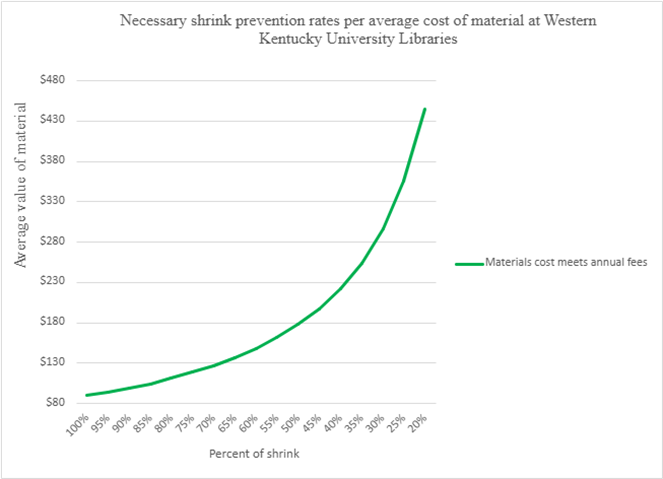
Figure
1
Graph
showing necessary rate of loss prevention given average cost of materials to
match gate maintenance costs at WKUL.
Discussion
Limitations
Sample Size
The sample size of the study at Chicago State
University (CSU) is problematically small. Furthermore, the study only ran for
six months, and researchers doubled the percentage of missing items to estimate
an annual loss rate. Because of these two issues, a more complete dataset would
be necessary to give an accurate picture of the rate of loss experienced at
CSU. It is also worth noting that
magnetic security gates were present but not functioning during this study,
providing a visual theft deterrent. Collection shrink data is needed from
academic libraries that do not have visible security gates at all.
Security Gate Pricing
Subsequent
or similar studies would also benefit from more accurate pricing information on
security gates. Researchers pulled price data for new magnetic gates from the OhioNet consortium’s listed retail prices from Bibliotheca
(2025), and data on annual maintenance and subscription fees reflect what
Western Kentucky University Libraries (WKUL) paid per set of magnetic security gates
in the fiscal year 2024. These price points will differ for other consortia or
individual libraries, and libraries will not know exactly what new gates will
cost until contacting a product vendor. However, averaging prices from multiple
sources could produce a more generalizable figure. Using data from multiple
sources will also present challenges given the variables that can affect
pricing, such as library size, consortial bargaining,
and the specific product being purchased. Magnetic security gate systems are
often tailored to the needs of the library, resulting in different pricing
models.
Furthermore,
product vendors that cater to libraries are not always quick to make their
pricing models available. This is especially true in academic journal pricing,
in which vendor negotiations have an outsized effect on libraries' ability to
serve their constituents (Eye, 2023). Whether due to the necessity for
customized solutions or a desire to maintain a competitive edge in the market,
library security gate vendors generally do not publish prices.
Labor Cost of Replacing Materials
This
study relied on calculating the average price of replacing material. In doing
so, researchers included the estimated labor cost of processing new material.
The time it takes to purchase, catalog, and physically process library material
may be viewed as an opportunity cost rather than a financial encumbrance. The
people working in technical services departments are presumably already on the
payroll. If a particular book was not replaced, the library would not recoup
the money spent on employee pay and benefits. Instead, the staff involved would
be free to concentrate on other work. The choice to include labor costs in
collection valuation in this study is intended to capture the larger effect of
upkeeping a large collection over time.
Hidden Cost of Collection Shrink
Academic
libraries serve the information needs of their users and provide welcoming
spaces to work and study. These objectives are not met when library users
attempt to retrieve material that is not present. There may be costs in terms
of frustration for students and scholars that are not quantified when measuring
the price tags of replacement books against an invoice from the security gate
vendor. These unseen qualitative costs may be balanced against the negative
experiences some people have with security measures.
Results in Context
One
book went missing from CSU's sample of 110 books over a six-month period,
suggesting a 1.8% annual loss rate. If we apply that rate to the main
collection housed in open stacks at CSU despite the issues with the sample set,
we come up with a $136,335 cost of replacing materials. After calculating the
expected rate and cost of collection shrink, it becomes simple to determine the
efficacy rate required for security gates to pay for themselves. The available
data suggest that security gates would have to stop less than 23% of loss to
pay for themselves in three years, a little over
half the rate Michalko and Heidtmann
found security gates to prevent theft by in 1978. Even when critiquing security
gates, Harwell (2014) could not claim less than 23% efficacy.
Why,
then, are institutions choosing not to repair defunct security gates or, in
cases like WKUL, electing to remove them altogether? The data from WKUL
provides a conclusive answer. Even if security gates enabled library personnel
to intervene and prevent 50% of the loss experienced in 2024, those materials
would have to carry an average value of $179 to justify the expense. It is very
unlikely that renewing the service contract on security gates would be a sound
fiscal decision at WKUL. Factoring in the issues associated with security gates
and students’ experience, we can see why WKUL made the decision to remove
security gates.
Library Material Lifecycle
Another problem with measuring the cost of shrinkage via the
methodology in this study is that it does not treat library books as consumable
material. The monograph that went missing from the sample set at CSU had 27 individual checkouts and nine recorded in-house
uses. It was added to the collection in 2002, and the last recorded use was in
2019. It had 36 recorded uses over a 17-year
lifespan. Given that the book had no
recorded use in the five years preceding this study, it is arguable that CSU
consumed the value of the monograph. Would it really have been necessary to
stop that book from leaving the shelf? Would it have made it into the next batch
of weeded material?
Recommendations for Further Inquiry
College
students who have had negative experiences with security gates in primary or
secondary school may feel demoralized by their presence in libraries. Students
could also be desensitized to their presence, having become used to security
gates at schools or other settings where we routinely encounter screening, such
as stores, airports, and public offices. A study of college students’
perceptions of security gates and other surveillance measures in academic
libraries is warranted. The literature on the importance of college students’
feelings of belonging in academic success is significant; if studies showed
that security gates in libraries alienate students, it would bolster arguments
against their use.
The
other side of this argument is that library users may have a negative
experience when material is unavailable. Even worse, someone might search for
material in the stacks and it is not there, contrary to what is shown in the
online catalog. Academic library collections are changing as focus shifts to
subscription databases and leased access to content. Library users’ experiences
and expectations surrounding collections may also be changing as a result.
Examining
patrons' expectations could also help guide decisions about security gates.
Conclusion
This study suggests that security gates have
the potential to save money at Chicago State University. However, another study
with a larger sample size or a comparison of two complete inventories over time
is necessary to draw a conclusion. Because researchers at Western Kentucky
University Libraries (WKUL) tracked actual loss over one calendar year, it is
safe to say that security gates do not make fiscal sense at that institution.
This is partially why the WKUL administration made the decision to remove
security gates in the spring of 2024.
Both sample and complete inventory models for
running a cost-benefit analysis of security gates in academic libraries are
feasible. Both can provide the necessary efficacy rates for gates to pay for
themselves over time given an assumed value of collection materials. Although
it is reasonable to believe that such rates can be achieved, especially over
longer time intervals, many libraries are electing not to maintain these
security measures. The reasons behind WKUL’s decision to remove security gates
are clear. It is likely to be more expensive to maintain security gates than to
replace missing materials for their institution.
Author Contributions
Loren D. Mindell: Conceptualization, Data curation, Formal
analysis, Investigation, Methodology, Visualization, Writing - original draft,
Writing - review & editing Amanda Hardin: Data curation,
Investigation Gabrielle M. Toth: Conceptualization, Writing - original
draft, Writing - review & editing
Joshua J. Vossler:
Conceptualization, Writing - original draft, Writing - review & editing
References
Aiken, L. (2017). Clemson University
Libraries SC. Library Journal, 142(1), 44.
Alnaim, M. (2018). The impact of zero tolerance policy on
children with disabilities. World Journal of Education, 8(1), 1. https://doi.org/10.5430/wje.v8n1p1
Anderson,
A. J. (1985). After the security system, what? Library Journal, 110(19),
59.
Aulisio, G.
(2022). Prices of U.S. and foreign published materials. In ALA Core Library
Materials Price Index Editorial Board (Eds.), Book trade research and
statistics (pp. 331-386). http://hdl.handle.net/11213/20443
Chander, R.,
Dhar, M., & Bhatt, K. (2022). Bibliometric analysis of studies on library security issues in academic
institutions. Journal of Access Services, 19(2/3), 86-104. https://doi.org/10.1080/15367967.2022.2118058
Charles, P. (2017). Book thief. AALL Spectrum, 21(4),
47-50.
Eye, J. (2023). Improving contract negotiations for
library collections through open records requests. College & Research
Libraries, 84(6), 954. https://doi.org/10.5860/crl.84.6.954
Foster, C. (1996). Determining losses in academic
libraries and the benefits of theft detection systems. Journal of
Librarianship and Information Science, 28(2), 93-103. https://doi.org/10.1177/096100069602800204
Gawley, M. P., Cuellar, M. J., & Coyle, S. (2021). A
theoretical and empirical assessment of authoritarianism’s effects on behavior,
attendance, and performance in urban school systems. Contemporary Justice
Review, 24(2), 197-217. https://doi.org/10.1080/10282580.2021.1881894
Gelernter, J.
(2005). Loss prevention strategies for the 21st century library: Why theft
prevention should be high priority. Information Outlook, 9(12), 12-22.
Griffiths, R., & Krol, A.
(2009). Insider theft: Reviews and recommendations from the archive and library
professional literature. Library & Archival Security, 22(1),
5-18. https://doi.org/10.1080/01960070802562834
Harper, K., & Seok, D. (2019). Five
questions to ask about school safety. Education Digest 84(5), 38-40.
Harwell, J. (2014). Library security gates: Effectiveness
and current practice. Journal of Access Services, 11(2), 53-65. https://doi.org/10.1080/15367967.2014.884876
Holt, G. (2007). Theft by library staff. The Bottom
Line, 20(2): 85-93. https://doi.org/10.1108/08880450710773020
Lipinski, B. & Saunders, N. (2021). Welcoming spaces,
welcoming environments: Addressing bias and over-policing in libraries. Journal
of Library Administration, 61(8), 1017-1022. https://doi.org/10.1080/01930826.2021.1984147
Michalko, J.,
& Heidtmann, T. (1978). Evaluating the
effectiveness of an electronic security system. College & Research
Libraries, 39(4), 263-267. https://doi.org/10.5860/crl_39_04_263
O’Connor, M.,
& Reid, B. (2007). Insider financial crime in U.S. public libraries: An
analysis of incidents with policy suggestions for prevention. Public Library
Quarterly, 26(1-2), 1-19. https://doi.org/10.1300/J118v26n01_01
OhioNet.
(2025). OhioNet 2025 Bibliotheca pricing. https://web.archive.org/web/20250325220025/https://www.ohionet.org/wp-content/uploads/2025/02/OhioNet-2025-Bibliotheca-Discounts.pdf
Smith, F. E.
(1985). Questionable strategies in library security studies. Library &
Archival Security, 6(4), 43-53. https://doi.org/10.1300/J114v06n04_05
Snyder, H.
(2006). Small change, big problems: Detecting and preventing financial
misconduct in your library. American Library Association.
Van Nort, S. C. (1994). Archival and library theft: The problem
that will not go away. Library & Archival Security, 12(2),
25-49. https://doi.org/10.1300/J114v12n02_03