Research Article
Library
Workers’ Perceptions of Immigrant Acculturation: Renewed Understandings for
Changing Contexts
Ana
Ndumu
Assistant
Professor
College of Information
University
of Maryland
College
Park, Maryland, United States of America
Email:
andumu@umd.edu
Hayley
Park
PhD
Student
College of Information
University
of Maryland
College
Park, Maryland, United States of America
Email:
hp00@umd.edu
Connie
Siebold
PhD
Candidate
College of Information
University of Maryland
College
Park, Maryland, United States of America
Email:
csiebold@umd.edu
Received: 10 June 2025 Accepted: 15 Oct. 2025
 2025 Ndumu, Park, and Siebold. This is an Open Access article
distributed under the terms of the Creative Commons‐Attribution‐Noncommercial‐Share Alike License 4.0
International (http://creativecommons.org/licenses/by-nc-sa/4.0/),
which permits unrestricted use, distribution, and reproduction in any medium,
provided the original work is properly attributed, not used for commercial
purposes, and, if transformed, the resulting work is redistributed under the
same or similar license to this one.
2025 Ndumu, Park, and Siebold. This is an Open Access article
distributed under the terms of the Creative Commons‐Attribution‐Noncommercial‐Share Alike License 4.0
International (http://creativecommons.org/licenses/by-nc-sa/4.0/),
which permits unrestricted use, distribution, and reproduction in any medium,
provided the original work is properly attributed, not used for commercial
purposes, and, if transformed, the resulting work is redistributed under the
same or similar license to this one.
DOI: 10.18438/eblip30823
Abstract
Objective – Immigrants’ adjustment to U.S. society, also known as immigrant
acculturation, is a vast area of study, but there are few studies relating to
immigrant acculturation within the library and information science field.
Methods – Data from 131
survey responses and 20 interviews suggest that library workers are somewhat
familiar with the immigrant acculturation process, but specific and evidence based training can further their knowledge.
Results
– Insight on immigrant acculturation contextualizes
immigrants’ realities and thus assists library workers in being aware of and
responsive to the nuances of adjusting to and thriving in a new country like
the U.S.
Conclusion – In the face of
anti-immigration legislation and heightened xenophobic misinformation,
librarians need professional development drawn from empirical investigations of
immigrants’ acculturative experiences.
Introduction
Michel,
a 48-year-old Afro-Latino, migrated to the United States from Nicaragua in 2023
through a parole program that allowed private U.S. citizens to sponsor Cuban,
Haitian, Nicaraguan, and Venezuelan (CHNV) immigrants. The CHNV program was
modeled after sponsorship initiatives among other countries and intends to both
circumvent dangerous, expensive Central American migration routes while
granting newcomers better community support and, hopefully, opportunities for
financial independence. Michel was sponsored by his sister after his small shop
was destroyed in a mudslide. Within a week of arriving in the U.S., he used his
life’s savings to apply for a work permit and Social Security number, open a
bank account, and establish a new phone line. The following week, he visited
the neighborhood public library to apply for a library card, register for
English language classes, and download a language learning application on his
mobile phone. Michel practiced English and became familiar with U.S. culture
while waiting for work authorization. His goal is to send remittances to his
wife and sons while saving to sponsor their migration to the U.S.
In
2021, thirty-five-year-old Hila arrived in the U.S. from Afghanistan through
the special immigrant visa humanitarian program after the U.S. military
withdrawal. Although her husband had been contracted as a logistics analyst
with the U.S. Army, Hila had little formal education and only speaks Dari.
Together with their four children, Hila and her husband are acclimating to life
within a tight-knit Afghan community. On Wednesdays, Hila and other Afghan
women visit the public library for welcome sessions geared toward refugee
families. Participants practice English through activities celebrating Afghan
traditions while also gaining access to local financial, educational, social,
and transportation resources. The sessions include Halal meals, childcare for younger
children, and tutoring for older children. Aside from attending weekly services
at the mosque and enjoying tea at the park during warmer weather, this is the
only other place where Hila and the women in her Afghan neighborhood recreate.
Michel
and Hila represent the myriad circumstances prompting migration to the U.S.
Embedded in their journeys is an aspect of contemporary migration that is often
overlooked: some newcomers have pre-migration connections to the U.S., and
their relocation is not as haphazard as is often presented in national
discourse. Many immigrants leave behind forms of stability and familiarity that
make emigrating a reluctant but necessary act.
Information
resources, locales, and networks remain vital for successful cultural adjustment,
or acculturation. Through these vignettes, the researchers aim to humanize immigrants’ lived experiences rather than simply
report research about the acculturative aspects of immigration. This study is
part of a multipart research project that captures immigrant acculturation from
the vantage points of library workers, immigrant advocates, and immigrants
themselves. This inquiry is guided by the grand question: What does it mean
to acculturate to U.S. society, and how can library workers support those who
are new to U.S. cultural norms? The current climate of anti-immigrant
misinformation and hardline immigration policies necessitates an evidence based understanding of immigrant acculturation.
U.S. Immigration and Library Service
The
United States is characteristically a country in which all groups except for
indigenous people are connected to ancestors born elsewhere. Large-scale
migration, whether forced or voluntary, has significantly influenced the
country's history. Libraries have long engaged with immigrants–albeit, some
more than others. As we argue, library service to immigrants has paralleled
U.S. racial and social political trends (Ndumu &
Park, 2025). Various other publications (Jones, 1999; 2003; 2020; Novotny,
2003; Weigand, 1989) chronicle library service to immigrants, which has evolved
into a defining aspect of the profession. Other publications synthesize how
immigrants use libraries (Grossman et. al, 2022; Burke, 2007).
Historical Context
Although
this type of library outreach began over a century ago when there was extensive
focus on European immigrants, today immigrants of all kinds report that they,
for the most part, perceive libraries as relatively easy to visit, uncumbersome in their requirements for service, and
non-threatening in their approach, according to the 2018 U.S. Institute of
Museum and Library Services (IMLS) Public
Needs for Library and Museum Services (PNMLS) data (Ndumu,
2024). To some immigrants, libraries are straightforward, helpful, and
welcoming–at least compared to other public service points.
Perhaps
since libraries have offered service to immigrants for hundreds of years and
the immigrant narrative remains a quintessential part of America’s famed
plurality, this aspect of the library profession is limited by a singular
epistemic tradition of utilitarian self-improvement. English language service,
citizenship preparation, and job placement often anchor library outreach as
well as recommended best practices for immigrant engagement. For example, the
Una Voz program at Richland Library in South Carolina
was created to reach out to the Hispanic and Latinx communities by providing
English as a Second Language (ESOL) classes and language translations for job
seekers (American Library Association, 2021). Project Welcome at Broward County
Library in Fort Lauderdale, Florida, demonstrates a similar programming
emphasis. Consisting of two parts – Engaging and Transitioning - the library
not only provided English and citizenship classes but also actively utilized Amazon
Echo devices to assist their non-English-speaking community members with
language barriers (American Library Association, 2021). The researchers were
motivated to probe the extent to which library workers understand immigrant
acculturation more broadly, given the field’s firmly
established, traditional library offerings.
Current Connections
Immigration
is changing; so, too, must our relationships with immigrant communities. When
we
consider,
for example, that mass migration has always been a part of United States
history, then we understand that people have and will always be on the move, and
the U.S. is a forever-changing nation. Viewed through this lens, we can deduce
that headlines like “The Immigration Crisis Arrives at the Library” (Price,
2020) are hardly new and echo library literature from over a century ago,
“Aliens storming all of our libraries: ‘Books for Everyone’ movement aims to
supply enormous demand and aid Americanization work” (Carr,
1920).
This
is not to suggest that Price’s (2020) article in American Libraries is solely alarmist and essentialist, for it does
raise awareness of the vastness of the U.S. Immigration and Customs Enforcement
(ICE). It also hints at the ongoing material impact of hardline immigration
legislation on libraries of all types. These changes in the circumstances and
backgrounds among immigrants, along with the “management” policies and global
dynamics affecting them—as Michel and Hila’s journeys portray—motivate us to
consider library engagement with immigrants anew. Immigration is becoming
increasingly complex and information-saturated, and we are curious about the
extent to which librarians comprehend the multifaceted and evolving nature of
the immigrant experience.
Aims and Positionality
This
study is one of a multipart research project exploring 1) the concept of
information acculturation among immigrants, 2) the role of acculturation and
acculturative stress in adjusting to new information environments, and 3) the
influence of information overload –rather than ubiquitous information poverty,
digital divide, or digital novice framings–on immigrant acculturation. The
researchers themselves identify as immigrants, and the goal is to grant realism
to what some might consider stock, at best, and romanticized, at worst, aspects
of library outreach to immigrants.
The
following research questions guided this study, which examines library workers’
knowledge of the nuanced aspects of adjusting to a new culture:
RQ1.
How do library workers define immigrant
acculturation?
RQ2.
To what extent are library workers
knowledgeable about immigrant acculturation?
RQ3.
To what extent do library workers
acculturate as they engage with immigrants?
Literature Review
Defined
in the population studies literature as “second culture acquisition and
adaptation” (Rudmin, 2009), acculturation in this
article refers to transitioning to a new information environment. Culture is
germane to information behavior or how humans interact with information (Bates,
2015). Bates suggests that “we understand information behavior within social
contexts and as integrated with cultural practices and values” (2010, para.
65); and that culture is “all that we have created as a species…it is our
entire social heritage as a species” (2015, para. 27). The information science
field has evolved to demonstrate “deeper and less simplistic understanding” of
information needs, seeking, and use” (Bates, 2010).
A
sizable proportion of information behavior research explores people’s
engagement with information within distinct cultural parameters. Some
scholarship, such as the thread of localized and geospatial information
behavior–for example, Fisher et al.’s (2004a; 2004b; Pettigrew, 1998; 1999)
information grounds and Lingel’s (2011; 2015)
information wandering–distinctly captures immigrants’ place-based information
norms. A holistic view of people, information, and the worlds they inhabit
means that researchers must be attuned to situation, time, geography, and
culture (Case & Given, 2016). Without context, or what Dewey (1960, p. 90)
describes as “a spatial and temporal background which affects all thinking,” information
research risks being circumscribed to scientific classifications, absent of
real-life, humanizing meaning.
Comprehending
communities’ physical and temporal habits remains important, but we must also
gauge subjective, deeply personal information dynamics. Nahl’s
(1996; 2004; 2007) focus on affect in information behavior, though not
explicitly centered on immigrants, sheds light on this important aspect of
acculturation. For example, Nahl’s studies of the
emotional, internal, but societally informed nature of people’s information
behavior attend to the salience of community and
cultural formations in human-information interactions. Contextual factors
include behaviors, emotions, rules, and structures of an organization, as well
as the attributes, norms, and beliefs of a given culture (Case & Given,
2016).
It
follows, then, that acculturation is important to information behavior research
and practice. Nahl (2001) describes acculturation as
a lifelong process and “state of operating that we all perform in our daily
societal functioning” (para. 25). Nahl further argues
that “being an information user is not a demographic category or personality
factor.” Nahl nods to Dervin’s
sense-making model and correlative arguments that being social and cultural
requires humans to be information seekers and consumers (Dervin,
1983).
Acculturation
is a process involving gathering and negotiating information about the
mainstream group and one's perceived or forced place within it. Theories like
information worlds (Jaeger & Burnett, 2010) reify this notion by accounting
for cultural forces. It suggests that myriad localized small worlds of a
culture converge with the full lifeworld of an entire culture; a person’s
exclusion from either sphere prompts cultural estrangement (Burnett, 2015).
Generally, people process information about their own group (in-group) and
other groups (out-groups), including how people are categorized and the extent
to which they identify with these categories (Tajfel & Turner, 1979; 1986).
Conceptually, this aligns with Berry’s (1993) well-known four-fold typology of
immigrant acculturation that theorizes immigrants as undergoing either 1)
integration, or retention of the original culture while being knowledgeable
about the new culture; 2) assimilation, or gradually foregoing the culture of
origin; 3) separation, or neither aligning with the new or original culture; or
4) marginalization, or retaining the original culture but never being included
in the new culture.
The
process of acculturation includes relocation into new information spheres,
leaving an acculturating individual to sort through massive amounts of
information that may be in unfamiliar formats, locations, or languages.
Acculturation can last decades, according to longitudinal studies (Meca et al., 2018), although the first five years
post-arrival comprises a “sensitive acculturative period” (Cheung et al., 2011)
when an immigrant is at higher risk of acculturative stress–a phenomena that is itself defined and
operationalized in many ways, including “negative reaction to intercultural
contact or the cultural adaptation process” (D’Alonzo
et al., 2019) and a negative response by people to life events that are rooted
in new intercultural contact (Berry, 2006). An immigrant’s encounters with acculturative
stress are subjective and unique (Berry, 1997; Ndumu,
2020). Immigrants might feel “pressured by voluminous and complex information
or pressures stemming from the various stages at which they need, seek, use, or
process resources” (Ndumu, 2020). Specific stress
points, such as a lack of trust in public officials (Bekteshi
& van Hook, 2015), are direct information access barriers.
Acculturation
can also be seen as a type of storytelling, yet another facet of information
whereby immigrants rely on narratives to weave their identities. According to Bekteshi & van Hook (2015), cultural stories can
promote a positive image through media and other community information sources.
Bekteshi and Kang (2020) similarly write that
climate—interpreted as perceived discrimination, immigrant depictions, and
one’s overall quality of life and happiness in the U.S.—also relies on
information ecosystems. Kim (1977) theorized that the acculturative process
involves “curiosity, searching out of necessity, and going beyond the customary
information.” Although much of Kim’s theoretical proposition relies on the
level of language proficiency, Kim argues that immigrants develop new
information processing systems as they acculturate. Interaction with mainstream
culture, or cultural knowledge, facilitates acculturation (Celenk
& Van de Vijver, 2011).
Relatedly,
pre-migration information access, mainly distilled through social media, also
determines one’s level of acculturation-related stress. Prior knowledge or
contact with the host society is a key individual factor, according to Cabassa (2003). The ease of global information access, made
possible mainly through smartphones, allows immigrants to map their journeys
and pose questions to trusted, informed community members. Greater facility and
agency in amassing information about migration destinations appears to benefit
acculturation. In their study on expectations (or what Plutchik’s
(1980) wheels of emotions sees as anticipation), Negy
and his colleagues (2009) suggest that discrepancies between anticipated and
actual experiences induce acculturative stress. Information in the form of
media portrayals and personal networks influences many immigrants to relocate
to the U.S. with high anticipation of positive social, economic, and relational
outcomes. The reality for most immigrants is that they will encounter a mixture
of satisfactory and dissatisfactory experiences. Misinformation, either in the
form of nativist, racist, or anti-immigrant views from U.S.-born groups toward
immigrants or as distorted, inaccurate, and even positive embellishments of
life in the United States, influences viewers and eventual emigrants in other
countries (Bhattacharya & Schoppelrey, 2004).
Relatedly, “immigrants already living in the United States may convey a
positive picture of life in the United States to their family and friends still
living in their country of origin" (Negy et al.,
2009, p. 259). These and other forms of information disconnects may prompt
acculturative stress.
Based
on a synthesis of acculturative literature, information leaders, especially
those who are non-immigrants, can support newly immigrated families by
mediating between newcomers, long-established immigrants, and local support
organizations. Immigrant leaders garner greater trust than non-immigrant
decision-makers. In their work around cultural fusion theory, Croucher and
Kramer (2017) posit that recent immigrants to the United States often seek out
and join institutions such as places of worship, festivals, and clubs
previously established by members of their immigrant communities. Interactions
between immigrant leaders and heads of households at times transcend social
class and backgrounds (Waters et al, 2010), whereas non-immigrant information
leaders, through complex or inaccessible systems, are prone to reinforcing
class and social hierarchies.
Acculturation
exists in any network, whether large organizations, small groups, dispersed
communities, or abstract associations. Few studies explore the acculturative
dimensions of information norms—that is, the ways in which people remain rooted
in their culture while navigating U.S. information environments. Community
embeddedness, a prominent indicator, connects people with significant resources
(Waters et al., 2010). U.S. society must be willing to organize its information
institutions and infrastructure to meet the needs of various immigrant groups,
which directly implicates knowledge-building sites such as libraries, archives,
museums, schools, higher education, and more (Esses
et al., 2015). Such institutions form hubs within larger cultural networks that
enable immigrants to interface with support systems.
Methods
To
explore the research questions in light of the aforementioned characteristics
of immigrant acculturation and immigrant information behavior, the researchers
designed an explanatory mixed-methods study comprised of a survey followed by
semi-structured interviews.
Pilot
Three
pre-testers (advisors on the broader research project) who met the inclusion
criteria of current library workers aged 18 and older living in the U.S. or its
territories provided feedback on both the survey and interview instruments
found in Appendices A and B. The feedback culminated in improvements being made
to simplify the open-ended questions, as well as probing about cultural
competence as a component of library workers’ bilateral acculturation.
Scale and Construct Development
To
design the present study’s questionnaire, a literature-derived taxonomy of scale
acculturative constructs (Appendix C) was used to gauge immigrant
acculturation. The scale emanated from an adjacent study aimed at improving the
immigrant information overload scale (Ndumu, 2020) by
now accounting for the influence of immigrant acculturation. The initial scale,
which includes behavioral, qualitative, and quantitative dimensions, did not
include acculturative indicators, solely reflecting information behavior
characteristics rather than immigrants' lived or
acculturative realities. The researchers thus conducted a bibliographic search,
thematic review, and thematic annotations to identify 56 scales measuring
immigrant acculturation or acculturative stress among the 128 articles. They
linked nodes based on overlapping logic and concepts, creating a network of
emergent arguments and evidence on how immigrant acculturation is captured. The
researchers also addressed points of conflict and convergence within the
corpus, such as the preponderance of proxy measures, lack of bidirectional or
multidimensional treatment, or inclusion of stereotypical and essentialist
immigrant representations. After filtering flawed scales, four scales were
selected as the basis for an improved, comprehensive scale to explore the role
of information in the acculturation process. These constructs were incorporated
into the present study’s survey instrument.
Survey Questionnaire
This
survey questionnaire explores librarians' comprehension of immigrant
acculturation, focusing on participants’ 1) demographics, 2) definition of
acculturation, and 3) knowledge of the acculturative process. Section four
invited respondents to participate in 30-minute online interviews. The survey
questionnaire was distributed through eight library association listservs along
with social media such as LinkedIn, ALAConnect, and
Facebook between July 28 and November 3, 2023. An a priori G*Power analysis
indicated that 83 responses were needed to achieve statistical power.
Descriptive and inferential data analyses were conducted using SPSS software. A
Chi-square test was performed to identify any correlations among key variables.
Interviews
Interviews
took place between August 4 and October 27, 2023. Informed by the survey
responses, the interview questions sought to gain an in-depth understanding of
librarians’ perceptions of acculturation as distinct from assimilation and
their willingness to engage in the process. Twenty interview participants were
selected based on their responses to a survey question about their willingness
to participate in a follow-up interview. Interviews were first transcribed,
standardized, anonymized, and staged within the tool Dedoose
in preparation for coding. Using an a priori literature-derived coding scheme
of immigrant acculturation concepts, the researchers separately coded a subset
of interview one, arriving at an .80 intercoder reliability score after several
iterations. Analysis consisted of deductive thematic coding, beginning with
first openly coding each interview, axial coding across interviews, followed by
in vivo coding to capture codes not represented in the a priori coding scheme.
The inductive qualitative analytic approach aligns with the study's
explanatory, etic design.
By
offering insight that can help realize reflective and responsive efforts, mixed
methods library and information science research advances evidence
based library practice (Fidel, 2008; Granikov
et. al, 2020; Hayman & Smith, 2020), a paradigm that stresses the use of
current, credible research findings to guide professional practice and
decision-making (Gillepsie, 2014). Adopting evidence based practices in library and information science
has several advantages, such as changing how libraries function, offer
services, and explain their value to communities (Wu & Pu, 2015). Evidence
based library and information science supports the ideology that professional
decisions should not be made exclusively on the basis of tradition, intuition,
or anecdotal experiences. Library workers and other information professionals
must actively seek out and assess evidence when developing systems. Although
the research herein cannot be considered representative of the entire
population of U.S. library workers, the findings show the field’s
understandings of immigrant acculturation.
Results
The
survey garnered 151 responses, of which 19 were less than 40 percent complete,
and 1 declined consent. Thus, 20 were omitted, leaving 131 usable survey
responses (sample N value) that then
garnered 20 interviews. With the exception of demographic backgrounds, the
subsequent data is reported according to the number of responses per question
item (item N value).
Participant Backgrounds
The
majority (n=96; 66%) of participants were under age 50.
Most participants (n=112; 78%) were
born in the United States, with approximately 31 (22%) respondents identifying
as having been born outside the United States in countries such as Mexico,
China, India, and Japan, among others. Thus, there is some immigrant
representation in the survey sample. There was considerable U.S. regional
representation, with participants residing in 28 different states. Kentucky,
Michigan, Vermont, and New Hampshire yielded the most responses. Table 1 and
Table 2 present participants' demographics by age and birth country, while
Figure 1 further illustrates the states represented in the sample.
Table
1
Participant Demographics
|
Age |
n |
% |
|
18-30 |
24 |
18.46 |
|
31-40 |
32 |
24.62 |
|
41-50 |
30 |
23.08 |
|
51-60 |
28 |
21.54 |
|
60 or above |
16 |
12.31 |
Item N=130
Table
2
Participant
Heritage
|
Birth Country |
n |
% |
|
United States |
101 |
78.3 |
|
Mexico |
5 |
3.9 |
|
China |
3 |
2.3 |
|
India |
3 |
2.3 |
|
Japan |
2 |
1.6 |
|
Others |
16 |
12.4 |
Item N = 129.
Other countries represented are Argentina, Colombia,
Cuba, El Salvador, Germany, Iran, Kuwait, Pakistan, Peru, Philippines, Poland,
Portugal, Singapore, St. Kitts, and Taiwan.
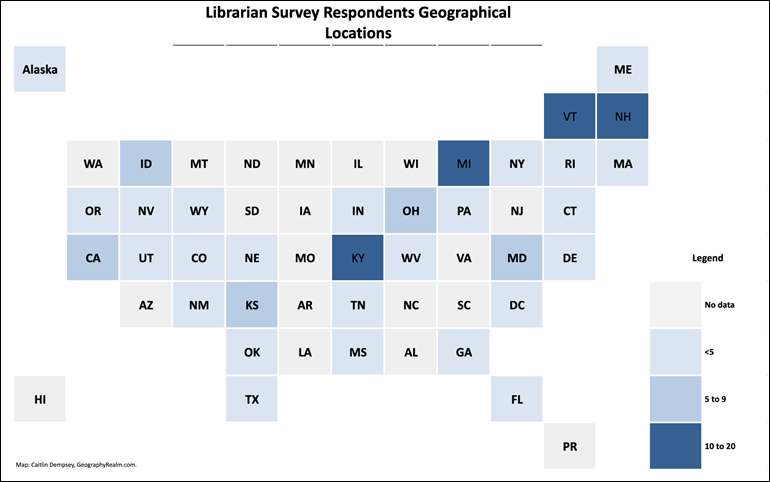
Figure
1
Participants’ state of residence. The map was created using the template
created by Caitlin Dempsey, GeographyRealm.com.
Most
respondents (n=88; 68%) had a
graduate or professional degree, with 88% of them holding an MLIS degree (n=79). The second most represented group
was bachelor’s degree holders (n=28;
22%). The average number of years in the current position was 5.73 years; and
the average number of years in the profession was 13.2 years. For the work
environment, out of 129 (N), most respondents reported working in library
settings (n=105; 81%) while 12
respondents (9%) reported working in education. Job titles range from library
assistant (n=30; 23%) to various
types of librarians (n=44; 34%),
coordinators and specialists (n=18;
14%), library directors (n=19; 15%),
and departmental heads (n=6; 5%),
managers (n=6; 5%), and faculty
members (n=2; 2%). Table 3 shows
participants' education levels by the highest degree completed, work setting,
number of years in the current position, and the total years of experience in
the LIS field.
Table
3
Participant
Work or Employment Background
|
Variable |
N |
n |
% |
|
Degree Earned |
129 |
|
|
|
Graduate or professional |
|
88 |
68.22 |
|
University - Bachelor’s degree |
|
28 |
21.71 |
|
Some university but no degree |
|
11 |
8.53 |
|
Secondary |
|
1 |
0.78 |
|
Vocational or similar |
|
1 |
0.69 |
|
Years in the Profession (by 5 years) |
129 |
|
|
|
0-5 |
|
36 |
27.97 |
|
6-10 |
|
34 |
26.36 |
|
11-15 |
|
16 |
12.4 |
|
16-20 |
|
13 |
10.08 |
|
21 and more |
|
30 |
23.26 |
|
Employment setting |
129 |
|
|
|
Library |
|
105 |
81.4 |
|
Education |
|
12 |
9.3 |
|
Municipal or government agency |
|
4 |
3.1 |
|
Nonprofit
organization |
|
4 |
3.1 |
|
Other |
|
4 |
3.1 |
|
Job positions |
129 |
|
|
|
Librarians |
|
44 |
34.1 |
|
Library assistant/associate |
|
30 |
23.26 |
|
Director |
|
19 |
14.73 |
|
Specialist |
|
9 |
6.98 |
|
Coordinator |
|
9 |
6.98 |
|
Supervisor/manager |
|
6 |
4.65 |
|
Department heads |
|
6 |
4.65 |
|
Faculty |
|
2 |
1.55 |
|
Miscellaneous |
|
4 |
3.1 |
RQ1: Definition of Acculturation
When
asked about the meaning of acculturation, 129 (N) respondents selected multiple choices. The largest proportion of
the returned responses included “Learning a new culture” (n=92; 71%), followed by “Transitioning to a new culture” (n=57; 39%), and “Creating a new culture”
(n=20; 16%). Further freeform
responses in “Other” include:
●
Giving up one’s culture while adjusting
to a new culture.
●
Adapting to another dominant culture,
not necessarily assimilation, but involves it.
●
Losing own culture in favor of learning
another.
●
Assimilation to a different culture,
typically the dominant one.
●
Blending of cultures.
●
Integrating into a new culture.
●
Learning a new culture
you are now living within.
●
Inviting another culture in addition to
one’s own.
When
asked if acculturation is the same as naturalization, the data suggest that
most respondents (n=109; 96%) were
able to distinguish between acculturation and naturalization. However, when
asked about acculturation and assimilation, some expressed confusion. Among the
sample (N=128), while more than half
(n=83; 65%) answered that acculturation is not the same as assimilation, 35% of
the sample answered that acculturation is the same as assimilation (n=20; 15%) or showed a lack of knowledge
on the subject (n=25; 20%). Table 4 further demonstrates the areas of
congruence and ambiguity in the participants’ understanding of acculturation.
Table
4
Definition
of Acculturation
|
Variable |
N |
n |
% |
|
Acculturation is the same as
naturalization. |
114 |
|
|
|
Yes |
|
5 |
4.39 |
|
No |
|
109 |
95.61 |
|
Acculturation is the same as assimilation. |
128 |
|
|
|
True |
|
20 |
15.63 |
|
False |
|
83 |
64.84 |
|
Don’t know |
|
25 |
19.53 |
Interview
data further pointed to library workers’ considerations of immigrant
acculturation. Similar to the survey response, some interview respondents
appeared to conflate the concepts of assimilation and acculturation; they used
the terms interchangeably. When the concepts appeared to be distinctly
understood, negative assimilation featured as a recurring theme. Some
disassociated acculturation and assimilation, with strong sentiments expressed
about assimilation representing cultural distancing. One interviewee shared,
“[Assimilation] has a connotation of neglecting, forgetting or dismissing your
previous experiences, culture, and way of life and doing things.” (P13), and
others similarly shared that assimilation equates to moving from one’s culture,
though it can be perceived as a requirement: "It's not an option. It’s the
way it is. I’m seeing myself as part of the community; now that we are living
here, it’s either we assimilate or we are going to struggle a lot. So it’s, of course, a necessity. It’s a need that we
[immigrants] have–to learn the new way.” (P3)
To
some interviewees, acculturation encompasses moving inward from the outside of
society; one expressed, “[Acculturation] would be arriving in a new culture,
learning about that culture and being able to apply the different beliefs,
behaviors, norms, etc. so that you would no longer appear to be an outsider–or,
at least appear less like one.” (P14) Another described the vastness of
assimilation as opposed to acculturation, specifically, “Understanding, using,
and adopting the ideals of just the laws and the politics. And when I say
‘laws,’ not only the legal laws, but sort of the unspoken laws in assimilation”
(P7).
RQ2: Knowledge of Acculturation
The
study also investigates the extent to which library workers understand the
characteristics of acculturation, such as duration, links to stress, positive
outcomes, and relation to successful integration. When given the same set of
literature-derived constructs in Table 4, the respondents showed variations in
their responses when asked about their knowledge of acculturation. For all the
following questions, the respondents were allowed to select multiple choices.
When asked about the changes that acculturation involves, 128 participants (N) responded, with 117 respondents (91%)
selecting language access, followed by community involvement (n=106; 83%). When asked about the areas acculturation promotes, community involvement was
again ranked at the top (N=127; n=102; 80%), closely followed by
economic or workforce empowerment (n=100;
79%), and educational attainment (n=92;
72%). The most significant difference in the response appeared in the question
about potential barriers to acculturation. While language access (N=129; n=118; 92%) and educational attainment (n=104; 81%) appeared to be
consistently predominant, digital literacy (n=97;
75%) was selected significantly more as a barrier when it was ranked at the
lowest for the question on the changes involved in acculturation.
Table
5
Participants’
Knowledge of Acculturation
|
Variations |
N |
n |
% |
|
When it comes to immigrants, acculturation
involves changes in: |
128 |
|
|
|
Language access |
|
117 |
91.4 |
|
Community involvement |
|
106 |
82.81 |
|
Economic or workforce empowerment |
|
102 |
79.69 |
|
Quality of life |
|
95 |
74.22 |
|
Educational attainment |
|
90 |
70.31 |
|
Physical and mental wellness |
|
83 |
64.84 |
|
Political participation |
|
79 |
61.72 |
|
Digital Literacy |
|
77 |
60.16 |
|
Other |
|
14 |
10.94 |
|
When it comes to immigrants, acculturation
promotes: |
127 |
|
|
|
Community involvement |
|
102 |
80.31 |
|
Economic or workforce empowerment |
|
100 |
78.74 |
|
Language access |
|
99 |
77.95 |
|
Educational attainment |
|
92 |
72.44 |
|
Political participation |
|
84 |
66.14 |
|
Quality of life |
|
81 |
63.78 |
|
Physical and mental wellness |
|
68 |
53.54 |
|
Digital literacy |
|
68 |
53.54 |
|
Other |
|
12 |
9.45 |
|
When it comes to immigrants, acculturation
can be limited by |
129 |
|
|
|
Language access |
|
118 |
91.47 |
|
Educational attainment |
|
104 |
80.62 |
|
Digital literacy |
|
97 |
75.19 |
|
Economic or workforce empowerment |
|
96 |
74.42 |
|
Community involvement |
|
94 |
72.87 |
|
Physical and mental wellness |
|
85 |
65.89 |
|
Political participation |
|
79 |
61.24 |
|
Quality of life |
|
79 |
61.24 |
|
Everyday habits |
|
64 |
49.61 |
When
asked about the length of acculturation, out of 119 respondents, 97 (82%)
answered ongoing, 15 (13%) answered 3-5 years, 5 (4%) answered 0-2 years, and 2
(2%) answered 6-10 years. The most interesting responses were found in the
question about the necessity of acculturation. Out of 118 respondents, while 50
(42%) found it necessary for immigrants to acculturate to succeed in a new
country, more than half (n=64; 54%) found the case neither true nor false.
Respondents
were asked about the connection between immigrant acculturation and information
access. Regarding specific areas in which immigrant acculturation positively
impacts information access, the respondents noted language acquisition,
expansion of resource and information access points, community involvement, and
cultural and civic education. Some of the specific responses include:
●
Knowing the new political, economic, and
social system.
●
Helping immigrants understand how and
where to obtain information in their new country, as well as how to interpret
it in context.
●
Improving new language skills opens up
information access. Improving understanding of new-culture structures also
opens up info access.
●
Language acquisition, community
engagement, and mutual understanding of their differences.
●
[Helping] eliminate cultural
misunderstandings.
●
Providing immigrants with interpersonal
and experiential knowledge of ways to get information in their new country.
Conversely,
when asked about how immigrant acculturation relates to stress and anxiety, the
respondents predominantly shared language barrier, limited access to employment
or educational opportunities, a sense of not belonging, alienation, fear, and
conflicts of identities. Freeform responses include:
●
Emotional load of trying to satisfy the
requirements of two societies.
●
Not knowing the language of the country you are in can be stressful. Not understanding the
political system causes stress and a lack of voting participation.
●
Anxiety of not knowing or understanding
who provides services to thrive in a certain country that is not the one you
grew up in.
●
Code switching, concerns about identity,
and social anxiety.
●
It is difficult to adjust to a new
culture, especially a demanding one like in the U.S., where a lot of times we
expect people to figure it out on their own, learn a new language to be able to
gain information (info isn't always offered in native languages). Learning
everything new again basically. I also know that sometimes educational
attainment isn't transferred or applicable to similar jobs here. For example,
you could be a doctor elsewhere but not meet the requirements to be a doctor in
the US, thus setting immigrants back even further when they try to set up a
good life.
●
Politics, religion, what to wear, and
access to education.
●
The process of acculturation causes
stress to the immigrant, even if the end result is positive. Acculturation may
reduce stress and anxiety over the long term, but the process is definitely
stressful. (I respond as someone who has lived in two foreign countries for a
year in each.)
To
explore the link between librarians’ perceptions of immigrant acculturation and
library services, the interview questions included how libraries might provide
opportunities for immigrant acculturation. Some participants shared specific
programs that have been implemented in their libraries, such as ESL/ESOL
classes for language access. Within language access, the creation of a
multilingual library collection appears to be prominent in both public and
academic library settings, based on the study sample. Some participants also
mentioned programs centered on creating a welcoming, community-centered
environment. The examples included a Spanish conversation circle, where anyone
interested in learning or speaking Spanish can participate and learn from one
another, along with a one-on-one buddy pairing program that connects a new
faculty member to an existing faculty member on campus for effective
acculturation to the new work and living environments.
Interview
insight clarified library workers’ perceptions of acculturation. Some library
workers acknowledged the role of age at migration and household composition.
Specifically, the acculturative experience varies by generation. One pointed to
acculturation as “trying to teach your children about one culture and the new
culture” (P10). English language preference was seen as a form of assimilation,
according to several interviewees. One shared, “Part of assimilation is the
abandoning of the language. It’s an abandoning of some of the other aspects,
too, but the language, especially when you see kids not speaking the language
that their parents speak, or not speaking it proficiently. Or their parents
speak to them in [for example] Arabic and they respond in English. I have a
language focus at the library with my program. So I’m
going to think of it through that lens. But the abandoning of the languages
that they used to speak…to me, that seems like a really significant part of
assimilation.” (P6) It appears then that bilingualism and language inclusion
are the preferred acculturation strategies, according to library workers;
assimilation risks monolingual adaptation.
Relatedly,
some library workers linked age at migration as an important factor in
immigrant acculturation. One shared, “People who are ‘only mildly’ first
generation have a certain understanding. Second generations swim in [U.S.
culture] generally so they understand.” (P7) Another interviewee shared, “Older
generations embrace their culture. While they may welcome other cultures,
they’re more guarded. But the younger generation, when they blend with other
cultures, sometimes I think they leave some of the older traditions of that
culture behind.” (P2)
RQ3: Librarians’ Acculturation
When
asked about the role of library workers in supporting immigrant acculturation,
most respondents indicated that they had witnessed the process of acculturation
(N=87; n=79; 90%), and many selected information access (n=
61; 56%), political and civic participation (n=18; 17%), and cultural
heritage appreciation (n=7; 6%) as the top focal areas in their
respective workplaces. As far as how library workers attempt to acculturate to
immigrant environments, “Understanding their cultural heritage” (n=80;
24%) and
“Creating events and programs” (n= 81; 24%) ranked among the top, with
partnering with local leaders (n=56; 17%) and including members in key
decision-making (n=52; 15%) and learning a new language (n=45;
14%) ranking lower. Other responses included:
●
Letting them lead and share their needs.
●
Expanding knowledge of resiliency
theory.
●
Everyone must have a seat at the table.
Acculturation goes both ways.
●
Getting to know individuals.
●
Providing relevant resources.
However,
the question of whether they had access to professional development training to
better understand immigrant acculturation reflects some ambivalence. Among
those who answered (N=109); 23 (21%)
answered no, while the majority responded maybe (n=47; 43%) and yes (n=39;
35%). Further still, 61 (75%) respondents indicated that they know where to
access educational resources to better understand immigrant acculturation (N=81), while 20 (25%) answered that they
did not.
Interview
responses garnered more detailed evidence of how library workers themselves
acculturate or adjust as they partner with immigrant communities. Based on the
survey results that evidenced the librarians’ witnessing of immigrant
acculturation in their library and local communities, the interview questions
probed into their perception of the need for librarians to acculturate to
immigrant heritage cultures. The majority responded positively. The theme of
librarian acculturation as a vital soft skill arose. One stated, “It keeps you
thinking. It keeps you moving. It keeps you active. It keeps you learning. And the
more you learn about other cultures, the more empathetic you are towards other
cultures” (P19). The inference is thus that acculturation is mutually
beneficial and important to library workers’ growth. One interviewee saw
library workers’ acculturation as a personal choice: “It’s not an institutional
level effort. It’s an individual choice, most of the time.” (P14), while
another alluded to it being a professional tenet: “this concept of universal
humanitarianism which finds its ethical values from interactions with different
cultures. It’s something that librarians can’t just read about or practice by
just offering services; they have to really adopt it” (P15).
Discussion
Varied Participants, Common Responses
The
complexity of immigrant acculturation makes it unlikely that library workers
will possess mastery of its terminology and psychology. It is plausible that
the concept of “immigrant acculturation” may not be a term that library staff
use in their day-to-day work environments. Our goal was not to validate notions
of collective professional failure or inexperience; in other words, to expose
library workers for not knowing enough about immigrant acculturation. While
outrage certainly holds epistemic value (Kulbaga
& Spencer, 2022), in the case of immigrant advocacy, a more generative
approach is to call in rather than call out (University of New Mexico Health
Sciences, 2025), which denotes bringing attention to an issue while also
minimizing shame and punishment on the part of those who are genuinely unaware. Calling in allows
those who are unaware to take a learning posture, thus inviting them to
reflect. While it must not be mistaken for excusing preventable and intentional
harm, calling in is rooted in building relationships and capacity. Calling out,
meanwhile, often disempowers and divides, creating more debate than dialogue
(University of New Mexico Health Sciences, 2025). The research discussion
herein thus aims to sow actionable, transformative ideas for improving how
libraries engage with immigrants.
The
data garnered responses from a wide range of library workers. As mentioned,
most held MLIS degrees and several worked in leadership positions such as
library directors, supervisors/managers, department heads, and faculty. Even then,
participants were largely early-to-mid career library workers with an average
of 6 years in their current position and 13 years in the library and
information science field. Approximately 81 percent (n=105) of respondents indicated that they work in traditional
settings such as public, academic, media center/school, law, and medical
libraries. Notably, survey respondents represented 29 states and territories.
One might expect the sample to skew toward states with high immigrant
populations. For example, states like New York, Texas, and California are
recognized for their vast immigrant communities and correlative innovative
library programs for immigrants. The fact that this study gleaned the most
responses from participants in Kentucky, Michigan, Vermont, and New Hampshire
might suggest that this area of library service is of interest to states with
small but growing immigrant populations. Michigan, Vermont, and New Hampshire
are comprised of 7.4 percent, 7.1 percent, and 4.5 percent of immigrants, respectively,
according to Census data (U.S. Bureau of the Census, 2023).
Participants’ demographics appear to show both congruence and heterogeneity
regarding knowledge of acculturation, but the data were hardly segmented along
the lines of participant identity. In terms of defining acculturation (RQ1),
the findings support that, despite some library workers’ conflation of
acculturation and assimilation, there is general parity as far as how library
workers understand immigrant acculturation. Many demonstrated positive
understandings of immigrant acculturation and negative perceptions of immigrant
assimilation. The theme of acculturation as social capital emerged. For
example, one interviewee valued acculturation and expressed:
“I will say that as a librarian,
I think acculturation is a better method than assimilation. Again, it is up to
the individual how they would like to proceed when they're transitioning into
the country. But assimilation and the concept of leaving behind their home
culture. I find that most of our immigrant patrons aren't trying to necessarily
do that. They still hold dear their own traditions in their own language. We
have many of our immigrant patrons who still speak their home native
language…they're learning to be like bilingual. But I think assimilation, to
me, has more of a negative connotation, because it is saying, ‘You need to
leave behind your home culture”, and what we try to do here at our library is
to make it possible so that they can acculturate but not assimilate where they can
learn the communication skills and the social skills needed to progress in our
community, but not necessarily have to leave their…culture.” (P1).
To
another interviewee, culture can be seen as an asset socially in that “people
come with their own assumptions, opinions, history, background story, and that
has to play a part in the society they join, as well as long as that society is
willing to accept those types of opinions, et cetera.” (P4).
However,
one acknowledged that assimilation is often unintentional, the outcome of total
blending with U.S. culture: “I think assimilation can be an active choice. But
I think it's also an unconscious choice simply of getting around” (P7). The
participant went on to add, “I think acculturation is, firstly, the most
important, so [immigrants] can navigate the general outline of American
culture. Where do you go for certain services? Who would you go to if you felt
you were in trouble? Who is it most approachable in the community for things
that you are entitled to, or problems you might have? And then I think
assimilation kind of will follow from that, as you start feeling comfortable,
you might say, ‘Hey, it's just a lot easier to do it this way here.’” (P7).
Thus, some respondents’ perceptions of acculturation versus assimilation
somewhat align with findings from immigrant acculturative research,
particularly Berry’s (1997) fourfold acculturation typology that suggests
acculturation is a continuum whereby people integrate, assimilate, separate, or
become marginalized. There are, therefore, hints that study participants’
understandings of acculturation align with established research; a bigger
sample or additional data might reveal more. Tangentially, a few participants
implied generational differences, which, too, subtly coincide with
acculturation research, specifically cross-sectional studies on the experiences
of children who migrated closer to birth (Generation 1.75) versus closer to
adulthood (Generation 1.25) and those who spent equal amounts of formative years
in both the birth and receiving country (Generation 1.5). A future study might
specifically probe library workers’ engagement with the adolescent segment of
the immigrant population.
Inferential
statistical analyses did not reveal significant relationships between the study
participants' ages, length of time on the job, years in the library field,
library settings, or positions, and their perceptions of immigrant
acculturation. A chi-square test of independence determined a lack of
significant relation between the respondents’ time/years at their current
position and their interpretation of acculturation (χ² (27, N=143) =22.16,
p=.0.729). Likewise, chi-square analysis revealed that the number of years in
the LIS field did not significantly relate to a library worker's interpretation
of acculturation (χ² (27, N=143) =27.25, p=0.6505. The same goes for library
setting (χ² (36, N=144) = 30.57, p =0.724) and level of education (χ² (36,
N=145) = 45.96, p=0.1236). To put it another way, factors such as library worker
education, leadership positions, workplace setting, or years of experience in
the library field do not explain or predict understanding of immigrant
acculturation, its determinants, and the outcomes. Those with greater
experience in the library profession held the same understanding of immigrant
acculturation and assimilation as those who are newer to the field or hold
non-leadership positions. Respondents overwhelmingly distinguished
acculturation from naturalization. Indeed, traditional library service has
positioned citizenship preparation as a bedrock of programming. But, as
acculturation research holds and the present political climate illustrates, a
person can be naturalized as a U.S. citizen without ever fully feeling included
in U.S. cultural norms, and, conversely, another immigrant might be
acculturated without ever achieving naturalization or even documentation.
Throughout the research design process, the researchers found no justification
for eliciting participants’ racial and gender information. They did, however,
gather data on participants’ nationalities; this variable seemed germane to a
study on immigration. As expected, the findings coincide with the library
workforce composition in that the majority (n=101)
of the respondents were U.S.-born. Of note, the interviews included
proportionately more immigrant representation than the survey section of the
study; 9 (45%) of the 20 interviewees noted that they were immigrants or
children of immigrants. There were slight distinctions in how respondents of
immigrant backgrounds perceive acculturation, assimilation, and determinants.
For example, during the interviews, participants of immigrant backgrounds
connected acculturation and acculturative constructs to their own lived
experiences. One stated, “I’m an Asian person in a predominantly white
community; there were maybe ten Asian kids in my graduating year of high
school…I moved through the world with a certain tension between more
traditional [Asian] values and the intricacies of the predominantly white
southern community in terms of where I was living. And I think acculturation
does have enough wiggle room to capture that kind of tension and fluidity”
(P11). Instances like these evince that immigrant representation and inclusion
help strengthen the field in the sense that library workers of immigrant
backgrounds stretch our awareness of what it means to relocate, acculturate,
and integrate within the United States.
Acculturation and Cultural Competence
If
viewed as a bidirectional dynamic, acculturation is such that library workers
must also learn about other immigrant cultures. Hence, immigrant acculturation
most certainly relates to library workers’ cultural competence, defined by
Overall (2009) as a broad term for the disposition, skillsets, and policies
necessary for library workers to interact with people from different cultures
in a healthy way. Participants' accounts align with Overall’s grounding, along
with other well-known acculturation research, specifically Mercado (1997), in
the sense that responses indicate that positive information encounters are
essential to acculturation, and the lack of information is not the only
possible circumstance. Regarding knowledge of acculturation (RQ2), survey
findings, including the open-ended, free-form entries, support that participants ranked immigrant acculturation as
positively impacting information access through language acquisition, followed
by community involvement, and cultural and civic education. It helps immigrants
understand the new political, economic, and social systems, improves language
skills among those who are English language learners (as not all immigrants are
non-English speakers), and eliminates cultural misunderstandings. According to
participants, positive immigrant acculturation also provides interpersonal and
experiential knowledge of the U.S. information landscape.
Furthermore,
the data support that respondents implicitly grasped acculturative stress,
characterized by a negative reaction to new cultural events and the cultural
adaptation process (D’Alonzo et al., 2019; Berry,
2006), as per the data showing that participants view immigrant acculturation
as a process that can cause stress and anxiety, particularly among those who
are unfamiliar with their new country. Participants highlighted language
barriers, limited access to employment or education, a sense of alienation,
fear, and conflicts of identities. The emotional load of adjusting to a new
culture, such as the U.S, can be overwhelming. Additionally, the process can be
challenging due to the lack of transferable educational attainment and the need
to adapt to new political, religious, and cultural norms, according to study
participants. This was emphasized in participants’ freeform, open survey
comments on the pressures of “code switching, concerns about identity, social
anxiety” and that “it is difficult to adjust to a new culture, especially a
demanding one like in the U.S. where a lot of times we expect people to figure
it out on their own, learn a new language to be able to gain information (info
isn't always offered in the native language). Learning everything new again,
basically.” These instances echo Bekteshi and Kang’s
(2020) notion that the information ecology is crucial to immigrants’
perceptions of climate, or the degree to which people feel discriminated
against, how they see themselves portrayed, and how happy and fulfilled they
are as a whole as newcomers to the United States. In other words, positive
representations of immigrant inclusion and resilience can reinforce
acculturation. Positive messaging or information about immigrants influences
material, affective, and acculturative outcomes.
In
this vein–and of particular import to this study rooted in evidence
based library practice–the library field would do well to heed critics
of acculturation research who warn of the perils of deficit-oriented,
unidimensional measures of immigrant experiences–that is, “bad habits in our
presumptions and research paradigms” (Rudmin, 2009,
p. 118). Several scholars have called for sound immigrant acculturation
research that eschews inferences of iconoclastic immigrant subcultures. It is
for this reason that it was important to also engage library workers in
thinking about their role in acknowledging and adjusting to immigrants’
cultural norms, whether or not they are themselves immigrants.
Limitations
This
study began with a literature-derived baseline conceptualization of immigrant
acculturation that culminated in an explanatory mixed-methods study whereby the
researchers first designed a questionnaire based on the research milieu. They
then piloted and disseminated the survey, gathered interviews, and analyzed the
comprehensive data. Upon reflection, this research approach was limited in that
it prescribed acculturative concepts with the goal of gauging the extent to
which library workers understood established definitions of acculturation.
Although this deductive and explanatory approach holds value, an inductive and
exploratory (qualitative-quantitative) study design may have allowed for
gathering raw, unprompted library worker definitions of immigrant
acculturation. Additionally, the researchers submit that library workers’ views
on acculturation cannot afford the same scope and scale of insight as direct accounts,
particularly from recently arrived immigrants. For this very reason, a separate
examination focuses on how immigrants conceptualize acculturation.
Conclusion
This
project got underway during the summer of 2021 amid a global pandemic and years
before the return of a populist, America-first presidential administration.
Globalization and immigration continue to be contentious topics, and
information is squarely at the center of these dynamics. Immigrant newcomers to
the U.S. face evolving challenges stemming from misinformation,
technology-driven policy-making, and various so-called information wars (Burke,
2018; Stengel, 2019). Within the two years that this study’s data was collected
and manuscript drafted, the fictional characters, Michel and Hila who were
introduced at the beginning, would have faced the reality of the Cuban,
Haitian, Nicaraguan, and Venezuela (CHNV) program being dismantled, the Afghan
Special Immigrant Visa (SIV) visa being revoked, and, in fact, Afghanistan,
among other countries, being placed on the U.S. travel and entry bans as of
June, 2025 (Proclamation No. 10949, 2025).
The
new demands placed on library workers, coupled with the field’s responsibility
to uphold accurate, unfettered information access, mean that library workers
need to know more about what immigrants experience as they acculturate to U.S.
society. The very essence of the library field calls for an informed and
equipped workforce, regardless of individual political ideologies. Hence, the
comprehensive evidence from this multi-part immigrant acculturation project was
useful for confirming knowledge gaps and assets. Equipped with this evidence,
the researchers developed self-paced training, immigration policy digests, a
library worker network, and a growing immigrant outreach advocacy coalition.
There is more to be done, nevertheless. Among other interventions, our field
needs a data-driven national standard for immigrant outreach and data tracking
on bias incidents or threats to immigrant engagement. In other words, we need
more evidenced-based library practice, as highlighted in one interviewee’s
request– “One thing that I would love as a professional resource, which I
haven’t really been able to find, is help with the process of acculturation for
librarians because I think more and more people working in small communities
like here are encountering much more diverse patrons. And I don’t have the
capacity to learn about all of the resources that are out there or the needs or
cultural aspects of all communities…so some sort of resources [would help]. I
don’t exactly know what that would look like, but it would be so helpful”
(P18).
Library
workers at all stages of their careers (early, mid, and advanced) and across
job positions (library assistants, coordinators and specialists, library
directors, managers, and so forth) benefit from understanding how information
factors impact acculturation. Working knowledge of the process of cultural
adaptation, or immigrant acculturation, can enhance library workers’ awareness of
immigrants’ realities. Intentionality in information service remains essential
in the current complex and fraught U.S. immigration landscape.
Author
Contributions
Ana Ndumu:
Conceptualization, Funding acquisition, Data curation, Investigation, Formal analysis,
Methodology, Project administration, Resources, Supervision, Validation,
Writing - original draft, Writing - review & editing Hayley Park: Data curation, Formal analysis, Investigation,
Methodology, Project administration, Visualization, Writing - original draft,
Writing - review & editing Connie
Siebold: Conceptualization, Investigation
References
American Library
Association. (2021). Engaging multilingual communities and English language
learners in U.S. libraries: Toolkit. American Library Association. https://www.ala.org/sites/default/files/advocacy/content/Engaging%20Multilingual%20Communities%20and%20English%20Language%20Learners%20in%20U.S.%20Libraries%20%20Toolkit_1.pdf
Bates, M. J.
(2010). Information behavior. In M. J. Bates & M. N. Maack
(Eds.), Encyclopedia of library and information sciences (3rd ed., pp.
2381–2391). CRC Press. https://doi.org/10.1081/E-ELIS3
Bates, M. J.
(2015). The information professions: Knowledge, memory, heritage. Information
Research, 20(1), Article 655. https://informationr.net/ir/20-1/paper655.html
Bekteshi, V.,
& Van Hook, M. (2015). Contextual approach to acculturative stress among
Latina immigrants in the US. Journal of Immigrant and Minority Health, 17(5),
1401–1411. https://doi.org/10.1007/s10903-014-0103-y
Bekteshi, V.,
& Kang, S. W. (2020). Contextualizing acculturative stress among Latino
immigrants in the United States: A systematic review. Ethnicity & Health,
25(6), 897–914. https://doi.org/10.1080/13557858.2018.1469733
Berry, J. W.
(1993). Ethnic identity in plural societies. In M. E. Bernal & G. P. Knight
(Eds.), Ethnic identity: Formation and transmission among Hispanics and
other minorities (pp. 271–296). State University of New York Press.
Berry, J. W.
(1997). Immigration, acculturation, and adaptation. Applied Psychology:
International Review, 46(1), 5–34. https://doi.org/10.1111/j.1464-0597.1997.tb01087.x
Berry, J. W.
(2005). Acculturation: Living successfully in two cultures. International
Journal of Intercultural Relations, 29(6), 697–712. https://doi.org/10.1016/j.ijintrel.2005.07.013
Berry, J. W.
(2006). Stress perspectives on acculturation. In D. L. Sam & J. W. Berry
(Eds.), The Cambridge handbook of acculturation psychology (pp. 43-56).
Cambridge University Press.
Bhattacharya,
G., & Schoppelrey, S. L. (2004). Preimmigration
beliefs of life success, postimmigration experiences, and acculturative stress:
South Asian immigrants in the United States. Journal of Immigrant Health,
6(2), 83–92. https://doi.org/10.1023/B:JOIH.0000019168.75062.36
Burke, S. K.
(2008). Use of public libraries by immigrants. Reference & User Services
Quarterly, 48(2), 164–174. https://doi.org/10.5860/rusq.48n2.164
Burke, C. B.
(2018). America's information wars: The untold story of information systems
in America’s conflicts and politics from World War II to the Internet age.
Rowman & Littlefield.
Burnett, G.
(2015). Information worlds and interpretive practices: Toward an integration of
domains. Journal of Information Science Theory and Practice, 3(3),
6–16. https://doi.org/10.1633/JISTaP.2015.3.3.1
Cabassa, L.
J. (2003). Measuring acculturation: Where we are and where we need to go. Hispanic
Journal of Behavioral Sciences, 25(2), 127–146. https://doi.org/10.1177/0739986303253626
Carr, J.
F. (1920, May 20). Aliens storming all of our libraries: ‘Books for everybody’
movement aims to supply enormous demand and aid Americanization work. The
Evening Post. New York Public Library, Carr
Papers. https://archives.nypl.org/mss/477
Case, D. O.,
& Given, L. M. (2016). Looking for information: A survey of research on
information seeking, needs, and behavior (4th ed.). Emerald.
Celenk, O.,
& Van de Vijver, F. J. (2011). Assessment of
acculturation: Issues and overview of measures. Online Readings in
Psychology and Culture, 8(1), Article 10. https://doi.org/10.9707/2307-0919.1105
Cheung, B. Y., Chudek, M., & Heine, S. J. (2011). Evidence for a
sensitive period for acculturation: Younger immigrants
report acculturating at a faster rate. Psychological Science, 22(2),
147–152. https://doi.org/10.1177/0956797610394661
Croucher, S. M.,
& Kramer, E. (2017). Cultural fusion theory: An alternative to
acculturation. Journal of International and Intercultural Communication,
10(2), 97–114. https://doi.org/10.1080/17513057.2016.1229498
D’Alonzo, K.
T., Munet-Vilaro, F., Carmody, D. P., Guarnaccia, P. J., Linn, A. M., & Garsman,
L. (2019). Acculturation stress and allostatic load among Mexican immigrant
women. Revista Latino-Americana de Enfermagem, 27, e3135. https://doi.org/10.1590/1518-8345.2578.3135
Dervin, B.
(1983). An overview of sense-making research: Concepts, methods, and results
to date. Paper presented at the annual meeting of the International
Communication Association, Dallas, TX.
Dewey, J.
(1960). On experience, nature, and freedom (R. J. Berstein,
Ed.). Bobbs-Merrill.
Esses, V.
M., Medianu, S., Hamilton, L., & Lapshina, N. (2015). Psychological perspectives on
immigration and acculturation. In M. Mikulincer, P.
R. Shaver, J. F. Dovidio, & J. A. Simpson (Eds.), APA handbook of
personality and social psychology, Vol. 2: Group processes, (pp.
423–445). American Psychological Association. https://doi.org/10.1037/14342-016
Fidel, R.
(2008). Are we there yet?: Mixed methods research in
library and information science. Library & information science research,
30(4), 265–272. https://doi.org/10.1016/j.lisr.2008.04.001
Fisher, K. E., Durrance, J. C., & Hinton, M. B. (2004a). Information
grounds and the use of need‐based services by immigrants in Queens, New York: A
context‐based, outcome evaluation approach. Journal of the American Society
for Information Science and Technology, 55(8), 754–766. https://doi.org/10.1002/asi.20019
Fisher, K. E.,
Marcoux, E., Miller, L. S., Sánchez, A., & Cunningham, E. R. (2004b).
Information behaviour of migrant Hispanic farm workers and their families in
the Pacific Northwest. Information Research, 10(1), Article 199. http://informationr.net/ir/10-1/paper199.html
Gillespie, A.
(2014). Untangling the evidence: Introducing an empirical model for
evidence-based library and information practice. Information Research: An
International Electronic Journal, 19(3), Article 632. https://informationr.net/ir/19-3/paper632.html
Granikov, V.,
Hong, Q. N., Crist, E., & Pluye, P. (2020). Mixed
methods research in library and information science: A methodological review. Library
& Information Science Research, 42(1), Article 101003. https://doi.org/10.1016/j.lisr.2020.101003
Grossman, S.,
Agosto, D. E., Winston, M., Epstein, R. N. E., Cannuscio,
C. C., Martinez-Donate, A., & Klassen, A. C. (2022). How public libraries
help immigrants adjust to life in a new country: A review of the literature. Health
Promotion Practice, 23(5), 804–816. https://doi.org/10.1177/15248399211001064
Hayman, R.,
& Smith, E. E. (2020). Mixed methods research in library and information
science: A methodological review. Evidence Based Library and Information
Practice, 15(1), 106–125. https://doi.org/10.18438/eblip29648
Jaeger, P. T.,
& Burnett, G. (2010). Information worlds: Behavior, technology, and
social context in the age of the Internet. Routledge. https://doi.org/10.4324/9780203851630
Jones, P. A.,
Jr., (1999). Imagine the future: An ex post facto analysis of the 53rd BLCA
Biennial Conference. North Carolina Libraries, 57(4), 159–161. https://doi.org/10.3776/ncl.v57i4.3068
Jones, P. A.,
Jr., (2003). The ALA committee on work with the foreign born and the movement
to Americanize the immigrant. In R. S. Freeman & D. M. Hovde
(Eds.), Libraries to the people: Histories of outreach (pp. 96–110).
McFarland.
Jones, P. A.,
Jr., (2020). Advocacy for multiculturalism and immigrants' rights: The effect
of U.S. immigration legislation on American public libraries: 1876–2020. North
Carolina Libraries, 78(1). https://doi.org/10.3776/ncl.v78i1.5376
Kim, Y. Y.
(1977). Communication patterns of foreign immigrants in the process of
acculturation. Human Communication Research, 4(1), 66–77. https://doi.org/10.1111/j.1468-2958.1977.tb00598.x
Kulbaga, T.
A., & Spencer, L. G. (2022). Outrage epistemology: Affective excess as a
way of knowing in feminist scholarship. Women's Studies in Communication,
45(2), 273–291. https://doi.org/10.1080/07491409.2021.1926032
Lingel, J.
(2011). Information tactics of immigrants in urban environments. Information
Research, 16(4). https://informationr.net/ir/16-4/paper500.html
Lingel, J.
(2015). Information practices of urban newcomers: An analysis of habits and
wandering. Journal of the Association for Information Science and Technology,
66(6), 1239–1251. https://doi.org/10.1002/asi.23255
Meca, A.,
Schwartz, S. J., Martinez Jr, C. R., & McClure, H. H. (2018). Longitudinal
effects of acculturation and enculturation on mental health: Does the measure matter?. Development and Psychopathology, 30(5),
1849–1866. https://doi.org/10.1017/S0954579418001165
Mercado, M. I.
(1997). Multicultural realities in the information age: questions of relevance
for public library resource allocation and adequacy. The Bottom Line, 10(3),
119–122. https://doi.org/10.1108/08880459710175728
Nahl, D.
(1996). Affective monitoring of Internet learners: Perceived self-efficacy and
success. In Proceedings of the Annual Meeting of the American Society for
Information Science (Vol. 33, pp. 100–109).
Nahl, D.
(2001). A conceptual framework for explaining information behavior. Studies
in Media and Information Literacy Education, 1(2), 1–16. https://doi.org/10.3138/sim.1.2.001
Nahl, D.
(2004). Measuring the affective information environment of web searchers. Proceedings
of the American society for information science and technology, 41(1),
191–197. https://doi.org/10.1002/meet.1450410122
Nahl, D.
(2007). The centrality of the affective in information behavior. In D. Nahl & D. Bilal (Eds.), Information and emotion: The
emergent affective paradigm in information behavior research and theory (pp.
3–37). Information Today.
Ndumu, A.
(2020). Toward a new understanding of immigrant information behavior: A survey
study on information access and information overload among US Black diasporic
immigrants. Journal of Documentation, 76(4), 869–891. https://doi.org/10.1108/JD-04-2019-0066
Ndumu, A.
(2024, October 25). Immigrants’ public library preferences: A demographic
analysis using (U.S.) IMLS data. Paper presented at the SIG-USE Symposium,
87th Annual Meeting of the Association for Information Science &
Technology, Calgary, Canada.
Ndumu, A.,
& Park, H. (2025). From the Committee on Work with the Foreign Born (CWFB)
to the Serving Refugees, Immigrants, and Displaced Persons (SRIDP) Committee: Chronicling
US race relations, immigration policy, and library engagement with immigrants
of color. The Library Quarterly, 95(3), 217–243. https://doi.org/10.1086/735796
Novotny, E.
(2003). Library services to immigrants: The debate in the library literature,
1900-1920, and a Chicago case study. Reference & User Services Quarterly,
43(4), 342–352. http://www.jstor.org/stable/20864060
Overall, P. M.
(2009). Cultural competence: A conceptual framework for library and information
science professionals. The Library Quarterly, 79(2), 175–204. https://doi.org/10.1086/597080
Pettigrew. K. E.
(1998). The role of community health nurses in providing information and
referral to the elderly: A study based on social network theory (Publication
No. NQ32323) [Doctoral dissertation, The University of Western Ontario].
ProQuest Dissertations & Theses. https://www.proquest.com/dissertations-theses/role-community-health-nurses-providing/docview/304481823/se-2
Pettigrew. K. E.
(1999). Waiting for chiropody: Contextual results from an ethnographic study of
the information behavior among attendees at community clinics. Information
Processing & Management, 35(6), 801–817. https://doi.org/10.1016/S0306-4573(99)00027-8
Plutchik, R.
(1980). A general psychoevolutionary theory of
emotion. In R. Plutchik & H. Kellerman (Eds.), Theories
of emotion (pp. 3–33). Academic Press.
Price, S. (2020,
January 27). The immigration crisis arrives at the library. American
Libraries Magazine. https://americanlibrariesmagazine.org/blogs/the-scoop/immigration-crisis-arrives-library/
Rudmin, F.
(2009). Constructs, measurements and models of acculturation and acculturative
stress. International Journal of Intercultural Relations, 33(2),
106–123. https://doi.org/10.1016/j.ijintrel.2008.12.001
Negy, C.,
Schwartz, S., & Reig-Ferrer, A. (2009). Violated
expectations and acculturative stress among U.S. Hispanic immigrants. Cultural
Diversity & Ethnic Minority Psychology, 15(3), 255–264. https://doi.org/10.1037/a0015109
Stengel, R.
(2019). Information wars: How we lost the global battle against
disinformation and what we can do about it (1st ed.). Atlantic Monthly
Press.
Tajfel, H.,
& Turner, J. C. (1979). An integrative theory of intergroup conflict. In W.
G. Austin & S. Worchel (Eds.), The social
psychology of intergroup relations (pp. 33–47). Brooks/Col.
Tajfel, H.,
& Turner, J. C. (1986). The social identity theory of intergroup behavior.
In W. G. Austin & S. Worchel (Eds.), Psychology
of intergroup relations (2nd ed., pp. 7–24). Nelson-Hall.
United States. (2025). Proclamation
No. 10949:
Restricting the entry of foreign nationals to protect the United States from
foreign terrorists and other national security and public safety threats
(June 9, 2025). https://public-inspection.federalregister.gov/2025-10669.pdf
University of
New Mexico Health Sciences Learning Environment Office. (2025). Calling in:
A toolkit for becoming an upstander. University of New Mexico. https://hsc.unm.edu/medicine/education/leo/_media/quarterly-reports/leo-toolkit_calling-in-vs-calling-out.pdf
Waters, M. C.,
Tran, V. C., Kasinitz, P., & Mollenkopf,
J. H. (2010). Segmented assimilation revisited: Types of acculturation
and socioeconomic mobility in young adulthood. Ethnic and Racial Studies, 33(7),
1168–1193. https://doi.org/10.1080/01419871003624076
Wiegand, W. A.
(1989). The development of librarianship in the United States. Libraries
& Culture, 24(1), 99–109.
Wu, C. C., &
Pu, H. T. (2015). Bridging the gap of practice and research: A preliminary
investigation of evidence-based practice for library and information science
research. Journal of Library and Information Studies, 41(2). https://doi.org/10.6245/JLIS.2015.412/667
Appendix A
Statement of Consent
By clicking below you confirm that you are at least 18 years of age; you have
read this consent form or have had it read to you; your questions have been
answered to your satisfaction, and you voluntarily agree to participate in this
research study. You may retain a digital copy of this signed consent form for
your own records or request a paper copy from the researcher.
- I consent (1)
- I do not consent (2)
Start of Block: Demographics
Q1 Age range:
- 18-30 (1)
- 31-40 (2)
- 41-50 (3)
- 51-60 (4)
- 60 or above (5)
Q2 In which state do you currently reside?
▼ Alabama (1) ... I do not reside in the United States (53)
Q3a What is the highest level of education you have
completed?
- Less than Primary (10)
- Primary (11)
- Some Secondary (12)
- Secondary (13)
- Vocational or Similar (14)
- Some University but no degree (15)
- University - Bachelors Degree
(16)
- Graduate or professional degree (MA, MS, MBA, PhD, Law Degree,
Medical Degree etc) (17)
- Prefer not to say (18)
Q3b What degree or credential did you earn? (e.g.,
B.A. in Education, M.A. in Political Science, J.D., M.L.I.S., M.S.W.)
________________________________________________________________
Q4 In which sector do you work?
- Nonprofit organization (e.g,. charity, foundation, advocacy group)
(1)
- Faith-based institution (e.g., church, temple, synagogue)
(2)
- Municipal or government agency (e.g., local social services) (3)
- Library (e.g., public, academic, media center, law, medical) (4)
- Education (e.g., elementary, middle, high, college/university) (5)
- Other (6) __________________________________________________
Q5 Job title or position
________________________________________________________________
Q6 Number of years in current job position
________________________________________________________________
Q7 Number of years in current profession or field
________________________________________________________________
Q8 In what country were you born?
________________________________________________________________
End of Block: Demographics
Start of Block: Concept of immigrant acculturation
Q9 Acculturation means:
- Transitioning from one culture to another (1)
- Creating a new culture (2)
- Learning a new culture (3)
- Other (4) __________________________________________________
Q10 When it comes to immigrants, acculturation involves changes in:
- Political participation (1)
- Economic or workforce empowerment (2)
- Educational attainment (3)
- Language access (4)
- Digital literacy (5)
- Community involvement (6)
- Physical and mental wellness (7)
- Quality of life (8)
- Other (9) __________________________________________________
Q16 When it comes to immigrants, acculturation
promotes:
- Political participation (1)
- Economic or workforce empowerment (2)
- Educational attainment (3)
- Language access (4)
- Digital literacy (5)
- Community involvement (6)
- Physical and mental wellness (7)
- Quality of life (8)
- Other (9) __________________________________________________
Q17 When it comes to immigrants, acculturation can be limited by
barriers to:
- Political participation (1)
- Economic or workforce empowerment (2)
- Educational attainment (3)
- Language access (4)
- Digital literacy (5)
- Community involvement (6)
- Physical and mental wellness (7)
- Quality of life (8)
- Everyday habits (9)
Q18 Immigrant acculturation is the same as assimilation:
- True (1)
- False (2)
- Don't know (3)
Q19 Immigration acculturation is the same as naturalization:
- True (1)
- False (2)
- Don't know (3)
Q20 In terms of length of time, immigrant acculturation typically spans:
- 0-2 years (1)
- 3-5 years (2)
- 6-10 years (3)
- ongoing (4)
Q21 Fill in the blank:
Immigrant acculturation positively
impacts information access in the following ways:
________________________________________________________________
Q25 Fill in the blank:
Immigrant acculturation relates to stress
and anxiety in the following ways:
________________________________________________________________
Q26 Acculturation is necessary for success in a new
country.
- True (1)
- Neither true nor false (2)
- False (3)
Q27 Library workers can support immigrant acculturation through:
- Information access (1)
- Cultural heritage celebration (2)
- Language training (3)
- Employment assistance (4)
- Civic education (5)
- Educational resources (6)
- Political and civic participation (7)
__________________________________________________
Q28 Immigrant acculturation relates to my line of work in the following
ways:
________________________________________________________________
Q29 I attempt to acculturate with local immigrant
community/communities by:
- Understanding their cultural heritage (1)
- Partnering with local leaders (2)
- Creating events and programs (3)
- Including members in decision-making (4)
- Learning a new language (5)
- Other (6) __________________________________________________
Q30 True or False:
In my work, I have witnessed the process of immigrant acculturation.
- True (1)
- False (2)
- Don't know (3)
Q31 True or False:
I have access to professional development training to better understand
immigrant acculturation.
- Yes (1)
- Maybe (2)
- No (3)
Q32 True or False:
I know where to access educational resources to better understand immigrant
acculturation.
- True (1)
- False (2)
- Don't know (3)
We invite you to participate in a follow-up 20-30
minute interview via Zoom.
Interview data:
Interviewees may select pseudonyms at the start of the
session. Interviews will take place via videoconference (Zoom). The researchers
will conduct the interview from a private location and will encourage each
interviewee to also locate a private setting. Interview recordings and
transcripts will be de-identified and organized by pseudonyms or participant ID
to mask participants’ names and contact information. The sessions will be
audio-recorded only and subsequently transcribed. The survey datasets and
participant reference/keys will be securely stored when offline and
password-protected online. Interview participants will receive a $25 Tango gift
card within 2-4 weeks. Please provide your full name and email below if you
would like to be contacted for a follow-up interview.
________________________________________________________________
Thank you so much for your interest and/or
participation in this study. If you have questions regarding any aspect of this
study, please visit the study website at [omitted] or contact the researcher at
[omitted].
Appendix B
Thank you for taking part in this interview study. Our
session will last approximately 20 to 30 minutes and consists of 5
questions.
Do you have any questions before we begin? I have
begun recording. Please confirm again that you agree to participate in this
interview by stating ‘Yes.’
[Begin recording if participant answered ‘Yes’ – Thank
participant if answered ‘No’]
Excellent - Before I start, I just want to point out
that our goal today is to investigate and advance library workers’ philosophies
when it comes to immigrant integration. We are interested in sense-making and
not necessarily correct terminology.
- Question 1: The first part of this
study, the survey questionnaire, asked about the definition of
acculturation. As a brief reminder, acculturation as we define it for this
study means the process of learning a new culture—for example, a society’s
traditions, values, norms, and sometimes language. I will put this
definition in the chat box. [copy and paste definition] Does
anything else come to mind that you would add to this definition of
acculturation?
- Follow-up: I have a follow up question – Our goal is to advance how
library workers understand how immigrants adjust to U.S. society
especially in the current immigration environment. So
going back to this question, how would you put acculturation in your own
words?
- Question 2: Assimilation is often
defined as the process of moving away from one culture to another—often
more dominant—culture. Again, this might involve learning a society’s
traditions, values, norms, and sometimes language. Does anything else come
to mind that you would add to this definition of assimilation?
- Follow-up: In other words, how would you put assimilation in your
own words?
- Follow-up: How would you describe the similar concept of “becoming
Americanized”?
- Question 3: Which approach do you
think most benefits immigrant community members: acculturation or
assimilation?
- Question 4: Can you describe how
your library provides opportunities for immigrant community members to
learn U.S. culture, or acculturate?
- Follow-up: A follow-up question, to what extent do you or your
colleagues think about or consider the philosophy behind immigrant
outreach or service?
- Question 5: Do you believe
librarians and library workers should acculturate or learn immigrants’
culture(s)? Why? Please feel free to give examples.
- Follow up: Do you have any another personal experiences or insight
from your library work with immigrants?
We have now completed the interview.
Thank you for participating. We will process your $25
incentive within the next 2-4 weeks. We will make sure to keep you updated on
our progress and share the research findings with you. If you think of any
other questions in the interim, please reach us at [omitted], which I have put in the chat.
Have a wonderful rest of your day.
[Email Zoom recording]
Appendix C
56 Scales Identified to Enhance Immigrant
Acculturation Constructs
|
Scale |
Author, Year |
|
A Short Acculturation Scale for Filipino Americans
(ASASFA) |
Cruz, F. A. D., Padilla, G. V., & Agustin, E. O.
(2000). |
|
Abbreviated Multidimensional Acculturation |
Zea,
M. C., Asner-Self, K. K., Birman, D., & Buki,
L. P. (2003) |
|
Acculturation Attitudes Scale |
Berry, J. W., Kim, U., Power, S., Young, M., & Bujaki, M. (1989) |
|
Acculturation Attitudes Scales (Latin and Canadian
acculturation attitudes) |
Don & Berry (1994) |
|
Acculturation Index |
Ward & Kennedy (1994) |
|
Acculturation Questionnaire for Children |
Van de Vijver, F. J.,
Helms‐Lorenz, M., & Feltzer, M. J. (1999) |
|
Acculturation Rating Scale for Mexican Americans
(ARSMA) |
Cuellar, I., Harris, L.C., & Jasso, R.(1980). |
|
Acculturation Scale |
Ghuman
(1991) |
|
Acculturation Scale American-International Relations
Scale (AIRS) |
Sodowsky
& Plake (1991) |
|
Acculturation Scale for Southeast Asians |
J Anderson, M Moeschberger,
MS Chen, P Kunn, ME Wewers,
R Guthrie (1993) |
|
Acculturation Scale for Vietnamese Adolescents
(ASVA) |
Nguyen, H. H., & von Eye, A (2002) |
|
Acculturation Strategies Scale |
Kosic
(1998) |
|
Acculturative Stress Index |
Noh & Avison (1996) |
|
African American Acculturation Scale |
Landrine
& Klonoff (1994) |
|
African American Acculturation Scale Revised
(AAAS-R) |
LKlonoff
& Landrine (2000) |
|
American and Puerto Rican Cultural Involvement
Scales |
Cortés, D. E., Rogler, L.
H., & Malgady, R. G. (1994) |
|
ARSMA-II (30-item) |
Cuellar, I., Arnold, B., & Maldonado, R. (1995) |
|
Asian American Acculturation Inventory (AAI) |
Flannery, W. P. (1996) |
|
Asian American Multidimensional Acculturation Scale
(AAMAS) |
Gim
Chung, R. H., Kim, B. S., & Abreu, J. M. (2004) |
|
Asian Value Scale (AVS) |
Kim, Atkinson & Yang (1999) |
|
Behavioral and Value Acculturation Scale |
Szapocznik,
J., Scopetta, M. A., Kurtines,
W., & Aranalde, M. D. (1978) |
|
Bicultural Involvement Questionnaire (BIQ) |
Szapocznik,
J., Kurtines, W. M., & Fernandez, T. (1980) |
|
Bicultural Stress Scale (BSS) |
Romero & Roberts (2003) |
|
Biculturalism/Multiculturalism Experience Inventory |
Ramirez (1983) |
|
Bidimensional Acculturation Scale |
Marin & Gamba (1996) |
|
Brief Acculturation Scale (A) |
Norris, Ford & Bava
(1996) |
|
Brief Acculturation Scale (B) |
Meredith, Wenger, Liu, Harada & Kahn (2000) |
|
Campisi's
1947 Scale |
Campisi
(1947) |
|
Chief's 1940 Scale |
Chief (1940) |
|
Children's Acculturation Scale |
Franco (1983) |
|
Cultural Adjustment Difficulties Checklist (CADC) |
Shim, Y. R., & Schwartz, R. C. (2007) |
|
Cultural Attitudes Scale |
Rudmin
& Ahmadzadeh (2001) |
|
Cultural Lifestyle Inventory |
Mondoza
(1989) |
|
Cultural Values Conflict Scale (CVCS) |
Inman, A. G., Ladany, N.,
Constantine, M. G., & Morano, C. K. (2001) |
|
Enculturation Measure for Native American Youth |
Zimmerman, Ramirez-Valles, Washienko,
Walter, and Dyer (1996) |
|
European American Value Scale for Asian Americans
(EAVS-SS) |
Wolfe, M. M., Yang, P. H., Wong, E. C., &
Atkinson, D. R. (2001) |
|
Evaluation of acculturation stress (EBEA) |
Urzúa,
A., Henríquez, D., Caqueo-Urízar,
A., & Smith-Castro, V. (2021) |
|
Greek-American Acculturation Scale |
Harris & Verven (1996) |
|
Hazuda
Scale |
Hazuda,
Stern & Haffner (1988) |
|
MASALA Scale |
Needham, B. L., Mukherjee, B., Bagchi,
P., Kim, C., Mukherjea, A., Kandula,
N. R., & Kanaya, A. M. (2017) |
|
Multidimensional Acculturative Stress Inventory
(MASI) |
Rodriguez, N., Myers, H. F., Mira, C. B., Flores,
T., & Garcia-Hernandez, L. (2002) |
|
Multiphasic Assessment of Cultural Constructs-Short
Form (MACC-SF) |
Cuellar, Arnold, & Gonzalez (1995) |
|
Na Mea Hawai'i Scale
American |
Rezentes
(1993) |
|
Nagaraj biculturalism measure |
Nagaraj, N. C., Vyas, A. N., McDonnell, K. A., &
DiPietro, L. (2018) |
|
Native American Acculturation Scale (NAAS) |
Garrett & Pichette (2000) |
|
Psychological Acculturation Scale (PAS) |
Topp,
L., Hando, J., Dillon, P., Roche, A., & Solowij,
N. (1999) |
|
Scale of Acculturation |
Rissel
(1997) |
|
Short Acculturation Scale for Hispanics (SASH) |
Marin, G., Sabogal, F.,
Marin, B. V., Otero-Sabogal, G., &
Perez-Stable, E. J. (1987) |
|
Social, Attitudinal, Familial, and Environmental
(SAFE) |
Negy,
C., Schwartz, S., & Reig-Ferrer, A. (2009) |
|
Sommerlad
1968 original Likert measure |
Sommerlad,
E. A. (1968) |
|
Stephenson’s (2000) Multigroup Acculturation |
Stephenson, M. (2000) |
|
Suinn-Lew
Asian Self Identity Acculturation Scale (AKA SL ASIA) |
Chun, K. M., Kwan, C. M., Strycker,
L. A., & Chesla, C. A. (2016) |
|
Taiwan Aboriginal Acculturation Scale (TAAS) |
Cheng, A. T., & Hsu, M. (1995) |
|
The Hispanic Stress Inventory (HSI-I) |
Cervantes, R. C., Padilla, A. M., & Salgado de
Snyder, N. (1991) |
|
The Revised Hispanic Stress Inventory (HSI-II) |
Cervantes, R. C., Fisher, D. G., Padilla, A. M.,
& Napper, L. E. (2016) |
|
Traditional Behavior Scale |
Solomon, T. G. A., & Gottlieb, N. H. (1999) |
|
Vancouver Index of Acculturation (VIA) |
Ryder, A. G., Alden, L. E., & Paulhus, D. L. (2000) |