Guest Editorial
Meet ESiLS—The Empirical
Studies in Libraries Summit
Logan
Rath
Librarian
SUNY
Brockport
Brockport,
New York, United States of America
Email:
lrath@brockport.edu
Laureen P.
Cantwell-Jurkovic
Humanities
& Multidisciplinary Librarian
Vassar
College
Poughkeepsie,
New York, United States of America
Email:
lcantwelljurkovic@vassar.edu
 2025 Rath and Cantwell-Jurkovic. This is an
Open Access article distributed under the terms of the Creative
Commons‐Attribution‐Noncommercial‐Share Alike License
4.0 International (http://creativecommons.org/licenses/by-nc-sa/4.0/),
which permits unrestricted use, distribution, and reproduction in any medium,
provided the original work is properly attributed, not used for commercial
purposes, and, if transformed, the resulting work is redistributed under the
same or similar license to this one.
2025 Rath and Cantwell-Jurkovic. This is an
Open Access article distributed under the terms of the Creative
Commons‐Attribution‐Noncommercial‐Share Alike License
4.0 International (http://creativecommons.org/licenses/by-nc-sa/4.0/),
which permits unrestricted use, distribution, and reproduction in any medium,
provided the original work is properly attributed, not used for commercial
purposes, and, if transformed, the resulting work is redistributed under the
same or similar license to this one.
DOI: 10.18438/eblip30959
The
inaugural Empirical Studies in Libraries Summit (ESiLS)
occurred this past March, culminating months of careful—and fun—brainstorming
and planning. As its founders, we want to share the story of how this
conference came to be in this editorial, while also making space to express our
excitement about the articles in this EBLIP issue resulting from ESiLS sessions and posters.
At
its heart, what became “ESiLS” could have begun when
we met through our respective doctoral programs at the University at Buffalo
(Logan’s in Learning and Instruction; Laureen’s in
Information Science). But first we became friends and colleagues, individuals
who respected each other’s experiences, skills, and personalities. We are both
practitioner-scholars working in academic library settings, roughly at the
mid-career stage. We are both individuals choosing to pursue doctoral degrees
as part of our own professional advancement and hoping to make contributions
not only in our daily work as practitioners but also through our scholarly
endeavors.
Logan
graduated in 2022. Laureen graduated in 2024. Then,
on June 16, 2024, Laureen received the following text
message:

After
Laureen caught up with Logan’s text from two hours
earlier, about whether she had a copy of Saldaña’s 2021 coding manual (she
didn’t), their conversation proceeded as follows:
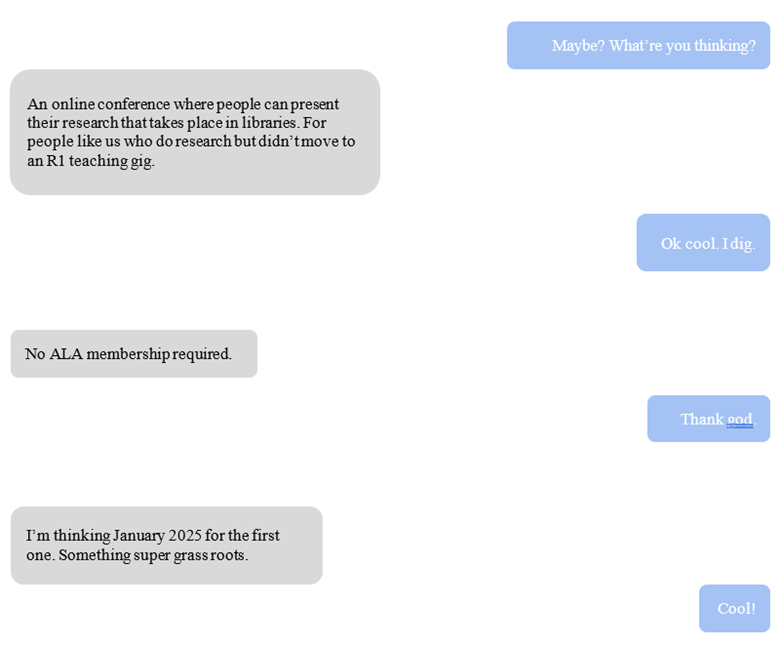
That’s
really how it all began. Over that day’s text message thread, we verbalized a
variety of important reasons why this concept resonated so powerfully for us
both. Neither of us had plans to leave the field of academic librarianship, but
we also identify as researchers and practitioners. We had graduated from
our “cohort” and were now post-docs, immersed in our practitioner settings once
more. As a result, we were struggling to stay connected to that “researcher”
identity and find a space where we could engage with others in similar
circumstances. We wanted our research agendas and interests to remain alive and
thriving—no easy task for librarians like us who do not have faculty positions
where research and publication is an expectation with support mechanisms to
facilitate. We needed a new “cohort” and understood we might have to build it
ourselves.
And
we were building a name. We wanted something that could be pronounced as a
word, rather than as an acronym, even though it would be an acronym—sort of like
ALISE or ASIS&T. We wanted the conference name to be self-explanatory,
though we weren’t sure we wanted to term it a conference. Eventually, we came
across the term “summit” and liked its association with high-level meetings of
individuals with common ground—and the Empirical Studies in Libraries Summit,
or “ESiLS,” was born.
We
had shared many conference sessions at ASIS&T and ALISE conferences and
appreciated their explorations of the latest frontiers of information science
research. But we also noticed how much library science-focused research at
these conferences was a step removed from the practitioners and that research
was rarely presented by practitioners. We wanted a conference-like space for
researchers like us. Further, we asked ourselves what would attract “us” to a
grassroots,
online conference dedicated to empirical research in/about the library context,
featuring research conducted by librarians rather than iSchool
faculty.
We
discussed what we liked from other conferences and professional development
sessions that we wanted to carry over—and what we wanted to do differently.
Among the ideas we decided to pursue for ESiLS: a
Teams-based virtual poster session with a dedicated timeslot; healthy
(30-minute) breaks between session timeslots so attendees could address their
inboxes, connect with colleagues, grab food or coffee, or take a walk; and a
seriously reasonable registration fee ($20), with complementary registration to
all presenters (and a select number of attendees from any iSchools
sponsoring the conference). This last part was particularly important to us so
that we could open up peer-reviewed conference opportunities to
first-generation scholars and scholars with marginalized identities. The
conferences we have been to were often more expensive than our professional
development budgets would support, and although we were (at times) privileged
enough to be able to make it happen, we wanted to shift the field a bit to show
that it was possible to put on a rigorous scholarly event that didn’t break the
bank.
We
debated paying for conference scheduling and networking tools (e.g., Sched) but
ultimately decided against it. Synchronous sessions would allow us to mimic
in-person conferences, while hosting the conference online would level the
playing field and enable participation for scholars and researchers with
limited professional development funding. In addition to these goals, we wanted
the Summit to be a low-stakes environment for new scholars and researchers to
present their work, including research-in-progress.
We
also made lists of tasks and divided them according to our skills and available
time. Logan drafted a website and created an email address. Laureen
worked on a logo and reached out to various iSchools
as potential sponsors. We recruited AI tools (e.g., ChatGPT and Photoshop AI)
to expedite some of these tasks, particularly the call for proposals and the
logo design. Text messages, Zoom calls, and emails. A Google Drive folder with
draft documents for promoting the conference and seeking conference sponsors; a
Google Form for session proposal submissions; a Google Sheet for our session
proposal evaluation rubric; and more.
We
began promoting the call for session proposals (CFP) on October 16, 2024, and
on October 17th—just a day later—we received an exciting email from
the EBLIP editor, Ann Medaille, notifying us that our Summit’s approach
and values seemed to align well with those at EBLIP. She wanted to know
if we would be interested in an issue of EBLIP featuring ESiLS content. We reflected on the “cohort” we wanted to
build and suspected that plenty of those pursuing a session at ESiLS would be interested in bridging that endeavor into a
paper for EBLIP. Having this conversation early in the CFP process
allowed us to build the journal into the conference in a sponsor role and share
about the post-Summit opportunity as part of the overall conference concept.
Accepted sessions and posters would not be guaranteed a spot and would still go
through editorial and/or peer review processes, but they knew they could be
intentional about keeping the momentum going from the conference into a
publication stage.
All
told, on Wednesday, March 26, 2025, between 10:00 am and 5:15 pm Eastern, ESiLS showcased 13 presentation sessions (including the
keynote) and 17 posters (see the schedule
online). Among the CFP submissions, six were doctoral students, 13 identified
as part of a marginalized community/ies, and 14 identified
as first-generation scholars. Including presenters, the Summit had 103
registrants. While the goal was not to make money, we made $1233 between
registrations and sponsorships. As the Summit itself uses institutional and/or
open tools (e.g., Teams, Google Forms, etc.), we hope to avoid needing to
dedicate registration costs to software or other similar needs. Instead, we
hope to be able to use a portion of funds from the previous conference year to
facilitate a keynoter honorarium, keep the conference low-fee-or-free to
attend, and to prepare for growth-driven needs (e.g., storing archived
recordings, software expenses related to increased attendance, etc.).
This
issue of EBLIP features nine articles (one review article, two using
evidence in practice pieces, and six research articles) resulting from four ESiLS presentations and five posters. In order of their
appearance on the ESiLS conference schedule:
Content Matters: How Information Literacy Workshops
Tailored for Marginalized Groups Can Impact Student Performance: Ball’s
research article reports on her exploration of the potential impact of
information literacy sessions tailored to the needs of marginalized groups. As
the first publication of her doctoral research, the article shares her
methodology and design approach as well as the theoretical framework underlying
her research. She applied participatory action research and critical race
theory to a multi-session instructional series, conducted outside the
traditional classroom environment, and her results may encourage practitioners
to explore such approaches at their own institutions as the study found
positive impacts on students’ performance and competence.
LibGuides
or Bust? Usability Testing Platforms for Research
Guides:
Higgins and Cumbo, based out of Auburn University, investigate whether Springshare’s LibGuides (as a
library-first platform) actually facilitates students’ successful navigation of
a “research guide”-type resource. They conduct this exploration by comparing
how (and how well) students go about various task assignments in a LibGuides-based research guide and, for comparison, within
an Adobe Express-built website-style research guide layout. Their findings
support the ease of use for both research guide styles, though readers will
appreciate that participants reported the research guide built in Adobe Express
was less confusing for them. Additionally, participants were more successful in
task assignments in the guide built with Adobe Express—and were more easily
able to differentiate between the guide and library resources. This article
might very well inspire readers to study this further with their own
constituents and make useful guide revisions—including at their template
levels—and could even be useful for vendors like Springshare
to consider in their product enhancements and development efforts.
Library Workers’ Perceptions of Immigrant
Acculturation: Renewed Understandings for Changing Contexts: Ndumu, Park, and Siebold’s article has only grown in
relevance since it was featured as an ESiLS
presentation. Their study seeks to address the gap in understanding how
immigrant individuals within the library and information science field
acculturate to U.S. society, and is a segment of a multipart research project.
As a mixed methods study, their survey and interview findings illuminate that,
while library workers have some familiarity with the acculturation process for
immigrants to the U.S., professional development that is both specific and
evidence based would help enhance their understanding. Deepened awareness of
this process may then lead to a greater ability for library workers to be
responsive to the nuances and realities of immigrants’ circumstances, as well
as to gain (and/or retain) a humanized lens on the lived experiences of
immigrants. Arguably, this has always been an important consideration for
library workers as information and resource providers—the concept of cultural
fusion in the United States dates back to the 18th century and the U.S.’s
“melting pot” image to the early 1900s—readers will find value in this
article’s considerations and findings, including how they interact with current
social, political, and economic debates in the U.S.
Plotting Your Job Hunt: The Use of Visual Timeline
for Investigating the Job Search Process: Estrada’s
research article was initially a poster at ESiLS and
reports on a qualitative study, based on over twenty in-depth interviews,
investigating individual’s processes of applying for academic librarian jobs.
Like Ndumu, Park, and Siebold’s piece, Estrada’s work
is also part of a larger project. In this phase of the project, Estrada
incorporated a visual timeline into the interviews—essentially a worksheet
where participants could chronologically illustrate their search process.
Uniquely, this approach allowed Estrada to thematically analyze not only the
interview transcripts but also the participant-drawn timelines. In turn, this
allowed the coding to function across the two data-gathering mechanisms.
Readers will find both the text and the visual elements of the article
compelling. We suspect readers will reflect upon how this approach might be
replicated in other research projects too, particularly given that the timeline
approach helped participants to recall additional details and to share feeling-based
elements in their visualizations.
A Syllabus
Review Model for Proactive Ebook Textbook
Provisioning: Hosford and Remus’s article also began as part of
the ESiLS poster session and shares their exploration
of provisioning e-book versions of textbooks assigned to courses across
multiple subject areas (History, Art, Music, and Computer Science). Many
readers will resonate with the authors’ observation of the dwindling checkouts
for print textbook copies as well as with the authors’ curiosity about what
would happen if they were to provide unlimited e-book access for students
instead. Findings highlight opportunities not only to enhance or prioritize
collection development efforts (especially as a means of enhancing equity and
access options for students) but also avenues for conversations between subject
librarians and their liaison areas.
Cost-Benefit Analysis of Security Gates and
Collection Shrink in the Academic Library: Mindell, Hardin,
Toth, and Vossler—hailing from Western Kentucky and Chicago State
Universities—consider the question of whether to keep the magnetic security
gates at their libraries through cost-benefit analyses. While they ran
concurrent studies, each library team used different cost-benefit analysis
(CBA) models to assess whether the investment in library security gates
actually prevents collection shrink. Financial strains and belt-tightening
conversations in libraries seem ever-present and readers may find exposure to
CBA in this context valuable in application as well as in terms of the
decisions made by the institutions involved in this study.
Assessing
Formatting Accuracy of APA Style References: A Scoping Review:
Scheinfeld et al.’s scoping review, initially shared as a poster at ESiLS, considers how APA citing and formatting is assessed
for accuracy within existing studies. Readers may be curious to know their
findings on commonly reported formatting errors as well as to discover whether
any standard assessment tools have been proposed and developed within the
literature. The authors’ lens on DEI-related issues associated with scoping
review variables may also be of interest to readers. Their conclusions
highlight the fragmented nature of research related to APA style formatting
accuracy and suggest an opportunity for standardized, source-specific
assessment tools—an opportunity perhaps uniquely well-suited for collaboration
between librarians and educators.
Understanding the Information Needs of Students
Conducting Multidisciplinary Capstone Projects in Engineering Education: Verdines’ article, the last in this issue drawn from the ESiLS poster session, is a Using Evidence in Practice piece
focused on the capstone work of engineering students at Ohio State University. Verdines notes that capstone courses are designed to be culminating
experiences for students, deliverables that apply and showcase students’
knowledge and skills—highlighting an important moment in students’
undergraduate experiences for their thoughtful and deft application of
information exploration, access, and incorporation competencies. As a librarian
new in their role and its engineering liaison responsibilities, Verdines seizes that newness as an opportunity to learn
about faculty and student needs within that program. Readers taking on new
liaison areas, or mentoring librarians through such adjustments, will benefit
from learning about Verdines’ approach to this
scenario.
Back to Normal?
Perspectives of Faculty and Teaching Librarians on Information Literacy
Instruction after the Lockdowns: Baird, Berg, Joachim, and
Wallace’s research article is based on their 45-minute presentation at ESiLS. Their work explores an important topic in the
post-pandemic environment: How information literacy instruction has changed in
the aftermath of the COVID-19 pandemic lockdowns. Their exploratory approach
surveyed both librarians and teaching faculty about several topics of interest,
including past and current session scheduling practices, the evaluation of
student research skills, and considerations for how students may gain research
skills. Notably, teaching faculty and librarians differed in their perspectives
on the impact of COVID-19 on faculty use of library instruction, faculty
reasons for scheduling that instruction, and faculty’s conceptions of students’
research skills. The authors indicate (ongoing) misperceptions of librarian
expertise and suggest librarians and teaching faculty may not agree on how
librarians should teach information literacy. While their findings may comfort
readers—the pandemic does not seem to have significantly altered how faculty
approach information literacy instruction—readers will appreciate the
additional context for how the post-pandemic environment highlights (ongoing)
issues with one-shot library sessions.
As
the ESiLS co-founders, we are excited and honored to
see this issue of Evidence Based Library and Information Practice come
to fruition. While we may have initially conceived of the Summit as a means to
meet our own professional, post-doc development needs and desires, the concept
clearly resonated among others in our field—we even created a Discord channel
to continue connecting over empirical research, and more, beyond the conference
itself. We aim for this community of practice to persist between Summits, and
want the Summit to be a valuable opportunity for our community to look forward
to and plan on each year. We hope ESiLS can serve as
an affordable home for researcher-practitioners looking to share about their
work and invite readers to reach out to ESiLS
organizers to join our Discord, too.
So readers may be
wondering: When’s the next ESiLS?
Don’t
worry, we have been up to our usual planning…
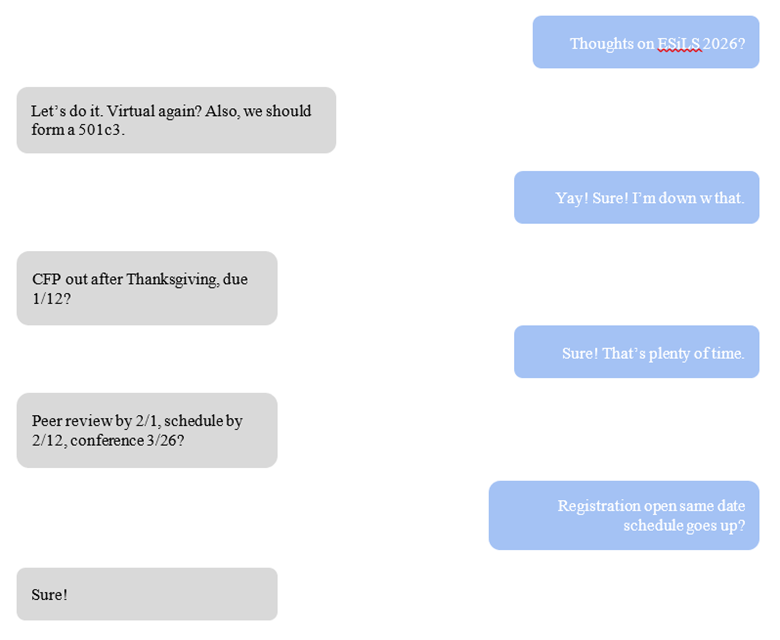
We
hope to see you at the 2nd Empirical Studies in Libraries Summit on Thursday,
March 26, 2026!